
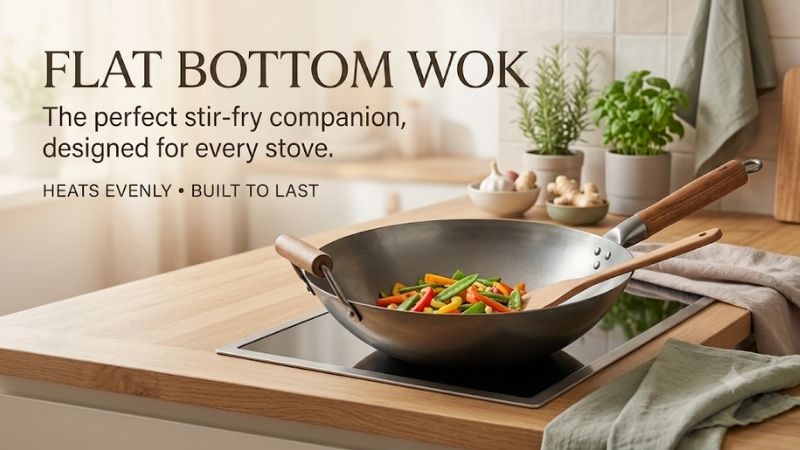
A flat bottom wok brings stir-frying to ordinary home burners without the specialized ring often required by round-bottom designs. But the base width, bowl shape, material, and handle change how the pan heats and moves. These six options cover traditional carbon steel, convenient coated cookware, and durable alternatives for different kitchens.
Best flat bottom wok choices for everyday stir-frying
A good flat-bottom design creates stable contact with the burner while preserving the curved walls that make wok cooking practical. Carbon steel is particularly attractive because it heats responsively and develops a seasoned surface. These first three models suit cooks who prioritize traditional cooking techniques on household equipment.
Yosukata 13.5-Inch Blue Carbon Steel Wok – Best overall
The Yosukata 13.5-Inch Blue Carbon Steel Wok offers a combination of practical stovetop compatibility and traditional stir-frying performance. Its flat base, substantial carbon steel body, and pre-seasoned surface make it suitable for cooks who want responsive high-temperature cooking without a specialized wok burner.
The 15-gauge construction provides enough material to feel substantial while retaining the relatively quick temperature response associated with carbon steel.
Its flat base can sit directly on compatible gas, electric, glass-ceramic, and induction cooking surfaces.
The curved sidewalls allow ingredients to be moved between the central cooking area and the upper bowl.
For example, when preparing chicken with bell peppers, the chicken can be browned in small batches before the vegetables are added.
The curved walls make stirring easier and provide space for combining ingredients with sauce near the end.
Factory pre-seasoning gives the surface an initial protective treatment.
However, the wok still requires thorough drying and periodic oil maintenance.
The wooden handle is comfortable for ordinary stovetop use, although the metal connecting section and helper handle may become hot.
At 13.5 inches, the wok provides a useful balance between cooking room and storage requirements.
The main disadvantage is that its relatively substantial construction may feel heavy to cooks who prefer very lightweight woks.
Advantages: Pre-seasoned blue carbon steel, broad stovetop compatibility, practical diameter, and responsive heating.
Limitations: Requires seasoning maintenance and can feel substantial during repeated tossing.
Best for: Home cooks wanting a versatile traditional wok for everyday use.
Joyce Chen Classic Series 14-Inch Wok – Best budget option
The Joyce Chen Classic Series 14-Inch Carbon Steel Wok is an accessible choice for cooks who want the fundamental advantages of wok cooking without investing in premium cookware. Its flat-bottom configuration, lightweight steel body, and traditional curved walls support quick vegetable dishes, fried rice, and simple protein stir-fries.
The relatively thin steel responds rapidly to changes in heat.
This can be useful when cooking delicate vegetables that need brief exposure to high temperatures.
For example, sliced zucchini and snow peas may benefit from short cooking periods that preserve some texture.
The wok’s wide upper bowl provides room for moving ingredients with a spatula.
Its flat base offers stable contact on conventional home burners, although induction compatibility should be confirmed for the exact configuration and cooking surface.
Wooden handles help improve comfort during ordinary cooking.
A helper handle provides additional support when transferring food, especially when the wok contains a substantial portion.
Some Joyce Chen configurations require initial seasoning, while pre-seasoned variants are also available.
The product listing should be checked carefully because preparation requirements can differ.
Its principal limitation is structural rigidity. Thin steel may distort more easily when exposed to sudden temperature changes or uneven heating.
Avoid aggressively heating an empty wok for extended periods.
Advantages: Affordable construction, generous bowl size, rapid heat response, and comfortable wooden handles.
Limitations: Potential seasoning preparation, thinner steel construction, and sensitivity to uneven heating.
Best for: Budget-conscious home cooks learning traditional stir-frying techniques.
Made In Seasoned Carbon Steel Wok – Best premium design
The Made In Seasoned Carbon Steel Wok is designed for cooks who value responsive heating and precise handling. Its flat cooking base, Swedish-made carbon steel body, and stainless steel handle distinguish it from traditional wooden-handled woks while preserving the curved shape needed for efficient ingredient movement.
The wok uses approximately 1.5 mm carbon steel and weighs about 3.5 pounds.
This combination provides a manageable cooking vessel while maintaining useful heat retention and responsiveness.
Its overall diameter is approximately 13.5 inches, with a flat cooking surface near 5.5 inches.
The compact base concentrates direct heating in a smaller area, making batch cooking especially important.
For example, thinly sliced beef should be cooked in small portions rather than covering the entire bowl with cold ingredients.
The stainless steel handle makes the wok suitable for certain oven applications according to the manufacturer’s stated specifications.
However, that handle can become hot when exposed to prolonged heat or direct flames.
The wok arrives with an initial seasoning layer that can develop further through normal use.
Its uncoated surface tolerates cooking techniques that would be inappropriate for many conventional nonstick coatings.
The main drawback is cost. Buyers preparing occasional stir-fries may find that a lower-priced carbon steel wok meets their needs.
Advantages: Premium construction, induction compatibility, responsive steel body, and durable handle.
Limitations: Higher purchase price and a relatively small directly heated cooking zone.
Best for: Frequent stir-fry cooks seeking refined handling and versatile cookware construction.
Other flat bottom wok materials and designs to consider
Carbon steel is a traditional choice, but other materials can be useful when cooking habits differ. A heavier cast iron wok retains heat effectively, while a coated hybrid pan can simplify food release and cleanup. Comparing these alternatives helps buyers determine whether traditional seasoning is worth the maintenance involved.
Babish 14-Inch Carbon Steel Wok – Best for larger stir-fries
The Babish 14-Inch Carbon Steel Flat Bottom Wok provides a wide bowl for cooks who regularly prepare noodles, vegetables, and meals involving several ingredients. Its smooth interior, pre-seasoned steel surface, and stable base make it a practical option for households that want generous cooking space without choosing cast iron.
The 14-inch diameter provides room for stirring and combining ingredients.
This is particularly useful when making fried noodles because long strands need space to move without continuously spilling over the sides.
The wok’s pre-seasoned surface offers a starting point for developing natural food release.
As with other carbon steel cookware, seasoning improves through appropriate cooking and maintenance.
The smooth interior is comparatively straightforward to clean after stir-frying.
A main handle supports one-handed maneuvering, while the helper handle offers extra control when the pan is full.
However, a larger wok does not eliminate the need for cooking in batches.
A home burner may not supply enough heat to brown several servings of cold meat simultaneously.
The best results come from cooking proteins and vegetables separately before combining them.
This model is particularly attractive for cooks who want more upper-bowl space without moving to a heavier cast iron alternative.
Advantages: Spacious bowl, accessible cooking design, smooth interior, and pre-seasoned carbon steel.
Limitations: Requires careful storage and does not prevent overcrowding on lower-powered burners.
Best for: Households frequently preparing noodles or larger vegetable stir-fries.
HexClad Hybrid 12-Inch Wok – Best coated alternative
The HexClad Hybrid 12-Inch Wok is intended for cooks who prefer easier food release and cleanup over traditional carbon steel maintenance. Its hybrid cooking surface combines raised stainless steel elements with coated areas, while the layered metal body supports use across a variety of conventional stovetops.
The main difference is its cooking surface.
Traditional carbon steel develops seasoning through repeated cooking, whereas the HexClad design incorporates a manufactured nonstick component.
This can simplify preparation of foods that are prone to sticking, particularly when the cook does not want to maintain bare steel.
The smaller 12-inch diameter also makes the wok practical for households with limited storage space.
Its flat base provides stable contact with compatible burners, including induction.
However, the hybrid construction should not be treated as identical to uncoated stainless steel.
The nonstick component still has temperature and care considerations.
Buyers should check the current manufacturer’s instructions for oven temperatures, utensil use, and cleaning because product generations may differ.
The wok can be useful for everyday chicken, vegetable, and noodle dishes.
Nevertheless, the coating creates a different long-term ownership model from bare carbon steel, which can be stripped and re-seasoned when necessary.
Its premium cost is also a consideration.
Advantages: Convenient food release, induction compatibility, easier routine cleaning, and manageable size.
Limitations: Premium pricing, coating-related care requirements, and a different cooking experience from traditional carbon steel.
Best for: Home cooks seeking convenient stir-frying without regular seasoning maintenance.
Lodge 14-Inch Seasoned Cast Iron Wok – Best for heat retention
The Lodge 14-Inch Seasoned Cast Iron Wok offers a different approach to stir-frying by emphasizing heat retention rather than lightweight maneuverability. Its heavy cast iron body, stable flat base, and two side handles make it suitable for cooks who prefer stirring ingredients with a spatula instead of repeatedly lifting the pan.
The most noticeable characteristic is weight.
At approximately 12.8 pounds, this wok is considerably heavier than many carbon steel alternatives.
That mass helps the cookware retain heat, although it also means the pan takes longer to respond when burner settings change.
The flat base is compatible with conventional stovetops, including induction, according to Lodge.
Its curved interior supports stir-frying, steaming, and other wok-style preparations.
However, tossing food by lifting the pan is generally impractical.
Instead, the wok is best used while remaining on the burner, with ingredients moved using a suitable spatula.
The factory-seasoned surface requires drying and occasional oil maintenance, similar to other bare cast iron cookware.
For searing substantial portions of meat, its thermal mass can be useful after the vessel has fully preheated.
The trade-off is slower responsiveness and difficult handling when full.
Its size and weight also require sturdy storage.
Advantages: Strong heat retention, stable flat base, durable construction, and induction compatibility.
Limitations: Very heavy, slow to respond to heat adjustments, and unsuitable for frequent one-handed tossing.
Best for: Cooks who prefer stationary stir-frying and value cast iron durability.
How to choose the right flat bottom wok for your stove
Stovetop compatibility should guide the buying decision before material, appearance, or accessories. The same wok can behave differently on gas, radiant electric, and induction burners. Base dimensions, magnetic properties, and pan weight determine how efficiently heat reaches the food and how safely the cookware can be handled.
Choosing a flat bottom wok for gas, electric, or induction
Different heat sources transfer energy to cookware in different ways. Gas flames can heat portions of the curved walls, radiant electric burners depend heavily on surface contact, and induction requires compatible magnetic metal. Understanding these differences helps prevent poor heating and unstable cooking conditions.
Gas burners provide flexibility because the flame can contact both the base and lower sidewalls.
However, excessively large flames may heat handles or waste energy by extending beyond the useful cooking area.
Electric coil and glass-ceramic cooktops rely more directly on contact between the pan base and the heated zone.
A stable flat base is therefore important.
Induction introduces an additional requirement: suitable magnetic construction and adequate base contact.
Although carbon steel and cast iron are generally magnetic, compatibility should still be verified for the specific product and appliance.
Some induction cooktops require a minimum base diameter.
Woks with narrow flat bottoms may not activate certain zones reliably.
For glass cooking surfaces, avoid dragging heavy cookware across the burner because this may cause scratching.
The best wok is one that works efficiently with your existing stove rather than requiring inconvenient modifications.
Comparing carbon steel, cast iron, and hybrid nonstick
Wok material influences heating response, food release, weight, and maintenance. Carbon steel is favored for traditional stir-frying because it heats relatively quickly and can be seasoned repeatedly. Cast iron retains more heat, while hybrid nonstick surfaces prioritize convenience at the expense of some high-heat flexibility.
Carbon steel is usually the most versatile option for cooks practicing traditional stir-frying techniques.
Its relatively light construction allows ingredients to be moved and tossed more easily.
Cast iron provides greater thermal mass but is considerably heavier.
A cast iron wok may be suitable for stationary cooking, although its slower temperature response changes the cooking experience.
Hybrid nonstick cookware simplifies cleanup and reduces reliance on a developing seasoning layer.
However, coated surfaces should be used according to their specific temperature and utensil limitations.
Traditional bare carbon steel can tolerate high-temperature cooking without the risk of damaging a synthetic nonstick coating.
It still requires maintenance to prevent rust.
Choose carbon steel for traditional technique, cast iron for stationary heat retention, or a coated alternative for easier food release.
How size, base width, and weight influence cooking
A wok’s advertised diameter does not describe how much food receives direct heat. The flat base is usually much smaller than the upper bowl, and its dimensions influence browning capacity. Overall weight also affects whether the cook can lift, tilt, or toss the cookware safely during a meal.
A 12-inch wok can be sufficient for smaller meals and compact kitchens.
A 13- to 14-inch wok provides more room for combining noodles, vegetables, and proteins.
However, an oversized wok on a small burner can develop a sharply concentrated central hot zone.
That arrangement may be useful for certain techniques but frustrating when attempting to brown large quantities evenly.
Consider the flat-base diameter in relation to the cooktop’s heating zone.
Also evaluate the weight of the empty pan.
A lightweight wok is easier to manipulate, but extremely thin steel may distort under uneven heating.
A heavier wok can feel stable but may require two-handed lifting.
The best balance depends on whether you plan to toss ingredients or primarily use a spatula.
For many households, a 13- to 14-inch carbon steel wok offers a practical compromise.
Conclusion
The best flat bottom wok combines stable burner contact, a manageable cooking surface, and material suited to everyday meals. Yosukata and Made In are attractive carbon steel options for frequent stir-frying, while Joyce Chen and Babish offer accessible alternatives. HexClad prioritizes convenient food release, and Lodge provides substantial cast iron heat retention. For most households, a 13- to 14-inch carbon steel model with a stable flat base offers the strongest balance between traditional cooking performance, maintenance, and versatility.








Write Your Review
No reviews yet. Be the first to share your experience!