
A reliable roasting pan helps you prepare chicken, turkey, beef, and roasted vegetables while managing cooking juices and oven space. However, stainless steel, nonstick, and fully clad designs differ in durability, heat distribution, cleaning, and compatibility. This guide compares six practical options and explains how to choose the right pan for your kitchen.
Quick verdict: Which roasting pan should you buy?
The best roasting pan depends on the foods you prepare, your oven dimensions, and whether you intend to make gravy directly from the drippings. A stainless steel model with a removable rack offers versatility, while a nonstick design can simplify cleanup. Fully clad construction becomes more valuable when the pan will also be used for stovetop sauce preparation.
| Category | Recommended product | Main reason |
|---|---|---|
| Best overall | Cuisinart MultiClad Pro 16-Inch Roasting Pan | Tri-ply construction and stainless rack |
| Best everyday value | Cuisinart Chef’s Classic 16-Inch Roasting Pan | Practical stainless steel design |
| Best premium roaster | All-Clad D3 Large Flared Roaster | Fully bonded construction |
| Best compact option | All-Clad Small Stainless Steel Roaster | Smaller 11-by-14-inch format |
| Best easy-clean option | All-Clad Nonstick Large Roaster | Nonstick cooking surface |
| Best for large holiday roasts | All-Clad Large Stainless Steel Roaster | Spacious pan with removable V-rack |
For households roasting meat and vegetables regularly, the Cuisinart MultiClad Pro offers a strong combination of construction and versatility. The smaller All-Clad roaster makes more sense when oven capacity and storage are limited.
Quick comparison table
A useful comparison should consider the complete roasting system rather than pan length alone. Rack material, actual cooking dimensions, oven-temperature limits, and stovetop compatibility can change how the cookware performs during preparation and cleanup. The following options represent different constructions and intended uses rather than six interchangeable stainless steel trays.
| Product | Pan size | Construction | Best for | Main trade-off |
|---|---|---|---|---|
| Cuisinart MultiClad Pro | 16-inch class | Tri-ply stainless steel | Everyday and holiday roasting | Relatively heavy |
| Cuisinart Chef’s Classic | 16-inch class | Stainless steel | General home cooking | Less advanced construction |
| All-Clad D3 Large Flared | 13 × 16 inches | Fully bonded tri-ply | Roasting and pan sauces | Premium investment |
| All-Clad Small Stainless | 11 × 14 inches | Stainless steel | Small ovens and portions | Limited capacity |
| All-Clad Nonstick Large | 13 × 16 inches | Nonstick-coated stainless steel | Easier cleanup | Coating and rack heat limits |
| All-Clad Large Stainless | 13 × 16 inches | Heavy-gauge stainless steel | Large poultry and meat | Requires storage space |
How we selected these roasting pans
These recommendations are based on identifiable products, manufacturer-published construction details, dimensions, rack designs, and compatibility instructions. Selection criteria include roasting capacity, safe lifting, cleaning requirements, and whether a pan supports additional cooking tasks. The assessments do not represent independent hands-on roasting or temperature-distribution tests.
A roasting pan should have enough room for food without forcing it against the sidewalls. The rack, when included, must support the food securely while allowing cooking juices to collect underneath.
Some pans use fully bonded multilayer construction, while others rely on heavy-gauge stainless steel or coated surfaces.
Those differences matter more when the roaster is used on the stovetop for gravy or reduction than when it simply holds food inside an oven.
We also considered buyers who need smaller cookware for everyday meals rather than purchasing a large holiday pan used only once or twice per year.
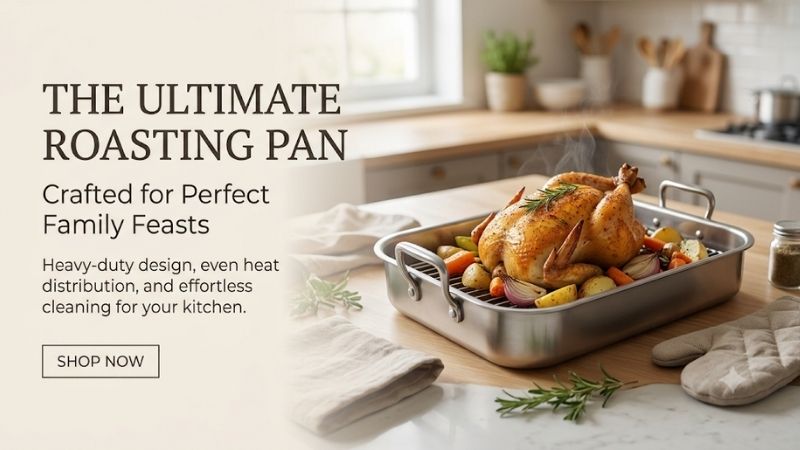
Detailed roasting pan recommendations
These six options serve different households, from people preparing smaller chickens to cooks roasting substantial holiday meals. Each product has specific strengths and limitations involving construction, dimensions, rack design, or cleaning. Buyers should match these characteristics to their oven and cooking habits instead of selecting solely by brand.
Cuisinart MultiClad Pro 16-Inch Roasting Pan — Best overall
The Cuisinart MultiClad Pro Triple Ply Stainless 16-Inch Roasting Pan with Rack, model MCPS117-16BRP1, uses a bonded stainless steel and aluminum construction designed to distribute heat through the base and sidewalls. Its included stainless steel rack, riveted handles, and approximately 19.3-by-12.1-inch overall footprint make it useful for family roasts and holiday poultry.
Best for: Households preparing turkey, chicken, beef, and substantial vegetable roasts.
Why we picked it: The combination of tri-ply construction and a stainless steel rack provides useful versatility for oven roasting and compatible stovetop cooking.
Key specifications:
-
Model: MCPS117-16BRP1.
-
Nominal size: 16 inches.
-
Overall dimensions: approximately 19.3 × 12.1 × 5.2 inches.
-
Listed weight: approximately 10 pounds.
-
Construction: Triple-ply stainless steel with an aluminum core.
-
Includes a stainless steel roasting rack.
-
Manufacturer-listed turkey capacity: up to 18 pounds, depending on bird shape.
-
Induction-compatible pan.
-
Hand washing recommended.
Features and benefits
The stainless steel rack elevates the roast above collected juices, helping expose more of its exterior to hot oven air.
The tri-ply construction also makes the pan useful for preparing sauces from drippings when used according to the manufacturer’s stovetop instructions.
Solid riveted side handles support two-handed lifting with appropriate oven protection.
Performance and practical use
For a family roast, the pan provides room to arrange the main protein with vegetables when capacity permits. The rack can be removed when roasting foods that benefit from direct contact with the pan.
Its main disadvantage is weight. The pan becomes substantially heavier when loaded with food and hot drippings.
What makes it different: Fully clad construction paired with a stainless steel roasting rack.
Pros: Versatile construction, induction compatibility, and a durable rack.
Cons: Relatively heavy and more demanding to wash than smaller pans.
Buy if: You roast regularly and intend to use pan drippings for gravies.
Skip if: Your oven or sink cannot comfortably accommodate the pan.
Cuisinart Chef’s Classic 16-Inch Roasting Pan — Best everyday value
The Cuisinart Chef’s Classic Stainless 16-Inch Roasting Pan with Rack, model 7117-16URP1, provides a stainless steel roasting vessel with riveted side handles and a removable rack. Its straightforward design supports poultry, beef, and vegetables without requiring buyers to choose a premium fully clad roaster.
Best for: Occasional holiday roasting and general household use.
Why we picked it: It provides the principal features of a roasting pan while keeping construction relatively simple.
Key specifications:
-
Model: 7117-16URP1.
-
Nominal size: 16 inches.
-
Overall dimensions: approximately 20.7 × 12 × 4.9 inches.
-
Listed weight: approximately 7 pounds.
-
Stainless steel body.
-
Removable stainless steel rack.
-
Riveted side handles.
-
Dishwasher-safe according to Cuisinart.
Features and benefits
The rack creates space below the meat for rendered fat and juices.
Stainless steel construction allows the pan to be cleaned without the restrictions associated with some nonstick interiors.
The tapered pouring arrangement can help transfer cooking liquids when handled carefully.
Performance and practical use
This model is useful for roasting chicken and vegetables as well as larger seasonal meals.
The rack can be removed for recipes that do not require food elevation.
However, buyers who regularly prepare concentrated sauces directly in the roaster may prefer the more versatile bonded construction of the MultiClad Pro.
What makes it different: A straightforward stainless steel roasting system without premium multilayer construction.
Pros: Practical rack, dishwasher compatibility, and general-purpose design.
Cons: Large storage footprint and fewer specialized construction features.
Buy if: You want a conventional stainless steel roasting pan for occasional or regular meals.
Skip if: You specifically require fully clad cookware for more demanding stovetop tasks.
All-Clad D3 Large Flared Roaster — Best premium option
The All-Clad D3 Stainless Large Flared Roaster uses fully bonded tri-ply construction with an aluminum core and stainless steel cooking surfaces. Its 13-by-16-inch roasting area, gently flared sides, and stainless steel rack make it particularly relevant for cooks who want to roast substantial cuts of meat and prepare sauces using the same vessel.
Best for: Serious home cooks who frequently roast and prepare pan sauces.
Why we picked it: Its bonded construction and compatibility with stovetop sauce preparation distinguish it from simpler roasting pans.
Key specifications:
-
Cooking dimensions: approximately 13 × 16 inches.
-
Fully bonded tri-ply stainless steel.
-
Aluminum core.
-
Included stainless steel rack.
-
Manufacturer-listed capacity for turkeys up to approximately 20 pounds.
-
Oven and broiler safe up to 600°F.
-
Stovetop compatible except induction.
-
Hand washing required.
Features and benefits
The flared sides provide access around large roasts and may make basting more convenient.
The stainless steel interior supports browning and the development of flavorful cooking residues that can be incorporated into gravies.
The aluminum core helps distribute heat through the bonded structure.
Performance and practical use
This is a versatile option for holiday roasts, large poultry, and meat dishes that require sauce preparation afterward.
However, buyers should not assume the pan can be used on induction merely because it belongs to a stainless steel cookware range.
All-Clad specifically excludes induction for this roaster.
What makes it different: Fully bonded construction in a large roasting format.
Pros: Durable stainless steel, useful heat distribution, and sauce-making versatility.
Cons: Premium cost and no induction compatibility.
Buy if: You want a long-term roasting pan for varied cooking tasks.
Skip if: You only need an inexpensive tray for occasional turkey roasting.
All-Clad Small Stainless Steel Roaster — Best compact design
The All-Clad Small Stainless Steel Roaster with Nonstick Rack uses an approximately 11-by-14-inch roasting area, providing a smaller alternative to full-size holiday roasters. Its removable rack and stainless steel body suit smaller poultry, vegetables, and everyday oven dishes while reducing the footprint required for storage.
Best for: Small households, compact ovens, and everyday roasting.
Why we picked it: Its smaller dimensions provide an alternative for buyers who do not need a large holiday pan.
Key characteristics:
-
Roasting area: approximately 11 × 14 inches.
-
Stainless steel pan.
-
Removable nonstick roasting rack.
-
Oven-compatible construction.
-
Manufacturer-listed pan heat limit up to 600°F.
-
Nonstick rack heat limit of 375°F.
-
Stovetop compatibility excludes induction.
Features and benefits
A smaller roasting pan is easier to fit into many cabinets and may be less awkward to wash.
The rack allows food to sit above drippings when roasting meats.
Removing the rack allows the pan to serve as a baking or roasting dish for vegetables.
Performance and practical use
The reduced size is particularly useful for chicken, small cuts of beef, or family-side-dish portions.
It is less appropriate for large turkeys.
An important limitation is the different temperature limits for the pan and rack. Recipes requiring temperatures above the rack’s limit must not use that rack.
What makes it different: Compact dimensions with a removable rack.
Pros: Smaller footprint, multipurpose design, and easier storage.
Cons: Limited capacity and rack-specific temperature restrictions.
Buy if: You have limited kitchen space or generally roast smaller portions.
Skip if: You need a pan for large holiday poultry.
All-Clad Nonstick Large Roaster — Best for easier cleanup
The All-Clad Nonstick Large Roaster with Rack uses a 13-by-16-inch format with a nonstick interior and a removable V-shaped rack. The coating can simplify removal of some cooking residue, while the rack elevates food above drippings. Its care requirements differ from those of uncoated stainless steel roasters.
Best for: Buyers who prioritize easier cleaning after substantial roasts.
Why we picked it: Its coated interior addresses a common problem with roasting cookware: stubborn baked-on residue.
Key specifications:
-
Cooking area: approximately 13 × 16 inches.
-
Stainless steel pan with nonstick interior.
-
Removable V-shaped rack.
-
Manufacturer-listed turkey capacity up to 25 pounds.
-
Pan oven-safe limit: 500°F.
-
Rack oven-safe limit: 375°F.
-
Dishwasher safe according to the manufacturer.
-
Not induction compatible.
Features and benefits
The nonstick surface can reduce the effort required to remove cooked-on food residue.
The V-shaped rack supports poultry and large cuts while helping keep them above accumulated drippings.
The pan can also be used without its rack for suitable baked dishes.
Performance and practical use
This design is particularly relevant for buyers who prepare large roasts occasionally and dislike extensive scrubbing.
However, the nonstick coating requires suitable utensils and cleaning methods.
It should not be treated as interchangeable with uncoated stainless steel for aggressive scraping or high-temperature cooking.
What makes it different: A coated large-capacity roasting system.
Pros: Convenient cleanup, removable rack, and spacious design.
Cons: Coating limitations and a lower heat tolerance for the rack.
Buy if: You want a large pan with simpler post-cooking cleanup.
Skip if: You want an uncoated roasting surface or frequently use very high oven temperatures.
All-Clad Large Stainless Steel Roaster — Best for holiday cooking
The All-Clad Large Stainless Steel Roaster with Nonstick Rack uses a heavy-gauge stainless steel pan and a removable V-shaped rack within a 13-by-16-inch roasting format. It provides space for large cuts of meat and poultry while retaining the durability advantages of an uncoated stainless steel roasting vessel.
Best for: Large roasts and seasonal entertaining.
Why we picked it: It combines a substantial stainless steel cooking vessel with a removable rack suitable for larger foods.
Key specifications:
-
Roasting area: approximately 13 × 16 inches.
-
Heavy-gauge stainless steel pan.
-
Removable nonstick V-shaped rack.
-
Pan oven-safe rating: 600°F.
-
Rack limit: 375°F.
-
Dishwasher-safe according to the manufacturer.
-
Stovetop compatible except induction.
Features and benefits
The stainless steel vessel offers a durable surface for roasting and handling cooking juices.
The rack supports large foods above the bottom of the pan.
Removing it creates a useful roasting area for vegetables or dishes that benefit from direct pan contact.
Performance and practical use
The pan is suitable for occasional large gatherings and holiday meals.
However, buyers must distinguish the rack’s temperature rating from that of the pan itself.
Its large footprint also makes it less practical for very small households.
What makes it different: Uncoated stainless steel construction with a removable nonstick rack.
Pros: Large cooking area, durable pan surface, and multipurpose use.
Cons: Bulky storage and rack temperature restrictions.
Buy if: You regularly roast large portions.
Skip if: You have limited oven space or mostly cook for one person.
Buying guide: What matters in a roasting pan?
Choosing a roasting pan involves matching its capacity, construction, handles, and rack to your cooking needs. Larger or more expensive cookware is not automatically better, particularly when the oven is small or the pan is rarely used. Practical dimensions and compatibility should determine which features justify the purchase.
Stainless steel versus nonstick roasting pans
Stainless steel roasting pans provide durable, uncoated cooking surfaces that can tolerate appropriate cleaning and support the development of browned cooking residues. Nonstick roasting pans may simplify cleanup but require greater care with tools, coatings, and heat limits.
Uncoated stainless steel is a useful choice for cooks who regularly make gravies from pan drippings.
The browned residue left after roasting can contribute flavor when loosened with a suitable liquid.
Nonstick interiors may be more convenient when the main objective is roasting and cleanup rather than developing a deeply browned fond.
Neither construction guarantees uniform cooking without adequate oven heat and correct food placement.
Choose the material according to cooking habits and willingness to clean the pan.
Fully clad versus single-layer construction
Fully clad roasting pans combine bonded metal layers through the body, often including an aluminum core to help distribute heat. Simpler stainless steel pans may use a different construction that provides adequate performance for ordinary oven roasting.
The main difference becomes relevant when the pan is used on a stovetop.
Direct burner heat may be more concentrated than oven heat, making heat distribution across the pan important for sauces.
However, not every roasting pan is approved for stovetop use.
Check manufacturer instructions before placing the roaster over a gas, electric, or induction burner.
Choosing the right roasting pan size
Pan dimensions should be selected according to the largest food you regularly roast, rather than the largest holiday meal imaginable. A large turkey needs space around its exterior, but a small chicken does not necessarily benefit from an oversized vessel.
For ordinary meals, a compact 11-by-14-inch roaster may offer sufficient room.
Larger 13-by-16-inch models are more appropriate for substantial poultry and large cuts of meat.
Always consider the manufacturer’s stated capacity as an approximate guide.
A turkey’s shape and height can differ significantly even when two birds weigh the same.
The food should not touch the oven walls or obstruct necessary airflow.
Flat racks versus V-shaped racks
A flat roasting rack provides a relatively level support surface, while a V-shaped rack helps cradle rounded poultry and certain cuts of meat. Both elevate food above accumulated juices, but they distribute support differently.
Flat racks may offer more flexibility for vegetables and irregularly shaped foods.
V-shaped racks are useful for holding large poultry in position.
The rack material and heat rating are important.
A nonstick rack may have a lower maximum safe temperature than the stainless steel roasting pan itself.
Never assume the two components share the same rating.
Oven fit and handle clearance
Roasting pans must fit inside the oven with enough clearance for safe insertion, removal, and airflow. Manufacturer descriptions sometimes emphasize the pan’s nominal interior length while the handles extend beyond that dimension.
Measure the oven’s usable width and depth.
Check the pan’s overall outside dimensions.
Allow space for the door to close properly.
Remember that side handles may increase total width.
A roasting pan that barely fits while empty may become difficult to remove when loaded with a heavy turkey and hot drippings.
Handle construction and lifting safety
Roasting pans can become extremely heavy during cooking because the weight includes the pan, rack, food, vegetables, and collected liquids. Strong side handles provide essential control when transferring the vessel.
Choose handles large enough to grip with oven mitts.
Check that they are securely attached.
Avoid trying to carry a fully loaded pan with one hand.
Plan the destination before removing it from the oven.
Place it on a sturdy heat-safe surface.
Do not use the rack’s lifting handles as a substitute for safely handling the entire roasting pan unless the manufacturer specifically permits the intended method.
How to get better roasting results
Successful roasting depends on food preparation, oven temperature, rack placement, and monitoring internal doneness. A quality pan provides a stable cooking vessel, but it cannot compensate for overcrowding, incorrect cooking temperatures, or an unreliable thermometer. These techniques apply to both premium and affordable roasting equipment.
Prepare the roast and pan correctly
Begin by checking that the food fits inside the roasting pan and that the intended rack is appropriate for the cooking method. The rack should support the food securely, leaving room for accumulated juices without tipping or sliding.
Pat suitable foods dry when surface browning is desired.
Season according to the recipe.
Position the roast securely.
Arrange vegetables without obstructing the main food excessively.
Avoid overcrowding the pan, because trapped moisture can reduce browning.
Preheat the oven according to the recipe and confirm that all accessories can tolerate the chosen temperature.
Understand the role of a roasting rack
A roasting rack elevates food above the pan bottom, allowing hot air to reach more of its surface while fat and juices collect underneath. This can support browning and help separate the food from accumulated liquid.
However, a rack is not necessary for every recipe.
Vegetables, for example, often benefit from direct contact with the hot roasting surface.
Some braised or covered dishes also require a different arrangement.
Use the rack when it supports the intended cooking outcome rather than treating it as mandatory.
Control cooking temperatures
Different foods require different oven temperatures and internal cooking targets. Poultry, beef, pork, and vegetables cannot be evaluated using one universal cooking time.
Use a dependable food thermometer when preparing meat and poultry.
For whole poultry, follow food-safety guidance calling for an internal temperature of 165°F.
For whole cuts of beef, pork, lamb, and veal, the USDA recommends at least 145°F followed by a three-minute rest.
Cooking preferences may involve additional temperature or texture considerations, but food safety should remain the priority.
Insert the thermometer in an appropriate thick section without relying on color alone.
Make pan gravy safely
Stainless steel roasting pans can collect flavorful cooking juices and browned residues that become the base for gravy. However, not every roaster is suitable for direct stovetop heating.
First confirm manufacturer approval.
Remove the roast and rack carefully.
Transfer excess fat when needed.
Add an appropriate liquid to loosen the browned residue.
Reduce or thicken the mixture according to the recipe.
If the pan is not stovetop-compatible, transfer the drippings to a suitable saucepan instead.
Do not place a large roaster over an unsuitable induction burner.
Cleaning and maintaining a roasting pan
Roasting cookware can accumulate browned fat, sticky sauces, and concentrated food residue during long oven sessions. Proper cleaning depends on the material and should protect the pan from thermal shock, surface damage, and unnecessary abrasion.
Cleaning stainless steel roasting pans
Allow the pan to cool enough for safe handling before washing.
Use warm water and an appropriate cleaning product.
For stubborn residue, follow the manufacturer’s recommended soaking or cleaning method.
Avoid suddenly filling a very hot pan with cold water.
Thermal shock can deform cookware or damage certain finishes.
Dry the pan before storage.
Protecting nonstick surfaces and racks
Nonstick roasters and coated racks require appropriate tools and cleaning methods.
Avoid scraping with sharp metal implements unless the manufacturer explicitly permits them.
Use gentle cleaning pads.
Follow the stated temperature limits.
Inspect surfaces for significant damage.
Remember that a coated rack may wear differently from the pan itself.
Storing large roasting pans
A large pan can occupy considerable cabinet space even when used infrequently.
Remove the rack when necessary for compact storage.
Protect the cooking surface from scratches.
Avoid stacking heavy cookware directly inside coated pans.
Store the pan where it can be removed without forcing it against other items.
A roasting pan may also hold compatible accessories during storage, but ensure that sharp utensils do not damage its interior.
Frequently Asked Questions
Roasting pan buyers often ask whether stainless steel or nonstick is preferable, how much capacity they need, and whether a separate rack is necessary. These questions are important because the best choice depends on actual cooking patterns rather than assuming one expensive pan will handle every recipe equally well.
What size roasting pan is best for a family?
An approximately 16-inch roasting pan can be useful for many families, but actual suitability depends on the food and the pan’s interior dimensions. Smaller households may find a 14-inch-class roaster more convenient for regular meals.
Check oven clearance and manufacturer capacity guidance before buying.
Is a roasting rack necessary?
A rack is useful for elevating poultry and some large cuts above accumulated juices, but not every roasting recipe requires one. Vegetables and certain baked dishes may cook better directly on the pan surface.
Choose a removable rack for greater flexibility.
Can a roasting pan go on the stovetop?
Only when the manufacturer approves the particular pan for stovetop use. Material and construction alone do not guarantee suitability.
Some roasting pans are compatible with gas or electric burners but not induction.
Follow exact model instructions.
Is stainless steel better than nonstick for roasting?
Stainless steel is attractive for durability and making sauces from browned drippings. Nonstick surfaces may simplify cleanup but have coating and temperature restrictions.
Choose based on your cooking methods and maintenance preferences.
Can I roast vegetables without a rack?
Yes. Many vegetables benefit from direct contact with the roasting surface. Arrange them with enough space to encourage browning rather than steaming.
Use suitable oil and cooking temperatures for the recipe.
Conclusion
The best roasting pan should match your oven, usual portion sizes, and preferred cleaning routine. The Cuisinart MultiClad Pro 16-Inch Roasting Pan is a versatile choice for regular cooking, while the Cuisinart Chef’s Classic offers a simpler stainless steel alternative. All-Clad provides premium fully bonded construction, compact options, and different rack designs for larger meals. Before purchasing, verify overall dimensions, rack temperature limits, handle clearance, and stovetop compatibility. Choose a pan that works for your normal recipes rather than buying excessive capacity for a single annual holiday.




Write Your Review
No reviews yet. Be the first to share your experience!