
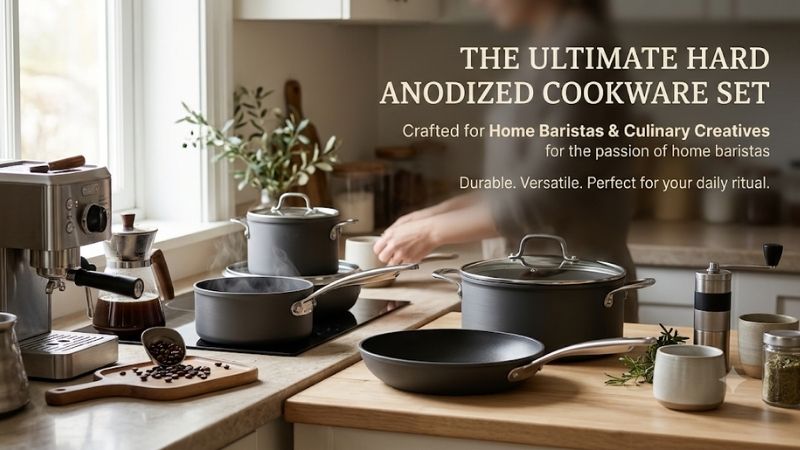
A hard anodized cookware set for home baristas can support coffee-related kitchen tasks such as warming milk, preparing flavored syrups, making hot chocolate, and cooking breakfast alongside coffee. However, ordinary cookware does not replace espresso machines or precision milk-frothing equipment. This guide explains which cookware pieces are genuinely useful and how to avoid unnecessary purchases.
- Do home baristas need a hard anodized cookware set?
- What hard anodized cookware can do for coffee preparation
- Which cookware pieces matter most?
- Choosing cookware construction for coffee-related kitchen tasks
- Hard anodized cookware collections worth considering
- Selecting the right cookware size for beverage preparation
- Why cookware cannot replace milk-frothing equipment
- Using hard anodized cookware safely
- Common buying mistakes for home baristas
- Frequently Asked Questions
- Conclusion
Do home baristas need a hard anodized cookware set?
Most home baristas do not need a complete cookware set solely for preparing coffee. Espresso extraction, milk steaming, and precision brewing depend on specialized equipment. However, a small saucepan or versatile nonstick cookware collection can support complementary kitchen tasks, particularly flavored syrup preparation, milk warming, and coffee-based recipes.
The distinction matters because home barista equipment and everyday cookware perform different functions.
A saucepan heats liquids through direct contact with the cooking surface.
A steam wand injects steam into milk and introduces air, creating texture suitable for drinks such as cappuccinos and lattes.
These processes are not interchangeable.
Hard-anodized cookware may be useful in a kitchen where coffee preparation is part of a broader breakfast routine.
However, buyers should prioritize the actual cooking tasks they need before purchasing a full set.
What hard anodized cookware can do for coffee preparation
Hard-anodized cookware commonly uses aluminum bodies with treated exterior surfaces and separate nonstick interiors. These characteristics can make certain pans convenient for warming liquids and preparing ingredients, but they do not provide the temperature precision of dedicated coffee equipment.
Warming milk and milk alternatives
A small saucepan can warm milk for hot drinks, hot chocolate, or certain coffee recipes. Hard-anodized aluminum cookware may respond relatively quickly to heat changes, although actual performance depends on the vessel’s construction and burner.
For home baristas, a small saucepan is more relevant than a large frying pan.
Milk should be heated gently while being monitored.
Excessive heating can cause scorching, skin formation, or unwanted flavor changes.
A suitable thermometer can help control temperature when the recipe requires it.
The cookware should have a stable base and a handle that is comfortable to hold.
A pouring lip can also make transferring warm milk easier, although not every saucepan includes one.
Preparing flavored coffee syrups
Flavored syrups are commonly prepared by dissolving sugar in water and adding suitable ingredients such as vanilla or spices. A small saucepan can handle this task, but the cooking process must remain controlled to prevent excessive reduction or burning.
A hard-anodized saucepan with a nonstick interior may be convenient for routine kitchen use.
However, a nonstick coating is not essential for simple syrup preparation.
Stainless steel saucepans can also work effectively.
For home baristas, the most important factors are manageable capacity, suitable heat control, and easy pouring.
Avoid buying an entire cookware collection solely to prepare occasional syrups.
Making hot chocolate and coffee-based sauces
Hot chocolate, mocha sauces, and certain dessert toppings require controlled heating and stirring. A saucepan with sufficient depth can contain the mixture while reducing splashing.
A nonstick surface may make cleanup easier when sugar or dairy ingredients adhere.
However, coated cookware should not be subjected to unsuitable temperatures or aggressive scraping.
Use silicone, wooden, or other manufacturer-approved utensils.
Monitor the mixture closely.
Do not leave sugar-rich liquids boiling unattended.
Preparing breakfast alongside coffee
For households that treat coffee preparation as part of a broader breakfast routine, a hard-anodized cookware set can provide additional versatility. Frying pans can prepare eggs and pancakes while saucepans handle oatmeal or warm milk.
This is where a complete collection becomes more justifiable.
A home barista may already own an espresso machine, grinder, kettle, and milk pitcher.
Cookware should complement these tools rather than duplicate their functions.
A practical collection can support both ordinary meals and occasional coffee-related preparation.
Which cookware pieces matter most?
A large cookware assortment is rarely necessary for coffee preparation alone. A small saucepan, a medium saucepan, and a versatile frying pan may provide enough functionality for most households. The ideal selection depends on whether the buyer also prepares breakfast, desserts, or meals regularly.
Small saucepans
A small saucepan is the most relevant cooking vessel for many home barista tasks.
It can warm milk, dissolve sugar, and prepare small quantities of syrup.
A 1- or 2-quart capacity may be sufficient for many recipes.
However, the ideal size depends on batch volume.
Avoid using an oversized stockpot for a small amount of milk because the liquid may spread thinly across the base and become difficult to manage.
Choose a pan that allows controlled stirring and pouring.
Medium saucepans
A medium saucepan provides more capacity for larger syrup batches, hot chocolate, or other drinks prepared for several people.
It may also support ordinary household cooking.
A covered 2.5- or 3.5-quart saucepan can prepare oatmeal, sauces, and boiled foods.
However, the additional capacity creates more cleanup and storage requirements.
Choose a medium pan when it will serve multiple tasks.
Frying pans
A frying pan has little direct role in espresso or filter coffee preparation.
However, it can be useful for breakfast foods served alongside coffee.
An 8-inch skillet suits individual portions.
A 10-inch skillet provides room for larger omelets, pancakes, or vegetables.
A coated cooking surface can simplify delicate egg preparation.
For home baristas who also enjoy cooking breakfast, a frying pan adds practical value.
Stockpots and sauté pans
Large stockpots and sauté pans are generally unnecessary for beverage preparation.
Their usefulness depends on wider household cooking.
A stockpot may support soups and pasta.
A sauté pan can prepare larger meals.
If the buyer already owns these vessels, purchasing another complete set may create unnecessary duplication.
Choosing cookware construction for coffee-related kitchen tasks
Material selection influences heat response, cleaning, and how easily small liquid quantities can be handled. Home baristas should compare hard-anodized nonstick cookware with stainless steel rather than assuming the hardened aluminum exterior provides unique advantages for coffee.
Hard-anodized aluminum bodies
Hard anodization changes the outer surface of aluminum through an electrochemical treatment.
The resulting surface can be more wear-resistant than untreated aluminum.
However, the cooking interior may use a separate PTFE or ceramic nonstick coating.
This distinction matters because the two surfaces require different consideration.
The hardened exterior does not make the cookware immune to damage.
For liquid heating, pan size and controlled burner output are usually more important than exterior hardness alone.
PTFE nonstick interiors
PTFE-coated cookware can simplify food release and cleaning.
This is useful for ordinary breakfast cooking.
However, home baristas should avoid overheating empty nonstick pans.
Use suitable utensils.
Follow the manufacturer’s temperature limits.
A nonstick saucepan is not inherently more accurate for milk heating than an uncoated saucepan.
The temperature must still be monitored.
Ceramic nonstick interiors
Ceramic-coated cookware provides another option for buyers comparing cooking-surface materials.
The coating can support convenient cleaning when maintained properly.
However, ceramic nonstick performance may deteriorate with wear or inappropriate heat exposure.
Manufacturers generally recommend gentle cleaning and controlled cooking temperatures.
For syrup and milk preparation, the buyer should prioritize ease of stirring, capacity, and pouring.
Stainless steel alternatives
Stainless steel saucepans provide durable uncoated cooking surfaces.
They can be useful for milk, syrups, and ordinary household cooking.
However, dairy and sugar mixtures may adhere or scorch if heated improperly.
For a home barista who mainly prepares simple syrup or hot chocolate, a good stainless steel saucepan may already be sufficient.
A full hard-anodized cookware set is not a necessary upgrade.
Hard anodized cookware collections worth considering
Several recognizable cookware collections include saucepans that can support coffee-related kitchen tasks. The relevant question is not whether the entire set has been designed specifically for baristas, but whether its cookware sizes and construction fit both beverage-related preparation and ordinary home cooking.
All-Clad HA1 Expert 10-Piece Set
The All-Clad HA1 Expert 10-Piece Set includes 2.5- and 3.5-quart covered saucepans, two frying pans, a sauté pan, and a stockpot. Its hard-anodized aluminum bodies use PTFE nonstick interiors and induction-compatible stainless steel bases.
This assortment is practical for a household that cooks regularly.
The saucepans can handle warming and syrup preparation when used correctly.
The frying pans support breakfast cooking.
However, the collection is far larger than most coffee-related tasks require.
Its principal value comes from general household versatility.
Calphalon Premier Space-Saving 10-Piece Set
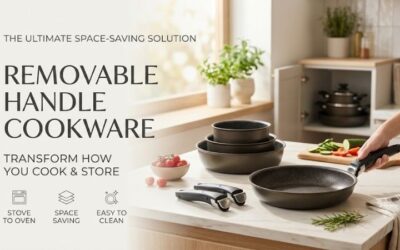
The Calphalon Premier Space-Saving 10-Piece Set includes 2.5- and 3.5-quart saucepans, frying pans, a sauté pan, and a stockpot. Its stackable construction is useful when the kitchen already contains coffee equipment that occupies substantial cabinet or counter space.
The cookware can support ordinary breakfast and sauce preparation.
Its nested design may help reduce storage demands.
However, the referenced model is not induction-compatible.
The set should therefore be considered only when the household’s stove supports its base construction.
All-Clad HA1 Ceramic 10-Piece Set
The All-Clad HA1 Ceramic 10-Piece Set provides hard-anodized aluminum cookware with ceramic nonstick interiors and an induction-compatible base.
Its 2.5- and 4-quart saucepans can accommodate various liquid and meal-preparation tasks.
The set also includes frying pans and larger vessels.
However, the manufacturer specifies hand washing and recommends avoiding high heat.
For home baristas, this is a general-purpose cookware collection rather than a replacement for milk-steaming equipment.
GreenPan Valencia Pro 11-Piece Set
The GreenPan Valencia Pro 11-Piece Ceramic Nonstick Cookware Set uses hard-anodized aluminum construction and an induction-compatible base.
Its covered pots and frying pans can serve ordinary cooking needs.
For coffee preparation, a saucepan is the most relevant component.
The other pieces become valuable when preparing breakfast or meals alongside coffee.
A home barista should not purchase the collection solely because it has a ceramic coating.
Selecting the right cookware size for beverage preparation
Capacity influences heat control, cleanup, and how easily a liquid can be transferred after heating. The correct saucepan should provide enough room to prevent overflow without being so large that small quantities spread excessively across the cooking surface.
Small batches of flavored syrup
A small saucepan is generally sufficient for occasional syrup preparation.
Choose a vessel that allows the sugar and water mixture to be stirred comfortably.
Avoid unnecessary high heat.
The mixture should be handled carefully because hot sugar solutions can cause severe burns.
Allow syrup to cool appropriately before transferring it into a storage container.
Follow safe storage guidance for the specific recipe.
Milk for one or two drinks
For a small quantity of milk, a compact saucepan offers more control than a large pot.
Use gentle heat.
Stir as needed.
Monitor temperature with a suitable thermometer when the recipe requires precision.
Do not assume the cookware’s coating eliminates the risk of scorching.
Larger hot chocolate batches
A medium saucepan may be useful when preparing several servings of hot chocolate.
Leave sufficient room for stirring.
Avoid rapid boiling.
Use a handle arrangement that supports safe pouring.
If the pot becomes heavy, transfer the liquid using a suitable ladle rather than tilting an unstable vessel.
Why cookware cannot replace milk-frothing equipment
Milk preparation for espresso beverages involves both heating and texture development. A saucepan can provide heat, but it does not automatically create the fine foam associated with steamed milk. Buyers should distinguish between warming milk and properly texturing it for latte art.
Heating versus texturing milk
Heating increases milk temperature.
Texturing introduces and distributes air to create foam.
A steam wand can perform both functions through controlled steam injection.
A saucepan performs primarily the heating function.
Other equipment may be required to create foam.
When a thermometer helps
A thermometer provides useful information when preparing milk-based beverages.
It can reduce reliance on guesswork.
However, accuracy depends on the thermometer and how it is used.
Choose equipment designed for the intended temperature range.
Avoid allowing the probe to contact the hot pan base when measuring milk.
When dedicated equipment is preferable
For repeated cappuccino and latte preparation, a suitable espresso machine or milk frother may be more practical than a saucepan.
A full cookware set does not improve espresso extraction.
It also does not replace a coffee grinder or brewing kettle.
Spend according to the equipment that actually addresses your brewing needs.
Using hard anodized cookware safely
Coated aluminum cookware can support ordinary beverage-related kitchen tasks, but safe use requires attention to temperature, food-contact surfaces, and handling. Sugar mixtures and hot liquids introduce additional burn hazards, so cookware should be stable and easy to control.
Avoid excessive heating
Use moderate heat for milk and syrup preparation.
Do not leave an empty coated saucepan over high heat.
Reduce the burner setting when the mixture approaches the desired temperature.
Never leave hot sugar mixtures unattended.
Stir with appropriate utensils
Use utensils permitted by the manufacturer.
Silicone and wood are common choices for coated cookware.
Avoid scraping with sharp metal tools when prohibited.
Clean utensils before transferring between ingredients.
Pour hot liquids carefully
A hot saucepan may contain liquid that can splash or spill.
Use appropriate heat protection.
Keep the pouring path clear.
Do not fill the vessel to the rim.
If the pan is difficult to control, use a ladle or suitable transfer container.
Clean milk and sugar residue promptly
Allow cookware to cool safely before washing.
Milk residue and dried sugar can become difficult to remove when left unattended.
Use warm water and suitable detergent.
Follow the coating manufacturer’s cleaning instructions.
Avoid abrasive scrubbing.
Common buying mistakes for home baristas
Some buyers assume that premium cookware will improve coffee extraction or milk texture, but ordinary saucepan construction does not determine these processes. The best purchase should serve genuine kitchen needs instead of adding unnecessary equipment.
Buying a full set solely for coffee
A full cookware collection is excessive when the only task is preparing flavored syrup.
Start with a suitable saucepan.
Add other cookware only when it serves regular meals.
Prioritizing coating over temperature control
A nonstick coating does not provide precise temperature regulation.
Use a suitable burner setting and thermometer when necessary.
Do not confuse easy cleaning with better beverage preparation.
Ignoring induction compatibility
Hard-anodized aluminum cookware is not automatically induction-compatible.
Choose a model with an appropriate magnetic base.
Verify exact product specifications.
Overlooking pouring convenience
A saucepan without a pouring lip may be awkward when transferring small quantities.
Consider handle comfort and rim design.
Use suitable utensils for controlled transfer.
Frequently Asked Questions
Home baristas often want to know whether specialty cookware improves coffee preparation and which saucepan material is best for milk or syrup. These questions are important because espresso equipment, milk frothing tools, and cookware solve different problems.
Is hard-anodized cookware good for heating milk?
It can be suitable when the pan is designed for the intended cooking task and used at controlled temperatures. Avoid overheating milk and follow the coating’s care instructions.
Can I make coffee syrup in a nonstick saucepan?
Yes. A suitable nonstick saucepan can prepare flavored syrup, but a nonstick coating is not essential. Stainless steel is also practical.
Does hard-anodized cookware improve espresso?
No. Espresso extraction depends on equipment and brewing variables such as grind, dose, water temperature, pressure, and extraction technique.
Ordinary cookware does not replace espresso equipment.
Can I froth milk in a saucepan?
A saucepan can warm milk, but it does not independently produce the fine foam created by a steam wand. A suitable frother or other texturing tool may be needed.
What cookware should a beginner home barista buy?
Start with the equipment required for your preferred brewing method. If you also prepare syrups, hot chocolate, or breakfast, a small saucepan and versatile frying pan may be sufficient.
Is ceramic nonstick better than PTFE for coffee-related cooking?
Both can support ordinary heating tasks under appropriate conditions. The best choice depends on manufacturer specifications, temperature limits, and cleaning preferences rather than coffee performance.
Conclusion
A hard anodized cookware set for home baristas is most useful when it supports both everyday cooking and complementary coffee-related tasks such as warming milk, preparing flavored syrups, and making breakfast. A compact saucepan is the most relevant vessel, while frying pans and stockpots add value only when used for regular household meals. The All-Clad HA1 Expert, HA1 Ceramic, Calphalon Premier, and GreenPan Valencia Pro collections provide different coating, storage, and compatibility options. However, none replaces dedicated espresso extraction or milk-texturing equipment. Prioritize controlled heating, safe handling, easy cleaning, and practical cookware sizes before buying a complete set.


Write Your Review
No reviews yet. Be the first to share your experience!