
Choosing a copper cookware set for dorm rooms requires careful attention to residence hall rules, available cooking equipment, storage space, and safety. Traditional copper cookware is attractive and responsive, but it may be expensive or impractical for student housing. This guide explains when copper cookware makes sense and how to choose a compact collection without unnecessary purchases.
- Is a copper cookware set practical for dorm living?
- Check dormitory cooking rules before buying
- Choosing the best copper cookware construction for dorms
- Choosing the right cookware pieces for a dorm kitchen
- Choosing cookware for different dorm stovetops
- Weight, storage, and transportation considerations
- Maintaining copper cookware in a shared kitchen
- Copper cookware versus other dorm cookware
- Safe everyday cooking in student housing
- Common buying mistakes
- Frequently Asked Questions
- Conclusion
Is a copper cookware set practical for dorm living?
A copper cookware set can be useful for students who have access to a permitted shared kitchen or apartment-style dormitory with suitable stovetop facilities. However, many residence halls restrict cooking equipment inside bedrooms, and traditional copper cookware may require more maintenance and storage than most students need.
The first step is determining whether cookware can be used legally and safely in the residence.
Some student accommodations provide communal kitchens with conventional electric or induction ranges.
Others have kitchenettes with limited equipment, while traditional dorm rooms may permit only specific electrical appliances.
A beautiful copper saucepan offers little practical value if there is no approved place to use it.
For students with legitimate cooking access, a compact set containing a small saucepan and frying pan is generally more appropriate than an extensive luxury collection.
Check dormitory cooking rules before buying
Residence hall cooking policies can affect whether any cookware purchase is useful. The permitted appliances, electrical requirements, and locations for food preparation differ between universities and buildings. Buyers should verify these restrictions before selecting materials or cookware sizes.
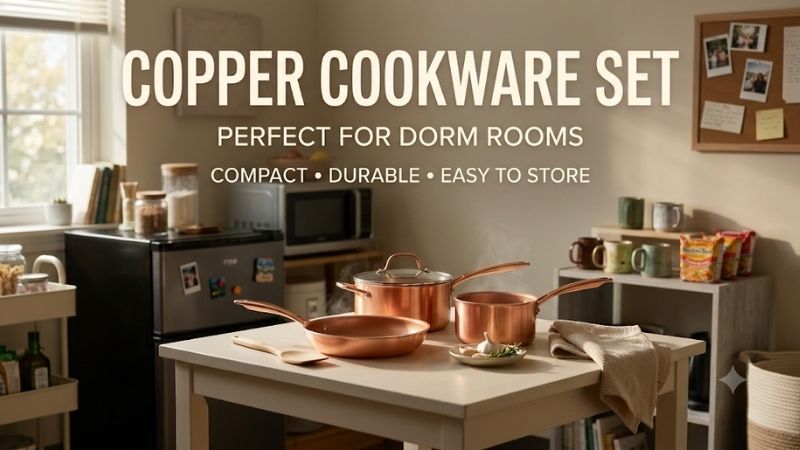
Determine whether stovetop cooking is permitted
A shared residence hall kitchen may provide a conventional electric range, induction burner, or another approved cooking surface. Students should confirm which facilities are available and whether cookware must be stored in personal rooms or in communal kitchen cabinets.
Some dormitories prohibit hot plates and portable burners in sleeping areas.
Other residences allow certain appliances only in supervised or designated kitchens.
Never assume that a portable induction burner is permitted simply because it lacks an exposed flame.
If there is no approved stovetop, a copper cookware set is not an appropriate immediate purchase.
The safer option is to use authorized cooking facilities or select permitted food preparation methods.
Check electrical and appliance restrictions
Electrical cooking appliances may be restricted because of fire risks, circuit capacity, or building policies. Even if a student owns induction-compatible cookware, that does not establish permission to operate an induction burner in a residence hall bedroom.
Review current housing policies.
Check whether appliances require approval.
Do not use extension cords or power strips with high-power cooking devices unless explicitly permitted by their manufacturers and housing rules.
Never bypass residence hall safety equipment.
The cookware should be selected only after the cooking environment has been established.
Understand shared kitchen storage arrangements
Shared kitchens may have limited secure storage, making expensive copper cookware difficult to manage. Students should consider whether their pots and pans can be stored safely and whether they must be transported between a bedroom and cooking area.
A compact saucepan is easier to carry than a large stockpot.
Stackable cookware may reduce storage requirements.
A protective storage bag can help prevent scratches during transport.
However, students should avoid placing hot cookware inside closed bags or containers.
Allow it to cool, clean, and dry before storage.
Choosing the best copper cookware construction for dorms
Copper cookware varies widely in composition. Traditional copper bodies, stainless steel pans with copper cores, and cookware with decorative copper-colored finishes are fundamentally different products. Students should understand these distinctions because they influence cost, compatibility, weight, and maintenance.
Traditional stainless-lined copper
Traditional stainless-lined copper cookware uses a copper body with a stainless steel cooking interior. The copper provides responsive heating, while the stainless lining protects food from direct contact with reactive copper.
Mauviel M’Heritage is an example of this construction.
Its copper body can respond quickly to changes in burner heat.
However, the collection is relatively expensive.
The exterior may also require polishing to retain its original appearance.
For a student preparing basic pasta, oatmeal, and eggs, this level of cookware may provide limited practical value compared with simpler alternatives.
Traditional copper is generally better suited to someone who actively enjoys precise cooking and expects to use the pans long after graduation.
Copper-core stainless steel
Copper-core cookware incorporates copper within a multilayer body that also includes stainless steel and other conductive materials. Its cooking surface is usually stainless steel, so the owner does not handle food directly against the copper.
The All-Clad Copper Core collection illustrates this approach.
It is compatible with induction cooktops and provides useful everyday cooking versatility.
However, its premium construction and cost may be excessive for a small dorm kitchen.
A student who already owns part of the collection or plans to use the cookware for many years may find it worthwhile.
Otherwise, a less expensive induction-compatible stainless steel pan is likely to meet ordinary student cooking needs.
Copper-clad cookware
Copper-clad cookware may use copper on the exterior with stainless steel and aluminum layers inside. The copper contributes to appearance and potentially thermal behavior, depending on its thickness and placement.
Lagostina Martellata is a recognizable example.
Its hammered copper exterior can be attractive.
However, the exterior may develop patina and require additional cleaning.
Induction compatibility is not guaranteed merely because the cooking interior contains stainless steel.
For a student using a shared induction stove, this limitation is especially important.
Copper-colored nonstick cookware
Some cookware advertised with copper-related names uses an aluminum body and copper-colored coating rather than a substantial copper construction. These products should not be evaluated as traditional copper cookware.
Their actual cooking performance depends on the metal body, base design, and interior coating.
A copper-colored nonstick pan may be useful for eggs or other delicate foods.
However, the appearance does not establish copper conductivity or premium construction.
Buyers should read the manufacturer’s material description carefully.
Avoid paying a premium based only on color or decorative marketing.
Choosing the right cookware pieces for a dorm kitchen
A dorm-friendly cookware arrangement should cover basic meals without creating unnecessary storage or washing requirements. One saucepan and one frying pan can handle many student recipes, while a larger pot may be useful when pasta or shared meals are prepared frequently.
Small saucepans for everyday meals
A small saucepan is one of the most useful cooking vessels for student housing because it supports oatmeal, sauces, soups, and other liquid-based preparations.
A 1.5- or 2-quart saucepan may be sufficient for individual portions.
A larger saucepan becomes useful when cooking for roommates.
Choose a lid when simmering or boiling is a frequent task.
A pouring rim can help with transferring liquids.
For copper cookware, confirm that the food-contact lining is suitable for ordinary ingredients.
Frying pans for simple breakfasts
An 8- or 10-inch frying pan can prepare eggs, vegetables, pancakes, and other basic meals.
An 8-inch pan is compact and convenient for individual servings.
A 10-inch skillet offers greater flexibility but takes more storage space.
Traditional stainless-lined copper may require greater attention to temperature and cooking fat than manufactured nonstick cookware.
Students who mainly prepare eggs may prefer a separate inexpensive nonstick skillet.
The best pan should reflect the foods actually cooked rather than matching the exterior appearance of every other piece.
Stockpots for shared meals
A stockpot provides capacity for pasta, soup, and larger quantities.
However, a large copper stockpot is rarely necessary for basic dorm cooking.
It occupies significant cabinet space and can become heavy when filled.
A medium stainless steel pot may be a more practical choice.
If the residence hall provides shared cookware, students may not need to purchase another stockpot at all.
Why large copper sets are often unnecessary
Copper cookware sets may contain several saucepans, skillets, lids, and specialty vessels.
An extensive collection can be expensive and inconvenient to store.
For dorm living, cookware should earn its space through frequent use.
Start with a small number of versatile pieces.
Add additional equipment only when recipes require it.
A two-piece arrangement used daily is generally more valuable than a large collection kept in a closet.
Choosing cookware for different dorm stovetops
Stovetop compatibility is essential because the cookware must work with the actual heating equipment. Traditional copper may work on gas or conventional electric burners but generally requires an interface disk for induction.
Induction cooking zones
Induction burners require cookware with an appropriate magnetic base.
Traditional Mauviel M’Heritage copper cookware is not directly induction-compatible.
All-Clad Copper Core and Mauviel M’6S use construction designed for induction.
However, these premium collections may be costly for students.
A basic induction-compatible stainless steel saucepan can often provide comparable practical usefulness for ordinary boiling tasks.
Before purchasing, confirm the dorm kitchen’s stove type and supported cookware sizes.
Electric coil cooktops
Traditional copper cookware can work on conventional electric coil burners when the base is suitable and the manufacturer’s instructions permit that cooking method.
However, the pan should sit securely.
A poorly matched or unstable base can create handling difficulties.
Use moderate heat initially.
Avoid moving hot cookware unnecessarily.
Follow the cooking surface manufacturer’s guidance.
Radiant glass cooktops
Glass-ceramic electric cooktops work differently from induction.
Many traditional copper pans can be used on compatible radiant electric surfaces.
However, the base should be flat and stable.
Avoid dragging cookware across the glass.
Keep the bottom clean to reduce the likelihood of scratching.
Check both cookware and appliance instructions.
Gas cooking
Gas burners are often compatible with traditional copper cookware.
Copper’s responsive thermal characteristics can be useful when adjusting the flame.
However, dormitory gas stoves may have additional safety and ventilation requirements.
Keep flames beneath the pan’s base.
Avoid allowing flames to extend around the handles.
Never leave the burner unattended.
Weight, storage, and transportation considerations
Dorm cooking may involve carrying cookware to a shared kitchen, washing it in communal facilities, and transporting it between semesters. These requirements make weight and compactness more important than they might be in a permanent home kitchen.
Choose manageable weight
Traditional copper cookware can be heavier than some aluminum alternatives.
Weight becomes particularly relevant when a pan contains boiling water or hot food.
A small saucepan may be more manageable than a large stockpot.
Evaluate whether you can lift the cookware safely.
Avoid carrying hot, liquid-filled pots over long distances through busy communal areas.
Protect cookware during storage
Copper exteriors and stainless interiors can be scratched during careless stacking.
Use suitable pan protectors.
Avoid placing sharp utensils directly against cooking surfaces.
Keep lids secured separately.
Store the cookware where it will not fall.
For shared kitchens, consider whether secure storage is available.
Plan for semester breaks
Students may need to transport cookware between housing locations.
Clean and dry all pieces before packing.
Protect handles and lids.
Use sturdy containers.
Do not place heavy cookware where it could damage fragile belongings.
A compact collection makes moving easier.
Maintaining copper cookware in a shared kitchen
Copper cookware can require more attention than ordinary stainless steel or coated aluminum pans. Shared kitchens also introduce practical concerns involving cleaning space, access to supplies, and whether other residents understand the cookware’s requirements.
Cleaning stainless-lined copper
Stainless steel interiors can be washed using suitable detergent and manufacturer-approved tools.
Allow the pan to cool before cleaning.
Avoid sudden exposure to cold water.
Do not use abrasive materials that could damage the finish unnecessarily.
Dry the cookware before storage.
Managing copper patina
Copper exteriors naturally darken with use.
This change is often cosmetic.
Polishing may restore a bright appearance when performed correctly.
However, maintaining a polished exterior may be inconvenient in dorm housing.
Students should decide whether they are comfortable with a natural patina.
Choose cleaning products compatible with the specific cookware.
Avoiding damage to the lining
Traditional copper cookware may use stainless steel or tin lining.
These surfaces have different cleaning and temperature restrictions.
Tin-lined cookware requires particular care and is not intended for aggressive high-temperature use.
Do not use damaged linings for ordinary cooking without following manufacturer guidance.
Copper cookware versus other dorm cookware
Copper can offer benefits for precise temperature control, but dorm cooking usually prioritizes affordability, easy cleaning, and compatibility. Other cookware materials may provide more practical value for everyday meals.
| Material | Main advantage | Dorm limitation |
|---|---|---|
| Traditional copper | Responsive heating | Expensive and high-maintenance |
| Copper-core stainless steel | Versatile, often induction-ready | Premium price |
| Stainless steel | Durable and multipurpose | Delicate foods may stick |
| Nonstick aluminum | Easy food release | Coating and induction restrictions |
| Cast iron | Durable seasoned surface | Heavy |
| Ceramic nonstick aluminum | Convenient everyday use | Coating wear and compatibility |
For students cooking simple meals, a small stainless steel saucepan and suitable frying pan will generally cover most needs.
Copper becomes more compelling when the owner has a specific interest in cooking technique and an appropriate kitchen.
Safe everyday cooking in student housing
Dorm kitchens can be busy shared environments, so cooking practices should prioritize fire prevention, sanitation, and safe handling. A high-quality cookware set does not eliminate the risks of hot surfaces, boiling liquids, or improperly stored food.
Keep the cooking area clear
Remove unnecessary items from around the stove.
Keep paper, towels, and combustible materials away from heating elements.
Position handles securely.
Avoid crowded workspaces.
Use approved ventilation when available.
Cook at appropriate temperatures
Copper can respond quickly to burner adjustments.
Begin with moderate heat.
Avoid overheating empty cookware.
Watch sauces and small quantities of food closely.
Do not leave cooking unattended.
Handle hot cookware safely
Use oven mitts or suitable heat protection.
Remember that copper, brass, and metal handles may become hot.
Do not carry boiling liquids through crowded hallways.
Allow cookware to cool before washing and storing.
Follow food-storage rules
Perishable foods should be refrigerated promptly.
Keep shared refrigerators at appropriate temperatures.
Label food containers when required.
Do not leave cooked meals at room temperature for extended periods.
Common buying mistakes
Dorm cookware purchases often go wrong when buyers choose equipment before checking housing rules, stove compatibility, or storage capacity. Copper adds another layer of complexity because the material can be expensive and requires particular maintenance.
Buying cookware before checking dorm policies
Confirm the availability of approved cooking facilities first.
Do not purchase a portable burner without verifying permission.
Paying for decorative copper color
Some products contain little or no functional copper.
Read construction specifications.
Do not judge quality from photographs alone.
Ignoring induction compatibility
Traditional copper generally does not work directly on induction.
Check the actual stove before purchasing.
Buying a large cookware collection
A complete set may be too bulky for dorm storage.
Start with essential pieces.
Expand only when necessary.
Frequently Asked Questions
Students considering copper cookware often need to know whether it is permitted, compatible with shared stoves, and worth the expense. These questions are important because dormitory requirements can make otherwise attractive cookware impractical.
Can I use copper cookware in a dorm room?
Only when the residence hall permits the intended cooking equipment and location. Many dormitories restrict cooking in sleeping areas.
Check housing policies before using cookware.
Is copper cookware good for induction dorm kitchens?
Only when the cookware has an induction-compatible magnetic base or is used with a manufacturer-approved interface solution.
Traditional copper is generally not directly compatible.
What size copper pan is best for one student?
A small saucepan or 8-inch skillet may be sufficient for many individual meals.
Choose based on recipes and storage space.
Is copper cookware worth buying for college?
It may be worthwhile for someone who enjoys cooking and plans to use it for many years.
For ordinary student meals, affordable stainless steel or suitable nonstick cookware is often more practical.
Is copper-colored cookware real copper?
Not necessarily. Copper-colored finishes do not establish a substantial copper body or core.
Check the material specifications.
Conclusion
A copper cookware set for dorm rooms is worthwhile only when the student has approved cooking facilities, compatible burners, and enough space for safe storage. Traditional copper cookware provides responsive heating but often brings costs and maintenance requirements that exceed typical dorm needs. Copper-core stainless steel offers induction compatibility in certain collections, although premium pricing remains a consideration. For most students, a small saucepan and versatile frying pan are more sensible than a large copper set. Confirm residence hall rules, actual construction, lining, weight, and cooktop compatibility before purchasing.








Write Your Review
No reviews yet. Be the first to share your experience!