
A corner cabinet organizer for everyday use should make frequently needed cookware, food containers, and pantry supplies easier to reach. The best setup depends on the cabinet opening and how often you use its contents. Learn which organizer styles work, how to measure correctly, and how to maintain convenient storage without unnecessary complexity.
- Quick Answer: Choose Accessibility Over Maximum Capacity
- Understand Why Corner Cabinets Become Difficult to Use
- Compare Organizer Styles for Everyday Kitchen Tasks
- Measure the Cabinet for Comfortable Daily Access
- Organize Everyday Cookware and Pantry Supplies
- Installation and Maintenance for Reliable Operation
- Common Problems and How to Avoid Them
- Frequently Asked Questions
- Conclusion
Quick Answer: Choose Accessibility Over Maximum Capacity
For everyday use, the best corner organizer is one that allows you to retrieve and replace items without repeatedly unloading the cabinet. A rotating Lazy Susan can work well in a compatible corner base cabinet, while a swing-out tray or blind-corner pull-out may be better when useful space sits behind a narrow opening. The right choice balances access, stability, installation difficulty, and cleaning.
Practical recommendations:
- For traditional corner cabinets: Consider a correctly sized rotating Lazy Susan.
- For deep blind corners: Evaluate specialized pull-out basket systems.
- For frequently used cookware: Look at strong solid-bottom swing-out trays with suitable load ratings.
- For pantry packages: Choose baskets or shelves that prevent containers from tipping.
- For rental kitchens: Consider removable bins or compatible freestanding turntables.
- For limited budgets: Improve the existing arrangement before replacing cabinet hardware.
An expensive corner organizer does not automatically make a kitchen more efficient. If the cabinet is currently used for occasional serving platters, a simple arrangement may be sufficient.
Daily convenience matters most when the cabinet holds items needed repeatedly during normal cooking.
Understand Why Corner Cabinets Become Difficult to Use
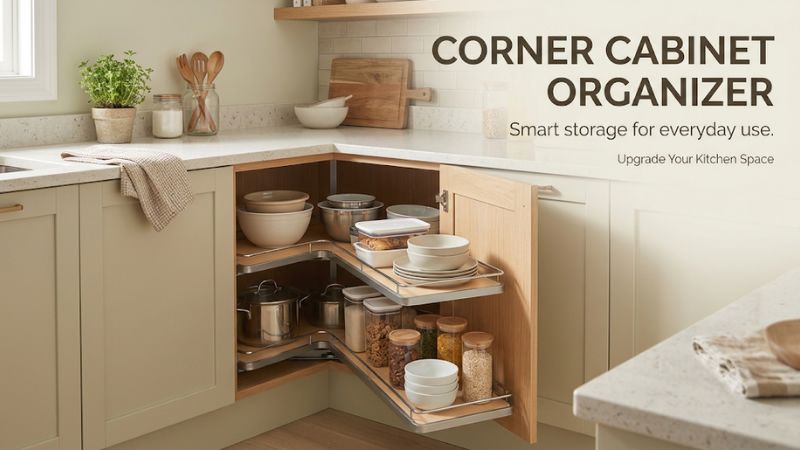
Corner cabinets often provide substantial interior space but relatively limited access through the door. The problem becomes more noticeable when several cookware sizes are mixed together or when small pantry containers sit behind larger objects. A suitable organizer changes how stored items are presented, allowing the user to bring them closer or rotate them into view rather than reaching deeply.
Recognize the Difference Between Corner Cabinet Types
Different corner cabinet shapes require different organizer mechanisms. A blind corner has storage hidden behind an adjacent cabinet section, while many traditional corner base cabinets have openings designed for shaped rotating shelves. Diagonal cabinets introduce another layout, and corner sink cabinets often contain plumbing that restricts storage equipment.
Common configurations:
- Blind corner: Hidden storage behind an adjacent cabinet.
- L-shaped corner cabinet: A wider corner arrangement with a shaped opening.
- Diagonal corner cabinet: Cabinet front positioned diagonally across the corner.
- Corner wall cabinet: Elevated storage above the countertop.
- Corner sink base: Corner storage affected by water and drain connections.
Identify the configuration before comparing products.
A mechanism designed for a blind corner should not be purchased for a different cabinet shape simply because the outside dimensions look similar.
When the original cabinet design is unclear, inspect the empty interior and note the position of the door, rear walls, and adjacent cabinetry.
Identify the Items That Create the Most Frustration
A corner organizer should solve the specific access problems that occur during normal meal preparation. Large saucepans, mixing bowls, baking dishes, and pantry containers can all become inconvenient when stored behind other objects. However, different products are suitable for different shapes and weights, so the inventory should guide the storage system.
Ask these questions:
- Which items do you retrieve every day?
- Which objects require moving other items first?
- Are heavy pots stored too far toward the back?
- Do small packages disappear behind larger containers?
- Are there enough clear surfaces to lift items safely?
- Does the door opening restrict movement?
For example, a family that cooks pasta frequently may want saucepans near the front of a rotating shelf.
A household that uses a stand mixer occasionally may prefer keeping that appliance in a separate cabinet rather than repeatedly moving it through a complicated corner mechanism.
Avoid turning a corner cabinet into the default home for every awkward kitchen object.
Decide Whether Accessibility or Capacity Matters More
Manufacturers often emphasize maximizing corner storage, but more theoretical storage space does not necessarily create a more convenient kitchen. A mechanism requires clearance for its frame and movement, and that can reduce the total space available for objects. The benefit is that users may retrieve the remaining items with fewer steps.
A useful comparison is the difference between keeping twelve containers on a deep fixed shelf and ten containers on an accessible rotating tray.
The larger number is not always the better outcome if the rear containers are rarely retrieved because they are difficult to reach.
Prioritize accessibility when:
- Items are used several times a week.
- Bending and deep reaching are uncomfortable.
- Cookware is heavy or awkward.
- Several people share the kitchen.
- Inventory is frequently forgotten at the back.
For less frequently used supplies, simple fixed storage can still be practical.
Compare Organizer Styles for Everyday Kitchen Tasks
Different corner organizers achieve access in different ways. Some rotate entirely within the cabinet, others pull rectangular baskets outward, and curved swing trays move toward the user through the door opening. A suitable mechanism should match the cabinet shape and the intended storage contents while remaining easy to operate during a busy cooking routine.
Rotating Lazy Susans for Quick Access
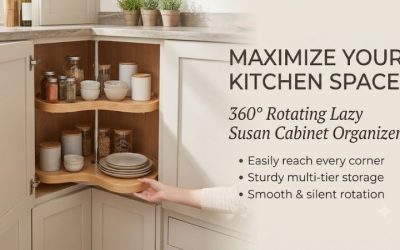
Lazy Susan systems use a rotating shelf to bring items from the rear toward the accessible opening. They can work well for cookware, pantry containers, and other objects that fit within the rotating platform. Their familiar movement makes them convenient when the cabinet was originally built for a circular or shaped rotating shelf arrangement.
Best for: Compatible corner cabinets with enough clearance for rotation.
Key benefits:
- Rear items can rotate into view.
- Access does not always require pulling a shelf into the kitchen aisle.
- Multiple shelf levels may be available.
- Contents can remain grouped by category.
Important limitations:
- Circular shelves leave some irregular unused space.
- Tall items may interfere with shelves above.
- Protruding pan handles can block rotation.
- Traditional rotating mechanisms may need adjustment or maintenance.
For everyday use, the organizer should rotate smoothly under an appropriate load.
Do not force a shelf when a pot handle catches the cabinet wall. Remove the obstruction and check the arrangement instead.
A Lazy Susan is most useful when contents remain within the intended shelf boundaries and can be lifted comfortably through the opening.
Blind-Corner Pull-Out Baskets for Hidden Storage
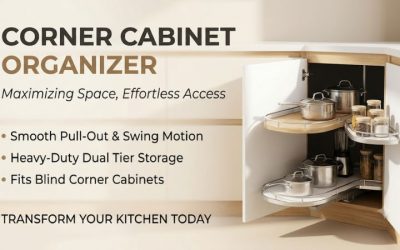
Blind-corner pull-out systems are designed for cabinets where a large area sits out of direct reach behind another cabinet section. These organizers may use moving front baskets and rear baskets that become accessible through a staged sliding motion. Their main advantage is making otherwise hidden space usable without unloading the entire cabinet.
Best for: Deep blind corners with compatible openings.
Key benefits:
- Improved access to rear storage.
- Separate compartments for different categories.
- Better visibility than a deep fixed shelf.
- Potentially useful for pantry products and medium-size cookware.
Important limitations:
- Complex installation.
- Rails and frames consume some internal space.
- Movement may require multiple actions.
- Weight capacity varies by configuration.
For households with many smaller pantry items, baskets can provide useful separation.
For large cookware, however, the basket’s width and height may restrict what fits. Check actual dimensions rather than assuming that a spacious cabinet can accommodate every pot once the hardware is installed.
Swing-Out Shelves for Pots and Serving Items
Swing-out corner organizers use shaped trays that move outward through the cabinet opening. This brings stored contents closer to the user and can reduce the need to reach deeply into awkward corners. Some premium systems use independently moving shelves, which may help when the upper and lower levels contain different categories of cookware.
Best for: Compatible base cabinets with adequate swing clearance.
Key benefits:
- Moves storage toward the user.
- Can improve visibility of cookware.
- Broad platforms may accommodate varied shapes.
- Separate trays offer organized levels.
Important limitations:
- The outward movement requires floor or aisle clearance.
- Installation can be complicated.
- Heavy objects demand secure mounting.
- Cabinet orientation matters.
Consider how the swing path interacts with the surrounding kitchen.
A large tray may need enough room to extend while another person is standing nearby or while an adjacent drawer is open.
For a busy household, a mechanism that frequently blocks movement may not provide the expected convenience.
Simple Removable Bins for Low-Commitment Organization
Not every corner cabinet needs a permanent mechanism. In some kitchens, a set of appropriately sized removable bins can group smaller packages and make the storage area less chaotic. This approach is especially useful for renters, people testing a new organization system, or households that use the corner for occasional supplies.
Best for: Low-cost organization without cabinet modifications.
Key benefits:
- No complicated hardware installation.
- Can be removed for cleaning.
- Flexible category grouping.
- Convenient when contents change.
Important limitations:
- Rear bins may still require reaching.
- Heavy cookware is awkward to manage in portable containers.
- Bins can waste space if poorly sized.
- Loose items can shift when a container is removed.
A removable bin should be easy to grip and lift without disturbing other objects.
Avoid using one enormous box for all supplies, because that simply recreates the original access problem inside a different container.
Smaller categories usually provide better visibility and more manageable movement.
Measure the Cabinet for Comfortable Daily Access
An organizer that fits inside a cabinet is not necessarily usable. The shelf or basket must also move through the opening, clear the door and hinges, and allow items to be lifted without collision. For everyday use, measuring should focus on the operating path as well as the stationary dimensions of the hardware.
Measure the Clear Cabinet Opening
Start with the door fully open and measure the narrowest clear width through which the organizer must move. Account for face-frame edges, hinges, and any fixed cabinet components. A product marketed for a nominal cabinet width may require a smaller but specific opening size that must be verified.
Record the following:
- Clear door opening width.
- Interior cabinet depth.
- Internal usable height.
- Distance to the rear wall.
- Face-frame thickness.
- Hinge protrusions.
- Left- or right-hand door arrangement.
Compare these measurements with the exact product installation requirements.
Do not rely on outside cabinet dimensions or photographs of a similar kitchen.
If the product requires permanent drilling, confirm the mounting surface is strong enough and that hidden plumbing or electrical components are not present.
Check Shelf Movement and Cookware Clearance
The organizer’s shelf movement is just as important as its resting size. Rotating trays need space for circular movement, pull-out baskets require a clear travel path, and swing-out shelves project beyond the cabinet opening. Tall bottles and protruding cookware handles can also interfere with movement even when the empty mechanism fits.
Use a simple cardboard template to visualize the shelf footprint and test whether nearby doors or appliances would obstruct it.
Observe the kitchen’s normal activity pattern.
For example, if a swing tray extends into the same area used to load a dishwasher, it may become inconvenient during meal cleanup.
Clearance checks:
- Full shelf travel.
- Door and hinge interference.
- Adjacent appliance access.
- Room to lift items from the shelf.
- Space around tall containers.
- Safe standing position during retrieval.
A mechanism should work naturally without requiring unusual body movement.
Organize Everyday Cookware and Pantry Supplies
Once the organizer is installed, its usefulness depends on what you put inside. Storing items in random positions can make even an expensive corner system frustrating. The goal is to create logical zones that reflect meal preparation, cleaning, and how frequently household members use the contents.
Keep Frequently Used Cookware Accessible
Daily cookware should be stored where it can be identified and lifted with minimal handling. Place frequently used pots, pans, and mixing bowls on stable shelves that support their shapes. Avoid placing heavy stockpots at an awkward height or creating unstable stacks that must be moved every time someone cooks.
Practical arrangement:
- Everyday saucepans in the easiest-access positions.
- Medium cookware together by purpose.
- Larger occasional pots on suitable lower shelves.
- Lids in compatible holders where space permits.
- Frequently used mixing bowls within comfortable reach.
Do not exceed shelf load ratings.
A large pot may be physically supported by the platform but still interfere with movement if its handle protrudes.
Check the organizer’s full travel after each major arrangement change.
Store Pantry Items Without Creating Hidden Clutter
Corner cabinets can hold canned foods, sauces, oils, and dry pantry supplies when the storage conditions are appropriate. However, small packages can disappear behind larger containers even on rotating shelves. Using consistent category groups and limiting unnecessary duplicates helps prevent the corner from becoming a forgotten pantry.
Suggested categories:
- Cooking oils and sauces.
- Canned vegetables and beans.
- Baking ingredients.
- Dry pantry packages.
- Occasional cooking accessories.
Keep spills contained and avoid placing unstable bottles where they might fall during movement.
For smaller packages, use appropriately sized bins that remain within the shelf boundaries.
Labels should face outward when practical, and older products should be used before newer replacements when appropriate.
Plan for Shared Family Use
When several people cook, a corner organizer must be understandable to everyone. A complicated arrangement that only one person remembers can lead to misplaced cookware and overloaded shelves. Keep categories straightforward, place commonly used items consistently, and explain the movement mechanism to household members who may not be familiar with it.
A simple family rule is to return each object to the same shelf zone after cleaning.
Do not allow children to climb on extended shelves or play with moving cabinet hardware.
Households with young children should evaluate the accessibility of sharp objects, cleaning chemicals, and heavy cookware.
Convenience is valuable only when the storage layout remains safe.
Installation and Maintenance for Reliable Operation
Corner organizers include moving components that need proper alignment and occasional inspection. Their load distribution can change as trays rotate or extend, so secure mounting and cabinet condition are important. Before using a newly installed system, test its full movement without contents and gradually add items while checking for rubbing, instability, or unusual resistance.
Follow the Exact Installation Instructions
Some corner organizers can be installed by experienced DIY users, while others are best fitted by cabinet professionals. Installation may require drilling, frame alignment, sliding hardware adjustment, and checking the complete movement path. A small alignment error can cause binding or contact with the cabinet door.
Before installation:
- Empty and inspect the cabinet.
- Verify the selected model and orientation.
- Confirm all required components are present.
- Check mounting surface strength.
- Follow the manufacturer’s installation sequence.
- Test the mechanism empty.
- Load gradually within the rated capacity.
Do not substitute unapproved fasteners or attempt to force an incorrectly sized mechanism into the opening.
A reliable installation should feel stable and operate without excessive effort.
Establish a Simple Maintenance Routine
Everyday use exposes cabinet organizers to movement, spills, and the weight of stored items. Routine maintenance helps identify problems before they interfere with operation. The most useful habits are simple: remove crumbs, wipe spills, inspect fasteners, and avoid overloading shelves.
Maintenance checklist:
- Clean shelves according to material instructions.
- Check for loose mounting components.
- Remove objects interfering with moving joints.
- Inspect cabinet flooring for moisture damage.
- Keep sliding hardware free of debris.
- Follow the manufacturer’s lubrication guidance.
If the organizer starts moving unevenly, investigate rather than applying extra force.
Do not assume that every mechanism requires added oil or lubricant. Some slide systems are designed to operate without homeowner lubrication, and unsuitable products may attract dirt or damage components.
Common Problems and How to Avoid Them
Corner storage systems can fail to provide convenient access when the chosen mechanism is too complicated for the actual inventory, the cabinet opening is measured incorrectly, or shelves are overloaded. Most problems can be reduced through careful planning before purchase and through straightforward loading habits after installation.
A Shelf That Does Not Rotate or Slide Smoothly
Resistance may occur when cookware protrudes beyond the shelf, a basket is overloaded, loose objects contact the frame, or mounting components become misaligned. Start by removing the contents and testing the mechanism according to the manufacturer’s instructions.
Do not force movement against a visible obstruction.
If the empty system still binds, inspect the hardware and installation.
For permanently mounted products, repeated forcing can damage both the mechanism and the cabinet.
A qualified installer may be needed when alignment cannot be corrected safely.
Too Much Storage but Too Little Accessibility
A corner cabinet can appear highly organized immediately after installation yet become frustrating when every shelf is packed. Containers may block one another, handles may catch, and lifting a heavy object may require moving several smaller objects first.
Reduce the load and organize according to frequency.
Leave clearance for hands and for normal shelf movement.
Avoid using every available inch simply because the organizer seems capable of holding more.
The best daily-use system creates a little intentional empty space around objects that need to be handled frequently.
Choosing a Mechanism That Is Too Complicated
A specialized pull-out cabinet system may be impressive but unnecessary when the household stores only a few occasional items. More moving components can mean additional installation requirements and more steps during use.
Consider whether a rotating shelf or simple removable bin would solve the original problem.
Before purchasing, imagine retrieving three items during a busy dinner preparation.
If the process requires several awkward movements, the mechanism may not be the most practical option for your household.
Frequently Asked Questions
Everyday corner cabinet storage raises practical questions about which mechanism is easiest to use, whether heavy cookware can be stored safely, and whether a permanent installation is worth the investment. The correct answers depend on cabinet geometry and household routines, but the best solutions consistently emphasize accessible contents, suitable load ratings, and straightforward operation.
What Is the Easiest Corner Cabinet Organizer to Use?
For compatible corner cabinets, a rotating Lazy Susan can be straightforward because users turn the shelf to bring items into view. Blind corners may require a specialized pull-out or swing-out mechanism. The easiest option is the one that works naturally with the cabinet opening and the objects being stored. A complicated system is not necessarily better when a simpler design provides adequate access.
Should I Use a Lazy Susan or Pull-Out Shelves?
Choose based on cabinet type and intended contents. A Lazy Susan is appropriate for many corner cabinets designed for rotating shelves. Specialized pull-out mechanisms can improve access to blind corners with narrow openings. Pull-out systems may require more installation work and outward movement space. Compare cabinet measurements, cookware dimensions, accessibility needs, and budget before deciding.
Can I Store Heavy Pots in a Corner Organizer?
Some systems are rated for cookware, but capacity varies. Check the exact product’s published limits and follow installation and loading instructions. Keep heavy objects stable and avoid placing them where handles interfere with movement. Do not rely on the appearance of thick metal or wood as proof that an organizer can safely hold a particular load. Cabinet structure and mounting quality are equally important.
Is a Corner Organizer Worth Installing in an Older Kitchen?
It may be worthwhile when the existing cabinet is structurally sound and everyday access is difficult. However, older cabinets can have unusual dimensions, damaged floors, or hardware that complicates installation. Measure carefully and inspect the mounting surfaces before buying. If permanent modifications would be expensive or risky, simple removable bins or an appropriate freestanding turntable may be a more practical first improvement.
How Often Should I Clean a Corner Cabinet Organizer?
Clean spills promptly and inspect the organizer periodically for crumbs, grease residue, loose objects, and hardware problems. The required frequency depends on how often the cabinet is used and what it stores. Follow the product’s material-specific cleaning instructions and avoid exposing sliding mechanisms to unsuitable cleaning agents. Regular light cleaning is usually easier than waiting until debris interferes with movement.
Conclusion
A corner cabinet organizer for everyday use should make meal preparation more convenient by bringing frequently needed items within comfortable reach. Choose a rotating Lazy Susan for a compatible corner cabinet, a specialized pull-out system for a blind corner, or swing-out trays when direct access to cookware is the priority. Measure the complete movement path, verify load capacity, and organize contents by frequency. A simple, stable system that everyone can maintain is more valuable than a complicated organizer packed to maximum capacity.







Write Your Review
No reviews yet. Be the first to share your experience!