
A good pot lid organizer keeps saucepan, stockpot, and skillet lids accessible without unstable stacks or scratched surfaces. Whether your kitchen has deep drawers, narrow cabinets, or unused door space, the right rack can turn an awkward collection of lids into an orderly system. This guide compares six practical products and explains their advantages, limitations, and best uses.
Quick Verdict: Which Pot Lid Organizer Is Best?
Pot lids are challenging to store because their diameters, handles, shapes, and weights rarely match. Glass lids with large knobs may not fit the same rack as thin stainless steel covers, and a shallow drawer creates different problems from a deep cabinet. The most useful organizer keeps lids separated, allows one lid to be removed without disturbing another, and accommodates the actual cookware collection.
Our recommended products:
- Best Overall: YouCopia StoreMore Adjustable Lid Holder.
- Best Expandable Rack: IKEA VARIERA Pot Lid Organizer.
- Best Cabinet Door Storage: Joseph Joseph CupboardStore Set of 3 Pan Lid Holders.
- Best Compact Countertop Stand: Joseph Joseph Space 3-Piece Pan Lid Storage Stand.
- Best for Mixed Pans and Lids: Yamazaki Tower Adjustable Pot Lid & Frying Pan Organizer.
- Best for Wall or Cabinet Mounting: Yamazaki Tower Self-Adhesive Pot Lid Holder.
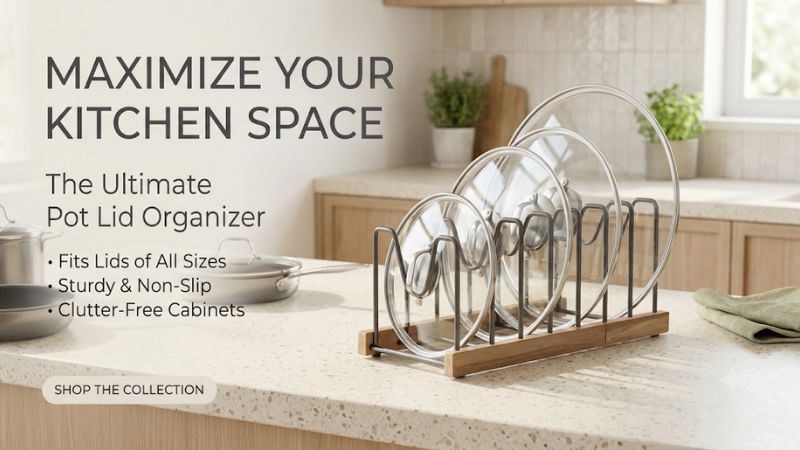
The YouCopia StoreMore is the most versatile starting point for ordinary kitchen cabinets because its dividers can be repositioned for differently sized lids. IKEA’s VARIERA offers another adaptable approach, especially when the organizer needs to expand across an available drawer section.
Joseph Joseph’s door-mounted holders preserve cabinet-floor space. Their usefulness depends on the interior clearance of the door and the size and weight of each lid.
For households with only a few lids, a compact stand may be more convenient than a large rack. Kitchens with mixed cookware may benefit from a system that also supports frying pans.
There is no universally best organizer. The correct choice depends on the number of lids, the available storage location, and the clearance required for handles.
Quick Comparison Table
A comparison is more useful when it accounts for how the organizer physically supports each lid instead of focusing only on an advertised capacity. Adjustable dividers, expandable rails, individual holders, and freestanding stands all manage cookware differently. The following table summarizes six identifiable designs, their principal uses, and limitations shoppers should consider before ordering.
| Product | Best For | Main Features | Advantages | Limitations |
|---|---|---|---|---|
| YouCopia StoreMore Adjustable Lid Holder | Everyday cabinet storage | Seven adjustable dividers, nonslip base | Flexible lid spacing | Uses cabinet floor space |
| IKEA VARIERA Pot Lid Organizer | Drawers and wider shelves | Expandable stainless steel rack | Adjustable overall length | Lid handles affect usable capacity |
| Joseph Joseph CupboardStore Set of 3 | Cabinet doors | Individual V-shaped holders | Saves shelf space | Requires compatible door clearance |
| Joseph Joseph Space 3-Piece Lid Stand | Three frequently used lids | Compact freestanding stand | Simple access | Limited capacity |
| Yamazaki Tower Adjustable Organizer | Pots, frying pans, and lids | Adjustable partitions, handle support | Multipurpose storage | Requires adequate depth |
| Yamazaki Tower Self-Adhesive Lid Holder | Suitable vertical surfaces | Adhesive-assisted mounting | Keeps lid off shelf | Surface and weight restrictions |
The comparison emphasizes practical features rather than invented performance scores. A product that occupies little room while empty may still be unsuitable after loading several large lids with raised knobs. Every buyer should measure their actual lids and verify manufacturer compatibility before selecting a storage method.
How We Selected These Pot Lid Organizers
These recommendations focus on real product designs with manufacturer documentation, practical household applications, and identifiable differences. The evaluation considers adjustability, space efficiency, material compatibility, installation, cleaning, and daily handling. It does not assume that manufacturer claims establish independently measured performance, and the products have not been represented as personally tested.
Selection criteria
- Lid compatibility: Support for different diameters, rim shapes, and handles.
- Stability: Whether lids can remain upright without excessive movement.
- Scratch protection: Construction and contact surfaces around glass or coated lids.
- Space efficiency: Suitability for drawers, shelves, and cabinet doors.
- Adjustability: Ability to accommodate a changing cookware collection.
- Installation: Tool-free assembly versus adhesive or hardware mounting.
- Cleaning: Ease of removing grease, dust, and accumulated food residue.
- Accessibility: Whether one lid can be retrieved without rearranging others.
A rack that stores six small saucepan lids may accommodate fewer large glass covers. Therefore, capacity should be assessed using the specific lids in the household rather than the maximum number of partitions.
We also considered whether the design allows lids to dry thoroughly before storage. Moisture trapped beneath a lid rim or inside a rack can create unpleasant odors and unnecessary maintenance.
Detailed Reviews of the Six Best Pot Lid Organizers
The following recommendations cover several different ways to organize cookware lids, from adjustable shelf racks to compact individual holders. Each option is evaluated according to its intended function, the types of lids it can reasonably accommodate, the storage conditions it requires, and the disadvantages that matter during everyday cooking.
YouCopia StoreMore Adjustable Lid Holder — Best Overall
The YouCopia StoreMore Adjustable Lid Holder is a freestanding organizer designed to hold pot and pan lids vertically inside an ordinary kitchen cabinet. Its seven adjustable dividers allow users to create wider or narrower spaces depending on their cookware collection. Coated steel wires and a nonslip base make it a practical choice for households with several glass and metal lids of different sizes.
Best For
- Everyday kitchen cabinets.
- Mixed saucepan and stockpot lids.
- Households with glass and stainless steel covers.
- Cooks who frequently change cookware.
- People who prefer tool-free organization.
Key Specifications
- Brand: YouCopia.
- Product: StoreMore Adjustable Lid Holder.
- Adjustable dividers: Seven.
- Dimensions: Approximately 11.5 inches wide, 7.3 inches deep, and 4.9 inches high with dividers.
- Divider material: Coated steel.
- Base: Plastic with nonslip feet.
- Installation: No drilling or mounting required.
Why We Picked It
The strongest advantage of this model is its adjustable spacing. Pot lids rarely share the same handle height or rim profile, and fixed narrow slots can make certain lids difficult to store.
With repositionable dividers, users can dedicate more space to a thick glass cover while keeping thinner metal lids closer together.
This flexibility also means the rack may remain useful when individual pots are replaced.
Features and Practical Performance
The rack holds lids separately from cookware, reducing the need to balance glass covers on top of stacked saucepans.
For a household cooking daily, a sensible arrangement is to place the most frequently used skillet and saucepan lids near the accessible end.
Less frequently used stockpot covers can occupy positions farther back.
The coated wire contact points are intended to reduce scratching, but users should still place delicate lids carefully rather than allowing heavy glass to strike the dividers.
A stable flat shelf is important. Nonslip feet help resist movement but do not make the organizer secure on every irregular or damaged cabinet surface.
What Makes It Different
Unlike an expandable accordion-style rack, the StoreMore uses individual dividers that can be positioned according to actual lid thickness.
It is an appealing middle ground between fixed-slot racks and fully customized cabinetry.
Pros
- Seven adjustable dividers.
- No permanent installation.
- Coated contact surfaces.
- Nonslip base.
- Accommodates different lid configurations.
Cons
- Occupies usable cabinet floor space.
- Large lid handles may reduce capacity.
- Not designed to hold extremely heavy cookware without checking supported use.
Buy If
You want a flexible organizer that can accommodate several different lids and may need adjustment as your cookware collection changes.
Skip If
Your cabinet floor is extremely narrow or you would rather store lids on a cabinet door.
IKEA VARIERA Pot Lid Organizer — Best Expandable Rack
The IKEA VARIERA Pot Lid Organizer uses an expandable stainless steel structure to hold cookware lids upright in a drawer or cabinet. Its adjustable length makes it useful when the available storage area is wider than the space needed for a small fixed rack. The straightforward construction also offers flexibility for storing other appropriately sized flat kitchen items.
Best For
- Deep kitchen drawers.
- Wider cabinet shelves.
- Households with several similarly sized lids.
- People seeking an expandable storage layout.
- Minimalist kitchen organization.
Key Specifications
- Brand: IKEA.
- Product: VARIERA Pot Lid Organizer.
- Material: Stainless steel with plastic components.
- Design: Expandable rack with upright partitions.
- Placement: Drawers, shelves, or suitable countertops.
- Installation: Freestanding arrangement.
Why We Picked It
An expandable rack allows shoppers to use the available storage length without buying a model with a fixed footprint.
This can be especially useful in deep drawers where the distance between other organizers changes as the kitchen is reorganized.
The VARIERA design is also recognizable and relatively uncomplicated, which may appeal to households that prefer basic hardware over elaborate storage mechanisms.
Features and Practical Performance
Lids can be positioned upright between the dividers, creating a row that is easier to inspect than a stack.
The organizer works best when each lid has sufficient space for its handle and rim.
A deep drawer is particularly useful because the drawer can bring the whole collection toward the cook.
However, expanding a rack farther does not automatically improve its capacity. The final arrangement must remain stable, and larger lids may need greater separation than thin covers.
The user should also check the drawer’s internal height with the lids loaded. A large glass knob can prevent a drawer from closing even when the rack itself fits comfortably.
What Makes It Different
Unlike separate holders mounted in fixed positions, the VARIERA is one adjustable unit that can be moved or repositioned.
Its simple expandable structure is particularly appropriate when several lids are stored together.
Pros
- Adjustable length.
- Stainless steel construction.
- Freestanding design.
- Simple everyday access.
- Suitable for drawers and cabinets.
Cons
- Some lids need extra spacing.
- An expanded rack still requires a stable surface.
- Tall handles can limit drawer compatibility.
Buy If
You have a drawer or shelf with available horizontal space and want an organizer that can be adjusted to fit the collection.
Skip If
You need individually mounted lid storage or only have a narrow cabinet door available.
Joseph Joseph CupboardStore Set of 3 Pan Lid Holders — Best for Cabinet Doors
The Joseph Joseph CupboardStore Set of 3 Pan Lid Holders is designed to move cookware lids away from crowded shelves and onto the inside of a cabinet door. Each V-shaped holder supports a compatible lid independently, allowing users to arrange the collection vertically. This is particularly useful when cabinet floor space is already occupied by pots and pans.
Best For
- Small kitchen cabinets.
- Households with limited shelf space.
- Cooks storing three frequently used lids.
- Cabinets with suitable interior doors.
- Users who prefer separate storage positions.
Key Specifications
- Brand: Joseph Joseph.
- Collection: CupboardStore.
- Product: Set of 3 Pan Lid Holders.
- Quantity: Three individual holders.
- Design: V-shaped support.
- Installation: Cabinet-door attachment.
- Manufacturer-stated maximum weight: 2.2 pounds per holder for the referenced set.
Why We Picked It
Cabinet doors are frequently underused storage surfaces. Mounting lids inside the door can free the main compartment for cookware while keeping the corresponding covers close by.
The individual-holder arrangement also allows the owner to choose positions based on the dimensions of the lids rather than relying on one fixed rack.
Features and Practical Performance
A sensible arrangement might place the largest compatible lid lower on the door and smaller covers above it, provided the mounting instructions allow this distribution.
The holder must support the lid securely without allowing its handle to collide with shelves or cookware when the door closes.
Before installation, temporarily position the lids against the door and check the full closing movement.
This step is essential because a door that closes comfortably when empty may collide with a saucepan handle after the lids are installed.
The adhesive mounting surface must also satisfy the manufacturer’s requirements. Textured, damaged, or unsuitable surfaces may not support the intended installation.
What Makes It Different
Most lid racks occupy cabinet floor space. This model uses a vertical surface and stores each lid separately.
That makes it particularly attractive for kitchens where pots already occupy nearly all available shelving.
Pros
- Saves cabinet shelf space.
- Individual storage positions.
- Suitable for compatible glass and metal lids.
- Convenient access.
- No large floor-standing rack.
Cons
- Supports a limited number of lids.
- Door clearance must be checked.
- Adhesive compatibility matters.
- Weight restrictions apply.
Buy If
You have suitable cabinet-door space and want to store a few frequently used lids independently.
Skip If
Your lids are especially heavy or the cabinet door has little interior clearance.
Joseph Joseph Space 3-Piece Pan Lid Storage Stand — Best Compact Stand
The Joseph Joseph Space 3-Piece Pan Lid Storage Stand is a compact freestanding solution intended to organize up to three compatible cookware lids. Instead of distributing lids across a cabinet door, it groups them in one defined location that can be placed in a suitable drawer or cabinet. This approach is useful for smaller cookware collections where a large expandable rack would be excessive.
Best For
- Small cookware collections.
- Deep kitchen drawers.
- Compact cabinet compartments.
- Frequently used saucepan lids.
- Households seeking simple lid access.
Key Specifications
- Brand: Joseph Joseph.
- Product family: Space.
- Product type: Three-piece lid storage stand.
- Intended capacity: Three compatible lids.
- Placement: Suitable drawers or cabinet shelves.
- Installation: Freestanding.
Why We Picked It
Some households own only a few pots and pans. For those kitchens, purchasing a large rack can waste more space than it saves.
A compact stand organizes the most-used covers without requiring significant shelf width or a permanent mounting system.
Its dedicated three-lid arrangement is easy to understand and maintain.
Features and Practical Performance
The stand is best considered for three lids that fit comfortably together.
A large stockpot lid may need more clearance than a small saucepan cover, and thick handles can change the available space considerably.
Before buying, arrange the intended lids next to one another and measure the total space required.
The location should also allow the largest lid to be removed vertically without striking a fixed shelf.
When used in a drawer, check the closing height with the lids loaded.
Lids should be clean and dry before storage. If moisture remains around the glass rim or handle attachment, placing the cover in a compact organizer can delay drying.
What Makes It Different
This model focuses on a small, predetermined collection rather than maximum capacity.
It suits users who value a simple defined storage station over adjustable hardware.
Pros
- Compact arrangement.
- No door mounting.
- Easy to relocate.
- Dedicated space for three compatible lids.
Cons
- Limited expansion potential.
- Large covers may reduce practical capacity.
- Drawer clearance must be verified.
Buy If
You own only a few frequently used cookware lids and want a compact, removable stand.
Skip If
You have a large cookware collection or regularly add new lids of different sizes.
Yamazaki Tower Adjustable Pot Lid & Frying Pan Organizer — Best Multipurpose Rack
The Yamazaki Tower Adjustable Pot Lid & Frying Pan Organizer is designed to store both cookware lids and frying pans in an upright arrangement. Its dividers can be repositioned at three-centimeter intervals, while a handle support helps keep pans oriented for convenient removal. The expandable design is particularly useful for deep drawers where several cookware items share the same storage area.
Best For
- Mixed frying pans and lids.
- Deep kitchen drawers.
- Households using several pan sizes.
- Cooks who want one organizer for multiple cookware types.
- Kitchens with sufficient drawer width.
Key Specifications
- Brand: Yamazaki.
- Collection: Tower.
- Product: Adjustable Pot Lid & Frying Pan Organizer.
- Design: Expandable base.
- Divider adjustment: Three-centimeter increments.
- Additional component: Frying-pan handle holder.
- Placement: Suitable cabinets and drawers.
Why We Picked It
Many kitchens have more difficulty organizing cookware than lids alone.
Frying pans are awkward to stack because handles extend beyond the pan body, while glass lids create a separate storage problem.
Combining both categories in one adjustable organizer can create a more coherent system when the drawer dimensions allow it.
Features and Practical Performance
The partitions support cookware in an upright orientation, reducing the need to stack smaller pans inside larger ones.
Position pans according to their width and handle shape, allowing enough room to remove one without striking adjacent cookware.
The handle holder is useful because pan handles often create the greatest storage inconvenience.
However, a large frying pan can occupy significantly more space than a lid. The overall organizer should therefore be evaluated using the intended combination of items rather than an assumed maximum count.
Check that the drawer can close with handles oriented upward.
Also account for the depth required by long skillet handles, particularly in shallow base cabinets.
What Makes It Different
Unlike a dedicated lid holder, this product manages multiple cookware categories in one rack.
It is a stronger choice when the household wants to reorganize a full cookware drawer rather than only a few covers.
Pros
- Stores both pans and lids.
- Adjustable partitions.
- Expandable design.
- Dedicated handle support.
- Reduces unstable cookware stacking.
Cons
- Requires adequate drawer dimensions.
- Takes more space than compact lid-only holders.
- Large pans can reduce the number of usable slots.
Buy If
You want one adjustable storage system for frying pans and their corresponding lids.
Skip If
You only need to organize two or three small lids.
Yamazaki Tower Self-Adhesive Pot Lid Holder — Best Vertical Mounting
The Yamazaki Tower Self-Adhesive Pot Lid Holder provides an alternative to conventional shelf racks by storing a compatible lid on a suitable vertical surface. It is intended for kitchens where the wall, cabinet interior, or another approved mounting location offers useful space. This approach can keep frequently used cookware lids accessible without occupying a large horizontal storage area.
Best For
- Compact kitchens.
- Households with limited cabinet floor space.
- Suitable smooth vertical surfaces.
- Cooks storing individual frequently used lids.
- Users seeking a less bulky organizer.
Key Specifications
- Brand: Yamazaki.
- Collection: Tower.
- Product: Self-Adhesive Pot Lid Holder.
- Installation: Manufacturer-specified adhesive mounting system.
- Storage format: Individual lid support.
- Placement: Approved compatible surfaces.
- Important restriction: Surface and load compatibility must be checked.
Why We Picked It
Vertical storage can be valuable when a small cabinet has little room for another rack.
An individual lid holder also allows a frequently used cover to have a predictable location instead of being stored underneath a stack of cookware.
This format is particularly useful when one awkward lid causes most of the storage frustration.
Features and Practical Performance
Correct installation is the defining requirement.
Adhesive mounting systems depend on the condition and material of the surface, so the holder should only be used where the manufacturer approves installation.
A glossy kitchen panel may offer a different installation environment from untreated wood, textured tile, or damaged paint.
Before mounting, check the lid’s weight, rim, and knob clearance.
Also ensure that the lid will not be exposed to excessive heat or collide with a cabinet door.
Storage near the stove may appear convenient, but a rack should not be placed where hot cookware or cooking flames create a safety risk.
What Makes It Different
It stores lids individually rather than as a collection in one freestanding rack.
The design is best viewed as a targeted solution for a small number of compatible lids.
Pros
- Uses vertical space.
- Minimal shelf footprint.
- Keeps a frequently used lid accessible.
- Useful in compact kitchens.
Cons
- Limited to compatible mounting surfaces.
- Not a high-capacity organizer.
- Requires careful installation.
- Lid weight and geometry affect suitability.
Buy If
You need an individual lid holder and have a manufacturer-approved mounting surface.
Skip If
You want to organize a large collection or cannot confirm that the mounting location is suitable.
Buying Guide: How to Choose a Pot Lid Organizer
The most common purchasing mistake is choosing a rack based only on the number of slots. Pot lids differ in diameter, thickness, handle height, weight, and edge construction, which means the usable capacity of a rack depends on the actual collection. A successful organizer should accommodate those differences while remaining convenient to clean and safe to use.
Measure Lid Diameter, Thickness, and Handle Height
Before selecting a rack, measure every lid that will be stored. The lid diameter determines the required width and height of the storage area, while thickness and handle shape affect how closely covers can be positioned. Glass lids with large knobs often require considerably more clearance than flat metal covers, especially inside drawers.
Measurements to record
- Maximum lid diameter.
- Total thickness, including rim.
- Height of the central knob.
- Weight of unusually heavy lids.
- Shape of any side handles.
- Available cabinet or drawer height.
- Clearance needed to remove a lid.
A simple measurement list makes it easier to compare organizers.
For example, a rack may have six dividers but accommodate only four oversized glass lids comfortably.
Do not force covers into slots that are too narrow or allow handles to become trapped between partitions.
Choose the Right Storage Location
Cabinet shelves, deep drawers, cabinet doors, and walls offer different advantages. Drawers can provide convenient top-down access, but their height limits large lids with prominent knobs. Cabinet shelves accommodate taller covers but may require more reaching. Door-mounted racks save floor space, although hinges and interior clearance determine whether they can be installed safely.
Storage options
- Deep drawer: Excellent for upright lid visibility.
- Cabinet shelf: Flexible for freestanding racks.
- Cabinet door: Useful when floor space is occupied.
- Wall or panel: Suitable for approved individual holders.
- Countertop: Convenient for frequently used lids when space permits.
Think about the normal cooking workflow.
If you often remove lids while preparing meals, place the most frequently used covers where they can be reached without moving heavy pots.
Consider Materials and Surface Protection
A lid rack must support cookware securely without creating unnecessary wear. Coated steel dividers can reduce direct metal-on-metal contact, while plastic components may be easier to wipe clean. Stainless steel structures can provide a simple durable format, but the finish and exact contact points still matter when storing glass or coated lids.
Material considerations
- Coated wire can help protect lid rims.
- Stainless steel is suitable for many kitchen storage environments.
- Plastic bases are often lightweight.
- Nonslip feet can reduce unwanted movement.
- Adhesive supports require suitable installation surfaces.
- Sharp or damaged contact points should be avoided.
Avoid allowing a heavy glass lid to fall against another cover during retrieval.
Even a well-designed rack cannot protect cookware from careless handling.
Match the Organizer to Your Cooking Habits
A household using the same saucepan and skillet every evening needs a different organization system from someone who owns several specialty stockpots. Frequently used lids should be accessible, while occasional covers may be stored farther back. The organizer should also leave enough room for clean drying and simple maintenance between cooking sessions.
Practical arrangements
- Group matching lids near their corresponding cookware.
- Put frequently used lids in easy-to-reach positions.
- Separate very heavy covers where appropriate.
- Avoid storing damp lids in enclosed spaces.
- Leave enough room to remove each lid independently.
- Periodically clean the rack and surrounding cabinet.
An organizer should simplify cooking rather than require a new rearrangement every time a different pot is used.
Common Pot Lid Storage Mistakes
Even a suitable rack can become frustrating if it is loaded incorrectly or placed where its contents interfere with daily cooking. Problems often arise when households overlook lid knobs, overfill narrow slots, store damp covers, or install holders without checking the entire range of cabinet-door movement. Avoiding these mistakes protects both the cookware and the storage area.
Mistakes to avoid
- Buying a rack before measuring actual lids.
- Assuming every slot accommodates a large cover.
- Stacking glass lids without adequate protection.
- Installing a door holder where shelves block closure.
- Overloading adhesive-mounted accessories.
- Placing wet lids in a poorly ventilated cabinet.
- Storing heavy lids where they can fall.
- Ignoring damaged divider coatings.
- Positioning lids where they obstruct other cookware.
- Choosing unnecessary capacity instead of accessibility.
A practical storage system should allow each lid to be removed and returned without disturbing neighboring cookware.
Frequently Asked Questions
Pot lid organization involves more than keeping round objects upright. Buyers often need clarification about fitting glass lids, arranging deep drawers, mounting racks safely, and determining how many covers an organizer can realistically hold. The following answers focus on household applications and the limitations of common storage designs.
What Is the Best Pot Lid Organizer for a Small Kitchen?
For most small kitchens, an adjustable freestanding rack is a useful starting point if suitable cabinet space is available. A door-mounted holder may be better when pots occupy the cabinet floor and the door has adequate clearance. The choice depends on the number and size of lids, the strength of the supporting surface, and how frequently each lid is needed.
Measure available storage space before buying.
A small organizer that fits comfortably is better than a larger rack that obstructs everyday cooking.
Can Glass Pot Lids Be Stored Vertically?
Yes, many glass lids can be stored vertically in organizers intended for that purpose. However, the rack should support the lid securely without placing excessive pressure on the glass or allowing the cover to fall against another object. Handle dimensions and rim construction also affect compatibility, especially when using fixed slots.
Use appropriately spaced dividers and avoid overcrowding.
Check the condition of glass lids regularly, and do not continue using cookware with damaged glass.
How Many Lids Can an Adjustable Organizer Hold?
The number depends on the organizer’s design and the dimensions of the lids. A model with seven dividers does not guarantee that seven large glass lids will fit comfortably. Oversized covers may require more spacing, while thin metal lids may fit closer together. Handle height can also reduce usable capacity in shallow drawers.
Arrange the intended lids before ordering and compare their total space requirements with the rack.
Prioritize stable storage rather than maximizing the advertised count.
Are Adhesive Pot Lid Holders Reliable?
An adhesive-mounted holder may be suitable when installed according to the manufacturer’s instructions on an approved surface and loaded within its stated limits. However, adhesive strength can be affected by surface condition, contamination, inappropriate installation, and excessive loads. No adhesive holder should be assumed suitable for every lid or cabinet finish.
Clean and prepare the mounting surface exactly as directed.
For heavy or unusual lids, consider a freestanding rack instead.
Should Pot Lids Be Stored With Their Pots?
Keeping each lid with its pot can be convenient when cabinets have enough room and the cookware can be stacked safely. However, lids often make stacked pots unstable and occupy extra height. Separate vertical storage can improve access and reduce contact between glass covers and metal cookware.
For frequently used cookware, consider placing lids near their corresponding pots.
The best arrangement is one that prevents damage and allows quick retrieval.
Conclusion
The best pot lid organizer is one that matches your lid collection and fits the available storage space without creating new access problems. YouCopia StoreMore is a strong choice for adjustable everyday cabinet storage, while IKEA VARIERA offers an expandable alternative. Joseph Joseph provides practical options for cabinet doors and smaller lid collections, and Yamazaki’s adjustable rack is useful when frying pans and lids need to be organized together. Measure lid diameters, handle heights, and cabinet clearance before buying, then prioritize stable storage and convenient cleaning.




Write Your Review
No reviews yet. Be the first to share your experience!