
A strawberry huller is a small tool with one job: remove the green leafy top and the tough white core from a strawberry while leaving as much red flesh as possible. A paring knife can do the same work, but it takes a steady hand and a circular cut, and it often takes a ring of good fruit with the stem. A huller does it in one push and one twist.
- How a Strawberry Huller Works
- What to Look For
- 1. Chef’n Original Stem Gem Strawberry Huller
- 2. Joie MSC Stainless Steel Strawberry Huller
- 3. Norpro Stainless Steel Strawberry Huller and Tomato Stem Corer Tool
- 4. Iconikal 2-Pack Strawberry Huller and Pitter
- 5. Hawrey 4-Piece Strawberry Huller and Tomato Corer Set
- How to Hull a Strawberry
- Claw, Scoop, or Tube: Which Style Fits You
- FAQ
- The Bottom Line
Hullers matter most when the quantity is large. A single pint for snacking barely needs a tool. A flat of berries for jam, shortcake, freezing, or a dessert table is a different story. Twenty minutes of hulling by hand turns into five minutes with the right tool, and the berries come out whole and neat instead of nicked and uneven.
As an Amazon Associate, I earn from qualifying purchases. This disclosure applies to the product links in this article.
How a Strawberry Huller Works
Every huller in this guide removes the hull — the green calyx and the pale core beneath it — from the top of the berry. The tool goes into the berry at the stem end, grips or cuts the core, and pulls it out in one piece. What differs is the mechanism.
Claw hullers use small metal teeth that open and close around the stem. You push a button, insert the claw, release the button, and twist. Scoop hullers work like a tiny melon baller: a small serrated cup scoops the core out. Tube hullers push a hollow cylinder through the berry from the bottom, driving the stem and core out the top. All three styles work. Claw hullers are the easiest to control on berries of different sizes. Scoop hullers give the cleanest hollow for filled berries. Tube hullers are the fastest when you hull a whole flat. A huller is not a slicer: it leaves the berry whole, so hull first and slice after if you want cut berries.
What to Look For
Material comes first. Stainless steel blades and scoops stay sharp, resist rust, and rinse clean. Plastic bodies keep the tool light and give the handle a comfortable grip. A huller that is all thin plastic will flex and dull quickly. A huller with a steel working end and a shaped plastic handle is the usual sweet spot.
Size and fit matter too. Most hullers are built for standard grocery-store berries. Very small wild berries can slip past the teeth of a claw huller, and very large berries may need a second twist with a scoop huller. If you buy mixed sizes at a farm market, a claw huller with an adjustable grip handles the range better than a fixed-size tube.
Cleaning is the last check. Berry juice dries fast and stains. A huller that comes apart or goes in the dishwasher on the top rack is easier to keep clean than one with a fixed mechanism and narrow gaps. Rinse the tool right after use, before the juice dries, and dry it promptly to keep the steel bright.
1. Chef’n Original Stem Gem Strawberry Huller

The Chef’n Stem Gem is the best-known strawberry huller on the market, and it earns that place with a simple push-button claw. Press the button, and the stainless steel claw opens. Push the claw into the top of the berry, release the button so the teeth close around the stem, twist once, and pull. The stem and core come out together, and the berry stays whole.
The body is shaped like a strawberry, in red and green, which makes it easy to find in a drawer. The claw is stainless steel, so it stays sharp and rinses clean. The mechanism is the whole point of this tool: it takes the guesswork out of hulling, because the claw does the gripping and you only guide it.
This is the huller to pick if you hull berries for snacking, lunchboxes, and desserts and want the most forgiving tool. It handles medium and large berries well. Very small berries need a careful aim, since the claw is sized for a standard berry top. It also works on other soft fruit and on cherry tomatoes when you want hollow cups for filled appetizers.
Specs:
– ASIN: B002XOHZWC
– Model: 102-138-005
– Mechanism: push-button stainless steel claw
– Colors: red and green
– Size: about 9 x 5 x 3 cm
– Works on: strawberries and other soft fruit
2. Joie MSC Stainless Steel Strawberry Huller

The Joie huller is a scoop-style tool. A small stainless steel cup with a serrated edge scoops the hull out of the berry, much like a tiny melon baller. Push the scoop into the stem end, twist, and lift. The serrated edge cuts a clean circle around the core, and the hollow it leaves is neat and even.
The handle is stainless steel with a red grip, shaped for a comfortable hold. The whole tool is stainless steel and BPA-free, and it goes in the dishwasher for easy cleaning. The scoop design has one clear advantage over a claw: it leaves a tidy hollow in the berry, which is useful when you fill strawberries with cream or chocolate for a dessert tray.
This huller suits cooks who hull berries for presentation. The scoop removes a little more flesh than a claw, so it is less ideal when you want to keep every bit of the berry for jam. For filled berries, shortcake toppings, and dessert platters, the clean hollow is worth the trade.
Specs:
– ASIN: B004NYB53U
– Model: 29167
– Mechanism: serrated stainless steel scoop
– Material: stainless steel, BPA-free
– Handle: ergonomic, red grip
– Cleaning: dishwasher safe
3. Norpro Stainless Steel Strawberry Huller and Tomato Stem Corer Tool

The Norpro huller is a straightforward stainless steel scoop corer built for canning and prep work. It has a slim steel shaft and a small scoop head that cuts around the stem and core. The design is simple, with no moving parts and nothing to jam, which is exactly what you want when you hull berries in large batches for jam, sauce, or freezing.
Norpro built this tool for both strawberries and tomatoes. The same scoop that removes a strawberry hull also cores the stem end of a tomato, so the tool earns its drawer space twice over. It is a good fit for cooks who process a lot of produce at harvest time and want a tool that does not depend on a mechanism.
The trade-off is control. A plain scoop corer needs a steady twist and a feel for how deep to push. On very soft berries it can take a little more flesh than a claw huller. On firm berries it works quickly and cleanly. Keep the scoop sharp by washing and drying it after use, and it will last for years.
Specs:
– ASIN: B0052O24HG
– Material: stainless steel
– Mechanism: scoop corer
– Works on: strawberries and tomatoes
– Best for: canning and large-batch prep
– Moving parts: none
4. Iconikal 2-Pack Strawberry Huller and Pitter
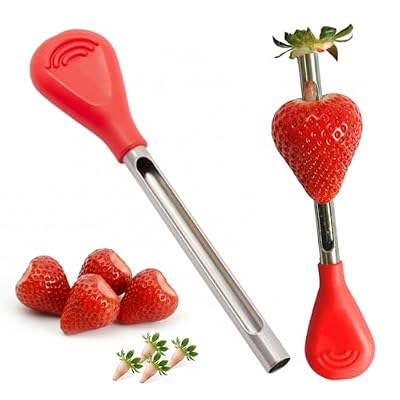
The Iconikal huller comes as a two-pack, which is useful in two ways. You can keep one in the drawer and one in a picnic or canning kit, or you can hand one to a helper and hull twice as fast. Each tool is five inches long, with a stainless steel corer and a red handle.
The design is a corer style: the tip presses through the fruit and removes the stem and core in one motion. The five-inch length gives good leverage, and the slim shape reaches the stem cleanly without splitting the berry. The two-pack also covers the common problem of a single small tool going missing in a busy drawer.
This is the practical pick for families and for cooks who hull berries often. Two tools for the price of one set means a spare is always at hand. The corer tip also works on cherry tomatoes and other small fruit, so the pair earns its keep beyond strawberry season.
Specs:
– ASIN: B0F9LL6G3F
– Pack: 2 hullers
– Length: 5 inches
– Material: stainless steel
– Handle: red
– Works on: strawberries, cherry tomatoes, small fruit
5. Hawrey 4-Piece Strawberry Huller and Tomato Corer Set

The Hawrey set takes a different approach: four hullers in one pack, in three styles. The set includes one all-stainless steel huller, one spring-type huller in blue, and two round white hullers. Each style removes stems a little differently, so you can try them all and keep the one that fits your hand best.
The variety is the point. A spring-type huller opens and closes with a squeeze, a round huller works like a small scoop, and the all-steel huller is the sturdiest of the group. Having all three in one pack means the set covers berries of different sizes and different hands, including younger helpers who may find one style easier than another.
The set also works beyond strawberries. The hullers handle tomato coring, potato eyes, and pineapple cores, so the four pieces cover a range of small prep jobs. For a household that hulls berries often and wants a spare for every drawer, this set is the most flexible pick in the guide.
Specs:
– ASIN: B08CKFCJC5
– Pack: 4 pieces
– Pieces: 1 all-stainless huller, 1 spring-type huller, 2 round hullers
– Works on: strawberries, tomatoes, potatoes, pineapples
– Material: stainless steel and plastic
How to Hull a Strawberry
Wash the berries first and pat them dry. Hold the berry with the stem end up. Push the huller into the top of the berry, just where the stem meets the fruit. Twist gently, about a quarter turn, and pull the tool out. The stem, leaves, and white core should come out in one piece. Check the berry: if a bit of white core remains, push the huller in again and twist once more.
Hull berries just before you use them, since a hulled berry loses moisture faster than a whole one. For jam or freezing, hull right before cooking or packing. For serving, hull just before plating.
Rinse the huller under running water right after use. Berry juice dries quickly and can stain plastic and dull a steel edge over time. Most hullers in this guide go in the dishwasher, but a quick hand wash and a prompt dry keep the tool in better shape.
Claw, Scoop, or Tube: Which Style Fits You
If you hull berries a few times a month for snacking and desserts, a claw huller like the Chef’n Stem Gem is the easiest choice. The push-button mechanism does the work, and the tool is forgiving on berries of different sizes.
If you fill berries for dessert trays, a scoop huller like the Joie or the Norpro leaves the cleanest hollow. The serrated cup cuts a neat circle, and the berry holds its filling well.
If you hull in bulk for jam, freezing, or canning, a simple tool with no moving parts, like the Norpro, or a multi-pack, like the Iconikal two-pack or the Hawrey four-piece set, keeps the work moving. A spare tool means the job never stops while one huller is in the sink.
FAQ
What is the difference between a strawberry huller and a strawberry slicer?
A huller removes only the green top and white core and leaves the berry whole. A slicer cuts the berry into rounds or wedges. Hull first, then slice if you want cut berries.
Can a strawberry huller work on tomatoes?
Yes. Most hullers in this guide also core cherry tomatoes and remove the stem end of small tomatoes. The scoop and corer styles work best for tomatoes, since they cut a clean hollow.
Do I need to wash strawberries before hulling?
Yes. Wash the berries and pat them dry before hulling. Hulling first and washing after lets water into the hollow where the core was, which softens the berry.
How do I clean a strawberry huller?
Rinse it under running water right after use, before the juice dries. Most hullers are dishwasher safe, but hand washing and drying promptly keeps the steel bright and the mechanism smooth.
The Bottom Line
A strawberry huller is a small tool that pays for itself the first time you face a flat of berries. The Chef’n Stem Gem is the easiest claw huller for everyday use. The Joie scoop huller leaves the neatest hollow for filled berries. The Norpro corer is the simplest tool for canning and large batches. The Iconikal two-pack keeps a spare at hand, and the Hawrey four-piece set covers every style in one pack. Pick the style that matches how you cook, and the stems will stop slowing you down.




Write Your Review
No reviews yet. Be the first to share your experience!