
A multicooker for travel can provide convenient meal preparation during extended stays, road trips, and visits to accommodations with suitable cooking facilities. However, portability alone does not make an appliance appropriate for travel. Electrical compatibility, local cooking restrictions, heat management, cleaning, and food safety are essential considerations. This guide explains how to choose a compact multicooker without creating unnecessary risks.
- Quick Verdict: What Multicooker Should Travelers Buy?
- Understanding Travel Multicookers
- The Most Important Requirement: Where Can You Use It?
- Choosing the Right Size and Capacity
- Electrical Compatibility for Travel
- Cooking Functions Worth Considering
- Portability and Packing
- Travel Meal Planning
- Food Safety During Travel
- Choosing for Different Travel Scenarios
- Common Buying Mistakes
- Frequently Asked Questions
- Conclusion
Quick Verdict: What Multicooker Should Travelers Buy?
For travelers who have confirmed access to approved cooking facilities, a compact electric multicooker with straightforward controls, manageable capacity, and easy-to-clean components may be a practical choice.
However, a travel multicooker is not automatically permitted in hotel rooms, dormitories, or other temporary accommodations.
Before buying, confirm where you will use it.
Prioritize:
-
Permission to operate cooking appliances at the destination.
-
Suitable electrical voltage and frequency.
-
An appropriate plug and outlet.
-
Manageable dimensions and packed weight.
-
A cooking capacity matched to your travel meals.
-
Clearly documented heating functions.
-
Automatic safety controls appropriate to the appliance.
-
Accessible cleaning and drainage.
-
Safe transport and storage procedures.
For many travelers, a simple compact rice cooker or nonpressurized cooking pot may be more practical than a larger pressure multicooker.
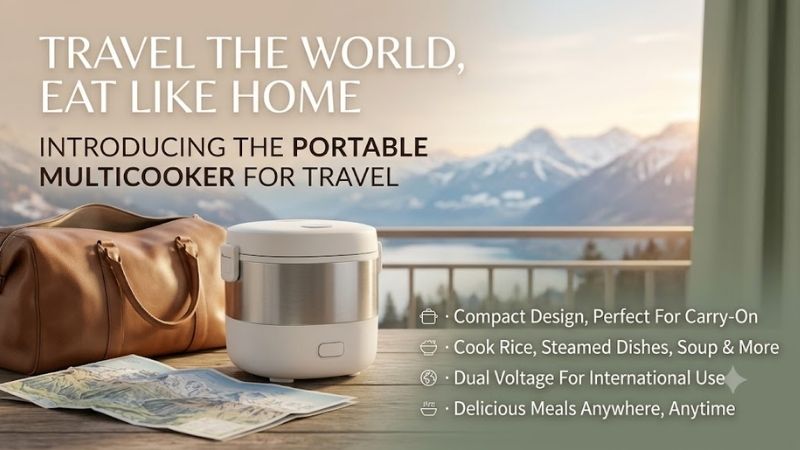
Understanding Travel Multicookers
What Is a Multicooker?
A multicooker is an electric cooking appliance that supports more than one preparation function.
Depending on its design, it may cook rice, simmer food, steam ingredients, prepare soups, or perform other tasks.
Some multicookers also include pressure cooking, sautéing, slow cooking, or temperature-controlled programs.
However, these functions vary substantially.
The word multicooker does not guarantee that a product supports every commonly advertised cooking method.
Choose according to the exact functions you need.
Travel Multicooker vs. Standard Multicooker
Travel-oriented cooking appliances often emphasize compact dimensions and portability.
Standard household multicookers may prioritize greater capacity or more cooking programs.
| Feature | Compact Travel-Oriented Multicooker | Full-Size Household Multicooker |
|---|---|---|
| Capacity | Usually intended for smaller portions | Often supports larger meals |
| Portability | More manageable when compact | May be bulky or heavy |
| Storage | Generally easier in limited spaces | Requires more room |
| Cooking functions | Varies; may be relatively simple | May support additional programs |
| Power requirements | Must be checked for destination | Also model-specific |
| Cleaning | Depends on pot and lid design | Can involve larger components |
| Best use | Approved travel kitchens and small meals | Regular home cooking |
A full-size multicooker can be transported, but that does not necessarily make it a practical travel appliance.
Multicooker vs. Portable Rice Cooker
A compact rice cooker is often designed around cooking rice and may include basic additional functions.
A multicooker can provide broader versatility when the manufacturer supports those tasks.
However, additional functions may introduce more complex controls and cleaning requirements.
If you primarily want rice or simple meals, a compact rice cooker may be sufficient.
For travelers who regularly prepare soups, vegetables, and varied dishes, a suitably equipped multicooker may provide greater utility.
The Most Important Requirement: Where Can You Use It?
Hotel Room Restrictions
Many hotels prohibit cooking appliances in standard guest rooms.
Restrictions may apply to rice cookers, hot plates, multicookers, slow cookers, and similar equipment.
Even when a room includes a microwave or electric kettle, that does not mean guests may bring and operate another cooking appliance.
Never assume that the absence of an explicit warning means permission has been granted.
Check the property’s rules before planning to cook.
When necessary, ask the property directly about the exact type of appliance.
Extended-Stay Hotels and Kitchenettes
Some extended-stay accommodations provide kitchenettes or shared cooking facilities.
However, the presence of a kitchenette does not automatically authorize every cooking appliance.
A property may permit certain appliances while restricting others.
Confirm the rules and inspect available counter space, ventilation, outlets, and cleaning facilities.
Only operate the multicooker in an approved location.
Vacation Rentals
Vacation rentals may offer greater cooking flexibility, but rules still vary.
Review appliance restrictions and electrical requirements.
A kitchen-equipped rental may already contain a suitable cooking appliance.
In that situation, bringing a multicooker could add unnecessary baggage weight and complexity.
Road Trips and Camping
A multicooker may be useful during road trips when you have access to an appropriate electrical supply and an approved cooking area.
However, camping power systems vary.
Do not assume that a portable power station, vehicle outlet, or inverter can support the multicooker’s rated electrical load.
Check continuous power capability, surge requirements when relevant, grounding, and manufacturer instructions.
Never operate an indoor electrical cooking appliance in wet or otherwise unsuitable conditions.
Choosing the Right Size and Capacity
Capacity for One Traveler
A compact multicooker may be enough for individual meals.
However, capacity should be evaluated in terms of usable cooking volume, not simply the advertised pot size.
Some recipes require substantial headroom for bubbling, expansion, or pressure operation.
Choose a machine that accommodates your normal portion without exceeding the manufacturer’s limits.
Capacity for Two People
For two travelers, a somewhat larger pot may reduce the need to cook separate portions.
However, larger capacity increases packed volume and may increase weight.
Consider whether the machine will travel in a vehicle or luggage.
A larger cooker may be reasonable for a road trip but inconvenient for airline travel.
Family Travel
A small travel multicooker may not be practical for feeding a family.
Cooking multiple batches can consume significant time and create challenges with food storage and serving temperatures.
For family stays, a rental with appropriate kitchen equipment may be more convenient.
Packed Dimensions vs. Operating Dimensions
Measure both the packed appliance and the space required during cooking.
The operating location must allow for:
-
Stable placement.
-
Steam release.
-
Lid opening.
-
Safe cord routing.
-
Manufacturer-required clearance.
-
Removal of the hot inner pot.
-
Access to cleaning facilities.
A small cooker may still require substantial open space around its steam outlet.
Electrical Compatibility for Travel
Understanding US Voltage Requirements
Many appliances sold specifically for the US market are designed for 120V electrical systems.
However, travelers should verify the exact appliance’s rated voltage and frequency.
International destinations may use different electrical supplies.
A plug adapter changes the physical plug connection but does not necessarily convert voltage.
Using an appliance on an incompatible electrical supply can damage it and create fire or shock hazards.
Dual-Voltage Appliances
Some travel appliances support a range of input voltages.
However, dual-voltage operation should never be assumed.
Check the manufacturer’s rating label and instructions.
A multicooker that requires a specific voltage should only be operated with an approved compatible electrical supply.
Do not rely on generic travel adapters to solve incompatible power requirements.
Power Draw and Electrical Loads
Electric multicookers can place meaningful loads on an electrical circuit.
The exact power requirement depends on the model and cooking mode.
Check the rated input and any restrictions on extension cords, power strips, or portable power sources.
Avoid overloaded outlets.
An appliance’s compact size does not necessarily mean that it has a low electrical demand.
Vehicle Power and Portable Batteries
Cooking with a portable electrical power source requires more than matching the wattage printed on the appliance.
Consider the power source’s continuous output rating, available battery energy, expected cooking duration, and connection requirements.
For example, a multicooker that consumes substantial power for an extended cooking cycle may deplete a portable battery quickly.
Do not use an automotive accessory socket unless the vehicle and power-system manufacturer explicitly support the appliance’s load and connection arrangement.
Cooking Functions Worth Considering
Rice Cooking
Rice cooking is useful for travelers who prepare simple meals.
However, different rice varieties may require different settings and water quantities.
Choose a multicooker with documented rice instructions.
Do not assume that the rice program is identical across brands.
Steaming
Steaming can be practical for certain vegetables and other approved ingredients.
Some models include a steaming rack or basket.
Check whether the accessory is included and correctly sized.
Be careful when opening the lid because accumulated steam can cause burns.
For meat, poultry, and seafood, use appropriate food-temperature guidance rather than relying only on a programmed cooking duration.
Simmering and Soup Preparation
A simmer function may help prepare suitable soups and one-pot meals.
However, minimum liquid requirements and maximum fill limits vary.
Avoid recipes that produce excessive foam or overflow.
A compact cooker may not provide enough volume for large soup portions.
Sauté Function
Certain multicookers include a sauté setting that allows food to be cooked before adding liquid.
This can be convenient for recipes involving onions or other aromatic ingredients.
However, sautéing may produce steam, smoke, or cooking odors.
Only use this function in a location where cooking is permitted and ventilation is appropriate.
Pressure Cooking
Pressure cooking can reduce cooking time for certain foods, but it introduces additional safety considerations.
A pressure multicooker requires correctly functioning seals, pressure-release mechanisms, and operating controls.
For travel, these components increase the importance of careful packing, inspection, and cleaning.
Do not operate a pressure cooker in an unauthorized location or attempt to open it while pressurized.
A simple nonpressurized multicooker may be easier to manage for occasional travel cooking.
Portability and Packing
Evaluate Weight Before Buying
A compact appliance can still be heavy because of its heating components, inner pot, and lid.
Check the total packed weight, including the power cord and accessories.
For car travel, weight may be less restrictive than for air travel.
For frequent travel, carrying convenience should be considered alongside cooking capability.
Protect the Inner Pot
Removable cooking pots can be damaged when packed carelessly.
Nonstick surfaces may be vulnerable to scratches from loose accessories.
Clean and dry the pot before packing.
Protect it from impacts and prevent utensils or other equipment from scraping its interior.
Manage the Power Cord
Some multicookers use detachable cords, while others have permanently attached cables.
A detachable cord may simplify storage, but it can also be misplaced.
Check whether the cord is designed for the exact appliance.
Do not substitute an incompatible power cord.
Avoid Packing a Wet Appliance
Moisture may remain around the lid, gasket, steam vent, or inner pot after cleaning.
Dry components according to the manufacturer’s instructions before storage.
Do not pack an appliance while it is still hot.
A compact carrying case may protect the exterior, but it should not trap moisture around electrical components.
Travel Meal Planning
Choose Simple Recipes
Travel cooking works best when ingredients, equipment, and preparation steps remain manageable.
Rice, suitable steamed vegetables, and approved one-pot recipes may be practical options.
However, recipe suitability depends on the machine’s functions.
Do not assume that every multicooker can safely handle frying, baking, pressure cooking, or other methods.
Check Access to Refrigeration
Cooking food while traveling requires appropriate ingredient storage.
Perishable foods should be maintained at safe temperatures.
A multicooker cannot replace a refrigerator.
If your accommodation lacks reliable refrigeration, plan meals around safe ingredient storage and prompt consumption.
Prepare Appropriate Portions
Cooking excessive quantities can create food-safety and storage problems.
Choose portion sizes that match the number of people eating and the available refrigeration facilities.
If leftovers cannot be cooled and stored safely, preparing smaller batches may be preferable.
Clean Between Meals
Repeated cooking without proper cleaning can leave residue around the pot, lid, seals, and steam components.
Follow the manufacturer’s cleaning instructions after use.
If the accommodation lacks appropriate washing facilities, a multicooker may be impractical even when its use is permitted.
Food Safety During Travel
Cook Food to Appropriate Temperatures
Cooking programs do not independently guarantee that every ingredient reaches a safe internal temperature.
For meat, poultry, and seafood, follow applicable food-safety guidance and verify temperatures with an appropriate food thermometer.
For example, poultry should reach an internal temperature of 165°F.
Cooking time alone is not a reliable substitute for temperature verification.
Refrigerate Perishable Leftovers
Cooked food should not remain at unsafe room temperatures for extended periods.
Follow the general two-hour rule for refrigerating perishable foods, reduced to one hour when the surrounding temperature exceeds 90°F.
Store refrigerated food at 40°F or below.
Do not assume a switched-off multicooker provides safe food storage.
Use Keep-Warm Functions Correctly
Some multicookers offer a keep-warm setting.
However, its intended function, maximum duration, and temperature behavior vary.
Follow manufacturer instructions and verify that food remains at a safe hot-holding temperature.
Do not use keep-warm as a substitute for proper long-term food storage.
Choosing for Different Travel Scenarios
Best for Road Trips
A compact multicooker may be practical when staying in accommodations that explicitly allow cooking.
Choose manageable size and sufficient capacity.
Confirm electrical access at each location.
Best for Extended-Stay Apartments
A multicooker can supplement a small kitchen when cooking appliances are permitted.
Prioritize useful functions and simple cleaning.
If the accommodation already provides a stove and cookware, consider whether bringing another appliance offers enough benefit.
Best for Business Travelers
For short hotel stays, a multicooker is often unnecessary or prohibited.
A property with permitted kitchenette access or an established cooking facility is a better setting.
Check accommodation policies before packing cooking equipment.
Best for Camping With Electrical Hookups
A compact multicooker may be useful when the campsite allows electrical cooking and provides a suitable power supply.
Check circuit limits and manufacturer requirements.
Do not operate the appliance outdoors in rain or near standing water.
Best for International Travel
Electrical compatibility becomes a primary consideration.
Verify voltage, frequency, plug requirements, and applicable travel restrictions.
A US-only multicooker may not be a practical choice for destinations with different electrical standards.
Common Buying Mistakes
Assuming Every Hotel Allows Cooking
Many properties restrict cooking appliances in guest rooms.
Confirm permission before purchasing or packing a multicooker.
Using a Plug Adapter as a Voltage Converter
A physical plug adapter generally does not change the electrical voltage.
Use only a properly compatible power supply.
Choosing the Smallest Appliance Without Checking Capacity
A tiny cooker may not accommodate a complete meal or approved liquid quantity.
Evaluate usable cooking volume.
Ignoring Steam Clearance
A compact cooker still produces heat and steam.
Do not operate it under unsuitable shelves, near sensitive materials, or in enclosed luggage or storage spaces.
Treating Every Multicooker as a Pressure Cooker
Some multicookers are nonpressurized.
Pressure cooking requires specific construction and safety features.
Never attempt pressure cooking in an appliance not designed for it.
Overlooking Cleaning Facilities
A cooker may be portable but difficult to maintain without running water, cleaning equipment, and suitable drying space.
Practical travel cooking requires a complete food preparation and cleaning setup.
Frequently Asked Questions
Can I Use a Multicooker in a Hotel Room?
Only if the property explicitly permits that appliance and the room provides a suitable location and electrical supply. Many hotels prohibit cooking appliances in guest rooms.
Are Mini Multicookers Good for Travel?
They can be useful for small meals in approved cooking facilities. However, weight, electrical compatibility, cleaning, and safe operation matter more than size alone.
Can I Use a US Multicooker in Europe?
Only if the appliance supports the destination’s electrical requirements or an appropriate manufacturer-approved power solution is available. A simple plug adapter does not convert voltage.
Can I Cook Rice in a Travel Multicooker?
Yes, if the specific model supports rice cooking. Follow its capacity, water-level, and program instructions.
Is a Pressure Multicooker Safe to Travel With?
A pressure multicooker can be transported when properly cleaned, cooled, and packed. However, operating it requires an approved location and strict compliance with pressure-cooking safety instructions.
Can I Run a Multicooker From a Portable Power Station?
Only when the power station and connection equipment support the cooker’s electrical requirements. Check continuous output, battery capacity, grounding, and manufacturer restrictions.
Conclusion
The right multicooker for travel should match your meal requirements, fit your transportation and storage limits, and operate safely with the electrical supply available at your destination. A compact nonpressurized multicooker may be the simplest option for approved travel kitchens, while larger pressure models make sense only when their additional functions are genuinely needed. Always confirm accommodation rules, electrical compatibility, ventilation, and food-storage facilities before planning to cook away from home.

Write Your Review
No reviews yet. Be the first to share your experience!