
A coffee pod organizer for families can keep different coffee varieties accessible while reducing clutter around a shared coffee machine. But an organizer that holds plenty of capsules is not automatically the most practical choice. Pod compatibility, storage capacity, countertop stability, labeling, and refill access all matter when several people use the same brewer. This guide explains how to choose a storage system that works for your household’s coffee habits.
- Quick Verdict: Which Coffee Pod Organizer Is Best for Families?
- Why Families Need Different Coffee Storage
- Coffee Pod Compatibility Comes First
- How to Calculate the Capacity Your Family Needs
- Drawer-Style Coffee Pod Organizers
- Rotating Coffee Pod Carousels
- Countertop Bins and Divided Trays
- Cabinet and Wall Storage
- Materials and Construction
- Organizing Regular, Decaf, and Flavored Coffee
- First-In, First-Out Inventory Rotation
- Organizing for Busy Mornings
- Coffee Pod Storage and Product Quality
- Safety in Family Kitchens
- Cleaning and Maintenance
- Budget and Value
- Common Buying Mistakes
- Frequently Asked Questions
- Conclusion
Quick Verdict: Which Coffee Pod Organizer Is Best for Families?
For most families using one capsule system, a sturdy drawer-style or divided countertop organizer with enough capacity for several days of normal coffee consumption is a practical starting point.
A drawer may be useful when it can safely sit beneath a compatible coffee maker, but load capacity and clearance must be verified.
A rotating organizer may be more convenient when several people want to see different flavors quickly.
For families using multiple pod formats, separate compatible compartments are essential.
| Organizer type | Best family use | Main advantage | Main limitation |
|---|---|---|---|
| Under-machine drawer | Shared coffee station | Uses space beneath the brewer | Must support appliance weight |
| Rotating carousel | Several visible coffee varieties | Easy visual selection | Occupies open counter space |
| Divided countertop bin | Flexible household preferences | Simple sorting and refilling | Can appear cluttered |
| Wall-mounted rack | Limited countertop space | Moves storage off the counter | Requires suitable installation |
| Cabinet drawer insert | Minimalist coffee station | Keeps pods out of sight | Uses cabinet space |
| Tiered shelf organizer | Multiple flavors and decaf | Visible inventory | Requires shelf clearance |
| Stackable storage boxes | Bulk purchases and backup inventory | Flexible expansion | Access may be awkward |
Best overall approach: Choose a pod organizer that fits the exact capsule system, accommodates realistic weekly consumption, and lets family members identify their preferred coffee without moving several containers.
Why Families Need Different Coffee Storage
Multiple People Create Different Preferences
A single coffee drinker may use the same pod every morning.
Families often have more variety.
One person may prefer a dark roast, another decaf, and someone else a flavored coffee.
An organizer can keep these choices separate.
However, the number of varieties should not automatically determine the size of the storage system.
If most household members drink one or two favorites, a simple divided drawer may be sufficient.
Different Morning Schedules
A shared coffee maker may be used throughout the morning.
A clearly organized supply helps each person find their preferred coffee without searching through boxes.
This can reduce delays and packaging clutter.
However, organization should remain intuitive.
A system that requires everyone to follow a complicated labeling scheme may not work well.
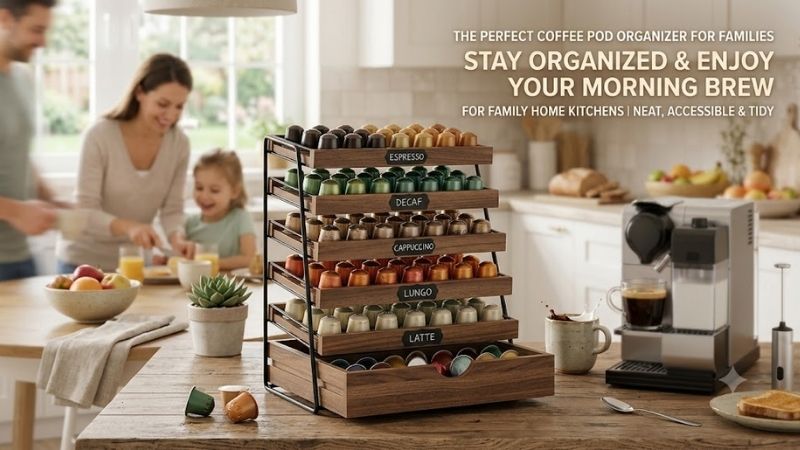
Family Consumption Can Be Substantial
A household using several pods per day can quickly empty a small organizer.
However, a very large display may occupy unnecessary counter space.
Choose capacity based on actual usage.
Household Safety
Coffee pods are small packaged products that may attract young children because of their colors or shapes.
Keep pods and other coffee supplies away from children who might mouth, open, or misuse them.
An organizer is not childproof simply because it contains drawers.
Hot brewing equipment and used capsules also require safe handling.
Coffee Pod Compatibility Comes First
K-Cup-Style Pods
K-Cup-style pods are commonly used in compatible single-serve coffee systems.
Their shape and dimensions differ from other capsule formats.
An organizer designed for K-Cup pods may use relatively large circular compartments.
However, product names and compatibility claims vary.
Check whether the holder fits the exact pods your family purchases.
Nespresso Original Capsules
Nespresso Original capsules use a different format from K-Cup pods.
Their smaller shape allows different storage arrangements.
Some organizers use narrow slots or rails.
However, a holder designed for Original capsules may not accommodate other capsule systems.
Nespresso Vertuo Capsules
Vertuo capsules differ from Original capsules.
They also come in more than one physical size.
An organizer intended for smaller Vertuo espresso capsules may not necessarily accommodate every larger beverage capsule.
Check the supported Vertuo capsule range.
Why Original and Vertuo Are Not Interchangeable
The brewing systems use different capsule designs.
The same distinction applies to storage accessories.
A tray marketed for Nespresso does not automatically fit both systems.
Read the specific compatibility description.
Soft Coffee Pods
Some coffee systems use soft paper pods rather than rigid capsules.
These may require different storage methods.
A rigid capsule carousel is not necessarily suitable.
Mixed-System Families
A household may own a K-Cup machine and an espresso capsule brewer.
In that situation, separate storage sections can prevent confusion.
However, a generic organizer should not be assumed to accommodate both pod types unless its compartments have been designed accordingly.
How to Calculate the Capacity Your Family Needs
Start With Daily Consumption
Count how many coffee pods are used on a normal day.
For example, if three adults each use two pods, the household consumes six pods daily.
Over seven days, that equals 42 pods.
This calculation helps establish a realistic refill schedule.
Seven-Day Capacity Example
| Household usage | Pods per day | Pods per seven days |
|---|---|---|
| One daily coffee drinker | 1 | 7 |
| Two people, one pod each | 2 | 14 |
| Two people, two pods each | 4 | 28 |
| Three people, two pods each | 6 | 42 |
| Four people, two pods each | 8 | 56 |
These figures are planning examples, not suggested caffeine intake.
Should the Organizer Hold an Entire Month?
Not necessarily.
A monthly supply can occupy substantial space.
It may be more practical to display one week’s pods and keep the remainder in their original packaging inside a cabinet.
Separate Display and Backup Inventory
A family can use a small countertop organizer for daily selection and store unopened boxes elsewhere.
This reduces clutter while keeping backup coffee available.
However, make sure that stored boxes remain dry and protected from excessive heat.
Capacity Claims and Mixed Pod Sizes
An organizer described as holding 40 capsules may be designed around one specific format.
Actual capacity can differ when pods vary in size.
Always verify what the stated count refers to.
Consider Decaf Inventory
A household with both regular and decaf drinkers may need separate compartments.
However, the amount of decaf consumed may be much smaller.
Allocate space according to actual demand rather than dividing every compartment equally.
Drawer-Style Coffee Pod Organizers
How Under-Machine Drawers Work
A drawer organizer commonly includes a rigid housing with a tray that slides outward.
The coffee maker may sit above the organizer when the product is designed to support that use.
This can consolidate the coffee station.
However, the drawer raises the height of the brewer.
That can interfere with cabinet clearance and water tank access.
Load Capacity
The organizer must support the coffee maker’s operating weight if the machine will be placed on top.
That includes the brewer, water reservoir, and other supported components.
Do not assume that a lightweight plastic drawer can hold any coffee machine.
Follow the organizer manufacturer’s load rating.
Drawer Clearance
Measure the area in front of the machine.
The drawer must open far enough for comfortable selection and refilling.
A drawer that hits a sink, wall, or countertop obstruction may be impractical.
Sliding Performance
Some drawers use tracks or rails.
They should open smoothly under normal load.
However, an overloaded drawer may become difficult to operate.
Cleaning
Coffee dust and crumbs can accumulate inside the tray.
Choose a drawer that allows the interior to be wiped or washed according to its instructions.
When a Drawer Is the Best Choice
A compatible under-machine drawer can be useful when counter width is limited but adequate vertical clearance remains.
However, it may not suit tall coffee makers beneath wall cabinets.
Rotating Coffee Pod Carousels
Why Carousels Are Popular
A carousel presents pods around a rotating structure.
This can make several coffee choices visible.
Family members can rotate the organizer to find their preferred variety.
However, the design requires space for rotation.
Countertop Footprint
A carousel’s base may be compact, but the full rotating structure can extend outward.
Check the maximum diameter.
Vertical Clearance
Tall carousels can interfere with overhead cabinets.
Measure assembled height.
Stability
A rotating organizer should not tip when one side is loaded more heavily than another.
Check construction and base stability.
Refill Convenience
Some carousels require pods to be inserted in a particular orientation.
If refilling takes substantial time, the organizer may become inconvenient.
Best Use Case
A carousel is a reasonable option when the family prefers several visible flavors and has adequate counter space.
It may be less suitable for minimalist kitchens.
Countertop Bins and Divided Trays
Open Bins
An open bin is simple and flexible.
It may hold different pod types when sufficiently large.
However, the contents can become mixed.
A family using several flavors may need dividers.
Divided Trays
Dividers can separate regular coffee, decaf, flavored pods, and tea capsules when compatible.
However, compartment dimensions matter.
Removable Dividers
Adjustable compartments can help when preferences change.
However, they may shift during use if poorly designed.
Clear vs. Opaque Containers
Clear bins make inventory easy to see.
However, opaque storage may reduce light exposure.
Sealed capsules are already packaged, so the organizer’s visibility is often more important than it would be for loose roasted beans.
Still, keep pods away from excessive heat and strong sunlight.
Best Use Case
A divided tray is practical when flexibility is more important than decorative display.
It may also be an affordable option.
Cabinet and Wall Storage
Cabinet Drawer Inserts
A drawer insert can keep capsules organized without occupying counter space.
However, cabinet dimensions must be measured.
Check whether the drawer closes fully when loaded.
Stackable Boxes
Stackable containers can hold backup supplies.
However, accessing the bottom box may require moving other containers.
For daily use, keep preferred pods readily accessible.
Wall-Mounted Racks
Wall storage can free counter space.
However, installation must be suitable for the wall and its load capacity.
Do not rely on weak adhesive mounting for heavy storage without appropriate support.
Rental Homes
Renters may prefer organizers that do not require drilling.
A cabinet insert or countertop tray may be more practical.
Pantry Storage
Unopened pod boxes can be stored in a suitable pantry or cabinet.
This can reduce the need for an oversized countertop organizer.
Materials and Construction
Metal Organizers
Metal racks and drawers may offer durable construction.
However, exposed edges should be finished appropriately.
Check whether the surface can scratch the coffee maker or countertop.
Plastic Organizers
Plastic designs are often lightweight and easy to shape.
However, durability varies.
Thin plastic tracks may wear with frequent opening.
Bamboo and Wood
Bamboo and wooden organizers may provide an attractive finish.
However, moisture and repeated spills require appropriate care.
Do not assume wooden components can be immersed in water.
Acrylic
Clear acrylic makes pod visibility easy.
However, it may scratch or crack.
Clean according to manufacturer instructions.
Material vs. Function
A premium finish does not guarantee better capacity or convenience.
Prioritize compatibility, stability, and access.
Organizing Regular, Decaf, and Flavored Coffee
Create Simple Categories
A family can divide capsules into regular coffee, decaf, and specialty flavors.
However, categories should reflect actual use.
Label Compartments
Labels may help avoid mistakes.
This can be particularly useful when regular and decaf capsules look similar.
Prevent Mixing
If capsules are removed from their original boxes, retain enough information to identify them.
Do not rely only on capsule color.
Manufacturers may use different color schemes across varieties.
Keep Packaging Information
Original packaging may contain product descriptions, best-by dates, and other information.
If pods are transferred into a display organizer, consider retaining relevant details.
Family Rules That Work
Simple habits such as returning unused pods to the correct compartment and refilling from older stock first can keep the system organized.
Avoid elaborate systems that require constant supervision.
First-In, First-Out Inventory Rotation
What Is FIFO?
First-in, first-out means using older stock before newer stock when appropriate.
This is a common inventory principle.
For coffee pods, it can help reduce forgotten supplies.
Why Rotation Matters
Capsules are packaged to protect the coffee, but they are not necessarily intended for indefinite storage.
Best-by information and packaging condition still matter.
How to Rotate Pods
When adding a new box, move older compatible pods to the front of the organizer.
Place newer stock behind them.
What if Pods Are Different Flavors?
Maintain rotation within each variety rather than mixing all capsules together.
Avoid Excessive Stock
Bulk discounts can be attractive.
However, buying substantially more than the household consumes may create clutter.
Calculate actual demand before ordering large quantities.
Organizing for Busy Mornings
Prepare the Station the Night Before
Ensure the organizer contains the family’s normal coffee options.
Check the water reservoir and brewer condition according to manufacturer instructions.
Make Popular Pods Easy to Reach
Place frequently used varieties in the most accessible locations.
Less common flavors can be stored farther back.
Reduce Packaging Waste Around the Machine
Keep empty boxes out of the preparation area.
However, retain any important product information before discarding packaging.
Keep Used Capsules Separate
An organizer is intended for unused coffee pods.
Do not place hot or wet spent capsules back into clean storage compartments.
Reset the Station After Use
Return unused pods to the organizer.
Wipe up spills.
A small daily habit prevents clutter from building.
Coffee Pod Storage and Product Quality
Keep Pods Dry
Water exposure can damage packaging or labels.
Store pods away from sink splashes.
Avoid Excessive Heat
Do not position the organizer immediately beside a hot stove or oven.
Heat can affect product storage conditions.
Protect Packaging Integrity
Do not use capsules that are visibly punctured, leaking, or damaged.
Follow the coffee manufacturer’s product guidance.
Is Refrigeration Necessary?
Coffee pods are generally intended for storage under their stated packaging conditions.
Do not assume they require refrigeration.
Follow product instructions.
Should You Remove Pods From Their Boxes?
You can organize compatible sealed pods in a suitable holder, but the original packaging can provide useful protection and product information.
For long-term backup stock, keeping unopened boxes intact may be practical.
Safety in Family Kitchens
Young Children
Small pods and packaging components should be kept away from children who might put them in their mouths.
A coffee organizer is not a toy.
Hot Appliances
Keep storage away from steam outlets, heated surfaces, and hot water.
Stacked Coffee Machines
If the brewer sits on a drawer, verify that the organizer is rated to support it.
Ensure the setup remains stable when the drawer opens.
Wall Racks
Use appropriate mounting hardware and follow weight limits.
Used Capsules
Spent capsules can remain hot and contain wet coffee.
Dispose of them through the approved brewing-system procedure.
Cleaning and Maintenance
Countertop Drawers
Remove loose dust and coffee residue.
Clean the interior according to the product instructions.
Rotating Mechanisms
Inspect the base for accumulated debris.
Avoid forcing rotation if the mechanism becomes obstructed.
Wooden Storage
Use appropriate gentle cleaning methods.
Avoid prolonged soaking.
Plastic and Acrylic
Use approved nonabrasive cleaning methods.
Harsh products may cloud or damage surfaces.
Drying
Allow containers to dry before adding pods.
Checking for Damage
Replace cracked drawers, unstable racks, or damaged mounting components.
An organizer should not create a falling-object hazard.
Budget and Value
Simple Bins
A basic divided container may provide excellent function with minimal expense.
Drawer Organizers
These can justify additional cost when they safely support the coffee maker and improve space use.
Rotating Displays
A carousel may be worthwhile for households with many regularly used varieties.
Premium Furniture-Style Organizers
Wood finishes and decorative construction can increase cost.
However, appearance is a personal preference rather than a functional requirement.
When Not to Buy an Organizer
If the family uses only one coffee variety and keeps a small box near the brewer, a separate organizer may be unnecessary.
Avoid buying storage equipment without a genuine organization problem.
Common Buying Mistakes
Buying Without Checking Capsule Type
K-Cup, Original, and Vertuo capsules have different dimensions.
Trusting Capacity Numbers Without Checking Pod Size
Advertised counts may refer to one format only.
Placing a Heavy Brewer on an Unrated Drawer
The organizer must support the weight safely.
Ignoring Cabinet Clearance
Under-machine storage increases total height.
Overbuying Capacity
A huge organizer can waste space.
Mixing Regular and Decaf Pods
Clear identification matters.
Storing Used Capsules With Unused Stock
Used pods belong in appropriate waste collection, not clean storage.
Frequently Asked Questions
What Type of Coffee Pod Organizer Is Best for Families?
A sturdy divided drawer or countertop organizer is a practical choice for many households. Capacity and capsule compatibility matter most.
Do K-Cup and Nespresso Capsules Fit the Same Organizer?
Usually not unless the organizer is specifically designed for both formats. Original and Vertuo capsules also differ.
How Many Pods Should a Family Organizer Hold?
Calculate normal daily use and multiply by the number of days between refills. A week’s capacity is a useful planning starting point.
Can I Put a Coffee Maker on Top of a Pod Drawer?
Only when the organizer is designed and rated to support the machine’s operating weight.
Is a Rotating Coffee Pod Holder Better Than a Drawer?
A carousel can make flavors visible, while a drawer may save space beneath the brewer. Choose according to your layout.
Should Coffee Pods Stay in Their Original Boxes?
Original boxes can be useful for long-term storage and product identification. A countertop organizer is mainly a convenience for regularly used pods.
Conclusion
The best coffee pod organizer for families should match the exact capsule system, accommodate realistic consumption, and make different coffee choices easy to identify. Under-machine drawers can save space when properly rated, while rotating carousels and divided bins offer convenient access. Plan capacity using actual household demand, keep regular and decaf coffee clearly separated, and choose sturdy construction over unnecessary decorative features.








Write Your Review
No reviews yet. Be the first to share your experience!