
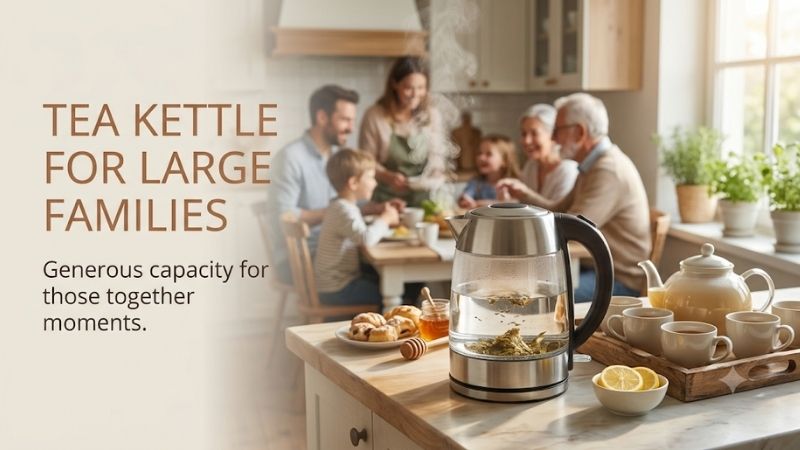
A tea kettle for large families needs enough capacity to serve several people without constant refilling, but size alone does not guarantee convenience. Heating speed, pouring comfort, temperature control, and safety all matter when hot drinks are part of a busy household routine. This guide explains how to choose a practical kettle that balances everyday performance, durability, and long-term value.
What makes a tea kettle suitable for large families?
Large households often prepare multiple drinks during breakfast, after dinner, or when guests visit. A suitable kettle must accommodate these demands while remaining manageable when filled with hot water. Capacity is important, but heating efficiency, stable construction, and practical handling can have an equally significant effect on daily convenience.
Choose capacity based on actual household demand
A kettle that works perfectly for one person may become frustrating when several family members need hot water at the same time. Repeated refilling interrupts the preparation process and can delay breakfast or other routines. Choosing an appropriate capacity helps households prepare enough water in fewer heating cycles.
Begin by estimating how much water the family typically uses during a single serving period.
For example, five people drinking approximately 10 ounces each require about 50 fluid ounces, equivalent to roughly 1.48 liters.
A 1.7-liter kettle may accommodate this demand, provided the total volume remains within its maximum fill line.
However, households that use larger mugs or prepare additional drinks may need more capacity.
A 2.0-liter kettle can be convenient when several family members prepare tea, instant coffee, or other hot beverages simultaneously.
Families should also consider whether everyone drinks at the same time. If morning schedules are staggered, a moderately sized kettle may be entirely sufficient.
Avoid assuming that the largest available kettle is automatically the best choice.
A larger appliance may be heavier, occupy more storage space, and become awkward when pouring.
The ideal capacity should cover typical demand without creating unnecessary handling difficulties.
Evaluate heating speed and energy consumption
Heating speed matters when several people are waiting for hot water. Electric kettles can offer convenient heating through integrated elements, while stovetop models depend on the performance of the available burner. Understanding these differences helps families choose equipment that supports their routine without unnecessary delays.
Electric kettle heating performance is often described using wattage, but higher wattage alone does not determine total efficiency.
The amount of water, starting temperature, insulation, and appliance design all influence how quickly the kettle reaches its target temperature.
For example, heating two liters of water requires more energy than heating one liter under otherwise identical conditions.
A powerful electric kettle may heat water quickly, but it can also draw substantial electrical power while operating.
Households should verify that the appliance is compatible with their electrical supply and outlet capacity.
Stovetop kettles can be practical when a suitable burner is already available.
However, heating performance varies significantly between gas, induction, and conventional electric ranges.
For families concerned about energy use, heating only the required quantity is often a simple improvement.
Avoid repeatedly boiling a full kettle when only one or two cups are needed.
A convenient water-level indicator can help family members measure appropriate quantities before each heating cycle.
Prioritize safe pouring and comfortable handling
A large kettle becomes considerably heavier when filled with water, and the weight increases the importance of handle design. Poor balance, slippery grips, and awkward spouts can make serving uncomfortable or hazardous. Families should prioritize stable construction and controlled pouring rather than selecting a model solely for its maximum capacity.
One liter of water weighs approximately one kilogram, excluding the weight of the kettle itself.
A two-liter kettle can therefore become a substantial object to lift and pour, particularly for users with limited grip strength.
Look for a handle that provides sufficient clearance from the hot body and supports a secure grip.
A balanced design should allow users to tilt the kettle without excessive wrist strain.
Spout construction also matters. A well-designed spout should direct water smoothly into mugs without unnecessary splashing.
A wide spout may fill large cups quickly, while a narrow gooseneck offers more precision but generally pours more slowly.
For family use, a conventional controlled-pour spout often provides a practical balance.
Automatic shutoff is a valuable feature on electric kettles, although it does not eliminate the need for careful operation.
Households with children should keep kettles and hot water away from accessible counter edges.
Safe placement and consistent handling habits are essential regardless of the model selected.
How to choose a tea kettle for large families by design
Electric, stovetop, and temperature-controlled kettles offer different advantages for family kitchens. The best choice depends on household size, preferred beverages, counter space, and available cooking equipment. Comparing these designs helps buyers identify which features improve everyday convenience and which may add cost without meaningful benefits.
Large electric kettles for busy morning routines
Electric kettles are popular for family use because they provide convenient water heating without occupying a stovetop burner. Many models include automatic shutoff, visible water-level markings, and cordless pouring arrangements. These features can simplify preparation when several household members need hot drinks during the same period.
A 1.7-liter electric kettle is a common choice for medium to large households.
Some models offer capacities around 2.0 liters or more, although larger appliances should be evaluated carefully for weight and pouring comfort.
The power base allows the kettle to heat water while remaining in a designated countertop position.
After heating, users can lift the kettle and pour without moving the attached electrical cord.
This is useful when serving several mugs arranged on a tray or counter.
Automatic shutoff can reduce the need to monitor the heating process continuously.
However, users should still follow the manufacturer’s instructions and avoid leaving appliances operating in unsafe conditions.
A clear water-level window can prevent accidental overfilling and help family members heat only the amount required.
For households that mainly prepare black tea, instant coffee, and hot water for food preparation, a straightforward electric kettle may be sufficient.
Advanced temperature programming is useful but not essential for every family.
Stovetop kettles for traditional family kitchens
Stovetop kettles appeal to households that prefer using an existing range rather than adding another countertop appliance. They are available in various capacities and materials, including stainless steel and enamel-coated steel. Many traditional designs include whistles that indicate when the water has reached boiling.
A large stovetop kettle can be practical when the kitchen has sufficient burner space.
Families should verify that the kettle is compatible with their cooking surface, particularly when using induction equipment.
Not every metal kettle works with every induction cooktop, so manufacturer specifications are important.
Whistling models provide an audible indication of boiling, which can be helpful during busy meal preparation.
However, a whistle does not automatically turn off the heat.
Users must remain attentive and remove the kettle from the burner when appropriate.
Stovetop designs also lack the temperature presets found on some electric models.
For delicate green tea, water may need to cool before brewing.
Handle placement is particularly important because stovetop heat can affect nearby surfaces.
Families should follow the manufacturer’s instructions regarding burner size, flame position, and safe handling.
A traditional kettle is a reasonable choice when the household values familiar operation and does not require automated temperature control.
Variable-temperature kettles for different tea preferences
Families rarely have identical beverage preferences. One person may enjoy black tea, another may prefer green tea, and others may prepare coffee or herbal infusions. A variable-temperature kettle can accommodate these differences by heating water to selected temperatures rather than automatically bringing every batch to a full boil.
Many temperature-controlled kettles include preset settings for common beverage categories.
Some premium models allow users to select temperatures more precisely.
This flexibility can be useful when preparing green tea, which is often brewed below boiling.
Black tea generally tolerates hotter water, while specific oolong and white tea varieties may require different conditions.
Families should follow the tea supplier’s recommendations rather than assuming one temperature works for every product.
A keep-warm function can also be convenient when household members prepare drinks at slightly different times.
However, keeping water hot continuously consumes energy, and the feature should be used only when it offers a genuine benefit.
A temperature display may improve convenience, but it also introduces additional electronic components.
For families that mainly need boiling water, a simpler model may provide better value.
Choose variable-temperature control when multiple household members regularly prepare teas with different brewing requirements.
Important materials and construction features
A family kettle is likely to experience frequent use, repeated heating cycles, and regular cleaning. Material quality and construction therefore influence both durability and everyday comfort. Stainless steel, glass, and plastic-containing designs each have practical advantages, but buyers should examine the complete appliance rather than judging performance from appearance alone.
Stainless steel construction and durability
Stainless steel is a common kettle material because it offers good resistance to ordinary moisture exposure and can withstand repeated heating when used appropriately. Many family-sized kettles use stainless steel bodies with plastic or silicone components around handles and lids. Construction quality remains important because materials alone do not guarantee durability.
A stainless steel interior can be straightforward to clean, particularly when the kettle has a wide opening.
Smooth surfaces generally make it easier to remove mineral deposits than designs with complicated internal structures.
However, stainless steel exterior surfaces may become very hot during operation.
Families should look for handles designed to reduce direct contact with heated metal.
Some kettles use double-wall construction to improve exterior insulation, although performance varies between products.
The lid should close securely and remain stable during pouring.
A loose lid can create unnecessary risks when the kettle is tilted.
Inspect the spout attachment, handle connection, and overall balance before purchasing.
Stainless steel kettles can also differ in weight, especially when additional insulation or decorative elements are included.
For large households, comfortable handling should receive as much attention as appearance.
A durable kettle should withstand regular operation without developing leaks, unstable components, or unreliable controls.
Glass kettles and visibility during heating
Glass kettles appeal to buyers who want to observe the water during heating and monitor visible mineral buildup. Many electric glass models include illuminated bases, stainless steel heating elements, and transparent capacity markings. Their appearance can complement modern kitchens, but glass construction requires careful handling.
One advantage of transparent glass is the ability to see the water level without relying entirely on an external indicator.
Users can also notice scale deposits and other visible residue more easily.
However, glass can break if dropped or subjected to unsuitable impacts.
Families with crowded countertops should consider whether a glass kettle can be stored and handled safely.
The exterior may also become hot during heating, depending on the design.
Some glass kettles include plastic or metal components around the lid, base, and handle.
Buyers should evaluate these components for comfort and durability.
Cleaning can be relatively simple when the kettle has a wide opening.
However, abrasive cleaning tools should be avoided because they may scratch or damage surfaces.
Glass kettles are not inherently better at heating water than stainless steel models.
Choose glass primarily for visibility, appearance, and personal preference rather than assuming it provides superior brewing performance.
Double-wall insulation and exterior heat protection
Double-wall kettles use an additional structural layer to reduce heat transfer to the outer surface. This design can be useful in busy family kitchens where several people may approach the appliance during breakfast or meal preparation. However, the level of insulation and exterior temperature varies between models.
A double-wall design may help the exterior remain cooler than a conventional single-wall metal kettle.
This can reduce certain contact risks, but it does not make the appliance completely safe to touch during or immediately after operation.
The spout, lid opening, and escaping steam can still cause burns.
Families should avoid treating insulated construction as a substitute for supervision.
Double-wall kettles may also retain heat differently, which can influence how long water remains warm after heating.
However, insulation does not necessarily provide an active keep-warm function.
Some designs are heavier or bulkier because of the additional material.
The extra construction may also affect how easily users can inspect or clean the interior.
Compare the actual product specifications rather than assuming all double-wall kettles perform identically.
For households with frequent use and crowded countertops, exterior insulation can be a worthwhile feature when combined with stable placement and careful handling.
Everyday safety and maintenance for family kettles
A kettle used by several people requires consistent care because different household members may have different habits. Establishing simple rules for filling, heating, pouring, and cleaning can prevent common problems. Regular maintenance also helps the appliance remain reliable despite frequent use and changing water conditions.
Automatic shutoff and boil-dry protection
Electric kettles commonly include safety systems intended to stop heating when the water reaches boiling or when insufficient water is detected. These features are valuable in busy households, but users should understand their limitations. Safe operation still depends on proper filling, stable placement, and following the manufacturer’s instructions.
Automatic shutoff is designed to interrupt the heating process at the appropriate point.
Boil-dry protection helps reduce certain risks when the kettle contains too little water.
Neither feature should be deliberately tested by running the appliance empty.
Families should establish a habit of checking the water level before every use.
Do not fill above the maximum marking, because boiling water may escape through the spout or lid.
The kettle should remain on a stable, dry surface away from counter edges.
Electrical cords should not hang where children can pull them.
Users should also avoid operating a kettle near standing water or damaged electrical outlets.
If the appliance fails to shut off normally, develops unusual odors, or shows electrical damage, discontinue use.
A safe kettle is one that combines reliable protective features with sensible household practices.
Descaling large kettles in hard-water areas
Frequent heating can cause mineral deposits to accumulate inside a kettle, especially when the household uses hard water. Scale often appears as white or chalky residue around heating surfaces. Regular descaling helps maintain a clean interior and reduces the buildup that can interfere with normal appliance performance.
The rate of scale accumulation depends on water hardness and how often the kettle is used.
Large families may need to inspect their kettles more frequently because of repeated daily heating cycles.
Follow the manufacturer’s recommended cleaning procedure.
Some models allow the use of diluted food-safe descaling solutions, but material compatibility should be confirmed first.
Never immerse an electric kettle or its power base in water unless explicitly permitted.
Avoid aggressive scraping or abrasive pads that could damage the interior.
After descaling, rinse thoroughly and complete any recommended flushing cycles.
A removable scale filter can be helpful, especially when water contains substantial mineral content.
Clean the filter according to the manufacturer’s instructions.
If mineral deposits return quickly, households may consider appropriate water filtration, although filtration effectiveness depends on the system and the minerals present.
Consistent maintenance is more effective than waiting until heavy deposits become difficult to remove.
Organize a safe family beverage station
A dedicated beverage area can make tea preparation more efficient when several people use the same kettle. Organizing mugs, tea containers, and accessories in one location reduces unnecessary movement with hot water. The arrangement should prioritize safe access, adequate counter space, and a clear separation from electrical hazards.
Place the kettle on a stable surface with enough room for filling and pouring.
Avoid positioning it directly beneath low cabinets if escaping steam could affect surrounding materials.
Keep the electrical base dry and maintain sufficient distance from sinks.
Store mugs within easy reach so users do not need to carry a full kettle across the kitchen.
Tea bags, loose leaves, and infusers can be organized in nearby containers.
However, avoid placing paper packaging or other vulnerable materials too close to hot surfaces.
Families with young children should establish clear rules about who may operate the kettle.
Hot water should never be treated as harmless simply because it is intended for beverages.
A serving tray can help organize multiple cups, but it should not be overloaded or carried with unstable containers.
For larger gatherings, preparing drinks in smaller batches may be safer than repeatedly moving a completely full kettle.
An organized station supports convenience while reducing unnecessary handling.
Budget, efficiency, and long-term buying decisions
Large families may use a kettle several times each day, making long-term reliability more important than occasional convenience. Buyers should compare purchase price with durability, cleaning requirements, capacity, and features they will actually use. A practical model does not need to be expensive, but it should meet the household’s needs consistently.
Balance purchase price with useful features
Kettle prices vary widely depending on capacity, materials, brand positioning, and electronic features. Budget models may provide simple boiling and automatic shutoff, while premium options add temperature programming, insulation, displays, and specialized pouring designs. Families should prioritize the functions that support their daily routines.
Start by identifying essential requirements.
For many households, these include sufficient capacity, reliable automatic shutoff, a comfortable handle, and an accessible filling opening.
Variable-temperature settings may be worthwhile when family members regularly prepare different tea varieties.
A keep-warm function can help during staggered breakfast schedules, although it may increase electricity use.
Decorative lighting and elaborate displays are generally less important than durability and safe operation.
Compare warranty coverage and available replacement support where possible.
A slightly more expensive kettle may offer better value if it remains reliable for years.
However, premium pricing does not guarantee superior performance for every household.
Avoid paying for a precision gooseneck design when the main purpose is filling several large mugs quickly.
The most economical purchase is usually the model that satisfies everyday requirements without unnecessary complexity.
Reduce wasted heating through better water measurement
Energy consumption depends partly on how much water the household heats and how frequently it repeats the process. Heating more water than necessary creates avoidable energy use, especially when several family members operate the kettle independently. Simple measurement habits can improve efficiency without requiring expensive equipment.
Encourage household members to estimate how many cups they actually need before filling the kettle.
A visible water-level indicator makes this easier.
For example, someone preparing one 10-ounce mug does not need to heat a full two-liter kettle unless additional servings are expected.
Families can also coordinate drink preparation during shared breakfast periods.
Heating one appropriately sized batch may be more convenient than several separate cycles.
However, avoid storing hot water in unsuitable containers or leaving prepared beverages at unsafe temperatures.
Use the kettle’s minimum and maximum fill markings as operating limits.
Do not attempt to heat less water than the manufacturer allows.
For temperature-sensitive teas, heating directly to the required temperature may avoid unnecessary boiling and cooling.
Efficiency improvements should remain compatible with the appliance’s design and safety instructions.
Know when to replace an aging kettle
Even well-maintained kettles eventually develop wear. Handles, lids, electrical contacts, and heating components can deteriorate after prolonged use. Recognizing warning signs helps families avoid continued operation of an unreliable appliance and determine whether repair or replacement is appropriate.
Inspect the kettle periodically for leaks, cracks, loose handles, and damaged cords.
A lid that no longer closes securely may create problems during pouring.
Electrical kettles that fail to shut off normally should not remain in service until the issue is properly resolved.
Unusual burning smells, visible electrical damage, or intermittent operation also require attention.
Mineral scale alone does not necessarily mean the kettle needs replacing.
Appropriate descaling may restore a clean interior and normal operation.
However, damage to structural or electrical components is a different concern.
Do not attempt improvised repairs involving sealed heating elements or mains electrical connections.
Check whether the manufacturer offers authorized service or replacement parts.
When repair is impractical or unsafe, replacement may be the better choice.
A reliable family kettle should operate predictably and remain comfortable to handle throughout its useful life.
Conclusion
The best tea kettle for large families combines adequate capacity, safe pouring, reliable heating, and easy maintenance. A 1.7–2.0-liter electric kettle is a practical starting point for many households, while larger or stovetop designs may suit specific routines. Prioritize automatic shutoff, stable construction, comfortable handles, and accessible cleaning over unnecessary features. Choose a kettle based on actual serving demand, and maintain it regularly for dependable everyday use.





Write Your Review
No reviews yet. Be the first to share your experience!