
A stainless steel saucepan for baking at home helps prepare caramel, pastry cream, chocolate ganache, fruit fillings, and delicate dessert sauces with greater control. The right pan distributes heat consistently, supports comfortable stirring, and pours without unnecessary mess. This guide explains how to choose a practical saucepan for frequent home baking.
Why stainless steel saucepans are useful for home baking
Home baking involves more than mixing dough and placing cakes in the oven. Many recipes require carefully heated ingredients, reduced liquids, or temperature-sensitive mixtures prepared on the stovetop. A suitable saucepan makes these steps more predictable by combining dependable heat distribution with a durable, nonreactive cooking surface.
Understand how stainless steel supports delicate dessert preparation
Stainless steel is widely used for pastry work because it tolerates ordinary cooking temperatures and does not require a maintained seasoning layer. When combined with a conductive aluminum core, it becomes suitable for custards, syrups, ganache, and sauces that need careful heating and frequent stirring.
One important advantage is its compatibility with acidic ingredients. Lemon juice, berry purées, and other fruit components can react with certain untreated metal surfaces. Quality stainless steel is generally more convenient for these preparations.
For example, lemon curd contains citrus juice, sugar, eggs, and butter. The mixture must be heated carefully while being stirred to prevent the eggs from coagulating into undesirable lumps.
A saucepan with stable heating characteristics gives the baker more opportunity to respond as the mixture thickens.
The metal surface is also suitable for using a silicone spatula or stainless steel whisk when appropriate. These tools help scrape the bottom and sides during preparation.
Unlike conventional coated nonstick cookware, an uncoated stainless steel saucepan does not have a synthetic food-release coating that can be damaged by ordinary stainless steel whisking.
However, stainless steel is not naturally nonstick. Milk, eggs, and sugar can adhere or scorch when overheated.
Successful results therefore depend on pan construction, suitable burner settings, and consistent movement of the ingredients.
A well-made saucepan provides a durable foundation, but good baking technique remains essential.
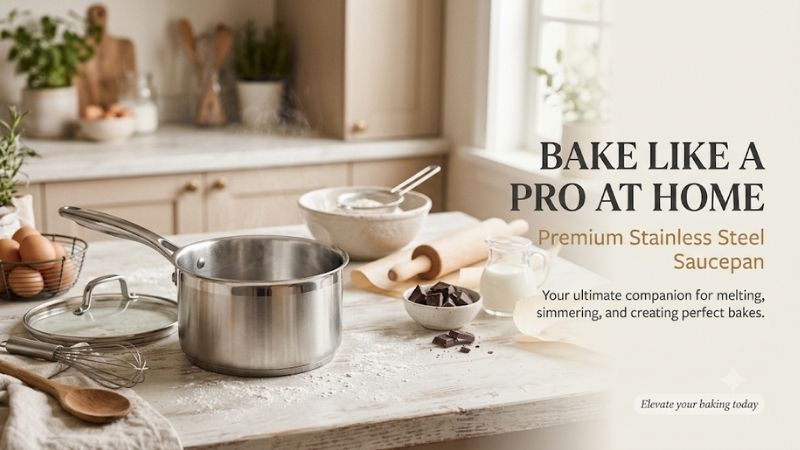
Compare stainless steel with aluminum and nonstick cookware
Different saucepan materials influence how quickly heat moves through the cooking surface and how easily ingredients can be stirred. Stainless steel, aluminum, and coated nonstick cookware all have useful applications, but their strengths differ when preparing custards, syrups, and other baking components.
Uncoated aluminum conducts heat efficiently and responds quickly to burner adjustments. However, certain acidic ingredients can interact with untreated aluminum, potentially affecting flavor or appearance.
Stainless steel is more chemically resistant in ordinary cooking applications, making it attractive for fruit sauces and acidic dessert components.
Because stainless steel alone is a relatively poor heat conductor, quality saucepans often include an aluminum or copper core.
This construction combines a durable cooking surface with more effective heat distribution.
Nonstick saucepans can be convenient for gently heating milk, chocolate mixtures, or certain sauces.
Their food-release coating can simplify cleanup when ingredients are prone to sticking.
However, conventional nonstick surfaces are generally less suitable for high-temperature caramel preparation or aggressive metal whisking.
The coating also has a finite service life.
For baking enthusiasts who want one saucepan for many different techniques, stainless steel is often the most versatile material.
It can accommodate sugar syrups, reductions, acidic fruit fillings, and ordinary savory recipes.
Its main limitation is the need to manage heat carefully when working with delicate ingredients.
Rather than relying on an easy-release surface, the baker must use appropriate temperature control and stirring technique.
Recognize the importance of responsive temperature control
Baking mixtures often change rapidly as they approach a critical temperature. Caramel can darken within moments, while pastry cream can thicken suddenly as starch gelatinizes and egg proteins begin to set. A responsive saucepan helps bakers make these transitions more predictable.
Consider preparing caramel from sugar and water.
The mixture initially behaves like a clear syrup. As water evaporates, the concentration rises and the sugar eventually begins caramelizing at much higher temperatures.
The color may change from pale gold to dark amber in a relatively short period.
A poorly constructed saucepan can develop localized hot spots that cause uneven browning.
A fully clad stainless steel design can help distribute heat across the cooking surface more evenly.
However, even excellent cookware requires attention. Caramel continues cooking briefly after the pan is removed from the burner because the metal retains heat.
For pastry cream, temperature control is equally important.
Excessive heat may cause the mixture to thicken unevenly or scorch at the bottom before the rest reaches the intended consistency.
Using moderate heat and continuous stirring can reduce these problems.
A silicone spatula is particularly useful for reaching corners and scraping the cooking surface.
Temperature responsiveness should therefore be considered alongside the saucepan’s shape, thickness, and overall weight.
Choose a versatile saucepan rather than specialized equipment
A home baker can accumulate numerous specialized tools, but a well-selected saucepan should handle several preparation tasks. Rather than buying different pots for caramel, ganache, fruit fillings, and syrups, many households can use one versatile stainless steel saucepan for most routine baking needs.
A two-quart saucepan is a practical starting point for people preparing small and medium batches.
It provides sufficient space for many frosting bases, dessert sauces, and modest quantities of pastry cream.
A three-quart model offers more flexibility for families or bakers who regularly prepare layered cakes and larger desserts.
However, an oversized saucepan can be inconvenient for small recipes.
When a small amount of liquid spreads thinly across a broad base, evaporation may become difficult to control.
A larger pan can also make shallow mixtures harder to stir evenly.
The most useful saucepan is therefore not necessarily the largest model.
Consider the recipes prepared most frequently.
Someone making single-layer cakes and small portions of ganache may prefer a compact two-quart design.
A baker preparing several batches of pastry cream or fruit filling may benefit from additional capacity.
A lid can expand the pan’s general cooking versatility, although many baking tasks require evaporation and stirring rather than covered simmering.
Choosing a well-constructed saucepan with practical proportions can reduce the need for unnecessary equipment.
How to choose a stainless steel saucepan for baking at home
The best saucepan should match typical recipe quantities while providing comfortable access for stirring and pouring. Capacity, layer construction, handle design, and interior geometry all affect daily performance. Understanding these features makes it easier to distinguish practical cookware improvements from specifications that add cost without improving results.
Select the right capacity for your baking recipes
Saucepan capacity determines how much mixture can be heated safely and how conveniently ingredients can be stirred. Home bakers commonly choose between one-quart, two-quart, and three-quart models, but the ideal size depends on recipe volume and the additional space needed for bubbling or expansion.
A one-quart saucepan is useful for warming small quantities of cream, melting butter, and preparing modest dessert toppings.
However, it can become inconvenient when mixing several ingredients or whisking vigorously.
A two-quart saucepan provides a more comfortable balance for many home baking tasks.
It accommodates moderate quantities of ganache, pastry cream, and fruit sauce while remaining relatively easy to lift.
A three-quart model is better suited to larger batches and recipes that require substantial stirring space.
For example, a pastry cream recipe using several cups of milk may foam or expand as it approaches boiling.
The saucepan should provide enough headroom to prevent the mixture from spilling during whisking.
Capacity markings indicate the total volume, not necessarily the recommended working volume for every recipe.
Avoid filling the saucepan completely when preparing boiling sugar syrups or milk-based mixtures.
Also consider the width of the pan’s base.
Two saucepans with identical capacities may have different proportions, resulting in different evaporation rates.
For general home baking, a two- or three-quart stainless steel saucepan is often the most versatile choice.
Prioritize fully clad construction for consistent heating
Fully clad cookware combines stainless steel with conductive metal layers extending through the base and walls. This design can reduce abrupt temperature differences across the saucepan, which is especially useful for recipes requiring continuous stirring and controlled heating.
A typical three-ply saucepan places an aluminum core between stainless steel layers.
The stainless steel interior provides a durable, nonreactive cooking surface, while the aluminum improves heat distribution.
Five-ply construction uses additional layers, although more layers do not automatically guarantee better cooking performance.
Actual thickness, material composition, and manufacturing quality are important.
For baking, the difference becomes noticeable when preparing mixtures that coat the walls of the pan.
Pastry cream, for example, thickens as it heats and may cling to the lower sides.
A fully clad saucepan provides conductive material beyond the flat bottom, helping reduce severe temperature differences between the base and adjacent walls.
Disc-bottom cookware can still perform well, especially when its conductive base is substantial and appropriately sized.
However, it may heat the sidewalls differently.
For someone who regularly makes delicate custards, fully clad construction is worth considering.
For occasional melting and simple syrup preparation, a good disc-bottom saucepan may offer adequate value.
Choose construction according to cooking frequency and temperature sensitivity rather than relying on marketing terminology alone.
Compare straight-sided saucepans with rounded sauciers
A traditional saucepan usually has a relatively flat base and nearly vertical sides. A saucier uses more rounded interior transitions, allowing a whisk to move smoothly between the bottom and walls. Both designs can work well for baking, but their shapes influence stirring and evaporation.
Straight-sided saucepans are useful when preparing syrups, boiling liquids, or simmering moderate quantities of ingredients.
Their relatively narrow openings can also reduce evaporation compared with a broad, open vessel of similar capacity.
However, the sharp transition between the base and walls can create corners where thick mixtures accumulate.
This becomes important when making pastry cream or custard.
If the whisk does not reach those corners effectively, the mixture may thicken unevenly.
A rounded saucier provides easier access with a whisk or spatula.
The shape can be particularly helpful when preparing lemon curd, pudding, ganache, and delicate sauces.
Its wider opening may also encourage faster evaporation.
That can be useful for reductions but less desirable when carefully maintaining liquid volume.
A home baker who makes custards frequently may prefer a saucier.
Someone seeking multipurpose cookware for boiling, steaming, and everyday food preparation may find a conventional saucepan more versatile.
Neither shape is automatically better.
The choice should reflect how often the cook needs continuous whisking compared with ordinary simmering.
Evaluate handles, pouring rims, and lid construction
A saucepan’s handle and rim influence everyday convenience, especially when transferring hot caramel or fruit sauce into another vessel. A poorly balanced pan may feel uncomfortable when filled, while an awkward rim can cause liquid to run down the exterior during pouring.
Look for a handle that provides a secure grip and sufficient clearance from the hot body.
Hollow stainless steel handles may transfer heat differently from solid metal designs, but no metal handle should be assumed permanently cool.
During prolonged stovetop cooking or oven use, suitable protection may still be necessary.
A flared pouring rim can help direct sauces and syrups into mixing bowls.
This is particularly useful for preparing ganache, when hot cream must be transferred accurately onto chopped chocolate.
However, very thick mixtures may still require a spatula rather than pouring alone.
A well-fitting lid increases the saucepan’s versatility for general cooking.
For baking, a lid may be useful when heating liquids or preparing certain covered infusions.
However, many pastry recipes require an uncovered pan so moisture can escape.
Glass lids allow visual monitoring, while stainless steel lids are often more resistant to accidental impact.
Buyers should also consider the complete weight of the pan with its lid.
For frequent baking, comfortable handling and precise pouring are more important than decorative features.
Essential baking tasks that benefit from stainless steel
A stainless steel saucepan can support many stages of dessert preparation, from melting chocolate to cooking fruit fillings. Each task requires different heating strategies, but all benefit from dependable construction and accessible stirring surfaces. Understanding these techniques helps bakers use one saucepan more effectively across different recipes.
Prepare pastry cream without scorching the bottom
Pastry cream combines milk, sugar, eggs, and starch into a thick filling for pastries, cakes, and desserts. Because the mixture changes texture rapidly as it heats, a saucepan with reliable temperature control and an accessible interior can make preparation significantly more manageable.
Begin by following a tested pastry cream recipe and preparing the ingredients before heating.
Eggs and starch are commonly mixed separately before being combined with hot milk through a tempering process or another specified method.
The goal is to warm the egg mixture gradually rather than suddenly exposing it to excessive heat.
Once the components are combined, return the mixture to the saucepan and heat according to the recipe.
Whisking helps distribute the heat and prevents thickened material from remaining on the bottom.
A silicone spatula can be useful for scraping the corners and lower sidewalls.
As the starch gelatinizes, the mixture becomes noticeably thicker.
The appropriate cooking endpoint depends on the recipe and the type of starch used.
Avoid relying solely on appearance when precise cooking instructions are available.
Once finished, transfer the pastry cream to a suitable container and cool it promptly under appropriate food-safety conditions.
A well-designed stainless steel saucepan simplifies the process, but careful stirring remains essential.
Make caramel and sugar syrups with greater control
Caramel and sugar syrups are common ingredients in cakes, frostings, and desserts. These preparations can reach extremely high temperatures, making cookware material and safe handling especially important. Stainless steel is a practical choice because it tolerates sugar cooking without relying on a vulnerable synthetic nonstick coating.
For wet caramel, sugar is combined with water and heated until the desired color develops.
During the early stages, the sugar dissolves and the mixture becomes a clear syrup.
As water evaporates, the syrup’s temperature rises and caramelization begins.
Some recipes advise avoiding stirring once boiling begins, using gentle pan movement instead.
Follow the specific method because unnecessary agitation can encourage crystallization in certain preparations.
A light-colored stainless steel interior helps the baker observe changes in caramel color.
This is a practical advantage over dark cookware, where subtle color differences may be harder to judge.
A heavy, evenly heated base also reduces the likelihood of severe hot spots.
However, hot sugar can cause serious burns.
Never taste caramel directly from the pan or touch it before it cools appropriately.
When adding cream or butter, follow the recipe carefully because the mixture may bubble vigorously.
Leave adequate headroom in the saucepan to accommodate this reaction.
A suitable stainless steel saucepan provides control, but patience and preparation are essential.
Melt chocolate and prepare smooth ganache
Chocolate is sensitive to excessive heat and moisture. A stainless steel saucepan can help prepare the warm cream used for ganache, while indirect heating may be preferable when melting chocolate itself. Understanding these differences prevents scorching and supports smoother dessert preparations.
Ganache commonly begins by heating cream until it reaches the temperature required by the recipe.
The warm cream is then poured over chopped chocolate.
After a brief resting period, gentle stirring combines the ingredients into a smooth mixture.
A saucepan with a flared pouring rim makes transferring cream easier.
For melting chocolate directly, extremely low heat and constant attention are required.
Many bakers prefer a double-boiler arrangement because indirect heating reduces the risk of scorching.
A stainless steel saucepan can hold the gently simmering water beneath a compatible heat-safe bowl.
The bowl should not contact the water unless the method specifically requires it.
Steam and condensation must be controlled because water droplets can affect certain chocolate preparations.
Avoid allowing the water to boil violently.
The goal is gentle heat transfer rather than rapid heating.
For ganache, the saucepan remains useful even when the chocolate is mixed elsewhere.
Its predictable heat behavior helps prepare cream and other liquid ingredients without unnecessary temperature fluctuations.
Cook fruit fillings, glazes, and dessert reductions
Fruit fillings and glazes often contain a combination of water, sugar, natural acids, and thickening ingredients. Stainless steel is particularly useful for these recipes because its cooking surface does not depend on seasoning. This allows bakers to prepare lemon, berry, and other acidic fillings without the maintenance concerns associated with bare iron cookware.
Consider a blueberry filling for pastries.
The berries release moisture as they heat, creating a mixture that gradually thickens when reduced or combined with an appropriate thickener.
A saucepan with sufficient capacity allows the mixture to bubble without overflowing.
A broad base can encourage evaporation, which may be useful when concentrating flavor.
However, rapid evaporation can also produce excessive thickening if the recipe is not monitored.
Stir regularly to prevent fruit solids from sticking to the bottom.
For citrus glazes, stainless steel provides a convenient alternative to reactive cookware.
When preparing a fruit reduction, consider the intended final consistency.
A filling for hand pies may need to be thicker than a sauce intended for pouring over cheesecake.
The pan’s diameter and burner setting influence how quickly moisture evaporates.
Use moderate heat and evaluate texture as the mixture cools.
Some fillings continue thickening after removal from the stove.
A versatile saucepan makes these preparations manageable without requiring specialized equipment.
Maintenance, safety, and long-term buying value
Baking ingredients can leave stubborn residue on cookware, particularly when sugar or dairy products are heated for extended periods. Stainless steel is durable, but regular maintenance and appropriate temperature control improve its usefulness. Buyers should also evaluate whether expensive cookware features provide meaningful benefits for the recipes they actually prepare.
Clean caramel, chocolate, and milk residue safely
Sugar and dairy residues can appear difficult to remove, but stainless steel cookware often responds well to soaking and gentle cleaning. Understanding how different residues behave helps bakers restore the cooking surface without unnecessary abrasion or damage.
For caramel, allow the pan to cool enough for safe handling.
Adding water and gently reheating the saucepan can dissolve hardened sugar, provided the process is performed carefully.
Avoid pouring cold water into an extremely hot empty pan.
For chocolate residue, warm soapy water and a soft sponge are often sufficient.
Milk proteins can adhere more stubbornly when overheated.
If scorching occurs, allow the pan to cool before using a manufacturer-approved cleaning method.
Avoid aggressive metal scraping when it could damage the finish.
Some stainless steel products can be cleaned with suitable powdered cookware cleaners.
Follow the product instructions and rinse thoroughly afterward.
Rainbow-colored discoloration can occasionally develop after heating.
Such cosmetic changes are not necessarily a sign of structural damage.
The most effective strategy is prompt cleaning after the cookware has cooled appropriately.
Regular maintenance prevents residue from accumulating around rivets, rims, and other difficult-to-reach areas.
Prevent warping through gradual heating and cooling
A stainless steel saucepan may contain several bonded metal layers that expand at different rates when heated. Quality cookware is engineered to accommodate normal use, but extreme temperature changes can still create unnecessary stress. Gradual heating and sensible cooling habits help preserve the shape and performance of the pan.
Avoid placing an empty saucepan over maximum heat for extended periods.
This is rarely necessary for baking because many dessert mixtures require moderate temperatures.
Begin with the burner setting appropriate to the recipe.
Increase the heat gradually when needed.
If using induction, remember that the cookware may heat rapidly, particularly when the burner operates at high power.
Select a burner that matches the saucepan’s base diameter.
A very small burner beneath a broad pan can produce uneven heating.
After cooking, allow the saucepan to cool before washing.
Avoid moving it directly from a hot burner into cold water.
This can place thermal stress on the bonded construction.
Also inspect handles and rivets periodically.
Loose attachments may affect safe pouring, especially when the pan contains hot sugar or syrup.
Proper heat management protects the cookware while improving control over delicate baking ingredients.
Compare budget and premium stainless steel cookware
Premium stainless steel saucepans often feature fully clad construction, refined handles, and carefully finished pouring rims. Budget models may use simpler materials or disc-bottom designs. Understanding the practical differences helps home bakers avoid overspending on features that do not improve their normal recipes.
A person who bakes occasionally may not require an expensive five-ply saucepan.
A well-constructed midrange three-ply model can provide excellent results for ganache, pastry cream, and fruit fillings.
Brands such as Tramontina and Cuisinart offer accessible stainless steel cookware with different construction options.
Premium manufacturers such as All-Clad and Made In emphasize multilayer construction and refined finishing.
However, brand reputation alone does not determine how successfully a baker prepares caramel.
Proper temperature management and suitable recipe technique remain essential.
Pay attention to flat base diameter, overall weight, handle comfort, and pouring control.
A practical two-quart saucepan may be more useful than a premium four-quart model that is too large for ordinary recipes.
Warranty coverage can also influence long-term value.
Review the manufacturer’s care requirements and service conditions.
The best purchase should make frequent baking tasks easier without introducing unnecessary expense.
Recognize when a saucier or double boiler is a better choice
Although a stainless steel saucepan is versatile, certain baking tasks benefit from specialized cookware. Knowing when to use a saucier or double boiler can improve results and prevent frustration. The goal is to select the correct heating method rather than expecting one saucepan to solve every preparation challenge.
A rounded saucier is especially useful when recipes require continuous whisking.
Pastry cream and delicate custards can collect near the corners of a traditional saucepan.
The curved transition in a saucier makes these areas easier to reach.
A double boiler is more appropriate when ingredients must be heated indirectly.
Chocolate is a common example because excessive direct heat can damage its texture.
Some egg-based sauces also benefit from gentle indirect heating.
A standard saucepan can serve as the lower water vessel when paired with a compatible heat-safe bowl.
However, the arrangement must remain stable.
Avoid allowing the bowl to tilt or expose the user to escaping steam.
For most home bakers, a quality two- or three-quart stainless steel saucepan remains the best first purchase.
Specialized tools become worthwhile when a recurring recipe exposes the limitations of the existing cookware.
Investing gradually helps keep the kitchen organized and the equipment budget focused.
Conclusion
The best stainless steel saucepan for baking at home combines predictable heating, comfortable handling, and enough capacity for common dessert preparations. A fully clad two- or three-quart model is a versatile starting point for pastry cream, caramel, ganache, and fruit fillings. Prioritize a sturdy handle, accessible interior, and controlled pouring over decorative details. With careful temperature management and regular cleaning, a quality saucepan can support years of reliable home baking.




Write Your Review
No reviews yet. Be the first to share your experience!