
An enameled Dutch oven for large families needs enough volume for generous servings without becoming unmanageable when full. The right shape allows meat to brown in batches, the lid controls moisture, and the handles make oven transfers safer. This guide explains capacity planning, practical features, and meal-prep techniques.
Choosing an enameled Dutch oven for large families
Cooking for a large household requires more than simply increasing the quantity of ingredients. Meals must fit inside the cookware with enough space for stirring, simmering, and developing flavor. Capacity, pot diameter, and shape should therefore be selected around the dishes your family prepares most frequently.
How much Dutch oven capacity does a large family need?
Dutch oven capacity is usually advertised in quarts, but actual serving capacity depends on the recipe. A thick stew, a whole chicken, and a pot of soup occupy space differently. Large families should select cookware based on their most demanding regular meals rather than a fixed number of quarts per person.
A 5- to 5.5-quart Dutch oven can accommodate many ordinary family dinners, particularly when side dishes are prepared separately.
However, households serving six or more substantial portions may benefit from a 6- to 7-quart model.
For families of eight or more, a 7- to 9-quart Dutch oven can provide useful flexibility for soups, stews, braised meats, and batch cooking.
These ranges are practical starting points rather than guaranteed serving counts.
A 7-quart pot filled with large cuts of meat may produce fewer servings than the same pot filled with vegetable soup.
The pot should also have enough headroom for bubbling, stirring, and expansion.
Filling it close to the rim creates unnecessary spill risks, especially when ingredients are being moved.
Before buying, identify three meals your household prepares most often and estimate the volume of ingredients used.
The best size is one that accommodates these meals without forcing the cook to use the vessel at its absolute capacity.
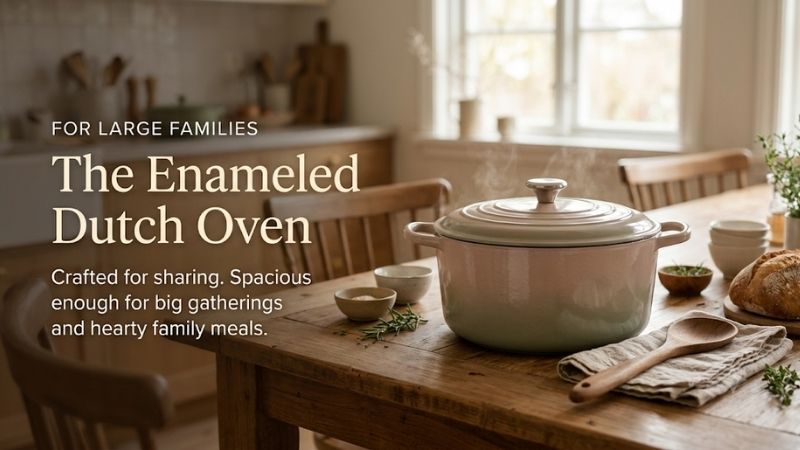
Should you choose a round or oval Dutch oven?
Round and oval Dutch ovens provide different advantages when preparing large meals. Round designs generally fit standard stovetop burners more naturally, while oval models can accommodate elongated ingredients. Choosing the correct shape improves how food fits inside the vessel and how efficiently the cooking surface is used.
A round Dutch oven is a versatile choice for soups, chili, stew, pasta sauce, and bread baking.
Its circular bottom usually aligns better with the shape of conventional burners.
That helps when browning meat or sautéing vegetables before adding liquid.
An oval Dutch oven is particularly useful for whole chickens, long roasts, and larger portions of meat.
Its elongated interior can provide a more natural fit for these ingredients.
However, a long oval base may extend beyond the burner, producing uneven direct heating during stovetop cooking.
This limitation matters less during oven braising because hot air surrounds the vessel more evenly.
Families preparing soups and stews most frequently may prefer a round 7-quart Dutch oven.
Households regularly roasting whole poultry or elongated meat cuts may find a 7- to 8-quart oval model more convenient.
Neither shape is universally superior.
The best choice depends on whether the vessel will spend most of its time on the stovetop or inside the oven.
Why usable cooking surface matters as much as capacity
A large Dutch oven can hold substantial food while offering relatively little space for browning. This distinction becomes important when recipes begin with searing meat before liquid is added. A wide base allows more ingredients to contact the heated surface, reducing the number of batches needed to develop flavor.
Imagine preparing beef stew for eight people.
If several pounds of meat are placed into a narrow pot simultaneously, the surface temperature may fall and released moisture may accumulate.
Instead of developing a browned crust, the meat can begin steaming.
A wider Dutch oven provides greater direct cooking area, although large quantities may still require multiple batches.
The same principle applies to vegetables.
Mushrooms, onions, and carrots can release considerable moisture when crowded together.
For family meals that begin with browning, compare the actual base diameter rather than relying entirely on quart capacity.
A wider 7-quart pot may be more useful than a narrower vessel with a slightly higher volume.
However, width creates its own challenges.
A very broad Dutch oven may not fit inside a small oven or refrigerator shelf.
The ideal design balances cooking area, depth, burner coverage, and storage dimensions.
Essential features for family-sized enameled cast iron cookware
Large Dutch ovens become increasingly demanding to handle as their capacity increases. The vessel must retain heat, maintain moisture, and support safe transfers between the stovetop and oven. Handle design, lid construction, and enamel durability are particularly important because replacing a large premium pot can be expensive.
Choose comfortable handles for a heavy cooking vessel
A family-sized Dutch oven can weigh well over 15 pounds before any ingredients are added. Once filled with meat, vegetables, and liquid, the combined weight can be difficult to control. Secure handles and adequate clearance for oven mitts are essential for safe movement around a busy kitchen.
Look for wide loop handles that allow both hands to grip the pot securely.
Narrow handles can become uncomfortable when lifting a heavy vessel.
The distance between the handles and pot body also matters because oven mitts add bulk.
A handle that feels comfortable with bare hands may be difficult to grasp when wearing heat protection.
Always consider the combined weight of cookware and food.
Eight quarts of water weigh approximately 16.7 pounds, so a large cast iron pot can become extremely heavy when filled close to that volume.
Avoid attempting to lift an unnecessarily full vessel across the kitchen.
When practical, remove some food or liquid before moving the pot.
Keep the transfer route clear of children, pets, and obstacles.
For families with limited lifting strength, two moderate-sized cooking vessels may be safer and more convenient than one oversized Dutch oven.
Compare lid fit, condensation features, and oven ratings
The lid influences how much moisture escapes during cooking and how effectively a Dutch oven supports long braises. A well-fitting lid helps retain liquid, while some designs use raised features to redistribute condensation. Oven temperature limits should also be checked because lids and knobs may have separate restrictions.
A fitted lid is particularly useful for beef stew, braised chicken, and slow-cooked pork.
These dishes depend on prolonged exposure to gentle heat and adequate moisture.
A lid that allows excessive steam to escape may require additional liquid during cooking.
Some Dutch ovens include textured or patterned lid interiors designed to encourage condensed moisture to return to the food.
These features can support moisture management, although they do not eliminate the need to monitor cooking liquid.
Oven compatibility should be confirmed for the specific model.
Different Dutch ovens have different manufacturer-stated temperature limits, and the lid knob may impose an additional restriction.
A pot rated for ordinary braising may not necessarily be suitable for a very high-temperature bread-baking method.
Avoid assuming that all enameled cast iron has the same heat tolerance.
For large families, a sturdy lid with appropriate oven compatibility is more important than decorative features.
Select durable enamel and understand its limitations
The enamel finish protects cast iron from direct exposure to food and moisture, eliminating the seasoning requirements of traditional bare iron. This makes enameled Dutch ovens convenient for large families preparing acidic sauces and frequent one-pot meals, but the protective surface still requires careful handling.
Enameled cast iron is particularly useful for tomato-based dishes, chili, and recipes containing wine or vinegar.
These ingredients can be cooked without the seasoning concerns associated with bare cast iron.
The enamel also simplifies routine cleaning because the surface does not require a protective oil layer after washing.
However, enamel is not equivalent to a conventional nonstick coating.
Food can adhere, especially when the pot is overheated or ingredients are left unstirred.
Use moderate heat for most cooking stages.
Cast iron retains substantial heat, so high burner settings are often unnecessary once the vessel is hot.
Avoid striking the interior with metal tools.
Wooden or silicone utensils are generally better choices for preserving the finish.
Do not place a very hot Dutch oven into cold water.
Sudden temperature changes can stress the enamel and may contribute to cracking.
For large families using the pot several times each week, consistent gentle handling can extend its useful life.
Planning family meals with an enameled Dutch oven for large families
Choosing the correct vessel is only the beginning. Large-family cooking also requires efficient ingredient preparation, portion control, and safe handling after the meal. A Dutch oven can simplify meal planning, but its capacity and heat retention must be managed carefully to avoid overcrowding and unsafe cooling practices.
Cook large batches without sacrificing browning and flavor
Large quantities of ingredients can create overcrowding even inside a spacious Dutch oven. Effective batch cooking develops flavor before liquids are added, allowing the finished meal to benefit from browning rather than relying entirely on prolonged simmering. The sequence of cooking stages matters as much as pot capacity.
Begin by cutting meat into reasonably uniform portions.
Dry the exterior when appropriate, then preheat the Dutch oven gradually over moderate heat.
Add a suitable amount of cooking fat and arrange the first batch of meat with space between individual pieces.
Allow the exterior to brown before turning.
Transfer the browned pieces to a separate dish and repeat until all portions have been prepared.
Next, sauté onions and other aromatic vegetables in the same pot.
Add a suitable liquid to loosen the browned residues from the bottom.
These residues contribute flavor to the finished stew or braise.
Return the meat, add the remaining ingredients, and bring the mixture to the appropriate cooking temperature.
A covered oven braise can then proceed with relatively little intervention.
This method may take longer initially than adding everything at once, but it generally produces better flavor development.
For very large households, preparing meat in batches is often unavoidable regardless of Dutch oven size.
Use a Dutch oven for weekly meal preparation
A large Dutch oven can prepare several portions of food in one cooking session, reducing repeated stovetop work during the week. Soups, stews, braised meats, and certain bean dishes are particularly suitable for batch preparation, provided leftovers are cooled, stored, and reheated safely.
Choose recipes that maintain their quality after refrigeration.
Beef stew, vegetable soup, chili, and braised chicken are useful examples.
Prepare a substantial batch, then divide the finished food into smaller portions.
Do not leave a large Dutch oven full of hot food sitting on the counter for hours.
Cast iron retains heat well, which is helpful during cooking but can slow cooling when a substantial quantity of food remains inside the pot.
Instead, transfer leftovers into shallow, food-safe containers.
Refrigerate perishable cooked food within two hours, or within one hour when ambient temperatures exceed 90°F.
For later meals, reheat leftovers thoroughly to a safe temperature.
The USDA recommends reheating leftovers to 165°F.
Avoid repeatedly reheating and cooling the entire batch when only one or two servings are needed.
Separate storage containers allow the family to reheat individual portions more efficiently.
A large Dutch oven therefore works best as a batch-cooking vessel rather than the default storage container for every leftover meal.
Manage storage, cleaning, and long-term maintenance
A large enameled Dutch oven occupies substantial cabinet space and may be difficult to clean in a narrow sink. Because the vessel is heavy and its enamel can be damaged by impact, storage and washing arrangements should be considered before purchasing. Careful handling reduces the risk of expensive damage.
Measure the available storage space before selecting a model.
Include the overall width across both handles and the total height with the lid installed.
Avoid storing an oversized Dutch oven on a high shelf where lifting it could be unsafe.
A lower cabinet or sturdy pull-out shelf is generally more convenient.
When washing, allow the cookware to cool before adding warm water and mild detergent.
For stubborn food residue, soaking is safer than scraping aggressively with abrasive tools.
Dry the pot thoroughly after washing.
If the lid has an exposed cast iron rim, follow the manufacturer’s guidance for keeping that area dry.
When storing the Dutch oven with its lid, consider using protective spacers to prevent direct enamel-to-enamel contact.
Avoid stacking heavy cookware inside the pot.
For households with young children, ensure the Dutch oven is stored where it cannot be pulled down accidentally.
The most durable cookware is still vulnerable to damage when handled carelessly.
Conclusion
The ideal enameled Dutch oven for large families combines sufficient capacity, a useful cooking surface, manageable weight, and durable enamel construction. A 6- to 7-quart round model can suit many larger households, while a 7- to 9-quart vessel may be more appropriate for frequent batch cooking or substantial gatherings. Choose an oval design for elongated roasts, prioritize wide handles and a secure lid, and plan safe cooling and storage for leftovers. The best purchase is the largest pot your household can use comfortably and safely, not simply the largest available.

Write Your Review
No reviews yet. Be the first to share your experience!