
Choosing a crepe pan for easy cleaning starts with understanding how different cooking surfaces release food, resist residue buildup, and respond to washing. Nonstick coatings generally require less scrubbing, while carbon steel and cast iron offer different long-term maintenance advantages. This guide explains how to find a practical pan that suits your cooking habits.
What makes a crepe pan easy to clean?
An easy-clean crepe pan combines a cooking surface that minimizes sticking with a shape that allows residue to be removed without complicated scrubbing. Low sides, smooth surfaces, suitable coatings, and straightforward care instructions all contribute to convenient maintenance. However, cleaning ease is not the same as freedom from care requirements.
Crepes are relatively thin foods, but batter can still adhere to a pan when the surface is improperly prepared or the cooking temperature is unsuitable.
Butter and oil residue may also accumulate, particularly when the pan is overheated or used repeatedly without removing excess residue.
A low-sided design generally simplifies wiping because there are fewer deep corners to reach.
The best pan should therefore release cooked batter reliably and remain easy to wash using methods that protect its surface.
Best crepe pan materials for easy cleaning
Cookware material determines both how food interacts with the surface and which cleaning methods are appropriate. Coated aluminum, carbon steel, and cast iron each offer distinct advantages, but their maintenance requirements differ substantially. Understanding these differences helps buyers avoid selecting a pan that appears convenient initially but does not suit their preferred care routine.
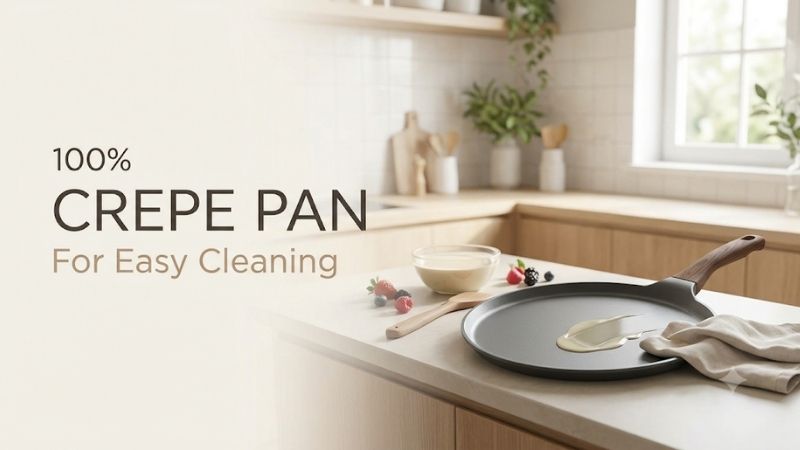
Nonstick aluminum crepe pans
Nonstick aluminum crepe pans are generally the easiest starting point for people who want straightforward cleanup. A properly maintained coating helps reduce batter adhesion, while the aluminum body is often lighter than cast iron cookware. However, the coating must be protected from overheating and unsuitable cleaning tools.
For daily crepe preparation, a coated surface can reduce the amount of force required to remove cooked-on residue.
A soft sponge and suitable dish detergent are often sufficient when the pan has cooled appropriately.
The precise care requirements depend on the coating.
Some products are dishwasher-safe according to their manufacturers, but hand washing may help preserve the surface.
Best for: Beginners, busy households, and buyers who prioritize convenient cleaning.
Main limitation: The coating can deteriorate over time, especially with improper use.
Carbon steel crepe pans
Carbon steel crepe pans have durable metal cooking surfaces that can develop seasoning through appropriate use. Once well maintained, the seasoned surface can assist with crepe release, but initial preparation and routine care are more demanding than with many manufactured nonstick coatings.
The de Buyer MINERAL B Crepe & Tortilla Pan is an example of this approach.
Its surface must be seasoned correctly and dried thoroughly after cleaning.
The manufacturer recommends hot-water cleaning and protective oiling rather than dishwasher use.
Although this process becomes familiar with experience, it is not the lowest-maintenance option for every buyer.
Best for: People who enjoy traditional cookware maintenance.
Main limitation: Seasoning, drying, and storage care are required.
Cast iron crepe pans and griddles
Cast iron griddles can provide broad, low-sided cooking surfaces for crepes, pancakes, and tortillas. Their durable construction supports long-term use, but traditional seasoned cast iron generally requires more careful drying and storage than nonstick aluminum. The heavier body can also make washing less convenient.
The Lodge Round Cast Iron Griddle illustrates the multipurpose cast iron approach.
A properly maintained seasoned surface can perform effectively for crepe preparation.
However, improper heating or insufficient surface maintenance may contribute to sticking.
Cleaning involves removing batter residue, drying the iron thoroughly, and maintaining the protective surface as recommended.
Best for: Buyers who value durability and multipurpose cooking.
Main limitation: Heavier handling and seasoning maintenance.
How to choose a low-maintenance crepe pan
Choosing cookware for cleaning convenience involves more than looking for a dishwasher-safe label. Buyers should evaluate whether the cooking surface releases batter easily, whether the pan can be washed without specialized equipment, and whether it fits comfortably in their sink and storage area. Long-term upkeep deserves as much attention as initial cleanup.
Choose a smooth cooking surface
A smooth cooking surface makes it easier to spread thin batter and remove remaining food particles after cooking. Surface texture, scratches, damaged coatings, and irregular seasoning can contribute to sticking, although their effect varies according to cookware material and cooking technique.
For beginners, an intact nonstick coating can be particularly forgiving.
A flat surface also allows a soft sponge or cloth to reach the cooking area without difficulty.
Avoid pans with unnecessary grooves or raised cooking patterns when making traditional thin crepes.
Those designs can complicate both batter distribution and cleaning.
Check dishwasher compatibility carefully
Dishwasher compatibility is a model-specific feature that should be confirmed through the manufacturer’s instructions. Some coated crepe pans are labeled dishwasher-safe, while carbon steel and traditional seasoned cast iron generally require hand washing and careful drying to protect their surfaces.
The Le Creuset Toughened Nonstick PRO Crepe Pan is manufacturer-listed as dishwasher-safe.
However, Le Creuset also recommends hand washing for ongoing care.
The de Buyer MINERAL B Carbon Steel Crepe & Tortilla Pan should not be placed in a dishwasher.
A dishwasher-safe label is therefore useful information, but it does not automatically make a product the best long-term choice.
Consider the handle and overall dimensions
Pan dimensions affect both cooking capacity and cleaning convenience. A large crepe pan may be suitable for preparing broad savory crepes, but it can be awkward to wash in a compact sink. Handle length, weight, and the shape of the pan’s rim also influence everyday handling.
Before purchasing, compare the overall dimensions with your sink.
Consider whether you can comfortably hold the pan while wiping the cooking surface.
A lighter aluminum design may be more convenient for frequent washing than a heavy cast iron griddle.
A medium-sized pan often offers a reasonable compromise.
How to clean a crepe pan properly
Cleaning should preserve the pan’s cooking surface rather than simply removing visible residue. The correct method depends on whether the surface is coated aluminum, seasoned carbon steel, or cast iron. Using the wrong cleaning tools can shorten a pan’s useful life, even when the cookware initially appears durable.
Cleaning a nonstick crepe pan
Nonstick crepe pans generally require gentle cleaning methods designed to preserve the coating. Although the surface may release food easily, abrasive scrubbers and harsh mechanical cleaning can damage some coatings and reduce their effectiveness over time.
Allow the pan to cool sufficiently.
Use warm water, suitable dish detergent, and a soft sponge.
Remove cooking residue without aggressive scraping.
Rinse the surface and dry it according to the manufacturer’s instructions.
Avoid stacking metal cookware directly against the coating without appropriate protection.
Cleaning a carbon steel crepe pan
Carbon steel needs cleaning methods that remove food residue while maintaining the seasoned cooking surface. Prolonged water exposure and poor drying practices can encourage rust, so washing should be followed by prompt drying and appropriate protective care.
Follow the specific manufacturer’s instructions.
For the de Buyer MINERAL B line, the manufacturer recommends cleaning with hot water and drying thoroughly.
Apply a thin layer of oil when directed.
Avoid placing the pan in a dishwasher.
Store it where moisture will not accumulate.
Cleaning a cast iron crepe griddle
Traditional cast iron griddles require particular attention to moisture management and seasoning. Food residue should be removed with suitable tools, while the pan should be dried thoroughly before storage. Modern care guidance may permit mild dish soap, so overly restrictive cleaning rules are not necessary when they conflict with manufacturer recommendations.
Allow the cookware to cool safely.
Remove stuck residue using appropriate cleaning tools.
Wash according to the manufacturer’s directions.
Dry immediately after cleaning.
Maintain the seasoning when necessary.
Avoid prolonged soaking and damp storage.
Preventing crepe batter from sticking
Preventing sticking makes cleanup easier because less batter burns onto the cooking surface. Pan temperature, batter consistency, surface preparation, and turning technique all affect food release. Even a premium nonstick pan can become frustrating when cooking conditions are unsuitable.
Preheat the pan correctly
A crepe pan should reach a suitable cooking temperature before batter is added, but excessive heat can cause premature browning or burning. Because carbon steel, cast iron, and aluminum respond differently, careful temperature adjustment is more reliable than using the highest burner setting.
Start with moderate heat.
Observe how the first crepe cooks.
If the batter burns before it can spread, reduce the temperature.
If the crepe remains pale and takes excessively long to set, adjust the heat as appropriate.
Avoid overheating empty nonstick cookware.
Use the correct amount of cooking fat
Butter or oil can support crepe release and surface browning, but excessive fat can create uneven cooking and unnecessary residue. The appropriate quantity depends on the recipe and cooking surface, and some nonstick pans require less added fat than traditional uncoated cookware.
Apply fat lightly and evenly when needed.
Avoid allowing large pools of butter to accumulate.
If the fat begins burning, reduce the heat and clean the affected residue when safe.
For repeated batches, reassess whether additional fat is actually necessary.
Turn crepes at the right time
Crepes may tear or stick when turned before the batter has developed enough structure. Waiting until the edges begin releasing and the underside is sufficiently cooked can make turning easier, reducing the need for aggressive scraping that might damage the pan.
Use a thin spatula appropriate for the surface.
Lift a small section of the edge to assess readiness.
Loosen the crepe gently.
Turn it with a controlled movement.
If the crepe resists strongly, assess whether it needs slightly more cooking time instead of forcing it loose.
Common cleaning mistakes to avoid
Cleaning problems often arise from preventable mistakes rather than unavoidable product limitations. Scrubbing coated cookware with abrasive tools, placing carbon steel in the dishwasher, storing cast iron while damp, or exposing a hot pan to sudden cooling can damage cookware and make future cleaning more difficult.
Using abrasive tools on nonstick coatings
Abrasive pads, sharp scraping tools, and aggressive cleaning methods can damage certain nonstick coatings, making future food release less reliable. The coating’s manufacturer determines which utensils and cleaning tools are acceptable, and those instructions should take precedence over generic assumptions.
Use a soft sponge whenever possible.
Do not attempt to remove stubborn residue through excessive pressure.
Instead, follow the manufacturer’s recommended soaking or gentle cleaning procedure.
If a coating is peeling or substantially damaged, evaluate whether the pan should be replaced.
Leaving carbon steel or cast iron wet
Moisture can encourage corrosion on exposed iron surfaces, especially when cookware is stored without adequate drying. Carbon steel and bare cast iron are therefore less forgiving of prolonged damp conditions than many coated pans.
After washing, dry the cookware thoroughly.
Pay attention to areas around handle attachments.
Apply an appropriate protective oil coating when directed.
Store the pan in a dry location with adequate airflow.
Cooling a very hot pan too quickly
Sudden temperature changes can create thermal stress in cookware and may damage certain finishes or constructions. Pouring cold water into a very hot pan is therefore not a suitable shortcut for removing cooking residue, particularly when the manufacturer warns against thermal shock.
Allow the pan to cool sufficiently before washing.
Use cleaning methods appropriate for its material.
Do not assume that an expensive pan is immune to temperature-related damage.
Frequently Asked Questions
People shopping for low-maintenance crepe cookware often compare dishwasher compatibility, nonstick performance, material durability, and everyday cleaning methods. These questions are particularly relevant to households that make crepes frequently and want to avoid spending more time washing cookware than preparing breakfast.
What is the easiest crepe pan material to clean?
A well-maintained nonstick aluminum crepe pan is generally among the easiest options to clean because its coating can reduce batter adhesion. However, the coating requires appropriate temperature control and gentle cleaning to maintain its usefulness.
Carbon steel and cast iron can also become manageable with proper care, but they involve additional maintenance.
Can I put a crepe pan in the dishwasher?
Dishwasher compatibility depends on the exact model. Some nonstick crepe pans are labeled dishwasher-safe, while traditional seasoned cast iron and carbon steel generally should not be cleaned this way.
Always check the manufacturer’s instructions.
Even for dishwasher-safe products, hand washing may offer benefits for long-term surface care.
Why does batter stick to my crepe pan?
Batter may stick because the cooking surface is insufficiently prepared, the heat is unsuitable, or the crepe is turned before it has set. Damaged coatings and poorly maintained seasoning can also contribute to food adhesion.
Adjust the cooking technique before assuming the cookware is defective.
Should I replace a scratched nonstick crepe pan?
Minor surface marks and substantial coating damage are not necessarily equivalent, but visible peeling, flaking, or significant deterioration warrants attention. Follow the manufacturer’s guidance on coating condition and replacement.
Avoid continuing to use cookware with a badly damaged cooking surface simply to postpone replacement.
Conclusion
The most practical crepe pan for easy cleaning is one that combines reliable food release with maintenance requirements you can follow consistently. Nonstick aluminum is usually the simplest choice for beginners and busy households, while carbon steel and cast iron offer durable alternatives for people willing to maintain seasoning. Prioritize a smooth, low-sided surface, manageable dimensions, verified dishwasher instructions, and gentle cleaning techniques. Good heat control and correct crepe-turning technique will also reduce sticking and make cleanup easier regardless of material.







Write Your Review
No reviews yet. Be the first to share your experience!