
Choosing a non toxic cookware set for large families involves balancing clearly identified food-contact materials with generous cooking capacity, durability, and manageable cleaning. Large households need more than attractive pots and pans: they require practical stockpots, spacious skillets, and cooking surfaces appropriate for frequent use. This guide explains how to compare materials, evaluate safety claims, and select cookware that genuinely supports family meals.
- What should large families prioritize in cookware?
- Understanding material safety for family cookware
- Choosing the right cookware sizes for large families
- Comparing useful cookware collections for families
- How to evaluate non toxic cookware marketing claims
- Choosing cookware for everyday family meals
- Managing cookware weight and safe handling
- Cleaning and maintaining family cookware
- Common buying mistakes
- Frequently Asked Questions
- Conclusion
What should large families prioritize in cookware?
A large household needs cookware that can prepare multiple portions efficiently, withstand regular use, and remain practical to lift and clean. When material safety is a purchasing concern, buyers should also examine actual food-contact surfaces, coating compositions, and manufacturer instructions rather than relying on vague labels such as toxin-free or chemical-free.
Family cooking creates several challenges that are less noticeable when preparing individual servings.
A small skillet may be adequate for two people but become overcrowded when preparing chicken or vegetables for six.
An undersized stockpot can make pasta, soup, or batch cooking inconvenient.
A collection with numerous small pans may still fail to provide enough usable cooking space.
For many families, a durable stainless steel collection combined with specialized cookware for particular recipes offers a practical arrangement.
However, the correct selection depends on normal cooking patterns, available burners, storage, and who will be handling the cookware.
Understanding material safety for family cookware
The phrase non toxic cookware is commonly used in marketing but does not identify one standardized material or guarantee complete freedom from risk. Responsible product selection involves understanding specific substances, the condition of the cooking surface, intended temperatures, and whether the cookware is suitable for the foods prepared.
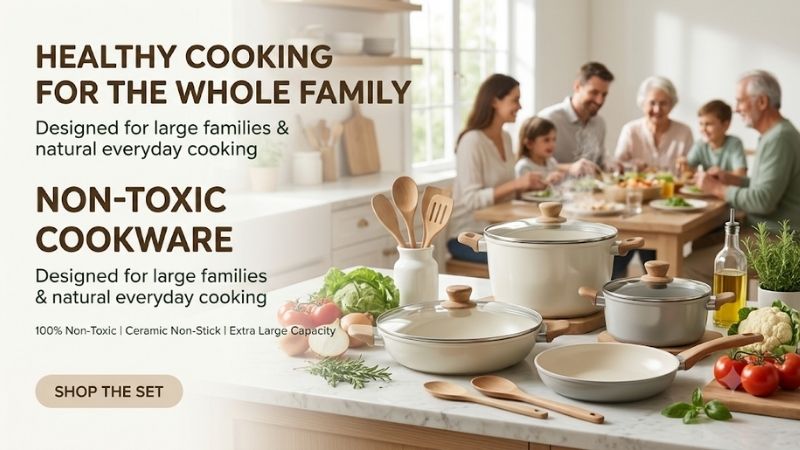
Stainless steel cooking surfaces
Food-grade stainless steel cookware is widely used for home cooking because it provides a durable, relatively corrosion-resistant surface that does not require a conventional manufactured nonstick coating.
Fully clad collections such as All-Clad D3, Tramontina Tri-Ply Clad, and Cuisinart MultiClad Pro use stainless steel cooking interiors.
These materials are suitable for many everyday tasks, including boiling, simmering, frying, and preparing acidic sauces when used appropriately.
However, stainless steel is an alloy.
Some common food-contact grades contain nickel and chromium.
Families with specific metal sensitivities should investigate material composition rather than assuming every stainless steel grade is identical.
The absence of a nonstick coating does not mean that stainless steel contains no chemical elements or has no operating limitations.
Traditional cast iron
Cast iron cookware offers a durable cooking surface that can develop seasoning through appropriate use and maintenance. It does not require a conventional manufactured nonstick coating, making it relevant to buyers who want traditional cookware.
Lodge cookware is a recognizable example.
Cast iron retains heat effectively, which can help when searing substantial portions of meat.
However, heavy pans can be inconvenient for family cooking.
An oversized cast iron skillet containing several pounds of food may be difficult to lift safely.
Cast iron can also contribute iron to food, and the amount depends on factors such as food acidity and cooking time.
People with medical conditions affecting iron regulation should obtain individualized professional guidance.
Carbon steel cookware
Carbon steel provides another traditional uncoated cooking surface.
It develops seasoning through use and appropriate maintenance.
Compared with some cast iron cookware, carbon steel may offer different handling and heat-response characteristics.
However, large carbon steel pans still require care.
Acidic foods may affect the seasoning.
The cookware must be dried thoroughly after washing.
For large families, carbon steel can be useful as a frying supplement, particularly when stainless steel already handles boiling and sauce preparation.
Ceramic nonstick cookware
Ceramic-coated cookware commonly uses a metal body with a manufactured ceramic-based nonstick interior.
This differs from traditional solid ceramic cooking vessels.
GreenPan Valencia Pro and Caraway cookware are examples of products that use ceramic nonstick surfaces.
Some manufacturers make specific claims about coatings being made without intentionally added PFAS.
However, these claims should not be expanded into absolute statements that every substance is absent or that cookware is universally risk-free.
Ceramic nonstick may offer convenient food release, but the coating can wear over time.
Large families should consider whether frequent use and cleaning will justify the long-term replacement requirements.
Enameled cast iron
Enameled cast iron combines an iron body with a protective enamel surface.
It can be useful for braising, soups, and acidic dishes where bare seasoned iron may require additional care.
However, enamel is not indestructible.
Chipping, impact damage, and thermal shock can affect the coating.
A large enameled Dutch oven is also heavy.
Families should prioritize stable handles, suitable oven-temperature ratings, and manageable lifting.
Choosing the right cookware sizes for large families
Cooking capacity is one of the most important factors when selecting a family cookware collection. A large set with many pieces may still be unsuitable if most vessels are too small. Buyers should examine usable cooking dimensions, stockpot capacity, and the relationship between cookware size and available burners.
Twelve-inch skillets for family portions
A 12-inch skillet offers more cooking area than an 8- or 10-inch pan, making it useful when preparing several portions of meat or vegetables.
However, the advertised diameter often describes the rim rather than the flat cooking surface.
The actual usable area depends on sidewall geometry.
A large skillet can help reduce overcrowding, but it does not guarantee that all food will fit in one batch.
Cooking several chicken breasts may still require sequential preparation.
For induction users, the skillet’s base must also be compatible with the cooking zone.
A pan substantially larger than the heating area may cook unevenly.
Large sauté pans
A sauté pan combines a broad base with relatively straight sides and greater capacity than many shallow skillets.
This makes it useful for family-size sauces, one-pan meals, and recipes containing multiple ingredients.
A 4- or 5-quart sauté pan may be practical for many households.
However, capacity is not equivalent to flat cooking area.
A deep pan can hold more liquid while still providing limited space for browning individual pieces of meat.
Check both capacity and diameter.
A helper handle is valuable when lifting a large pan filled with food.
Eight-quart stockpots
An 8-quart stockpot can serve many family cooking tasks, including soups, pasta, stocks, and batch preparation.
The All-Clad D3 Everyday Family-Sized collection includes an 8-quart stockpot.
This capacity is useful for larger households but may still be insufficient for exceptionally large batches.
The correct pot depends on how much liquid and food the recipe requires.
Never fill a stockpot to the rim.
Leave adequate space to prevent boilovers and allow stirring.
Larger Dutch ovens
A large Dutch oven is useful for stews, braised meats, soups, and recipes requiring long cooking times.
Stainless steel and enameled cast iron versions offer different handling characteristics.
A stainless steel Dutch oven may be lighter than a similarly sized heavy cast iron model, depending on construction.
Enameled cast iron provides substantial thermal mass but increases lifting demands.
For families that frequently prepare slow-cooked meals, a suitable Dutch oven may justify more storage space than several small saucepans.
Medium saucepans
Even large families benefit from smaller cookware.
A 2- or 3-quart saucepan can prepare gravy, sauces, oatmeal, or modest side dishes.
Not every cooking task requires a large pot.
The ideal collection includes complementary sizes rather than exclusively oversized vessels.
This helps reduce unnecessary heating, cleaning, and storage.
Comparing useful cookware collections for families
Several real cookware sets provide different material approaches and family-oriented capacities. The following examples illustrate what buyers should look for when evaluating food-contact surfaces, included pieces, and cooking requirements.
All-Clad D3 Everyday Family-Sized 10-Piece Set
The All-Clad D3 Everyday Family-Sized collection uses fully bonded tri-ply stainless steel construction.
Its larger skillets and substantial stockpot are particularly relevant to households cooking several portions.
The uncoated stainless steel interior avoids a conventional manufactured nonstick surface.
Its induction compatibility also provides flexibility across modern cooktops.
However, stainless steel requires appropriate technique for delicate foods.
The collection may be more expensive than simpler cookware alternatives.
For a family that cooks frequently, the practical vessel sizes may justify the investment.
Cuisinart MultiClad Pro 12-Piece Set
The Cuisinart MultiClad Pro collection offers a broad assortment of fully clad stainless steel cookware.
Its stainless steel cooking surfaces support varied recipes.
The included skillets, saucepans, sauté pan, and stockpot cover numerous household tasks.
The collection is useful when several dishes are cooked simultaneously.
However, buyers should confirm actual pan sizes.
The number of advertised pieces includes lids.
A large family should ensure the set contains sufficiently spacious cooking vessels rather than relying only on piece count.
Tramontina Tri-Ply Clad 12-Piece Set
The Tramontina Tri-Ply Clad stainless steel collection uses a stainless steel interior, aluminum core, and magnetic exterior.
Its fully clad construction supports induction and conventional cooking.
The range offers a practical alternative to more expensive stainless steel cookware.
However, configurations differ, and buyers should confirm the exact vessel sizes and lid materials.
Some models use tempered glass lids with lower oven-temperature limits.
Choose according to recipes and household capacity.
Lodge cast iron cookware collections
Lodge offers cast iron cookware sets containing skillets and other traditional iron vessels.
These products can be useful for households seeking seasoned cooking surfaces without conventional synthetic nonstick coatings.
However, the weight of several cast iron pieces can become substantial.
A large family may prefer one or two useful cast iron pans rather than an entire heavy collection.
For soup and acidic sauces, a stainless steel pot can provide a more convenient complement.
GreenPan Valencia Pro ceramic cookware collections
The GreenPan Valencia Pro range uses hard-anodized aluminum with a ceramic nonstick interior and induction-compatible base.
The collection offers convenient coated cooking surfaces for everyday family meals.
The manufacturer states that the ceramic coating is made without intentionally added PFAS.
However, coating durability and maintenance remain important.
Buyers should consider whether the included stockpot and sauté pan capacities are sufficient for large portions.
A smaller ceramic collection may be better as a supplement to larger stainless steel cookware.
How to evaluate non toxic cookware marketing claims
A cookware label that emphasizes health or safety should be evaluated through specific, verifiable information. Material composition, coating disclosures, temperature limits, and intended food-contact use are more meaningful than broad promises.
Non toxic is not a universal certification
The term non toxic is not a single standardized cookware classification guaranteeing zero health risk.
A manufacturer may use it to describe a particular coating formulation or marketing position.
Buyers should determine exactly what is being claimed.
Does the claim concern PFAS?
Does it concern lead or cadmium?
Does it refer to a product being suitable for food contact under specified conditions?
The answers matter more than the general wording.
PFOA-free and PFAS-free are different claims
PFOA is one particular substance.
PFAS refers to a larger category of chemicals.
A cookware product described as PFOA-free may still contain a PTFE-based nonstick coating.
Buyers who wish to avoid a particular chemical category should review explicit composition statements.
Avoid assuming that one declaration establishes the absence of every related substance.
Coating-free does not mean maintenance-free
Uncoated stainless steel does not require nonstick coating care, but it can still develop residue, discoloration, or food adhesion.
Cast iron and carbon steel require seasoning management.
These materials have different trade-offs rather than being universally superior.
The best choice is one that the household can use correctly and maintain consistently.
Oven-safe ratings matter
Safety also includes using cookware within its documented temperature limits.
A stainless steel pan may tolerate higher oven temperatures than a ceramic-coated alternative.
Glass lids may have lower limits than metal pans.
Never assume every component shares the same rating.
Follow the specific manufacturer’s instructions.
Choosing cookware for everyday family meals
Large families frequently prepare combinations of proteins, vegetables, grains, and sauces. No single pan is ideal for every component, so a useful cookware collection should provide complementary cooking surfaces and capacities.
Breakfast for several people
Preparing eggs and pancakes for multiple people requires enough cooking area and controlled heat.
A large stainless steel skillet can work for many foods, but eggs may stick without appropriate preparation.
A ceramic-coated or properly seasoned pan can provide an alternative.
Avoid using excessively high heat.
Cook in batches when needed.
Family pasta dinners
A large stainless steel stockpot is useful for pasta.
Choose a stable base and comfortable handles.
Use enough water for the intended quantity.
Stir pasta to reduce clumping.
Drain boiling water carefully.
A conventional stainless steel stockpot does not require a nonstick coating for ordinary boiling.
Chicken and vegetable meals
A large skillet or sauté pan can prepare multiple portions.
However, overcrowding increases moisture and reduces browning.
Arrange food with adequate space.
Cook in batches when necessary.
For poultry, use a food thermometer and reach a safe internal temperature of 165°F.
Soups and stews
A large stockpot or Dutch oven supports liquid-heavy recipes.
Stainless steel is convenient for tomato-based soups and other acidic preparations.
Enameled cast iron can also be useful when its surface is intact and suitable for the recipe.
Choose a pot with secure handles and sufficient capacity.
Avoid leaving long-simmering foods unattended.
Batch meal preparation
Batch cooking can reduce weekday workload for large families.
Choose cookware that accommodates reasonable portions.
Prepare ingredients in organized stages.
Cool cooked food safely.
Refrigerate perishable leftovers promptly.
Most properly refrigerated cooked leftovers should be used within three to four days or frozen for longer storage.
Managing cookware weight and safe handling
Large cookware becomes significantly heavier when filled with food and liquid. This is particularly important with cast iron and large stainless steel stockpots. Handle placement and stability should therefore be considered alongside material selection.
Choose secure handles
Large cookware benefits from sturdy handles.
Helper handles can make lifting easier.
Check how handles are attached.
Do not assume metal handles remain cool.
Use appropriate heat protection.
Avoid carrying heavy boiling water
A large stockpot filled with boiling water presents a serious burn risk.
Avoid unnecessary movement.
Use a suitable draining setup.
Keep the route to the sink clear.
Do not allow children near hot cookware.
Consider lifting ability
Cookware that is too heavy to move safely is not a practical purchase.
A large cast iron skillet may provide excellent heat retention but remain unsuitable for a person who cannot comfortably lift it.
Choose manageable sizes.
Consider lighter stainless steel or aluminum alternatives when appropriate.
Cleaning and maintaining family cookware
Frequent family cooking exposes cookware to repeated heating, washing, stacking, and handling. The cleaning method should protect the actual food-contact surface while remaining manageable for a busy household.
Stainless steel cleaning
Stainless steel can accumulate browned residue after searing and roasting.
Allow the cookware to cool.
Wash with suitable detergent.
Use manufacturer-approved cleaning methods for stubborn deposits.
Avoid sudden thermal shock.
Dry before storage.
Cast iron seasoning maintenance
Traditional cast iron requires thorough drying.
Follow manufacturer washing guidance.
Maintain seasoning when necessary.
Avoid prolonged damp storage.
Inspect for rust or damage.
Ceramic nonstick care
Ceramic coatings should be protected from excessive heat and abrasion.
Use appropriate utensils.
Wash gently.
Follow dishwasher instructions for the exact product.
Avoid stacking without protection.
Common buying mistakes
Large families can spend unnecessarily on cookware that looks comprehensive but lacks suitable capacities or has maintenance requirements that do not fit daily routines.
Choosing by piece count alone
A large advertised piece count may include numerous lids.
Count the actual cooking vessels.
Check their capacities.
Avoid redundant small pans.
Buying only one material for every task
Stainless steel, cast iron, and coated cookware each offer different advantages.
A mixed collection may be more practical.
Choose tools according to recipes.
Ignoring cooktop compatibility
Not all cookware works on induction.
Verify magnetic base construction.
Match pan base dimensions to the cooking zone.
Trusting absolute safety claims
Avoid products marketed using unsupported statements such as completely chemical-free.
Look for specific material disclosures.
Follow appropriate usage guidance.
Frequently Asked Questions
Family cookware buyers frequently compare stainless steel, ceramic nonstick, cast iron, and carbon steel while considering durability and safety. The following answers focus on practical distinctions rather than unsupported universal rankings.
What cookware material is best for large families?
Stainless steel is a versatile choice for large pots, sauces, and many everyday meals.
Cast iron and coated cookware can supplement it for specialized tasks.
How many cookware pieces does a family of six need?
The exact number depends on cooking habits.
A large skillet, sauté pan, stockpot, several saucepans, and appropriate lids provide a useful starting arrangement.
Is stainless steel cookware free of all metal exposure?
No absolute claim should be made. Stainless steel contains alloying elements, and their behavior depends on construction and use conditions.
Buyers with specific sensitivities should consider the exact material.
Are ceramic nonstick pans suitable for frequent family cooking?
They can be useful when maintained correctly.
However, the coating may wear over time, so long-term replacement considerations matter.
Should families use cast iron for every meal?
Not necessarily.
Cast iron is useful for many tasks but can be heavy and requires maintenance.
Stainless steel or other cookware may be more convenient for certain recipes.
Conclusion
A practical non toxic cookware set for large families should emphasize transparent material information, generous cooking capacity, safe handling, and realistic maintenance rather than absolute safety promises. Fully clad stainless steel collections from All-Clad, Tramontina, and Cuisinart provide versatile uncoated cooking surfaces, while Lodge cast iron and ceramic-coated GreenPan cookware can support particular tasks. Prioritize a large skillet, useful sauté pan, adequately sized stockpot, and complementary saucepans. Choose materials according to the foods you prepare, check manufacturer disclosures, and avoid buying excessive pieces that do not improve everyday family cooking.

Write Your Review
No reviews yet. Be the first to share your experience!