
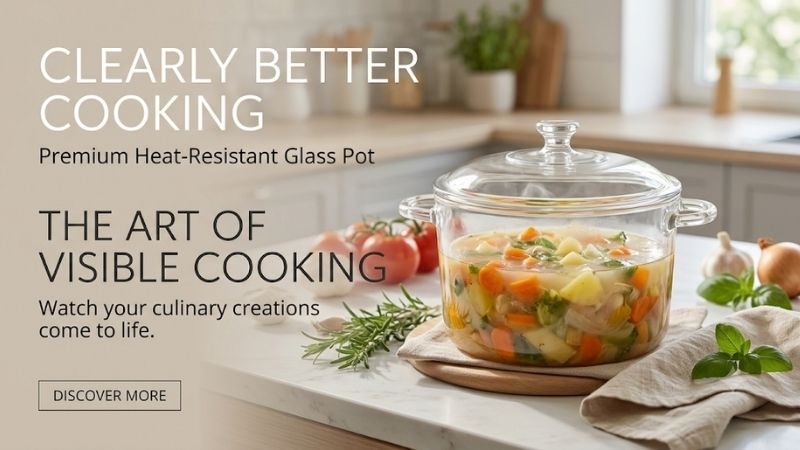
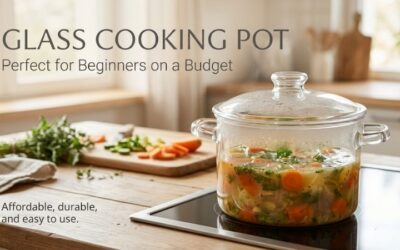
A glass cooking pot lets you monitor food while it cooks and offers an attractive alternative to conventional metal cookware. However, glass pots differ substantially in heat resistance, burner compatibility, and durability. This guide compares six identifiable products and explains which designs suit everyday simmering, family meals, and oven cooking.
Quick verdict: Which glass cooking pot should you choose?
The most suitable glass pot depends primarily on whether you intend to cook directly on a stovetop or inside an oven. Glass-ceramic cookware and certain specifically approved borosilicate pots can handle stovetop cooking, while many familiar glass casserole dishes are designed for ovens only. Choosing the correct material is more important than appearance or capacity.
For everyday stovetop simmering, the Visions 2.5L Covered Cookpot is a useful all-around option because its transparent glass-ceramic body is designed for burner use and provides capacity for multiple portions.
The SIMAX NYKO 2L Pot is an alternative for buyers interested in clear borosilicate cookware, although gas burners require a suitable flame diffuser.
For small quantities of sauces or oatmeal, the Visions 1L Covered Saucepan offers a more compact form.
The Visions 5L Covered Dutch Oven is a better match for larger batches of soup and stew.
The Luminarc Vitroflam 2L Casserole provides another glass-ceramic option, although buyers should verify the exact model, condition, and regional availability.
For oven-only cooking, the Pyrex 4-in-1 Round Glass Casserole offers a different solution. It should never be treated as interchangeable with stovetop-rated cookware.
Quick comparison table
A meaningful comparison must separate stovetop cookware from oven-only glass dishes. Capacity alone does not determine suitability, because the material and manufacturer’s operating instructions govern how heat can safely be applied. The table below focuses on identified products and their important practical distinctions rather than unverified retailer prices.
| Product | Best for | Material / capacity | Heat-source guidance | Main trade-off |
|---|---|---|---|---|
| Visions Covered Cookpot | Everyday soups and stews | Glass-ceramic, 2.5L | Gas and conventional electric stovetops | Limited US retail selection |
| SIMAX NYKO Pot | Clear borosilicate cooking | Borosilicate glass, 2L | Electric hob; gas with diffuser | Requires careful heat management |
| Visions Covered Saucepan | Small meals and sauces | Glass-ceramic, 1L | Gas and conventional electric stovetops | Limited capacity |
| Visions Covered Dutch Oven | Family-size liquid-based meals | Glass-ceramic, 5L | Gas and conventional electric stovetops | Bulkier and heavier |
| Luminarc Vitroflam Casserole | Glass-ceramic simmering | Glass-ceramic, 2L version | Verify exact model’s stovetop instructions | Availability and identification |
| Pyrex 4-in-1 Round Casserole | Oven casseroles and serving | Borosilicate glass, 1L | Oven and microwave; not stovetop | Cannot cook directly on burners |
Availability varies by region. Several glass-ceramic cookware lines are easier to find through specialty sellers than through ordinary US kitchen retailers.
How we selected these glass cooking pots
The selections prioritize identifiable cookware products with documented materials, named capacities, and useful cooking applications. Manufacturer guidance establishes the important difference between direct-burner cookware and oven-only glass vessels. Practical usefulness, cleaning requirements, safe handling, and appropriate meal size also influence the recommendations.
These are research-based editorial recommendations, not results from personal cooking tests.
The evaluation considered the following factors:
-
Whether the product is a real, identifiable cookware model.
-
Whether its construction is glass, borosilicate glass, or glass-ceramic.
-
Whether the manufacturer permits direct stovetop heat.
-
Whether restrictions apply to gas burners, electric burners, or induction.
-
How the vessel’s capacity matches everyday meals.
-
Whether its shape is practical for pouring, stirring, and cleaning.
-
Whether the product offers a meaningful advantage over other options.
-
What limitations a buyer should understand before ordering.
A lower-priced product is not necessarily better value if its permitted cooking methods do not match the buyer’s kitchen.
Likewise, a heat-resistant glass dish should not receive a stovetop recommendation merely because it looks similar to an approved cooking pot.
Detailed glass cooking pot recommendations
The six products below serve different household requirements, from small portions and daily stovetop cooking to larger soups and oven-based casseroles. Each recommendation explains why the construction may be useful, which cooking situations it supports, and where a different option would be more appropriate. Buyer suitability matters more than declaring one vessel universally superior.
Visions 2.5L Covered Cookpot — Best overall for stovetop cooking
The Visions 2.5L Covered Cookpot is a transparent glass-ceramic vessel designed for everyday cooking. Its approximately 2.6-quart capacity is practical for soup, stew, vegetables, and other liquid-based dishes. The material distinguishes it from ordinary glass bakeware because it is intended for use on compatible stovetop heat sources.
Best for: Home cooks who regularly prepare liquid-based meals and want to observe the contents without repeatedly lifting the lid.
Why we picked it: The combination of stovetop compatibility, moderate capacity, and transparent construction makes it a practical general-purpose choice within the relatively specialized glass cookware category.
Key specifications: The identified model belongs to the Visions covered cookpot range, with a nominal 2.5-liter capacity and glass-ceramic body.
Features and benefits: The transparent walls allow cooks to monitor liquid levels, bubbling, and the appearance of ingredients. A fitted cover supports covered simmering and helps reduce unnecessary moisture loss.
Glass-ceramic is also nonporous, making it useful for preparing foods that might leave persistent odors in certain other materials.
Performance and practical use: This pot is particularly appropriate for soups, vegetables, simmered sauces, and dishes containing sufficient liquid.
It is less appropriate for cooking methods that depend on the fast response and aggressive searing behavior of a conventional metal skillet.
Use controlled heating and follow the product’s care instructions.
What makes it different: Its capacity is more adaptable for everyday meals than a small saucepan, without reaching the bulk of a large Dutch oven.
Pros:
-
Useful size for several portions.
-
Transparent, nonporous cooking surface.
-
Designed for conventional stovetop use.
Cons:
-
Not a direct replacement for induction cookware.
-
US availability may require specialist sellers.
Buy if: You mainly cook soups, vegetables, sauces, and modest batches of stew on a compatible burner.
Skip if: You rely exclusively on induction or frequently need rapid, high-heat searing.
SIMAX NYKO 2L Pot — Best clear borosilicate option
The SIMAX NYKO 2L Pot is a clear borosilicate glass cooking vessel produced by Kavalierglass. Its identified 2-liter version is designed for liquid-based food preparation and has documented compatibility with electric cooking surfaces and gas burners when a flame diffuser is used. This makes its operating requirements more specific than those of some glass-ceramic cookware.
Best for: Buyers who want a transparent borosilicate cooking pot and are prepared to follow model-specific heating instructions.
Why we picked it: The manufacturer identifies the NYKO product family, provides distinct model codes and capacities, and publishes guidance about appropriate heat sources.
Key specifications: The 2-liter model is identified as code 6073. The published dimensions are approximately 170 mm in diameter and 125 mm in height. It belongs to the SIMAX heat-resistant borosilicate glass range.
Features and benefits: The transparent material makes it easy to observe soups, sauces, and other contents during simmering.
The nonporous surface does not require seasoning and can be cleaned using suitable nonabrasive methods.
Performance and practical use: This pot is suitable for water-containing foods such as light soups, rice preparations, and sauces when used according to manufacturer instructions.
On a gas stovetop, a suitable flame diffuser is required. Users should avoid abrupt temperature changes, heating the vessel empty, and exposing hot glass to cold or wet surfaces.
What makes it different: Unlike a generic glass saucepan with uncertain specifications, the NYKO has a documented manufacturer and identifiable product code.
Pros:
-
Clearly identified borosilicate construction.
-
Published heat-source guidance.
-
Transparent walls and straightforward cleaning.
Cons:
-
Gas cooking requires additional equipment.
-
More heating precautions than conventional metal cookware.
Buy if: You want a documented borosilicate pot for gentle liquid-based cooking.
Skip if: You want a vessel for aggressive sautéing or prefer cookware that needs no special heat-management precautions.
Visions 1L Covered Saucepan — Best for small portions
The Visions 1L Covered Saucepan is a compact glass-ceramic cooking vessel intended for smaller quantities of food. Its approximately 1.1-quart nominal capacity makes it appropriate for sauces, oatmeal, and reheating modest portions. The saucepan format is useful when a large cooking pot would be unnecessarily bulky.
Best for: Individuals or couples who regularly prepare small portions.
Why we picked it: Small-capacity cookware can be more practical than a family-size vessel for quick everyday tasks, particularly in kitchens with limited storage space.
Key specifications: The product appears in the identified Visions range as a 1-liter covered saucepan, commonly referenced by the VSP-1 model designation.
Features and benefits: Its compact capacity can help keep small amounts of food together during gentle heating rather than spreading them across the bottom of an oversized pot.
The glass-ceramic body allows visual monitoring and supports the line’s intended conventional stovetop applications.
Performance and practical use: This saucepan is a useful choice for warming a serving of soup, making a small batch of sauce, or preparing porridge.
However, it is not large enough for substantial family meals or recipes that produce considerable foam and require significant headroom.
When boiling liquids, avoid filling the pot near its rim. Leave sufficient space to prevent spillovers.
What makes it different: Compared with the 2.5-liter cookpot, the saucepan emphasizes small quantities and compact handling.
Pros:
-
Appropriate size for modest servings.
-
Easier to store than large covered pots.
-
Glass-ceramic construction intended for stovetop cooking.
Cons:
-
Limited room for larger recipes.
-
Specialty product availability can vary.
Buy if: You frequently make sauces, oatmeal, or single-serving soups.
Skip if: You usually cook for four people or need room for several ingredients.
Visions 5L Covered Dutch Oven — Best for larger meals
The Visions 5L Covered Dutch Oven provides a larger transparent glass-ceramic cooking vessel for households preparing family-size meals. Its nominal capacity is approximately 5.3 quarts, offering substantially more room than a small saucepan. The design is most relevant to soups, stews, and other recipes that benefit from covered cooking.
Best for: Families and home cooks who prepare larger quantities of food.
Why we picked it: The size addresses a genuine limitation of smaller transparent cookware: insufficient capacity for multiple servings and long-simmered liquid-based dishes.
Key specifications: The documented Visions VSD-5 model is a 5-liter covered Dutch oven within the transparent glass-ceramic cookware family.
Features and benefits: The pot provides room for liquid, vegetables, and proteins in recipes requiring extended simmering.
The transparent body makes it easier to observe liquid reduction and changes in the food’s appearance.
Performance and practical use: A larger pot is useful for vegetable soup, chicken stew, and similar dishes.
However, the additional capacity also means greater weight when filled. Lifting a large hot pot requires suitable oven mitts, a clear work surface, and careful handling.
A glass-ceramic Dutch oven should not be assumed to behave exactly like a thick enameled cast iron Dutch oven.
Its thermal properties, handling characteristics, and ideal recipes differ.
What makes it different: Its main advantage is greater cooking volume while retaining the visual benefits of transparent glass-ceramic.
Pros:
-
Capacity suitable for family meals.
-
Useful for liquid-based cooking.
-
Transparent construction helps monitor contents.
Cons:
-
More demanding to lift and store.
-
Not suitable for every induction setup.
Buy if: You frequently prepare several servings of soup or stew.
Skip if: Your kitchen has very limited storage or you rarely cook large batches.
Luminarc Vitroflam 2L Casserole — Best alternative glass-ceramic design
The Luminarc Vitroflam 2L Casserole belongs to a glass-ceramic cookware family offered in different sizes and finishes. The 2-liter version provides a covered vessel for modest meals and simmered dishes. Because product identification and regional availability vary, buyers should carefully distinguish genuine Vitroflam cookware from ordinary Luminarc glass tableware.
Best for: Buyers comparing established glass-ceramic cooking systems and who can verify the exact product being sold.
Why we picked it: Vitroflam provides another identifiable glass-ceramic cookware option rather than relying entirely on the Visions product line.
Key specifications: The selected version has a nominal 2-liter capacity. Vitroflam products have been offered in different finishes, including amber and opaque white varieties.
Features and benefits: The glass-ceramic body is designed for heat-resistant cooking applications and does not have a conventional nonstick coating.
Depending on the exact model, the covered construction can be useful for vegetable dishes, soups, and gentle simmering.
Performance and practical use: The main purchase consideration is product identification. Similar-looking glass casserole dishes may not share the same heat-source permissions.
Confirm the exact model’s original instructions before using it on a stovetop.
Do not assume that all Luminarc cookware or serving dishes are suitable for direct burner contact.
The condition of used cookware also matters. Inspect surfaces, rims, handles, and lids for visible damage.
What makes it different: Vitroflam provides an alternative construction and design choice within the glass-ceramic category.
Pros:
-
Glass-ceramic cooking construction.
-
Useful medium-size capacity.
-
No conventional nonstick coating to maintain.
Cons:
-
Model verification can be difficult.
-
Availability may be inconsistent.
Buy if: You can confirm authenticity, intended heat sources, and suitable condition.
Skip if: The seller cannot identify the model or provide adequate usage information.
Pyrex 4-in-1 Round Glass Casserole — Best for oven cooking
The Pyrex 4-in-1 Round Glass Casserole is a borosilicate glass dish designed for oven-based cooking, serving, and storage. The identified 1-liter model is a compact covered casserole suitable for baked vegetables, small casseroles, and other oven recipes. Crucially, it is not approved for use directly on a stovetop burner.
Best for: Home cooks who want a transparent oven casserole rather than a stovetop cooking pot.
Why we picked it: This product demonstrates an important difference within the glass cookware category: an oven-rated glass vessel can be useful even when direct burner use is prohibited.
Key specifications: The 1-liter version is identified under reference 207A000. Manufacturer information specifies borosilicate glass construction and oven compatibility, with a stated maximum conventional oven temperature of 350°C.
Features and benefits: Transparent walls make it possible to observe changes during baking without using an opaque metal or ceramic container.
The covered format is useful for certain moist oven-cooked dishes, while the glass construction allows food to be presented in the same vessel.
Performance and practical use: Use this casserole inside an oven according to the manufacturer’s instructions.
Never place it directly on a gas burner, electric coil, ceramic stovetop, grill, or barbecue.
Avoid sudden temperature changes and stop using a vessel that has chips, cracks, or other damage.
The small capacity is better suited to side dishes or modest portions than large meals.
What makes it different: It is an oven-only choice within a comparison that also includes stovetop-rated glass cookware.
Pros:
-
Identifiable borosilicate glass construction.
-
Suitable for selected oven recipes.
-
Convenient oven-to-table presentation.
Cons:
-
Not suitable for direct stovetop heat.
-
Limited capacity.
Buy if: You primarily bake small covered dishes.
Skip if: You need to boil soup or cook sauces directly on a burner.
Glass cooking pot buying guide
The safest purchasing process begins with identifying the cooking method rather than choosing a preferred color or capacity. Glass-ceramic, borosilicate, and ordinary glass products are not interchangeable. The exact model’s manufacturer instructions determine whether the vessel can be used on a gas burner, conventional electric cooktop, microwave, or inside an oven.
Understand the difference between glass and glass-ceramic
Glass cookware is commonly described using broad terms that hide important technical differences. Borosilicate glass has relatively low thermal expansion compared with ordinary soda-lime glass, making it useful for appropriately designed heat-resistant vessels.
Glass-ceramic is a different material produced through controlled crystallization. Certain glass-ceramic cookware systems are designed for direct stovetop cooking and substantial temperature changes.
Ordinary tempered glass used in lids or baking dishes may be suitable for specific cooking environments without being approved for direct burner contact.
The important rule is straightforward: material descriptions alone do not grant unlimited heating permission.
A borosilicate baking dish should never be placed on a burner unless the manufacturer specifically permits that use.
Likewise, a glass-ceramic product should still be used according to its published care instructions.
Choose the right capacity for your household
Capacity influences both cooking usefulness and storage requirements. A small 1-liter pot may be convenient for sauces, individual meals, and reheating, while a 2- to 2.5-liter vessel provides more room for everyday liquid-based recipes.
Larger pots around 5 liters are more appropriate for family-size stews and soups.
However, nominal volume is not the same as recommended working capacity. Foaming liquids, boiling pasta, or ingredients that expand during cooking require additional space.
Avoid filling a pot to the rim.
Also consider the weight of the filled vessel. A large glass-ceramic pot can become difficult to carry when loaded with food.
Choose capacity based on regular portion sizes rather than automatically purchasing the largest available option.
Check your stovetop before ordering
Stovetop compatibility deserves particular attention because some glass cooking pots work on conventional electric burners but require additional precautions on gas.
SIMAX NYKO models, for example, specify a flame diffuser for gas cooking.
Most conventional glass cookware is not inherently suitable for induction because induction cooktops require an appropriate magnetic cooking interface.
Some specialty products use a separate induction-compatible construction, but compatibility must be verified for the exact model.
Do not improvise with an induction adapter or diffuser unless both the cookware and adapter manufacturers permit the combination.
Even when a heat source is supported, burner size and heating technique matter.
Avoid heating glass cookware empty unless the manufacturer explicitly allows it.
Evaluate handling, lids, and cleaning requirements
A glass pot may look convenient on a shelf but become difficult to manage when filled with hot soup. Handle placement, grip size, and lid design can make a substantial difference during cooking.
Consider whether the pot has two side handles or one long handle.
Side handles may require both hands when lifting a heavy pot. A long handle may provide easier control for small quantities but increase storage requirements.
Glass lids allow visibility but introduce separate breakage and temperature considerations.
Use suitable dry oven mitts when handling hot cookware.
Cleaning should follow the manufacturer’s instructions. Many glass products can be washed using mild detergent and nonabrasive cleaning tools.
Avoid impact against sinks, countertops, and other cookware.
If a glass vessel develops visible damage, discontinue use.
Consider replacement cost and availability
Glass cookware may remain serviceable for many years when properly maintained, but its useful life depends on careful handling and avoiding damage. The purchase decision should consider more than initial price.
Check whether replacement lids can be obtained.
A discontinued product with a broken lid may be difficult to restore to its original configuration.
For specialty or imported cookware, consider shipping costs, return policies, and whether the seller supplies authentic documentation.
Used glass-ceramic cookware may be attractive when new inventory is limited, but condition becomes particularly important.
Do not buy a cooking vessel with visible cracks, chips, or structural damage.
A reasonably priced, identifiable model with clear care instructions is preferable to an unfamiliar product advertised with unsupported temperature claims.
Frequently Asked Questions
Glass cookware raises safety questions because different products may look nearly identical while having substantially different heating permissions. Understanding those distinctions helps prevent inappropriate use and makes it easier to choose a practical cooking vessel. These answers address common concerns about burners, induction, glass durability, and everyday maintenance.
Can a glass cooking pot be used on a gas stove?
Some glass cooking pots are designed for gas stovetop use, but others are not. Visions glass-ceramic cookware is intended for compatible conventional burners, including gas, while the SIMAX NYKO range requires a suitable flame diffuser when used over gas.
Ordinary glass baking dishes should not be placed over direct flame.
Always confirm the exact product’s instructions before use.
Avoid exposing handles to direct flame or heating an empty glass pot unless specifically permitted.
Is borosilicate glass safe for direct heat?
Borosilicate glass has properties that make it useful in heat-resistant cookware, but not every borosilicate product is approved for direct burner heating.
The vessel’s shape, construction, manufacturing method, and published operating instructions all matter.
A borosilicate casserole approved for oven use may still be prohibited on a stovetop.
Use only products specifically designed and labeled for the intended direct-heat application.
Can you use glass pots on induction cooktops?
Most conventional glass and glass-ceramic pots are not directly induction-compatible because they do not provide the magnetic cooking interface required by induction technology.
Specialty designs may incorporate induction-compatible components, but that feature must be confirmed for the exact product.
Do not assume a pot will work on induction because it is oven-safe or stovetop-safe.
Check both the cookware manufacturer’s instructions and your cooktop’s requirements.
Does glass cookware heat food evenly?
Glass and glass-ceramic have different thermal properties from aluminum, copper, and stainless steel cookware. The way heat moves through the vessel depends on material, wall thickness, heating method, and food contents.
Glass cookware can work well for appropriate simmering and oven applications, but it should not automatically be expected to match the heat response of a high-quality metal skillet.
For best results, follow the manufacturer’s recommended heat settings and avoid inappropriate high-heat cooking methods.
How should a glass pot be cleaned?
Allow the cookware to cool according to its manufacturer instructions before washing.
Use a soft sponge and suitable detergent to remove ordinary food residue.
Avoid abrasive cleaning pads that may scratch the glass.
Do not expose hot glass to sudden cold-water contact unless the manufacturer’s instructions specifically allow that treatment.
Before each use, inspect the vessel for cracks, chips, or damage around the rim and handles.
Conclusion
A glass cooking pot is worth considering when transparent construction, nonporous surfaces, and visually monitored cooking fit your kitchen routine. The Visions 2.5L Covered Cookpot offers a practical stovetop option, while SIMAX NYKO provides an identifiable borosilicate alternative with specific burner requirements. Choose a smaller Visions saucepan for modest portions, a larger Dutch oven for family meals, or a Pyrex casserole for oven-only cooking. Above all, confirm the exact model’s permitted heat sources before purchasing.

Write Your Review
No reviews yet. Be the first to share your experience!