
A stovetop steamer pot for busy mornings can help prepare vegetables, dumplings, and other simple breakfast foods without relying on complicated equipment. The right steamer should be easy to assemble, provide enough capacity for normal portions, and clean quickly. This guide explains what to buy and how to build an efficient morning cooking routine.
- Why a stovetop steamer works for morning meals
- Choosing the best steamer size for morning cooking
- Important features for quick morning preparation
- Morning foods suitable for stovetop steaming
- Building a practical morning steaming routine
- Common mistakes to avoid when buying or using a steamer
- Frequently Asked Questions
- Conclusion
Why a stovetop steamer works for morning meals
Stovetop steaming can simplify breakfast preparation because it requires a water-holding pot, suitable steaming insert, and lid rather than numerous cooking surfaces. Foods such as vegetables, prepared dumplings, and some reheatable dishes can cook using steam, although actual cooking time depends on ingredient size, quantity, and the equipment.
A steamer also avoids the need to fry every breakfast ingredient in oil.
This can be convenient when preparing vegetables or reheating suitable foods alongside other breakfast dishes.
However, stovetop steamers are not automatically faster than microwaves or electric appliances. Water must heat sufficiently to produce steam, and the amount of time required varies with the stove and pot.
For busy households, the greatest advantage is often an uncomplicated and repeatable process.
Preparing ingredients the evening before can save more time than purchasing an oversized or expensive steamer.
Choosing the best steamer size for morning cooking
Capacity determines how much food can be steamed at once, but larger equipment is not necessarily better for quick breakfasts. A small steamer may require less storage and be easier to wash, while a medium model offers more room for family portions. The ideal size depends on the number of servings and the foods regularly prepared.
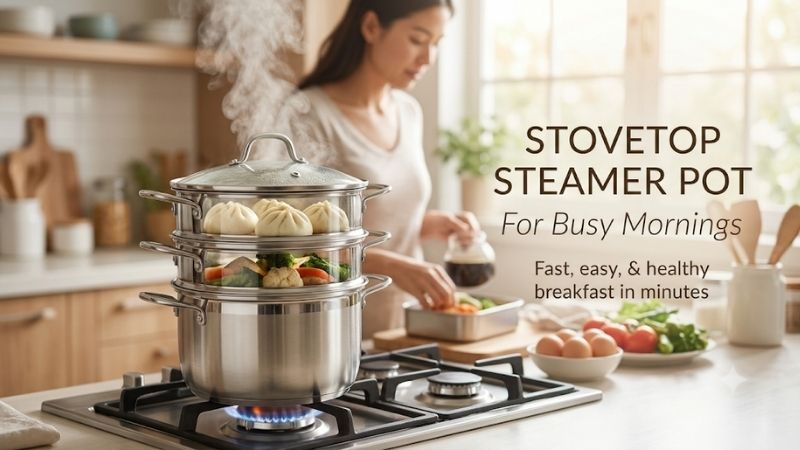
Compact three-quart steamers for one or two people
A three-quart saucepan with a matching steamer insert can be a practical choice for preparing modest portions of vegetables, small dumpling batches, and other breakfast accompaniments. Its relatively compact dimensions make it easier to store and may reduce the amount of cookware that needs to be cleaned afterward.
The Farberware Classic 3-Quart Saucepot with Steamer Insert illustrates this type of setup.
It includes a stainless steel saucepan and matching steaming accessory.
The pot can also be used without the insert for ordinary boiling or reheating tasks.
This multipurpose construction is particularly useful in kitchens where storage space is limited.
The main disadvantage is capacity.
Bulky vegetables or large batches of dumplings may not fit comfortably in one layer.
Medium steamers for family breakfasts
A medium steamer provides more room for several portions without requiring the footprint of a large stockpot. This format is useful when family members eat breakfast together and prefer foods that can be prepared simultaneously using steam.
The Tramontina Stainless Steel 20 cm Steamer Set includes a 3.6-liter casserole and a matching insert.
Its stainless steel construction and induction-compatible base provide flexibility across several stovetop types.
A medium steamer can prepare vegetables or a suitable quantity of dumplings, depending on their dimensions.
However, the insert should not be overcrowded.
Steam must circulate sufficiently around food to support consistent cooking.
Large multipots for batch preparation
Large multipots are useful when the household prepares substantial quantities of food in advance or regularly cooks for several people. Their greater capacity may support multiple portions, but they also require more water management, storage space, and cleaning effort than compact steamers.
The All-Clad Simply Strain 8-Quart Multipot is an example.
It includes a deep perforated insert intended for several cooking functions.
Although the pot can be used for steaming, buyers should consider whether its insert geometry is convenient for their normal breakfast foods.
A large multipot is not automatically the most efficient choice for a small morning meal.
For households preparing only one or two servings, a compact pot is usually more manageable.
Important features for quick morning preparation
Convenient breakfast cookware should reduce unnecessary setup and cleaning while remaining safe and predictable to use. A well-fitting lid, stable steaming insert, comfortable handles, and straightforward washing instructions are often more valuable than complex accessories that rarely contribute to everyday meals.
A well-fitting lid
A properly fitting lid helps contain steam and maintain a suitable cooking environment. Without an appropriate lid, steam can escape rapidly, potentially extending cooking time and increasing the amount of water needed for the process.
A transparent glass lid allows some visual monitoring, although condensation may obscure the contents.
Stainless steel lids are durable and commonly included with traditional cookware.
Neither material eliminates the need to open the lid carefully.
Always direct escaping steam away from your face and hands.
A removable steaming basket
A removable insert makes it possible to transfer cooked food out of the steaming environment without pouring away the water. This can be useful for repeated batches and helps separate food from the liquid below.
Look for stable handles and a secure fit.
The insert should remain supported by the pot rather than dropping into the water.
Perforations should allow steam circulation without permitting the intended food to fall through.
For small ingredients, a suitable food-safe liner may be necessary.
Dishwasher compatibility
Dishwasher-compatible components can simplify cleanup, particularly when preparing food before work or school. However, washing instructions vary according to the steamer’s material, handle design, and lid construction.
The Farberware Classic steamer set is manufacturer-listed as dishwasher safe.
Tramontina also lists dishwasher compatibility for its stainless steel steamer set.
Nevertheless, buyers should follow the exact product’s care instructions.
Allow hot cookware to cool appropriately before washing.
Induction compatibility
Induction compatibility matters in households using induction stoves because the base pot must contain an appropriate magnetic material. The steaming insert itself does not need to contact the burner or generate heat directly.
A stainless steel pot may or may not work on induction, depending on its construction.
Check the specific manufacturer’s compatibility statement.
Also make sure the pot’s base dimensions suit the induction cooking zone.
Morning foods suitable for stovetop steaming
Steaming can prepare a variety of breakfast foods, but different ingredients require different cooking times and food-safety precautions. Choosing recipes that fit the steamer’s capacity and require limited preparation can make the morning routine easier. Foods should be grouped according to compatible cooking requirements rather than placed together indiscriminately.
Vegetables for breakfast bowls
Vegetables such as broccoli, carrots, asparagus, and green beans can be steamed and incorporated into breakfast bowls, egg dishes, or prepared meals. Their cooking times vary according to size, thickness, and desired texture, so cutting ingredients consistently helps reduce uneven cooking.
Wash produce appropriately.
Cut vegetables into pieces of similar thickness when practical.
Arrange them without tightly packing the basket.
Keep the water level below the intended steaming surface.
Cook until the desired tenderness is reached.
Avoid leaving vegetables in the hot steamer after cooking, because residual heat can continue softening them.
Frozen dumplings and buns
Frozen dumplings and suitable steamed buns can be convenient breakfast foods because many products are designed for steaming from frozen. However, manufacturer instructions must be followed, especially when fillings contain meat or poultry.
Use a suitable liner if needed to reduce sticking.
Leave sufficient space for steam circulation and any expansion during cooking.
Do not assume all frozen dumplings share the same cooking time.
For foods requiring a safe internal temperature, check appropriately.
Avoid transferring raw meat juices to ready-to-eat foods.
Eggs and steamed egg dishes
Eggs can be cooked using steam, although the method differs from ordinary frying. Shell-on eggs, custard-style preparations, and certain savory egg dishes may be suitable, depending on the cookware and recipe.
For steamed egg custards, use a heat-safe container designed for stovetop steaming.
Place the container securely within the steamer.
Avoid overfilling it.
Control the steam intensity according to the recipe.
Because eggs can carry foodborne pathogens, use suitable ingredients and follow safe cooking guidance, particularly when serving young children, older adults, pregnant people, or individuals with weakened immune systems.
Reheating suitable prepared foods
Steaming can reheat some previously cooked foods without direct contact with hot water, making it useful for certain dumplings, buns, and other dishes that benefit from moisture. However, not every leftover is appropriate for steaming, and thorough reheating remains essential.
Refrigerate cooked foods promptly after their original preparation.
Keep refrigerated leftovers at 40°F or below.
Most cooked leftovers should be used within three to four days.
Reheat leftovers to 165°F when applicable.
Do not use steaming as a way to make food safe after improper storage.
Building a practical morning steaming routine
A successful morning routine depends on preparation, safe equipment setup, and choosing foods that fit the available cooking time. Organizing ingredients and tools before turning on the burner helps reduce unnecessary delays and limits the risk of leaving a hot steamer unattended while searching for utensils.
Prepare ingredients the night before
Preparing suitable vegetables or portioning frozen foods in advance can reduce morning workload. Proper refrigeration is essential because ingredients should not remain unrefrigerated overnight simply to make breakfast preparation faster.
Wash and cut appropriate vegetables.
Store them in clean food-safe containers.
Keep perishable items refrigerated.
Check that the steamer pot and lid are clean and ready for use.
Prepare serving bowls and utensils beforehand when practical.
Set up the steamer safely
The steamer should sit securely on a suitable burner with enough water to support the planned cooking duration. The steaming insert should remain above the water level when the recipe calls for true steaming rather than boiling.
Add water according to the manufacturer’s instructions.
Fit the steaming insert correctly.
Place food inside without overcrowding.
Cover with the lid.
Heat until steam develops, then maintain an appropriate level of steam.
Avoid allowing the pot to boil dry.
Coordinate different cooking times
Not all breakfast foods cook at the same rate. Dense carrots may require more time than thin asparagus, while frozen dumplings need the cooking duration specified by their manufacturer. Planning the order of ingredients helps avoid undercooking or excessive softening.
Begin with foods requiring longer cooking when appropriate.
Add faster-cooking foods later only when this can be done safely.
Minimize unnecessary lid lifting.
Check doneness using suitable methods.
For meat-containing foods, use internal temperature guidance where applicable.
Serve and clean efficiently
Once the food is cooked, remove the steamer from the heat and transfer the contents using appropriate tools. Hot steam and condensed water can cause burns, so the insert should be handled carefully.
Lift the lid away from yourself.
Use suitable oven mitts.
Place hot components on heat-safe surfaces.
Allow cookware to cool before washing.
Clean and dry all food-contact components before storage.
Common mistakes to avoid when buying or using a steamer
Busy households may prioritize speed and overlook important details such as insert stability, actual usable capacity, or safe lifting arrangements. These issues can make everyday steaming less convenient and, in some cases, create avoidable hazards. The best solution is usually straightforward equipment paired with a repeatable cooking method.
Choosing a large pot for very small servings
A large steamer can be inconvenient when preparing one person’s breakfast because it occupies more storage space and may require additional cleaning. Larger capacity is valuable only when the household uses it regularly.
Choose a size based on normal portions.
Do not purchase oversized cookware solely for rare gatherings.
Overcrowding the steaming basket
Too much food can prevent steam from circulating properly. Dense ingredients placed in thick layers may cook unevenly, especially when their pieces differ substantially in size.
Arrange food with reasonable spacing.
Cook in batches when necessary.
Never assume the outer pieces and center of a crowded basket are equally cooked.
Leaving the pot unattended
Steaming requires an ongoing heat source and enough water to prevent the vessel from boiling dry. Leaving a pot unattended can create a dangerous situation, particularly when the water evaporates.
Monitor the cooking process.
Use an appropriate burner setting.
Turn off the stove after cooking.
Frequently Asked Questions
Shoppers looking for convenient morning cookware often ask whether a steamer is faster than a microwave, whether frozen foods can be cooked directly, and which capacity is sufficient for an ordinary household. These answers clarify the practical benefits and limitations of stovetop steaming.
Is a stovetop steamer good for quick breakfasts?
Yes. A compact stovetop steamer can prepare vegetables, dumplings, and other suitable foods with a relatively simple setup. However, total cooking time includes heating the water and should not be assumed shorter than other cooking methods.
What size steamer is best for one person?
A compact steamer designed for a small saucepan is usually sufficient for modest portions. A complete three-quart saucepan-and-insert set can also provide useful versatility.
Can frozen dumplings go directly into a steamer?
Many frozen dumplings are intended to be cooked from frozen. Follow the product’s instructions, use an appropriate steaming liner when needed, and ensure any meat-containing fillings reach a safe temperature.
Can I steam breakfast foods while cooking eggs separately?
Yes. A steamer can operate on one burner while another pan prepares eggs, provided there is sufficient stovetop space and both cooking processes can be monitored safely.
Is an electric steamer better for busy mornings?
Electric steamers may offer timers and automatic controls, while stovetop steamers use cookware that can serve additional purposes. The better choice depends on available space, cooking habits, and desired convenience.
Conclusion
A stovetop steamer pot for busy mornings should be compact enough for everyday use, easy to clean, and compatible with your stove. A three-quart saucepan-and-steamer set suits many individuals and couples, while a medium stainless steel model offers additional flexibility for families. Choose equipment with a stable insert, a secure lid, manageable handles, and straightforward maintenance. Preparing ingredients in advance and using consistent cooking routines will usually save more time than purchasing oversized equipment. Whatever the recipe, monitor water levels, control steam carefully, and follow proper food-safety guidance.

Write Your Review
No reviews yet. Be the first to share your experience!