
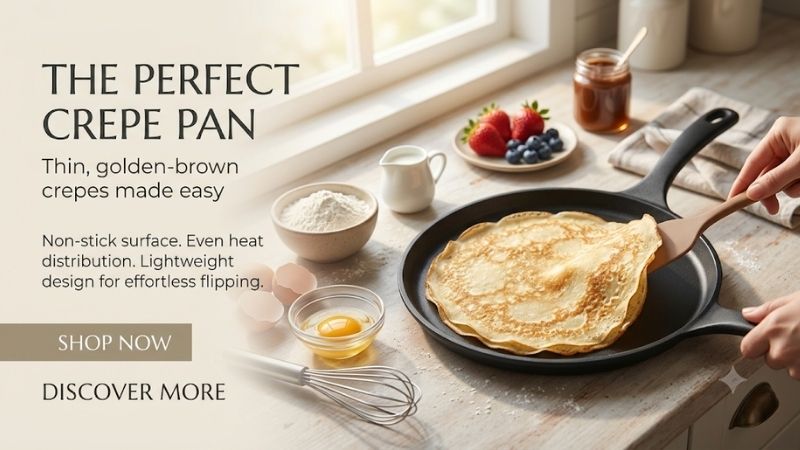
A good crepe pan combines a broad, relatively flat cooking surface with a low rim that makes spreading batter and turning delicate crepes easier. Material, diameter, weight, and maintenance requirements influence the experience. This guide compares six cookware options and explains how to choose one for your stovetop and cooking habits.
Quick verdict: Which crepe pan is right for you?
The right crepe pan depends on experience level, preferred cooking surface, and whether you want to use the cookware for other recipes. Dedicated carbon steel pans are attractive for cooks who enjoy developing seasoning, while nonstick designs offer more straightforward initial food release. Flat cast iron griddles provide a durable multipurpose alternative.
-
Best traditional carbon steel option: de Buyer MINERAL B Carbon Steel Crepe & Tortilla Pan, 10.25 inches.
-
Best compact carbon steel option: de Buyer MINERAL B, 9.5 inches.
-
Best for larger crepes: de Buyer MINERAL B, 12 inches.
-
Best premium nonstick option: Le Creuset Toughened Nonstick PRO Crepe Pan, 11 inches.
-
Best multipurpose cast iron alternative: Lodge 10.5 Inch Round Cast Iron Griddle.
-
Best compact griddle alternative: Lodge 8 Inch Cast Iron Griddle.
These six configurations offer different advantages, although the three de Buyer options belong to the same product family and mainly differ in size. They are included as separate purchase configurations because diameter materially affects how crepes are prepared.
Quick comparison table
The most important specifications are cooking surface diameter, material, coating, rim design, and compatibility with the available cooktop. A larger pan provides room for broader crepes but may require more careful batter distribution. Likewise, carbon steel and cast iron differ in handling and temperature responsiveness from coated aluminum cookware.
| Product | Material | Nominal size | Best for | Main trade-off |
|---|---|---|---|---|
| de Buyer MINERAL B Crepe & Tortilla Pan | Carbon steel | 9.5 inches | Smaller crepes | Requires seasoning |
| de Buyer MINERAL B Crepe & Tortilla Pan | Carbon steel | 10.25 inches | Everyday crepes | Requires seasoning |
| de Buyer MINERAL B Crepe & Tortilla Pan | Carbon steel | 12 inches | Larger crepes | More storage space |
| Le Creuset Toughened Nonstick PRO Crepe Pan | Hard-anodized aluminum with nonstick coating | 11 inches | Easy release | Coating care |
| Lodge Round Cast Iron Griddle | Seasoned cast iron | 10.5 inches | Multipurpose cooking | Heavy |
| Lodge Round Cast Iron Griddle | Seasoned cast iron | 8 inches | Compact kitchens | Limited cooking area |
How we selected these crepe pans
A useful crepe pan should provide enough flat surface to spread batter into a thin layer and allow the finished crepe to be loosened and turned without unnecessary tearing. We focused on identifiable cookware configurations, material characteristics, manufacturer-supported care information, and the needs of different home cooks. These selections are not presented as firsthand cooking-test results.
Dedicated crepe pans generally have lower sides than standard skillets. This helps a thin spatula reach beneath the edge of a crepe.
The shape is valuable because crepes are delicate and often need to be turned before the entire surface has developed substantial structure.
Thermal behavior also matters. Carbon steel can respond reasonably quickly to burner adjustments, while cast iron typically provides greater thermal mass.
Nonstick coatings can reduce the difficulty of releasing crepes, especially for beginners.
However, nonstick coating durability depends on use, cleaning practices, and avoiding overheating.
Detailed crepe pan recommendations
The six options below address different crepe-making situations rather than assuming that every buyer needs professional-style equipment. Some are specialized pans designed for thin batters, while others are versatile flat griddles that can also prepare pancakes and other breakfast foods. Consider how often you make crepes before investing in dedicated cookware.
de Buyer MINERAL B 10.25-Inch Crepe & Tortilla Pan — Best overall carbon steel
The de Buyer MINERAL B 10.25-Inch Crepe & Tortilla Pan is a French-made carbon steel pan with a relatively low rim, riveted steel handle, and a cooking surface designed for thin crepes and tortillas. Its 2.5 mm material thickness, approximately 9-inch cooking surface, and seasoning requirements distinguish it from conventional nonstick pans.
Best for: Home cooks who frequently prepare crepes and prefer carbon steel.
Why we picked it: Its dimensions provide a practical balance between surface area and handling.
Key specifications:
-
Nominal diameter: 10.25 inches.
-
Cooking surface diameter: approximately 9 inches.
-
Body: Carbon steel.
-
Thickness: 2.5 mm.
-
Weight: approximately 2.93 pounds.
-
Riveted steel handle.
-
Manufacturer-listed induction compatibility.
Features and practical use
The relatively low sidewall makes turning and lifting crepes easier than using a deep skillet.
Carbon steel requires initial seasoning and consistent maintenance.
A well-maintained seasoned surface can support food release, although it should not be assumed to behave identically to a manufactured nonstick coating.
The pan’s size is suitable for ordinary home crepes.
What makes it different: It offers a dedicated low-rim crepe profile with traditional carbon steel construction.
Pros:
-
Dedicated crepe-friendly shape.
-
Durable metal cooking surface.
-
Suitable for several common cooktop types.
Cons:
-
Requires seasoning.
-
Needs careful drying after washing.
Buy if: You make crepes regularly and enjoy maintaining carbon steel cookware.
Skip if: You want dishwasher convenience or minimal surface maintenance.
de Buyer MINERAL B 9.5-Inch Crepe & Tortilla Pan — Best compact option
The 9.5-inch de Buyer MINERAL B Crepe & Tortilla Pan uses the same general carbon steel construction as its larger family members but offers a smaller cooking area. With an approximately 8.25-inch cooking surface and a listed weight of 2.86 pounds, it is suited to moderate crepe portions and kitchens where controlling a smaller pan is preferable.
Best for: Small households and compact stovetops.
Why we picked it: A smaller cooking area can make batter distribution easier for some users while requiring less storage space.
Key specifications:
-
Nominal diameter: 9.5 inches.
-
Cooking surface: approximately 8.25 inches.
-
Thickness: 2.5 mm.
-
Weight: approximately 2.86 pounds.
-
Carbon steel body.
Features and practical use
A smaller crepe pan can help keep batter portions manageable.
It also requires less room on the stovetop than a larger model.
Like other traditional carbon steel pans, it needs seasoning and proper maintenance.
The main disadvantage is limited space for wide, filled crepes.
What makes it different: Compact dimensions within a dedicated carbon steel crepe pan design.
Pros:
-
Manageable size.
-
Low-rim construction.
-
Durable cooking surface.
Cons:
-
Smaller finished crepes.
-
Requires seasoning care.
Buy if: You prefer smaller crepes and limited storage requirements.
Skip if: You regularly prepare large savory crepes.
de Buyer MINERAL B 12-Inch Crepe & Tortilla Pan — Best for large crepes
The 12-inch de Buyer MINERAL B Crepe & Tortilla Pan is the largest of the three configurations considered here. Its approximately 10-inch cooking surface and four-pound listed weight provide more space for spreading batter, making it particularly relevant for larger breakfast portions and savory crepes that will be folded around fillings.
Best for: Larger crepes and experienced home cooks.
Why we picked it: It offers additional cooking area within the same carbon steel product family.
Key specifications:
-
Nominal diameter: 12 inches.
-
Cooking surface: approximately 10 inches.
-
Thickness: 2.5 mm.
-
Weight: approximately 4 pounds.
-
Carbon steel body.
Features and practical use
A wider surface provides greater flexibility when distributing thin batter.
It may also make larger crepes easier to fold around fillings.
However, handling a wider pan requires more deliberate control.
The pan must also fit the burner and available storage space.
What makes it different: Larger usable surface area than the smaller MINERAL B variants.
Pros:
-
More room for large crepes.
-
Suitable for savory preparations.
-
Traditional carbon steel construction.
Cons:
-
More demanding batter distribution.
-
Requires more storage space.
Buy if: You want larger crepes and are comfortable managing a wider pan.
Skip if: You cook on a small burner or have limited cabinet space.
Le Creuset Toughened Nonstick PRO Crepe Pan — Best premium nonstick
The Le Creuset Toughened Nonstick PRO Crepe Pan uses forged hard-anodized aluminum construction with a reinforced nonstick coating. Its approximately 11-inch interior diameter, low sides, and manufacturer-listed induction compatibility make it suitable for cooks who want a dedicated crepe shape without the seasoning requirements of traditional carbon steel.
Best for: Cooks prioritizing convenient food release and cleaning.
Why we picked it: Its construction addresses buyers who prefer coated cookware and want a purpose-built crepe pan.
Key specifications:
-
Nominal diameter: 11 inches.
-
Forged hard-anodized aluminum body.
-
Reinforced nonstick coating.
-
Induction compatible.
-
Manufacturer-listed oven-safe rating up to 500°F.
-
Dishwasher-safe according to the manufacturer.
Features and practical use
The low cooking surface supports spreading thin batter and sliding a spatula beneath finished crepes.
Its nonstick finish can simplify crepe release.
The manufacturer permits certain metal utensil use but recommends gentler silicone or wooden implements to protect the surface.
This product uses a PFAS-containing nonstick coating, which should be considered by buyers with specific material preferences.
What makes it different: Dedicated crepe geometry with premium coated aluminum construction.
Pros:
-
No seasoning process.
-
Low-rim design.
-
Compatible with induction.
Cons:
-
Coating requires appropriate care.
-
Higher purchase price than many basic pans.
Buy if: You prioritize easy food release.
Skip if: You specifically want uncoated cookware.
Lodge 10.5-Inch Round Cast Iron Griddle — Best multipurpose alternative
The Lodge 10.5-Inch Round Cast Iron Griddle is a traditional seasoned cast iron cooking surface with relatively low sides, making it usable for pancakes, tortillas, and crepes. Although it is not a dedicated specialist crepe pan in the same sense as the de Buyer designs, its flat surface offers flexibility for households that prepare several kinds of breakfast foods.
Best for: Home cooks who want one pan for multiple purposes.
Why we picked it: It offers versatile flat cooking space rather than specializing exclusively in crepes.
Key characteristics:
-
Nominal size: 10.5 inches.
-
Seasoned cast iron construction.
-
Low-sided griddle format.
-
Suitable for various flat-surface cooking tasks.
Features and practical use
The broad cooking surface can support pancakes, tortillas, and crepes.
Cast iron retains heat well once preheated.
However, its weight makes tilting the pan to spread batter more demanding than with lighter cookware.
A batter spreader may therefore be useful.
What makes it different: Greater versatility for everyday flat-surface cooking.
Pros:
-
Durable.
-
Useful for several breakfast foods.
-
No manufactured nonstick coating.
Cons:
-
Heavier than many dedicated crepe pans.
-
Requires seasoning care.
Buy if: You want versatile breakfast cookware.
Skip if: You primarily want a light pan for thin French crepes.
Lodge 8-Inch Round Cast Iron Griddle — Best small griddle alternative
The Lodge 8-Inch Round Cast Iron Griddle offers a smaller, low-sided cooking surface that can accommodate compact crepes, pancakes, and tortillas. Its greatest advantage is its reduced footprint compared with larger griddles, although the smaller cooking area limits finished crepe diameter and may not suit recipes designed for broad, thin pancakes.
Best for: Single servings and kitchens with limited space.
Why we picked it: It provides a compact alternative to larger multipurpose griddles.
Key characteristics:
-
Nominal size: 8 inches.
-
Seasoned cast iron.
-
Flat griddle design.
-
Intended for stovetop cooking.
Features and practical use
A smaller cooking area is straightforward to manage when making modest portions.
The pan’s low rim can help with spatula access.
However, its relatively small surface restricts the size of the finished crepe.
It also retains the weight and seasoning considerations associated with traditional cast iron.
What makes it different: Its compact footprint.
Pros:
-
Suitable for small portions.
-
Multipurpose flat cooking surface.
-
Durable construction.
Cons:
-
Limited crepe diameter.
-
Heavier than some lightweight alternatives.
Buy if: You want a small cast iron griddle for several foods.
Skip if: You regularly prepare large crepes.
Buying guide: How to choose a crepe pan
The ideal crepe pan should make spreading, cooking, and turning thin batter manageable without requiring unnecessary maintenance. Pan material, cooking-surface diameter, rim height, and handle comfort all affect the result. Understanding these differences is more useful than simply choosing the most expensive product or the largest advertised size.
Carbon steel versus nonstick versus cast iron
Carbon steel, nonstick aluminum, and cast iron provide different combinations of surface behavior, thermal characteristics, and maintenance requirements. Carbon steel develops seasoning over time, coated aluminum offers convenient initial food release, and cast iron provides substantial thermal mass but often requires more effort when tilting the pan.
Choose carbon steel when you value durable traditional cookware.
Choose nonstick when simple release and cleaning are priorities.
Choose cast iron when you want a versatile flat cooking surface and are comfortable with its weight.
Choosing the correct crepe pan diameter
Crepe pan diameter determines the maximum practical size of the finished crepe, but the usable cooking surface is often smaller than the advertised outside diameter. A pan with a 10-inch nominal measurement may have a smaller flat center because of its rim and wall geometry.
Small pans are convenient for compact breakfasts.
Medium pans are practical for ordinary dessert crepes.
Large pans are attractive for savory crepes and recipes involving substantial fillings.
Always consider the burner size and cabinet space.
Why low sides matter
Low sides make it easier to reach beneath a thin crepe with a spatula and reduce interference when turning or transferring the finished food. Traditional deep skillets can make this movement awkward, especially when a crepe spreads nearly to the edge of the cooking surface.
A shallow rim can also assist with controlled batter distribution.
However, extremely low sides provide less containment for liquid batter.
The ideal rim balances access with sufficient edge height to keep the mixture on the cooking surface.
How to make crepes without sticking
Successful crepe preparation depends on batter consistency, controlled heat, cooking-surface preparation, and correct timing. A premium pan can make these steps more forgiving, but no cookware guarantees perfect results if the batter is excessively thick, the surface is overheated, or the crepe is turned before it has developed enough structure.
Prepare the batter and cooking surface
Thin crepe batter should spread readily across the cooking surface while maintaining enough structure to form a flexible cooked sheet. Excessively thick batter produces pancake-like results, while uneven mixing can create lumps that interfere with uniform spreading.
Use a dependable crepe recipe.
Mix ingredients until the batter is smooth.
Allow resting time when the recipe calls for it.
Prepare the cooking surface according to its material.
Use an appropriate amount of cooking fat if required.
Control heat during cooking
Crepes need enough heat to set the batter and develop gentle browning without scorching the underside before the upper surface has cooked sufficiently. Because stove output and pan materials vary, successful cooking requires observing the first crepe and adjusting the burner rather than relying on a single universal heat setting.
Begin with moderate heat.
Pour a measured amount of batter onto the pan.
Spread or tilt promptly while the batter remains fluid.
Allow the surface to set before turning.
Adjust the heat if the crepe browns too quickly or remains pale for too long.
Turn and remove the crepe
Turning a crepe is easier when the underside has cooked sufficiently and the edges begin separating from the pan. Attempting to flip it too early can cause tearing, while waiting excessively may produce a dry, brittle texture that is difficult to fold.
Slide a thin, suitable spatula beneath the edge.
Loosen the crepe carefully.
Turn it using a controlled movement.
Cook the second side as needed.
Transfer the finished crepe to a plate and repeat with the remaining batter.
Frequently Asked Questions
Buyers frequently wonder whether a dedicated crepe pan is necessary, which surface is easiest for beginners, and how to prevent sticking or tearing. These questions matter because a properly selected pan can simplify the process, but technique remains a major factor in consistently producing thin, flexible crepes.
Do I need a special pan to make crepes?
A dedicated crepe pan is helpful but not strictly necessary. A regular flat skillet can prepare crepes when it has enough usable cooking space and allows the finished food to be loosened and turned.
Low sides provide an advantage, but proper batter consistency and cooking technique remain essential.
Is carbon steel better than nonstick for crepes?
Carbon steel is useful for cooks who want a durable surface that develops seasoning, while nonstick cookware often offers easier initial food release. The best choice depends on the owner’s maintenance preferences and cooking experience.
Neither material guarantees good crepes without correct heat control.
What size crepe pan should beginners buy?
A medium pan is generally a practical starting point because it offers enough surface area for ordinary crepes without requiring the user to spread batter across an excessively wide area.
A 9.5- or 10.25-inch dedicated crepe pan is worth considering, depending on the actual usable cooking surface.
Can I use a crepe pan for tortillas?
Many low-sided pans are suitable for warming or preparing tortillas when their materials and heat limits match the cooking method. Some manufacturers specifically describe their products as crepe and tortilla pans.
The ideal temperature and technique depend on the tortilla recipe and pan material.
Conclusion
A well-chosen crepe pan should make thin batter easy to spread, turn, and remove while matching your preferred maintenance routine. The de Buyer MINERAL B 10.25-Inch Crepe & Tortilla Pan is a practical carbon steel choice, while the Le Creuset Toughened Nonstick PRO Crepe Pan is better suited to buyers who prioritize coated-surface convenience. Lodge cast iron griddles provide useful multipurpose alternatives. Choose according to cooking-surface size, weight, coating preferences, and how frequently you prepare crepes rather than relying on price alone.


Write Your Review
No reviews yet. Be the first to share your experience!