
A stainless steel cookware set for baking at home can handle far more than stovetop cooking when its pans, handles, and lids are rated for oven use. From baked pasta and frittatas to braised meat and skillet desserts, the right collection provides useful versatility. This guide explains how to select oven-compatible cookware without confusing ordinary pots and pans with specialized bakeware.
- Can you use a stainless steel cookware set for baking?
- Choosing the right stainless steel cookware construction
- Oven-safe features that matter most
- Essential cookware pieces for baking at home
- Stainless steel cookware versus dedicated bakeware
- Choosing cookware for different baking recipes
- How to prevent sticking when baking in stainless steel
- Cleaning stainless steel cookware after baking
- Frequently Asked Questions
- Conclusion
Can you use a stainless steel cookware set for baking?
Many stainless steel cookware sets include oven-safe frying pans, sauté pans, saucepans, and Dutch ovens. These can be useful for oven-finishing, braising, roasting, and selected baked dishes. However, cookware designed for stovetop use does not automatically replace cake pans, loaf pans, muffin tins, or other dedicated baking equipment.
The distinction matters because different recipes depend on the shape, dimensions, heat distribution, and cooking surface of the vessel.
A stainless steel skillet may be suitable for a frittata or oven-finished chicken. A sauté pan may accommodate baked pasta, while a stainless steel Dutch oven can be used for covered bread baking if its temperature rating and construction are appropriate.
By contrast, delicate cakes may require particular pan dimensions and preparation techniques that an ordinary stainless steel saucepan cannot provide conveniently.
The most useful collection is one that supports both everyday stovetop cooking and the oven recipes you actually prepare.
Choosing the right stainless steel cookware construction
Stainless steel cookware is available in several constructions that influence heat transfer, weight, durability, and oven compatibility. The outer material does not explain everything about a pan’s performance, so buyers should consider conductive layers, base design, handle construction, and the complete product’s temperature limits.
Fully clad stainless steel cookware
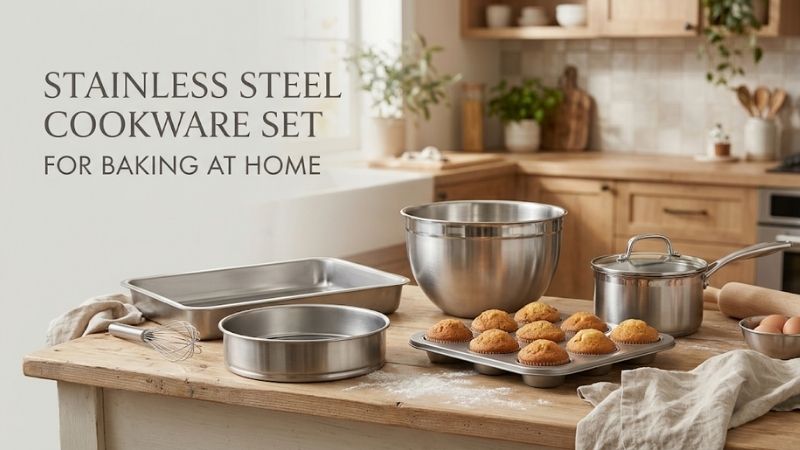
Fully clad stainless steel cookware incorporates bonded metal layers throughout the cooking vessel, commonly combining stainless steel surfaces with an aluminum core. This construction can help distribute heat across the bottom and sidewalls, making it useful for recipes that begin on the stove and finish in the oven.
The All-Clad D3 Stainless 10-Piece Cookware Set and Cuisinart MultiClad Pro 12-Piece Cookware Set are examples of this construction.
Fully clad cookware can be particularly useful when browning ingredients before oven-finishing them.
A sauté pan might begin by browning chicken on the stovetop, then move into the oven to complete cooking.
The same vessel can subsequently be used for a pan sauce if its stovetop compatibility permits.
However, fully clad construction does not guarantee identical heat distribution in every oven or recipe. Actual performance depends on the materials, cookware dimensions, and oven environment.
Encapsulated-base stainless steel cookware
Encapsulated-base cookware commonly incorporates a conductive layer, such as aluminum, within the bottom of a stainless steel vessel. This arrangement supports stovetop heat distribution but differs from fully clad construction because the sidewalls may not contain the same bonded layers.
The Cuisinart Chef’s Classic Stainless Steel collection illustrates this category.
An encapsulated-base saucepan can handle simmering sauces, boiling, and suitable oven tasks when approved by the manufacturer.
However, cookware that heats primarily through its base may behave differently from fully clad cookware during certain stovetop-to-oven recipes.
For oven cooking, the shape and overall construction of the vessel remain important.
An encapsulated base is not inherently unsuitable for oven use, but its complete temperature rating must be confirmed.
Three-ply versus five-ply construction
Three-ply cookware typically combines three bonded layers, while five-ply construction uses additional metal layers. The number of layers can affect thermal mass and temperature response, but it should not be interpreted as a universal indicator of better baking results.
The All-Clad D3 range uses tri-ply construction.
The All-Clad D5 Brushed Stainless range uses five-ply construction.
Both can support oven cooking when used within their documented limits.
Five-ply cookware may be heavier or respond differently to heat changes.
For ordinary baked pasta, casseroles, or oven-finished proteins, a well-designed tri-ply pan may already meet the household’s needs.
Choose based on the actual cookware, not the number of layers alone.
Oven-safe features that matter most
The oven-safe rating of a stainless steel pan depends on its complete construction, including the handles, lid, attachments, and any additional components. Buyers should verify the exact product’s published limits instead of assuming that all stainless steel cookware can tolerate every baking temperature.
Oven temperature limits
Different cookware collections have different oven-temperature ratings, even when their cooking surfaces are all stainless steel. These limits become especially important when preparing bread, roasting at elevated temperatures, or moving a pan directly from the stovetop into a hot oven.
The All-Clad D3 Stainless collection is manufacturer-listed as oven and broiler safe up to 600°F.
The Cuisinart MultiClad Pro range is listed as oven safe up to 500°F.
These ratings support a variety of suitable oven recipes, but they should not be treated as invitations to use maximum temperatures unnecessarily.
Choose the temperature required by the recipe and stay within the cookware’s stated limits.
Never assume a pan’s lid has the same rating as the uncovered vessel.
Stainless steel lids versus glass lids
Lid material affects oven compatibility and can influence which recipes a cookware set supports. Stainless steel lids often provide greater flexibility at elevated temperatures, while tempered glass lids commonly have lower manufacturer-specified limits.
All-Clad HA1 cookware, for example, has different temperature limits for its pans and glass lids, although that range uses hard-anodized aluminum rather than stainless steel cooking surfaces.
This illustrates why lids must be evaluated separately.
For stainless steel collections, check whether the included lids are approved for oven use.
A covered braise may require a lid that can remain in the oven for a prolonged period.
If the lid is unsuitable, use a recipe-compatible alternative rather than improvising with unsafe materials.
Handle materials and riveted construction
Metal handles are common on stainless steel cookware and may support oven use when approved by the manufacturer. However, handle shape, attachment, and total temperature rating still matter.
Riveted stainless steel handles provide secure mechanical attachment.
Their primary disadvantage during baking is that they can become extremely hot.
Use appropriate oven mitts whenever handling cookware that has been inside the oven.
Do not assume a metal handle is cool because it appears identical to one used on the stovetop.
Avoid placing hot cookware on surfaces that cannot tolerate the temperature.
Broiler compatibility
Broiling exposes cookware to intense radiant heat from an oven element, which can create different operating conditions from ordinary baking. A pan rated for oven use is not necessarily approved for broiler use.
The All-Clad D3 Stainless range includes manufacturer-listed broiler compatibility.
Other collections may have different restrictions.
Check the exact cookware instructions.
Avoid using glass lids or unsuitable accessories beneath a broiler.
Consider the distance between the pan and heating element, particularly with tall handles.
Essential cookware pieces for baking at home
A useful stainless steel cookware collection should include vessels that serve both stovetop and oven purposes. Rather than buying the largest available set, select pieces that match ordinary cooking and occasional baking tasks, paying attention to capacity, handle clearance, and compatible lids.
Stainless steel frying pans
An oven-safe stainless steel frying pan is useful for foods that benefit from initial stovetop browning followed by oven finishing. Examples include frittatas, thick cuts of meat, skillet potatoes, and selected desserts.
A 10-inch frying pan is a practical all-purpose size.
An 8-inch skillet may suit individual servings.
A 12-inch skillet offers additional space for family meals.
However, larger frying pans require greater oven clearance because their handles extend beyond the cooking surface.
For delicate desserts, a stainless steel skillet may need careful greasing or lining to reduce sticking.
Stainless steel sauté pans
A sauté pan usually has relatively straight sides and a larger usable interior volume than a comparable shallow skillet. This makes it useful for recipes containing sauces, vegetables, and proteins that begin on the stove and finish in the oven.
A 3- or 4-quart sauté pan can accommodate many family dishes.
The higher sides help contain ingredients and cooking liquids.
The wide cooking surface also supports browning before oven finishing.
However, a loaded sauté pan can be heavy.
A helper handle may make lifting safer when the pan is filled with hot food.
Stainless steel saucepans
Saucepans are typically associated with simmering sauces, boiling, and reheating, but oven-safe models can be useful for selected recipes requiring a relatively deep vessel. Their limited diameter and higher sides make them less appropriate for some baked dishes but suitable for others.
A small saucepan can hold certain custards or preparations requiring gentle heating when the recipe permits.
However, a stainless steel saucepan does not automatically behave like a dedicated cake pan.
Its wall height and shape can alter cooking time and heat distribution.
Use the cookware only for recipes that suit its design.
Stainless steel Dutch ovens and stockpots
A stainless steel Dutch oven can be useful for covered oven recipes, including some braised dishes and bread preparations when the vessel and lid meet the required temperature specifications.
A stockpot may also be oven-compatible, but its height and shape can make it inconvenient for certain ovens.
Check total dimensions before using it.
A covered bread recipe may require substantial preheating, which should be performed only when permitted by the cookware manufacturer.
A metal lid can become extremely hot and must be handled carefully.
For frequent bread baking, a dedicated Dutch oven or bread vessel may offer a more convenient design.
Stainless steel cookware versus dedicated bakeware
Stainless steel cookware and specialized bakeware overlap in some tasks, but their shapes and intended uses differ. A frying pan is convenient for oven-finishing and certain skillet desserts, while a rectangular baking dish, loaf pan, or muffin tin provides geometry specifically suited to particular baked goods.
| Baking task | Stainless steel cookware | Dedicated bakeware |
|---|---|---|
| Frittata | Oven-safe frying pan | Baking dish |
| Baked pasta | Oven-safe sauté pan | Casserole dish |
| Braised meat | Covered Dutch oven | Covered roasting vessel |
| Skillet dessert | Oven-safe skillet | Cake or baking pan |
| Sandwich bread | Not generally ideal | Loaf pan |
| Muffins | Not suitable as a direct substitute | Muffin tin |
| Layer cake | Requires recipe adaptation | Round cake pans |
| Large roast | May have limited capacity | Roasting pan |
For a household with limited storage, versatile cookware can reduce the number of specialized vessels needed.
However, replacing every bakeware item with ordinary pots and pans may compromise convenience or recipe results.
The objective should be sensible overlap, not forcing unsuitable cookware into every baking task.
Choosing cookware for different baking recipes
Different oven recipes require different cookware geometry, surface preparation, and temperature handling. Buyers should consider the kinds of dishes they prepare most frequently and avoid purchasing an expensive collection solely because it has a high oven-temperature rating.
Frittatas and baked egg dishes
An oven-safe skillet is practical for frittatas because the egg mixture can begin on the stovetop and finish in the oven.
A 10-inch skillet offers useful flexibility for many household portions.
However, the cooking surface must be properly prepared to reduce sticking.
Eggs can adhere strongly to uncoated stainless steel.
Use adequate cooking fat and follow a suitable recipe.
When transferring the skillet, remember that the handle remains hot after removal.
Baked pasta and casseroles
A deep sauté pan can be useful for baked pasta when its capacity and oven rating are appropriate.
The higher sides help contain sauce and cheese.
The pan may also support initial stovetop cooking of vegetables or meat before the remaining ingredients are added.
However, stainless steel cookware may develop stubborn baked-on residue.
Consider whether a dedicated ceramic or glass baking dish would be easier for your normal routine.
Oven-finished chicken and meat
Oven-safe stainless steel cookware is particularly useful for proteins that benefit from searing before baking.
Begin with suitable stovetop browning.
Transfer the pan to the oven as directed by the recipe.
Use a food thermometer to verify doneness.
Poultry should reach a safe internal temperature of 165°F.
Do not rely solely on exterior color or cooking time.
Bread and skillet desserts
Certain bread and dessert recipes can be prepared in suitable stainless steel cookware, but the pan’s thermal behavior and shape influence the result.
A stainless steel skillet may work for some skillet cakes.
A covered stainless steel Dutch oven may support certain bread recipes.
However, recipe adaptation may be necessary.
Do not substitute cookware without considering pan dimensions, heat limits, and the intended baking method.
How to prevent sticking when baking in stainless steel
Stainless steel is durable and versatile, but it does not have the same release properties as manufactured nonstick coatings. Baked foods containing eggs, sugar, starch, or cheese can adhere to the surface, making preparation and cleaning important.
Prepare the cooking surface
Use cooking fat appropriate for the recipe.
Spread it evenly across the relevant surfaces.
For certain desserts, suitable parchment paper may help when the recipe permits.
Do not place parchment in direct contact with heating elements or use it beyond its stated temperature limit.
Avoid excessive temperatures
An oven-safe rating is a maximum permitted condition, not a recommended temperature for every recipe.
Excessive heat can burn food and create stubborn residue.
Follow recipe temperatures.
Use an oven thermometer if temperature accuracy is uncertain.
Avoid unnecessary broiler exposure.
Allow food to set before removal
Some baked dishes need a short resting period before cutting or serving.
This can help the structure stabilize.
However, foods should not remain unrefrigerated beyond safe holding periods.
For recipes containing perishable ingredients, follow appropriate food-safety guidance.
Cleaning stainless steel cookware after baking
Baked-on food residue can be more difficult to remove than ordinary stovetop residue because foods may remain in contact with hot surfaces for extended periods. Proper cleaning protects the finish while removing starch, fats, and proteins that adhere during cooking.
Remove baked-on residue safely
Allow the cookware to cool sufficiently.
Add warm water and suitable detergent.
Use manufacturer-approved cleaning tools.
For persistent residue, follow the recommended soaking or cleaning method.
Avoid pouring cold water into a very hot pan because sudden temperature changes can damage cookware.
Address discoloration and water spots
Stainless steel may develop heat-related discoloration or mineral marks after repeated use.
These changes are often cosmetic.
Use suitable stainless steel cleaning products when recommended.
Avoid inappropriate abrasive materials.
Dry the cookware thoroughly before storing it.
Protect handles and lids
Clean around handle rivets where residue may accumulate.
Wash lids according to their specific instructions.
Do not expose glass lids to sudden temperature changes.
Check for damage before further use.
Frequently Asked Questions
Buyers often want to know whether stainless steel cookware can replace baking pans, whether all metal handles are oven-safe, and how high a temperature their cookware can tolerate. These concerns matter because construction and accessory limits vary considerably between product lines.
Can I bake a cake in a stainless steel frying pan?
Some cakes can be prepared in suitable oven-safe skillets, but the recipe may require adjustments for pan dimensions, surface preparation, and baking behavior.
A dedicated cake pan is generally more convenient for conventional layer cakes.
Is stainless steel cookware safe at 450°F?
Some stainless steel cookware is rated for temperatures above 450°F, but compatibility must be confirmed for the exact pan and any attached lid or accessories.
Do not infer temperature limits from material alone.
Can stainless steel handles go in the oven?
Many stainless steel handles are designed for oven use, but the complete cookware product must be approved for the intended temperature.
Handles become very hot and require protection.
Is tri-ply cookware better for baking?
Tri-ply construction can help distribute heat, but oven performance also depends on pan shape, recipe, and cooking temperature.
It is not universally superior to all other cookware for every baked food.
Do I still need a baking sheet?
For cookies, many vegetables, and other flat foods, a baking sheet remains useful.
A stainless steel cookware set should be viewed as complementary to dedicated bakeware rather than a complete replacement.
Conclusion
The right stainless steel cookware set for baking at home should provide oven-compatible vessels that also perform well on the stovetop. A fully clad collection with skillets, a sauté pan, saucepans, and a suitable covered pot offers substantial versatility for frittatas, braised dishes, baked pasta, and oven-finished meats. All-Clad D3 and Cuisinart MultiClad Pro are examples of collections with useful documented oven ratings, but buyers should verify the exact configuration and lid limits. Prioritize practical vessel sizes, safe handles, and recipe compatibility, and retain specialized bakeware for foods that require particular shapes or baking characteristics.

Write Your Review
No reviews yet. Be the first to share your experience!