
A spice drawer organizer for easy storage should speed up cooking, not merely arrange jars in perfect rows. The right system keeps labels readable, prevents rolling, and makes refills and cleaning manageable. This guide covers measuring, choosing an insert, organizing mixed containers, and maintaining a drawer that works after weeks of use.
- Quick Answer: Easy Storage Means Easy Retrieval
- Measure and Prepare the Drawer Before Buying an Insert
- Pick a Format That Matches Your Everyday Routine
- Arrange the Drawer for One-Motion Access
- Reduce Refill, Cleaning, and Maintenance Work
- Budget and Purchasing Decisions That Avoid Regret
- Frequently Asked Questions
- Conclusion
Quick Answer: Easy Storage Means Easy Retrieval
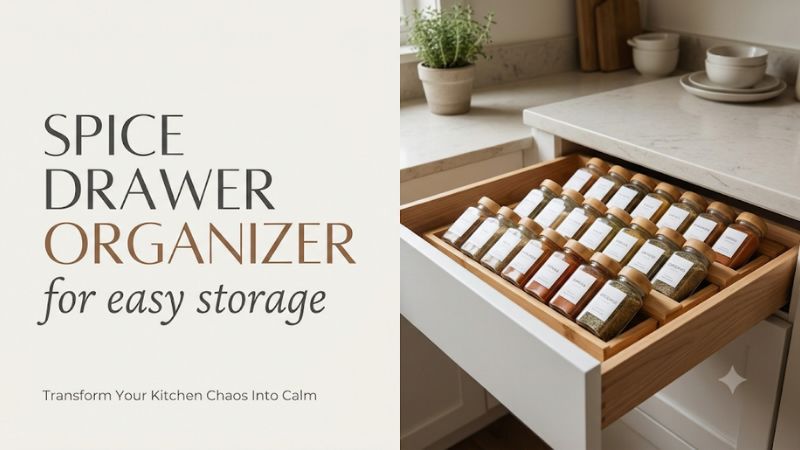
The simplest spice drawer is not necessarily the one with the highest jar capacity or the most elaborate dividers. It is the one where you can open the drawer, identify a seasoning without moving other bottles, lift it comfortably, and return it to the same place. A low-profile cut-to-fit liner, compact molded tray, or well-fitted tiered insert can all meet that goal when paired with the right containers.
- Fast retrieval: Each label faces upward or toward the person opening the drawer.
- Reliable stability: Round bottles do not roll freely when the drawer moves.
- Good fit: The drawer closes without rubbing against jar caps.
- Flexible capacity: Empty spaces are intentional rather than packed with rarely used spices.
- Simple upkeep: Powder spills can be cleaned without dismantling the entire system.
Ease of use depends on the actual kitchen and the hands using it. Someone who opens the spice drawer many times per day may prefer the most-used seasonings near the front, while a baker with an occasional spice collection might prefer alphabetical organization. The layout should reflect ordinary movement through the kitchen rather than an arbitrary social-media display. Do not purchase new matching jars until you know whether existing bottles can already work in the available drawer.
Measure and Prepare the Drawer Before Buying an Insert
The first purchasing mistake is treating a kitchen drawer as an empty rectangle defined only by its stated cabinet width. Drawer slides, structural supports, back corners, and the cabinet frame can reduce usable space. For easy storage, you must also have enough clearance to grip a jar, lift it from an angled tray, and close the drawer without scraping caps or bending labels.
Measure the Inside Width, Depth, and Actual Closed Clearance
Use a tape measure to record the clear inside width from one wall to the other, the usable depth between front and back obstructions, and the maximum height available once the drawer is closed. The drawer-front exterior may be wider or taller than the internal box, and a raised jar on a stepped rack can extend beyond the height of the organizer itself.
- Inside width: Account for rails or side braces that protrude into the drawer.
- Usable depth: Do not count space blocked by the rear wall or drawer-front hardware.
- Closed height: Test whether the tallest cap fits beneath the cabinet frame.
- Hand clearance: Leave room to grip a lid without scraping a knuckle.
- Drawer action: Test full travel, including the point where the box passes the cabinet opening.
A cardboard mockup is an effective way to see whether a tiered organizer will fit. Place a few representative spice bottles on a piece of cardboard cut to the proposed footprint, tilt them slightly, and test the drawer’s opening and closing path. This is not a substitute for the manufacturer’s exact dimensions, but it reveals why a rack that fits on paper can still interfere with daily use. Record the smallest usable measurement rather than the most generous one.
Count and Categorize the Containers You Already Own
Before choosing a fifteen- or thirty-jar solution, remove all seasonings from the current storage area and count the ones you truly use. Distinguish round grocery-store bottles, square glass jars, squat tins, refill packets, and unusually tall containers. A product that is designed around one standardized bottle shape may be a poor match for a collection whose real forms vary widely.
Group ingredients by daily, weekly, and occasional use. Note which have damaged labels, duplicate packages, clumped contents, or loose caps. Discard items that show contamination or other safety concerns, and check quality when aroma and flavor have faded. This inventory may reveal that you need only a compact tray for common seasonings plus a small bin for refill packets, rather than a complicated full-width insert.
- Keep full, legible labels whenever possible.
- Consolidate duplicates only when contents and freshness are clear.
- Record the tallest and widest bottles for fit checks.
- Separate packet storage from open-mouthed or frequently accessed jars.
- Reserve a small expansion margin without buying empty containers for display alone.
Choose a Drawer Away From Heat, Moisture, and Cleaning Products
A closed drawer protects spices from direct sunlight, but it is not automatically an ideal storage environment. A drawer under a persistently hot appliance or beside a humid sink area may expose seasonings to unfavorable conditions. Dried herbs and ground spices retain their quality better when stored in tightly closed containers in cool, dry locations away from heat, light, and moisture.
Check whether the drawer feels warm after normal cooking or develops dampness during dishwashing. If it does, select another cabinet or storage unit rather than relying on the organizer to solve environmental problems. Keep seasonings separate from detergents and household chemicals. A well-fitted spice tray is helpful only when the ingredients themselves can remain clean, dry, and correctly labeled between meals.
Pick a Format That Matches Your Everyday Routine
Easy storage is fundamentally about reducing the number of actions required to retrieve an ingredient and put it away. A flexible foam liner can solve uneven drawer dimensions, a compact tray can support a small collection, a bamboo rack can create structured rows, and a complete jar kit can standardize an otherwise chaotic assortment. Choose the format that reduces work for your existing kitchen rather than the one with the most dramatic before-and-after photograph.
Cut-to-Fit Liners for Unusual Drawers and Mixed Bottles
Soft modular liners such as YouCopia SpiceLiner can be trimmed and arranged to suit an irregular drawer. The product is described as a ten-foot foam roll that can be cut with scissors. This format may allow more control over row spacing than a rigid insert, although jar shape and width still affect how effectively the strips hold containers in place.
Best for: A drawer that does not match standard rack dimensions or contains several common bottle shapes.
- Benefits: Flexible arrangement, low-profile support, potential reuse of existing jars.
- Limitations: Cutting is required; the finish is less integrated than a solid insert.
- Setup tip: Test a few bottles and confirm the correct strip orientation before cutting all pieces.
- Skip if: You want a one-piece rack you can remove and clean as a unit.
A liner is particularly useful when an extra few inches of space remain beside the spice rows. That area can hold unopened seasoning packets or a small measuring tool in a separate compartment. However, do not layer bottles carelessly just to use every inch. The whole point is to make individual ingredients visible and accessible. Keep enough clearance for caps, labels, and hands, especially when drawers are shallow.
Compact Molded Trays for Small Everyday Collections
A molded organizer such as OXO’s Compact Spice Drawer Organizer creates defined angled spaces for standard round and square jars. Its described features include non-slip feet and a removable tray, making it a sensible choice for cooks who want a straightforward installation and simple cleanup rather than a custom configuration that fills the entire drawer.
Best for: A focused everyday spice collection and a drawer with limited space.
- Benefits: Structured support, good label angle, removable cleaning surface.
- Limitations: Fixed dimensions and tier geometry may not suit unusual bottle sizes.
- Setup tip: Leave an adjacent compartment for refill packets or measuring spoons.
- Skip if: You need wall-to-wall flexibility for a large varied collection.
A compact tray’s apparent unused space can be an advantage. It allows the drawer to serve more than one related purpose without mixing loose utensils into the spice rows. Keep small tools in a separate section so they do not push jars out of position. A rigid tray is also easier to lift out as one unit than a series of loose pieces when you need to wipe accumulated spice powder from the drawer bottom.
Expandable Bamboo and Wooden Inserts for Structured Rows
Expandable bamboo racks such as the SpaceAid four-tier design create a more finished appearance while allowing some width adjustment. Other wooden inserts, including trim-to-fit models, can occupy most of a dedicated spice drawer. These systems work best when you have measured carefully, use relatively consistent bottles, and prefer a clear row-based layout rather than flexible loose bins.
Best for: Dedicated spice drawers where visual order and a predictable bottle position matter.
- Benefits: Defined rows, angled label display, cohesive appearance.
- Limitations: Depth and closed height remain fixed constraints even on adjustable-width models.
- Setup tip: Check the full product footprint and your tallest jar before ordering.
- Skip if: You move frequently, rent with limited modification options, or have many irregular packets.
A wooden insert can provide satisfying daily organization, but it must be maintained properly. Powder, oil, and moisture can collect around the tiers, and excessive soaking may be unsuitable for the finish. Follow cleaning instructions and wipe spills promptly. Do not assume that a rack marketed as expandable is compatible with every drawer width or jar shape. Confirm which dimension actually expands and whether the closed drawer still clears the angled bottles.
Complete Jar-and-Rack Kits for a Fresh Start
Some drawer systems are sold with matching glass spice jars and label collections, such as SpaceAid’s complete organizer kits. These can solve compatibility problems by providing a coordinated container format, but they require transferring ingredients out of original packaging. They are most useful when existing spice storage is highly inconsistent and the household is willing to maintain labels and refills.
Best for: Home cooks replacing many mismatched bottles and creating a long-term dedicated drawer.
- Benefits: Uniform footprint, coordinated labels, more predictable row spacing.
- Limitations: Decanting, cleaning, and preserving ingredient information require effort.
- Setup tip: Prepare and label every clean, dry jar before transferring a single ingredient.
- Skip if: Your existing bottles already fit a good tray or you use only a few spices.
A complete kit is not necessarily the easiest system for a beginner. The first setup may involve a large number of jars and several hours of cleaning, labeling, and transferring ingredients. If you want an immediate improvement with minimal disruption, a liner or compact tray is often more sensible. The benefit of standardization increases when many seasonings are accessed regularly, not merely when a kitchen has many possible jars to fill.
Arrange the Drawer for One-Motion Access
Once the organizer fits, the next goal is to make the arrangement intuitive. A cook should see the seasoning name, reach it, and return it without moving other jars. Start with your normal standing position at the preparation counter and arrange the most-used ingredients where your eyes and hands naturally go when the drawer opens. This turns a tidy drawer into a genuinely useful cooking tool.
Place Everyday Seasonings Where Your Eyes Land First
Frequency-based placement often works better than strict alphabetical order for a small collection because the highest-use ingredients become easy to reach. Garlic powder, pepper, paprika, cinnamon, and preferred blends may all deserve the front row depending on the household. Specialty items can occupy a later row or a separate shaded compartment without making everyday meals less convenient.
The exact front row depends on drawer location and which edge is easiest to see when partially open. Test by retrieving three common seasonings in the order they would appear in a real recipe. If the layout requires fully opening the drawer every time or lifting one bottle to reach another, rearrange it before committing labels. Good organization follows repeated physical use rather than decorative symmetry.
- Put daily-use items in the most visible positions.
- Put occasionally used items farther back without hiding them completely.
- Keep similarly named spices clearly distinguishable.
- Reserve a separate area for refill packets and large containers.
- Return bottles to the same place after every use.
Label the Surface That Faces Up When Jars Lie Flat
A label on the side of a jar may be useless when the container lies on a sloped drawer rack. Choose the top, cap, or outward-facing surface that remains visible from your typical viewing angle. Use large, unambiguous ingredient names and avoid tiny decorative scripts that require picking the jar up before it can be identified.
This matters for similar-looking powders such as ground cinnamon, cumin, ginger, and certain seasoning blends. For mixed spices, preserve ingredient details when allergens or dietary restrictions are relevant. If you change the jar contents, remove or cover the previous label completely. Reusing a jar with two conflicting names is a preventable source of cooking mistakes, especially when multiple family members share the drawer.
Balance Appearance With Room for Your Hands
A photograph of a perfectly filled spice drawer may show no visible gaps, but a real drawer requires clearance for fingers and changing container sizes. Pack bottles too tightly and the organizer becomes difficult to use, particularly when labels curl, caps widen, or a jar is returned at a different angle after cooking. Leave a margin around the edge and between groups of bottles.
A slightly underfilled tray often works better than a maximum-density layout. It permits easier cleaning, reduces the risk of caps rubbing against the cabinet frame, and makes future replacement containers less disruptive. If a new spice does not fit, reconsider the overall inventory before buying an add-on organizer. The desired result is a manageable system that remains stable as products are replaced over time.
Reduce Refill, Cleaning, and Maintenance Work
A drawer organizer remains easy to use only when it is easy to maintain. Spice powders scatter, labels wear, and jars need refilling, so the best storage design keeps those ordinary chores simple. Favor removable elements when possible and avoid creating tiny inaccessible cavities where spilled powder can accumulate. The less effort cleaning requires, the more likely the drawer will stay functional throughout daily cooking.
Refill Without Losing Ingredient Identification
A good refill routine begins before a jar is empty. Keep refill packages in one designated dry pantry location, record or preserve ingredient information, and refill the primary jar only when its identity is certain. Avoid pouring new powder into containers with unknown residue, dampness, or a conflicting label. Clean according to container instructions and allow every part to dry completely.
- Inspect the current contents before adding a refill.
- Keep spice names and blend ingredients clearly identified.
- Use a clean, dry funnel or spoon when transferring powders.
- Close the container tightly and check the seal.
- Store unopened reserves away from heat, sunlight, and moisture.
Some herbs and spices lose aroma more quickly than others; an enormous reserve supply is not automatically an economical purchase if it sits unused. Smaller, fresher quantities may be more valuable for infrequent ingredients. Plan refills according to household cooking frequency rather than the dimensions of the jar or the apparent discount on bulk packages.
Clean Powder Spills Without Damaging the Organizer
Ground spices can stain and cling to drawer corners, particularly when a cap loosens or a jar tips. A removable molded tray may be easier to wipe, while wooden inserts and foam liners require the cleaning methods recommended for their materials. Empty and clean one section at a time rather than scattering every jar across the countertop each time a small spill occurs.
Do not soak bamboo or wood unless manufacturer guidance permits it. Avoid strong cleaners near food containers and dry surfaces before returning spices. Check that jars are completely closed and that no powder remains trapped in threads or lid seals. This brief maintenance step helps prevent clumping, cross-contact, and repeated messes in the same location.
Make the Drawer Accessible for Everyone Who Cooks
Easy storage should work for all regular cooks, not only the person who installed the rack. Some users may struggle with tiny labels, narrow jar caps, high or deep drawers, or heavy glass containers. If accessibility is important, consider larger print, jars with easy-to-grip closures, and a drawer position that minimizes stretching or bending. Test the real motion of retrieving and replacing a container.
Avoid assuming that the visually neatest arrangement is most accessible. A shorter row of well-labeled jars may be more usable than three crowded tiers. An older cook may prefer a shallow pull-out tray, while someone who often cooks with one hand may need a particularly stable container and rack. Product-specific ease of opening should be assessed directly or through credible evidence rather than inferred from photographs.
Budget and Purchasing Decisions That Avoid Regret
A spice drawer organizer can be a low-cost functional improvement, but expenses rise when the project includes new jars, labels, mounting accessories, or woodworking. Start with the least complicated option that solves the actual issue. There is little reason to discard serviceable food-safe containers merely because a staged kitchen drawer shows matching bottles and identical lids.
Decide Which Features Are Truly Worth Paying For
If spice bottles roll around, the priority is stable support. If labels are difficult to read, the priority is a better angle and clearer identification. If the drawer is oddly shaped, the priority is adjustability. A premium wooden finish may be worth considering for a dedicated kitchen renovation, but it will not help if the tray cannot accommodate the jar necks or drawer clearance.
- For the lowest setup effort: Use a small ready-made tray that fits existing bottles.
- For irregular spaces: Consider cut-to-fit foam or modular dividers.
- For a permanent finished look: Evaluate bamboo or trim-to-fit wood.
- For a large coordinated reset: Compare complete jar kits with the effort required to decant.
- For mixed packages: Add a separate packet bin rather than forcing everything into jar channels.
Look at replacement needs and long-term flexibility. A drawer may be redesigned, a spice brand may change its bottle shape, or a household may begin using fewer blends. Systems that tolerate such changes can provide better lasting value than rigid arrangements designed around one set of jars. Always confirm current product dimensions and return terms, especially before trimming a wooden insert or transferring spices into included containers.
Know When Not to Use a Spice Drawer at All
Not every kitchen has a suitable drawer. Some drawers are too shallow, too warm, too close to moisture, or needed for cutlery and essential tools. Forcing a spice insert into the only available drawer may make the kitchen less efficient overall. In that case, a cool cabinet with a small stepped shelf or portable caddy may provide easier and safer access.
An organizer should solve the full storage problem, not win a competition for how many items fit inside one drawer. Before buying, observe your daily cooking route and decide which cabinet, drawer, or shelf is naturally reachable without crossing hot burners or moving other kitchen equipment. The best location often saves more effort than changing from one rack material to another.
Frequently Asked Questions
People shopping for easy spice storage frequently ask whether a rack requires matching jars, what dimensions matter, and how to keep the organizer useful after the initial setup. The main principle is straightforward: protect flavor, preserve clear ingredient identification, and choose a system whose footprint and cleaning needs match the kitchen you already use.
What Is the Easiest Type of Spice Drawer Organizer?
A compact one-piece tray is often the simplest to install when it fits your existing bottles and drawer. A cut-to-fit liner is more flexible for irregular spaces but requires measuring and trimming. Expandable wood or bamboo inserts can create structured rows, although full depth and height must still be checked. The easiest option is the one that requires the fewest unnecessary container changes while keeping jars visible and stable.
Do I Need Matching Jars for a Spice Drawer Organizer?
No. Many liners, modular trays, and compact organizers are intended for common retail bottles. Matching jars can improve visual consistency and may fit dedicated rack channels more predictably, but they create decanting and labeling work. Measure the bottles you own first, especially the tallest and widest ones. If they fit securely and labels are readable, transferring every spice into new glass containers may offer little practical benefit.
How Do I Stop Spice Bottles From Rolling in a Drawer?
Choose a tray or liner designed to cradle round containers and place it on a clean, stable surface. Verify that the row geometry fits the specific bottles rather than merely counting available slots. If the tray itself slides, inspect its feet or manufacturer-recommended placement and avoid overloading it. Do not rely on loose improvised wedges that can shift and cause bottles to hit the drawer face.
Should I Organize Spices Alphabetically or by Cooking Frequency?
Both methods can work. Cooking-frequency organization reduces retrieval effort for daily seasonings, while alphabetical order helps when a collection is large and varied. Many households use a hybrid: frequently used jars in the first row and remaining spices alphabetized behind them. The method matters less than clear top-facing labels and a consistent habit of returning each container to the same position after use.
How Often Should I Clean a Spice Drawer Organizer?
Clean promptly after spills and inspect the drawer periodically for crumbs, powder residue, damaged labels, and moisture. There is no single schedule that fits every kitchen. Frequent cooks may need more regular wiping, whereas a lightly used drawer may stay tidy longer. Follow the organizer’s material-specific cleaning instructions, dry surfaces thoroughly before replacing jars, and keep food containers separate from household cleaning chemicals.
Conclusion
A spice drawer organizer for easy storage should deliver fast identification, stable jars, straightforward refilling, and cleaning that does not become a chore. Measure the complete usable drawer space, keep existing bottles when possible, and select a flexible liner, compact tray, or structured tiered rack to match the collection. Place everyday seasonings where they are easy to reach, maintain clear labels, and store all spices away from heat and moisture. The simplest system that works consistently is better than a crowded drawer that only looks organized on the first day.



Write Your Review
No reviews yet. Be the first to share your experience!