
A fridge egg organizer for large families needs to accommodate frequent breakfasts, baking, and meal preparation without making eggs difficult to track. Large-capacity trays and rolling dispensers can improve access, but they also require careful handling and cleaning. This guide explains how to plan egg storage, choose an appropriate capacity, preserve purchase information, and follow safe refrigeration practices.
- Quick Answer: Keep Egg Storage Simple and Traceable
- Understand How Large Families Use and Store Eggs
- Compare Egg Storage Designs for Larger Households
- Food Safety: The Most Important Buying Consideration
- How to Choose Capacity and Fit
- Create a Family-Friendly Egg Rotation System
- Common Mistakes Large Families Should Avoid
- Frequently Asked Questions
- Conclusion
Quick Answer: Keep Egg Storage Simple and Traceable
For large families, the most practical starting point is a dedicated refrigerator shelf area for original egg cartons. This follows FDA recommendations and preserves the information printed on each carton. If the household prefers a separate organizer for convenience, select one with sufficient capacity, gentle egg support, easy cleaning, and a reliable method for keeping purchases identifiable.
Recommended approaches:
- Best for food safety and simplicity: Original cartons grouped on an interior refrigerator shelf.
- Best dedicated covered organizer: A large compartment tray holding approximately twenty eggs.
- Best for frequent sequential access: A carefully loaded rolling dispenser.
- Best for two-dozen inventories: A larger dual-track egg organizer.
- Best for several household cooks: Clearly identified separate purchase groups.
- Best for limited refrigerator space: Multiple compact cartons or trays arranged without blocking airflow.
A family using many eggs does not automatically need to transfer them into one decorative container. Organization should make older purchases easy to identify and reduce unnecessary handling rather than encouraging the mixing of eggs with unknown purchase dates.
Understand How Large Families Use and Store Eggs
Family size influences egg consumption, but cooking habits matter just as much. A household preparing breakfast at home every morning may use more eggs than a larger family that eats breakfast elsewhere. Baking, meal preparation, and entertaining can also create temporary increases in demand. The right storage system should reflect actual usage rather than a fixed number of eggs per person.
Estimate Weekly Egg Consumption
Start by recording how many eggs the household uses during a typical week. Include breakfast meals, baking recipes, family lunches, and any other frequent dishes. This will help distinguish ordinary consumption from occasional high-volume needs.
Practical inventory questions:
- How many eggs are used at breakfast?
- How frequently does the household bake?
- Are eggs included in meal-prep recipes?
- Does the family shop once or several times a week?
- Are multiple cartons purchased together?
- How often do unused eggs remain after shopping?
For example, a family of five preparing scrambled eggs several mornings per week may need significantly more storage than a family of seven that rarely cooks eggs.
Buy organizer capacity for the household’s normal inventory, not an unrealistic maximum.
Separate Daily Access From Reserve Inventory
Large families often benefit from a dedicated location for frequently used eggs and a clearly identifiable reserve carton or purchase group. This reduces confusion when someone buys another carton before the previous supply has been used.
The simplest version keeps original cartons together on an appropriate refrigerator shelf.
Useful arrangement:
- One clearly accessible carton for everyday use.
- Additional original cartons grouped nearby.
- Older purchases positioned for use first.
- Newer purchases kept identifiable.
- No loose eggs mixed into unrelated food bins.
If using a dedicated organizer, maintain the same purchase-group distinction through clear records or separate containers.
Avoid adding new eggs directly on top of older ones without considering the rotation system.
Plan for Multiple Household Cooks
When several adults or older children prepare meals, storage needs to be intuitive. A complicated organizer that requires one person to explain which eggs are oldest can create unnecessary confusion. Keep the arrangement straightforward and make relevant purchase information available.
Family-friendly practices:
- Use one designated egg storage area.
- Keep cartons or purchase labels accessible.
- Avoid moving eggs between unrelated containers.
- Teach household members to handle eggs gently.
- Return unused eggs promptly to refrigeration.
- Clean spills or broken shells immediately.
An organizer should reduce mistakes and unnecessary searching.
For families where several people shop independently, a shared grocery list can also help prevent buying more eggs than the refrigerator can accommodate comfortably.
Compare Egg Storage Designs for Larger Households
Egg organizers vary from simple compartment trays to high-capacity rolling dispensers. Each design emphasizes a different benefit, such as individual egg support, sequential access, or greater capacity within a narrow footprint. However, every design introduces handling considerations because eggs are transferred from their original packaging. Evaluate those trade-offs before choosing a large container.
Large Covered Egg Trays
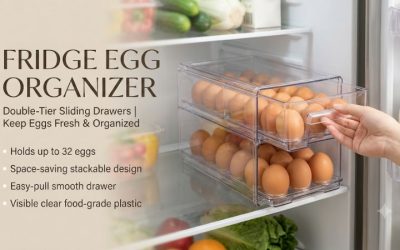
Covered egg trays use individual compartments to hold eggs in a defined arrangement. Some models accommodate twenty or twenty-one eggs, making them relevant for larger households that want more than a standard dozen-egg container. A clear lid can help users see the remaining inventory, while a removable internal tray may simplify cleaning.
Best For: Families preferring stationary egg storage with individual compartments.
Key Features:
- Defined positions for each egg.
- Transparent outer container.
- Removable lid.
- Handle or grip area on selected models.
- Optional stackable upper surface.
Pros:
- Easy visual inventory.
- Separate egg positions.
- Straightforward access.
- Useful for larger purchases.
Cons:
- Requires transferring eggs.
- Original-carton labeling is lost unless preserved.
- Large trays use substantial shelf depth.
- Covers add cleaning work.
Buy If: Your refrigerator has sufficient room and your family values a covered organizer.
Skip If: Several original cartons already fit comfortably.
An organizer with twenty egg positions does not necessarily replace two full dozen-egg cartons. Consider the difference between the tray’s capacity and the quantities your household normally buys.
Double-Track Rolling Egg Dispensers
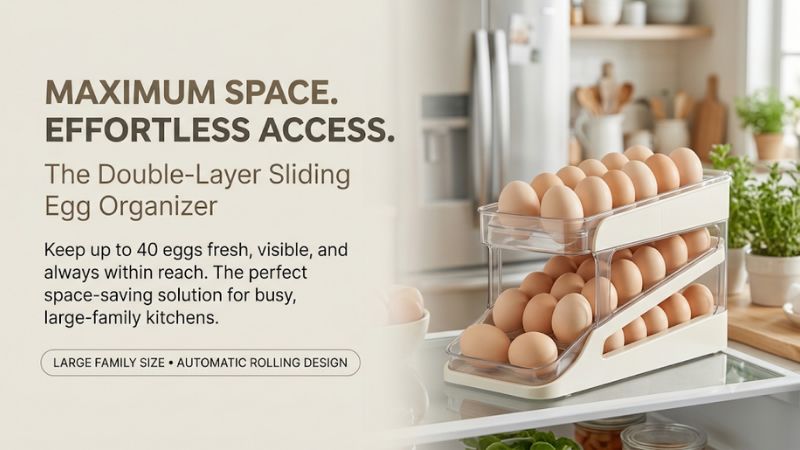
Double-track rolling dispensers use two channels that allow eggs to move toward front openings. Some identified models are designed for twenty-four or more eggs, making them attractive for households that use eggs frequently. The main benefit is convenient front access without reaching through a deep refrigerator shelf.
Best For: Families with high egg consumption and suitable refrigerator space.
Key Features:
- Two rolling tracks.
- Gravity-fed access.
- Front egg retrieval.
- Defined container footprint.
- Capacity for multiple cartons on selected models.
Pros:
- Convenient sequential access.
- Larger egg inventory.
- Can reduce reaching.
- Clear remaining-egg visibility.
Cons:
- Moving eggs require gentle handling.
- Loading order must be managed.
- Original-carton information needs separate tracking.
- Some refrigerator shelves may be too shallow.
Buy If: Your family frequently uses more than a dozen eggs and accepts the transfer and cleaning routine.
Skip If: You prefer keeping cartons intact or cannot maintain a clear purchase-date system.
The organizer’s rolling action does not guarantee that the oldest eggs are used first. If new eggs are loaded into a track containing older stock, rotation may become confusing.
Multiple Compact Egg Trays
Using more than one small egg tray can offer flexibility when the refrigerator cannot accommodate a large organizer. Separate trays may also make it easier to maintain purchase groups, although transferring eggs still requires keeping their original identification information.
Best For: Families needing modular storage across available shelf areas.
Key Features:
- Separate removable containers.
- Smaller individual footprints.
- Covered or open configurations.
- Optional stacking on compatible models.
- Flexible arrangement.
Pros:
- Easier to rearrange.
- Supports separate groups.
- Individual containers can be removed.
- Can suit awkward shelf dimensions.
Cons:
- More components to clean.
- Individual trays may have low capacity.
- Stacking can make lower eggs harder to reach.
- Additional transfer handling.
Buy If: Your refrigerator layout favors smaller containers and you need separate inventory groups.
Skip If: The original cartons already provide the same organization with less work.
Two smaller trays are not inherently better than one large container. Choose whichever format provides convenient access without excessive handling.
Original Cartons as an Organized Storage System
Original egg cartons are not a specialized organizer accessory, but they provide an important practical alternative. FDA guidance recommends keeping commercially refrigerated shell eggs in their original carton inside the refrigerator. The carton also retains purchase and identification details that can be useful when multiple packages are stored together.
Best For: Families prioritizing straightforward, recommended egg storage.
Advantages:
- No additional purchase required.
- Preserves carton information.
- Minimizes unnecessary handling.
- Keeps purchases separate.
- Easy to rotate by purchase group.
Limitations:
- Carton shapes may not match every refrigerator shelf.
- Paper cartons can become damaged when wet.
- Visual inventory may require opening the carton.
- Multiple cartons still need a dedicated location.
For most households, these limitations are manageable through simple shelf organization.
A designated egg area and reliable shopping routine often provide more value than transferring several dozen eggs into plastic trays.
Food Safety: The Most Important Buying Consideration
Egg-storage accessories should never be evaluated only by appearance. Shell eggs can carry foodborne pathogens, and safe handling depends on proper refrigeration, clean equipment, and appropriate cooking. A large-capacity organizer does not compensate for unsafe temperatures, cracked shells, or lost identification information. These concerns are particularly important when several family members use the same egg supply.
Keep Shell Eggs Refrigerated at 40°F or Below
FDA consumer guidance recommends storing commercially refrigerated shell eggs promptly in a clean refrigerator at 40°F or below.
Safe storage practices:
- Keep eggs refrigerated promptly.
- Use an appliance thermometer.
- Store eggs inside the refrigerator.
- Avoid the refrigerator door.
- Keep eggs in their original carton when practical.
- Preserve package information.
- Avoid unnecessary exposure to room temperature.
A dedicated egg organizer should remain on a stable interior shelf away from situations that could cause breakage.
Do not assume that a clear plastic lid makes eggs safer or keeps them fresh longer.
Preserve Original Carton Information
A major drawback of decanting eggs is losing the label information attached to the original package. This becomes more important when a family buys multiple cartons from different shopping trips or suppliers.
If eggs are transferred, keep relevant carton information available.
Information worth preserving:
- Purchase date.
- Carton date markings.
- Product identification.
- Source or brand information.
- Relevant handling instructions.
Avoid mixing eggs from different purchase groups without a reliable way to identify them.
This is particularly important during food recalls, when original packaging can help determine whether a product is affected.
Avoid Unnecessary Egg Handling
Every transfer introduces another opportunity for an egg to be dropped or cracked. A family that buys several cartons every week may handle many eggs unnecessarily if each purchase is moved into a decorative organizer.
Choose a setup that minimizes handling.
If using a removable tray or rolling dispenser, load gently and follow the manufacturer’s directions.
Inspect eggs for visible damage before use.
Discard eggs with concerning cracks, leakage, or contamination, and clean surfaces affected by raw egg residue.
Handle Raw Eggs Safely During Cooking
Good refrigerator organization should support safe cooking rather than replace it.
Important food-handling practices:
- Wash hands after handling raw eggs.
- Keep raw egg contents away from ready-to-eat foods.
- Clean utensils and work surfaces after contact.
- Cook eggs and egg dishes appropriately.
- Refrigerate leftovers promptly.
- Avoid using cracked or contaminated eggs.
For dishes requiring raw or undercooked eggs, consider appropriately pasteurized egg products when suitable.
Follow current food-safety guidance for vulnerable household members.
How to Choose Capacity and Fit
A large egg organizer should be selected using the actual refrigerator shelf dimensions and the household’s purchasing pattern. Capacity alone is misleading when the dispenser is too deep, obstructs other food, or makes the refrigerator difficult to clean. Measure the full system and assess how eggs will be loaded and removed during everyday use.
Measure Refrigerator Shelf Dimensions
Before purchasing, measure the usable interior width, depth, and height of the proposed storage area. Account for shelf supports, door-bin interference, and clearance needed to remove the organizer.
Measurement checklist:
- Shelf width.
- Front-to-back depth.
- Height beneath the shelf above.
- Door closure clearance.
- Refrigerator ventilation requirements.
- Container handle space.
- Room for loading.
- Space for cleaning and removal.
Do not assume that every large refrigerator has sufficient depth for a long rolling dispenser.
A wide shallow shelf may accommodate cartons better than a narrow gravity-fed system.
Choose Capacity According to Shopping Frequency
Families buying eggs once a week may benefit from a different layout than those shopping several times weekly.
For smaller weekly purchases:
- Keep one or two cartons.
- Avoid oversized containers.
- Prioritize easy identification.
- Use a compact shelf zone.
For larger weekly purchases:
- Plan enough interior shelf space.
- Keep purchase groups separate.
- Use older appropriate stock first.
- Avoid overcrowding.
- Consider dedicated storage only when it provides a real convenience benefit.
A larger organizer may save space in one dimension while consuming more in another.
Evaluate the entire refrigerator arrangement.
Assess Large and Jumbo Egg Compatibility
Egg organizers with fixed compartments or rolling tracks may not accommodate every shell size equally. A product advertised for twelve to fourteen eggs may have different practical capacity with jumbo eggs than with standard-size eggs.
Check the exact product’s stated size compatibility.
Avoid forcing eggs into narrow openings.
If a container’s lid contacts the tops of larger eggs, choose a different design or retain the original carton.
A storage system should never rely on pressure to hold fragile shells in place.
Create a Family-Friendly Egg Rotation System
A large inventory is useful only when household members can identify what to use next. Without a clear routine, families may purchase new eggs while older cartons remain forgotten at the back. A practical rotation system should preserve purchase groups, avoid unnecessary transfer, and make shopping decisions easy.
Use Older Suitable Purchases First
Arrange cartons according to purchase or package information and establish a consistent location for the oldest appropriate stock.
Simple rotation steps:
- Check existing inventory before shopping.
- Identify the older purchase group.
- Place it in the easiest-access position.
- Keep newer cartons separate.
- Use older suitable eggs first.
- Remove empty cartons promptly.
This approach is usually easier with original cartons because the package information remains attached.
If using plastic organizers, create a corresponding record rather than relying on memory.
Prevent Duplicate Purchasing
Large households sometimes buy eggs independently, particularly when several adults handle groceries.
A shared inventory note can prevent unnecessary purchases.
Keep the system simple: record how many cartons remain and whether another purchase is needed.
Useful habits:
- Check the refrigerator before shopping.
- Maintain one designated egg-storage area.
- Avoid hiding cartons behind large containers.
- Communicate when the last carton is opened.
- Plan purchases around actual meal needs.
The goal is to reduce waste and confusion, not create a complicated inventory database.
Clean the Storage Area Regularly
Egg cartons and plastic organizers can accumulate residue or spills.
Check the shelf during normal refrigerator cleaning.
If a shell breaks, remove affected items and clean contaminated surfaces appropriately.
Maintenance checklist:
- Inspect containers for residue.
- Clean broken egg spills promptly.
- Follow product washing instructions.
- Dry reusable organizers completely.
- Keep raw egg contamination away from ready-to-eat foods.
- Return eggs promptly to refrigeration.
A clean, well-organized shelf supports safer household routines.
Common Mistakes Large Families Should Avoid
High-capacity storage can look efficient while creating avoidable problems. Families may buy a dispenser too large for the refrigerator, combine eggs from several cartons without records, or assume that rolling access guarantees proper inventory rotation. The best system should remain easy to use even when multiple people shop and cook.
Buying the Largest Dispenser Without Measuring
A twenty-four-egg organizer may occupy less width than two cartons but require significant depth.
Measure the exact shelf and door clearance.
Check the space needed for loading and removing the product.
Do not buy based only on advertised egg count.
Mixing Purchase Groups Without Identification
Combining eggs from several cartons can make it difficult to determine their age or source.
Keep original packaging information available.
Avoid adding new eggs to older stock without a clear rotation procedure.
If several purchases overlap, separate them rather than relying on the organizer’s appearance.
Assuming Plastic Storage Improves Freshness
A covered tray or rolling dispenser can improve accessibility, but it is not automatically a freshness-preserving system.
Safe refrigeration remains essential.
The original carton is still recommended by FDA consumer guidance.
Avoid claims that a decorative organizer extends egg life unless reliable product-specific evidence supports them.
Frequently Asked Questions
Large families often want to know whether a high-capacity egg dispenser is worth buying, how many eggs can fit in one refrigerator, and whether plastic trays are safe. These questions are closely connected to purchase frequency and food handling. A practical answer prioritizes proper refrigeration, easy inventory control, and the preservation of useful carton information.
How Many Eggs Should a Large Family Keep Refrigerated?
There is no fixed number. Capacity should reflect the family’s normal weekly consumption, shopping frequency, and available safe refrigerator space. A household cooking eggs daily may need multiple cartons, while another family may use fewer. Avoid buying more eggs than can be comfortably refrigerated and used within appropriate quality guidance.
Are Rolling Egg Organizers Suitable for Large Families?
They can be convenient when the household uses eggs frequently and has sufficient refrigerator space. However, rolling movement introduces additional handling, and purchase groups can become difficult to track. Follow the manufacturer’s loading instructions and retain relevant carton information. A rolling dispenser does not provide a proven safety advantage over original-carton storage.
Can I Stack Multiple Egg Organizers?
Only use containers designed for stacking, and follow their stated loading instructions. Check that the lower container can support the intended weight and that the refrigerator has sufficient clearance. Avoid blocking airflow or making lower eggs difficult to retrieve. Original cartons may provide a simpler organization method when several purchases are stored together.
Should Eggs Be Stored on the Refrigerator Door?
No. FDA guidance recommends placing commercially refrigerated shell eggs inside the refrigerator rather than in the door. Keep the refrigerator at 40°F or below and store eggs in their original cartons when practical. A door-mounted egg tray may appear convenient, but refrigerator temperature conditions and safe handling take priority over accessibility.
How Can I Rotate Eggs From Multiple Cartons?
Keep purchase groups identifiable, place older suitable cartons where they will be used first, and check inventory before buying more. If eggs are transferred to plastic organizers, retain the original package information separately. Do not assume that a rolling mechanism alone guarantees correct rotation, especially when eggs from several shopping trips are loaded together.
Conclusion
A fridge egg organizer for large families should make inventory easier to manage without adding unnecessary handling or food-safety risks. Original cartons on a dedicated interior refrigerator shelf remain the recommended starting point. If a separate organizer is genuinely useful, choose a capacity that matches consumption, verify refrigerator dimensions, and preserve purchase information. Covered trays and rolling dispensers offer different convenience features, but proper refrigeration, careful handling, and consistent stock rotation matter more than maximum capacity.






Write Your Review
No reviews yet. Be the first to share your experience!