
A dependable serrated bread knife helps you slice crusty sourdough, soft sandwich bread, bagels, and delicate baked goods without crushing their interiors. The right knife combines appropriate blade length, effective serrations, and a comfortable handle. This guide compares six established models and explains which features matter for everyday home baking and meal preparation.
- Quick Verdict: Which Serrated Bread Knife Should You Buy?
- Quick Comparison Table
- How We Selected These Bread Knives
- Detailed Reviews of Six Serrated Bread Knives
- Buying Guide: What Matters When Choosing a Serrated Bread Knife
- How to Slice Bread Without Crushing the Loaf
- Cleaning, Sharpening, and Safe Storage
- Common Bread Knife Buying Mistakes
- Frequently Asked Questions
- Conclusion
Quick Verdict: Which Serrated Bread Knife Should You Buy?
The best bread knife depends on what you slice most frequently. A long blade is useful for broad artisan loaves, while a shorter knife can be more manageable when cutting bagels, sandwich bread, and smaller baked goods. Serration shape also matters because aggressive teeth can catch delicate crusts or tear soft interiors when used with excessive pressure.
Our six recommended products:
- Best overall for many households: Mercer Culinary Millennia 10-Inch Wide Wavy Edge Bread Knife.
- Best practical all-purpose alternative: Victorinox Fibrox Pro 10.25-Inch Curved Bread Knife.
- Best premium double-serrated design: WÜSTHOF Classic 9-Inch Double-Serrated Bread Knife.
- Best lightweight Japanese bread slicer: Tojiro Bread Slicer 235mm F-737.
- Best for bread and roasted foods: MAC Superior SB-105 10.5-Inch Bread/Roast Slicer.
- Best refined Japanese option: Shun Classic 9-Inch Bread Knife.
For most households, the Mercer Millennia is a sensible starting point because its wide wavy edge, long blade, and practical handle suit many everyday bread-cutting tasks. Victorinox offers another utilitarian option with a curved blade and textured synthetic grip.
WÜSTHOF is appropriate for shoppers seeking forged German construction and distinctive double serrations. Tojiro offers a lightweight Japanese-style approach, while MAC combines long cutting reach with a bread-and-roast slicing purpose.
Shun Classic provides a more refined finish and handle construction for buyers willing to maintain premium cutlery carefully.
These are research-based recommendations drawn from product design and manufacturer descriptions, not claims that every knife was independently researched for this article.
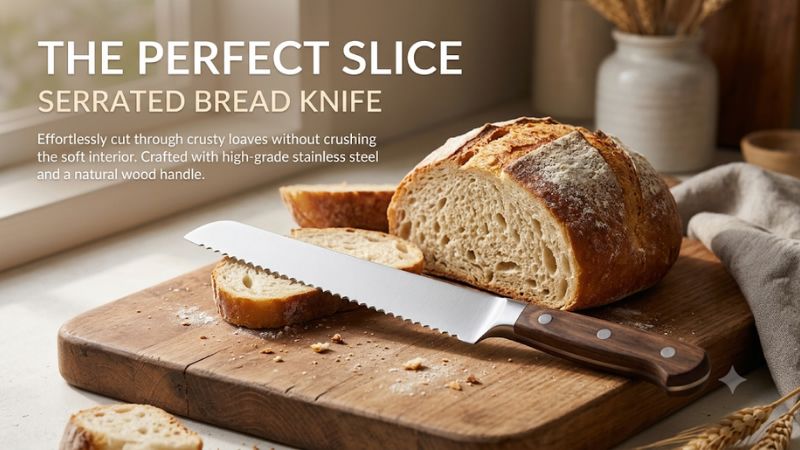
Quick Comparison Table
A bread knife should cut through the crust while minimizing compression of the soft interior. Blade length, serration style, and handle clearance influence the cutting experience, but actual results also depend on bread texture and user technique. The following table compares six identifiable models and highlights their intended advantages without inventing measured cutting performance.
| Knife | Blade Length | Design | Best For | Main Trade-Off |
|---|---|---|---|---|
| Mercer Millennia Wide Wavy Edge | 10 inches | Wide wavy serrations | Everyday sourdough and sandwich bread | Utilitarian appearance |
| Victorinox Fibrox Pro Curved Bread Knife | 10.25 inches | Curved serrated blade | Large loaves and general bread cutting | Curved profile may feel unfamiliar |
| WÜSTHOF Classic Double-Serrated | 9 inches | Precision double serrations | Premium everyday bread slicing | Higher investment |
| Tojiro F-737 Bread Slicer | 235mm | Lightweight serrated blade | Controlled bread slicing | Less substantial handle feel |
| MAC Superior SB-105 | 10.5 inches | Long bread/roast slicer | Wide loaves and appropriate cooked foods | Requires longer storage space |
| Shun Classic Bread Knife | 9 inches | Serrated blade with premium handle | Refined home baking setup | More demanding care |
No knife is universally superior for every baked good.
A long serrated blade can be excellent for a large sourdough boule yet less convenient when cutting a single small dinner roll on a narrow board.
The goal is matching the cutting tool to normal household baking and serving habits.
How We Selected These Bread Knives
The shortlist focuses on recognizable manufacturer models that offer different blade designs, handle styles, and intended uses. We considered bread-cutting versatility, manufacturer-described materials, length, grip, maintenance, and storage requirements. We did not assign fabricated sharpness scores or claim to have performed cutting tests, since edge condition and bread texture can substantially change the experience.
Selection criteria
- Blade length: Enough reach for ordinary and artisan loaves.
- Serration geometry: Teeth suited to cutting crust without excessive pressure.
- Handle: Comfortable and secure during a sawing motion.
- Knuckle clearance: Space between the hand and cutting board.
- Construction: Manufacturer-described blade and handle materials.
- Maintenance: Cleaning and eventual sharpening requirements.
- Versatility: Suitability for bagels, sandwich bread, and selected baked goods.
- Value: Useful features rather than appearance alone.
- Storage: Ability to protect the long serrated edge.
The chosen knives represent different buying priorities rather than a list of nearly identical models.
For example, the Mercer emphasizes practical cutting, while the WÜSTHOF and Shun occupy more premium categories.
Detailed Reviews of Six Serrated Bread Knives
Each knife in this section addresses a recognizable bread-cutting preference, whether that means handling large crusty loaves, prioritizing grip comfort, or choosing a refined blade for a home baking station. The reviews explain documented construction, practical use cases, limitations, and reasons to buy or skip each model. They should help narrow the choice before checking the exact variant and current availability.
Mercer Culinary Millennia 10-Inch Wide Wavy Edge Bread Knife
The Mercer Culinary Millennia 10-Inch Wide Wavy Edge Bread Knife is a professional-oriented kitchen tool designed for cutting bread and other foods with firm outer surfaces and softer interiors. Its long blade uses a wide wavy serrated edge, while the textured handle includes a finger guard. The straightforward construction makes it especially relevant to households that prioritize dependable everyday function.
Key Specifications
- Brand: Mercer Culinary.
- Series: Millennia.
- Model: M23210.
- Blade length: 10 inches.
- Blade: High-carbon Japanese stainless steel.
- Edge: Wide wavy serrations.
- Handle: Santoprene and polypropylene.
- Additional feature: Textured finger-guard design.
Why We Picked It
The 10-inch blade offers useful reach for round sourdough loaves and longer sandwich bread.
Mercer’s wavy-edge design is intended to penetrate firm crusts while limiting unnecessary tearing of soft interiors.
The handle is also designed around practical kitchen use.
Features and Practical Performance
When cutting a crusty loaf, position the bread on a stable board and start with a gentle forward-and-back motion.
Allow the serrations to engage the crust rather than pressing straight down.
Once the crust is opened, continue the sawing movement through the crumb.
The long blade can reduce the number of repositioning movements needed for larger loaves.
However, its full length may feel excessive for a compact kitchen with small cutting boards.
The knife is best maintained by handwashing and careful drying.
Pros
- Long blade suited to larger loaves.
- Wide wavy serrated edge.
- Practical textured handle.
- Finger guard.
- Suitable for regular household bread cutting.
Cons
- Relatively long storage footprint.
- Utilitarian appearance.
- Serrated edge requires appropriate sharpening methods.
Buy If
You regularly cut sourdough, sandwich loaves, and other bread and want a practical long-bladed knife.
Skip If
You mostly slice small rolls or have very limited storage space.
Victorinox Fibrox Pro 10.25-Inch Curved Bread Knife
The Victorinox Fibrox Pro Curved Bread Knife is a long serrated slicer designed for bread and related kitchen preparation. Its curved blade profile and textured synthetic handle distinguish it from straight-edged bread knives with more conventional handle shapes. The approximately 10.25-inch blade makes it particularly relevant to larger loaves that benefit from extended cutting reach.
Key Specifications
- Brand: Victorinox.
- Product family: Fibrox Pro.
- Blade length: Approximately 10.25 inches.
- Blade style: Curved serrated.
- Blade material: Stainless steel.
- Handle: Textured synthetic Fibrox.
- Intended purpose: Bread and general serrated slicing.
Why We Picked It
The extended blade provides room for broad cuts through a loaf.
The Fibrox grip also appeals to cooks who prefer practical synthetic materials over decorative handles.
A curved profile may feel more natural to some users during repetitive slicing.
Features and Practical Performance
The knife can be useful when preparing several sandwiches, cutting a large baguette, or portioning a homemade loaf for breakfast.
A gentle sawing movement helps the teeth enter the crust without flattening the bread.
The textured handle is intended to support a secure grip, but the user’s hands should still be clean and dry during cutting.
Because this is a long knife, the cutting board should be large enough to support both the loaf and the full cutting motion.
Do not assume the long blade is appropriate for very small detailed tasks.
Pros
- Generous cutting reach.
- Curved serrated blade.
- Practical Fibrox handle.
- Suitable for larger loaves.
- Established kitchen cutlery manufacturer.
Cons
- Long blade needs adequate workspace.
- Curvature may not suit everyone.
- Requires protective storage.
Buy If
You prefer a practical long serrated blade with a textured handle for regular bread preparation.
Skip If
You want a short straight bread knife for a very small board.
WÜSTHOF Classic 9-Inch Double-Serrated Bread Knife
The WÜSTHOF Classic 9-Inch Double-Serrated Bread Knife is a forged German knife that uses serrations within larger serrations. Its triple-riveted handle and traditional Classic-series construction create a more substantial alternative to lightweight stamped bread knives. The double-serrated design is intended to cut through firm crusts while supporting controlled slicing of the bread beneath.
Key Specifications
- Brand: WÜSTHOF.
- Series: Classic.
- Model: 1040101123.
- Blade length: 9 inches.
- Construction: Forged German steel.
- Edge: Precision double-serrated.
- Handle: Triple-riveted synthetic material.
- Intended use: Bread and suitable baked goods.
Why We Picked It
The double-serrated edge is the defining feature.
Instead of relying on a single repeating tooth pattern, WÜSTHOF uses smaller serrations inside larger ones.
This provides a distinct alternative for shoppers interested in premium bread-cutting geometry.
Features and Practical Performance
The nine-inch length is practical for many household loaves without reaching the length of the largest commercial-style slicers.
Its blade is useful for sourdough, crusty rolls, sandwich bread, and similar foods.
However, the double-serrated edge should not be treated as a guarantee of permanently sharp performance.
Like all cutting tools, it wears with use and may eventually require suitable specialist sharpening.
Owners should avoid attempting to sharpen every tooth using an ordinary flat sharpening stone without understanding the edge design.
Pros
- Distinctive double-serrated edge.
- Forged construction.
- Traditional handle.
- Versatile nine-inch length.
- Premium established product line.
Cons
- Higher purchase category.
- Specialized edge maintenance may be necessary.
- May feel more substantial than lightweight alternatives.
Buy If
You want a premium traditional bread knife with a distinctive serration design.
Skip If
You prefer inexpensive utilitarian cutlery or want the simplest possible edge to maintain.
Tojiro Bread Slicer 235mm F-737
The Tojiro Bread Slicer 235mm, model F-737, is a Japanese-made bread knife designed for slicing bread with a relatively slim, lightweight profile. The manufacturer identifies its high-carbon stainless steel construction and 235mm blade length. Its straightforward design is especially attractive to home bakers who want extended cutting reach without a heavy forged handle.
Key Specifications
- Brand: Tojiro.
- Product: Bread Slicer 235mm.
- Model: F-737.
- Blade length: 235mm, approximately 9.25 inches.
- Blade material: High-carbon stainless steel.
- Edge: Serrated.
- Country of manufacture: Japan.
- Intended use: Bread slicing.
Why We Picked It
The Tojiro represents a different design philosophy from substantial Western forged bread knives.
Its practical construction and useful blade length make it worth considering for bakers who regularly slice homemade loaves.
Features and Practical Performance
A slim serrated blade can be useful when cutting bread into consistent serving slices.
For example, a home baker may use it to portion a cooled sandwich loaf or slice a baguette for a meal.
The important requirement is allowing the serrations to cut with controlled sawing motions.
A narrow blade does not mean that the knife should be bent sideways or forced through frozen bread.
The F-737 should be handwashed, dried, and stored with edge protection.
Its longer blade also needs a suitable storage location.
Pros
- Practical Japanese bread slicer.
- Useful 235mm length.
- Straightforward construction.
- Suitable for homemade bread.
- Distinct alternative to heavy forged knives.
Cons
- Simple appearance.
- Requires adequate cutting-board length.
- Not intended for frozen foods or rough chopping.
Buy If
You want a Japanese bread slicer with a practical, relatively lightweight design.
Skip If
You specifically prefer a substantial forged handle or decorative construction.
MAC Superior SB-105 10.5-Inch Bread/Roast Slicer
The MAC Superior SB-105 is a long bread-and-roast slicer with a 10.5-inch serrated blade. Its broader intended use makes it relevant to home cooks who frequently serve bread alongside appropriate cooked foods. The extended blade length offers useful reach for large loaves, although the exact suitability for a roast depends on the food’s texture and the desired cut.
Key Specifications
- Brand: MAC Knife.
- Series: Superior.
- Model: SB-105.
- Blade length: 10.5 inches.
- Product type: Bread/Roast Slicer.
- Edge: Serrated.
- Country of manufacture: Japan.
- Intended use: Bread and compatible cooked-food slicing.
Why We Picked It
The MAC offers one of the longer blades in this comparison.
It is worth considering when a household frequently handles wide loaves or wants a versatile serrated slicer for appropriate serving tasks.
The bread-and-roast designation distinguishes it from strictly bread-focused alternatives.
Features and Practical Performance
For a large artisan boule, the long blade can provide a continuous cutting path with fewer short movements.
When slicing suitable cooked foods, the user should still consider whether a plain-edge carving knife would provide a cleaner presentation.
Serrations are not automatically ideal for every roast.
A tender boneless roast may be better served with a smooth slicing blade, while certain crusted foods may benefit from serrations.
The SB-105 also requires enough storage space to protect its long edge.
Pros
- Long 10.5-inch blade.
- Suitable for broad bread loaves.
- Bread-and-roast design.
- Established Japanese manufacturer.
- Useful for selected serving tasks.
Cons
- Long blade may feel excessive for small kitchens.
- Serrations are not ideal for every roast.
- Requires careful protective storage.
Buy If
You regularly cut large loaves and want a long serrated slicer for additional suitable kitchen tasks.
Skip If
You only slice small sandwich loaves or need a dedicated plain-edge carving knife.
Shun Classic 9-Inch Bread Knife
The Shun Classic 9-Inch Bread Knife is a Japanese-made serrated blade featuring the refined construction and handle style associated with Shun’s Classic series. The model combines a nine-inch cutting edge with the brand’s recognizable Pakkawood handle and layered stainless steel blade construction. It is a premium option for home bakers who value materials and presentation as well as everyday use.
Key Specifications
- Brand: Shun.
- Series: Classic.
- Model: DM0705.
- Blade length: 9 inches.
- Edge: Serrated.
- Blade: Manufacturer-described layered steel construction.
- Handle: Ebony-finished Pakkawood.
- Country of manufacture: Japan.
- Intended use: Bread and suitable baked foods.
Why We Picked It
The Shun Classic provides a premium alternative without departing from the practical nine-inch bread-knife format.
Its handle and blade finish may appeal to cooks who already own Shun cutlery and want a coordinated set.
Features and Practical Performance
Use the knife with a gentle sawing motion when cutting crusty bread.
Avoid pressing downward with excessive force, which can compress soft interiors regardless of blade quality.
The blade length is suitable for many artisan loaves, but larger extra-wide boules may still require careful positioning.
The Pakkawood handle should not be soaked.
The entire knife should be washed by hand, dried, and stored safely.
A decorative blade should not be treated as proof of superior sharpness or tested performance.
Pros
- Refined Japanese construction.
- Nine-inch serrated blade.
- Pakkawood handle.
- Useful for artisan bread.
- Coordinated Classic-series appearance.
Cons
- Premium purchase category.
- Handle needs appropriate moisture care.
- Decorative construction does not guarantee better results.
Buy If
You appreciate Shun Classic cutlery and want a premium serrated bread knife for regular home baking.
Skip If
You prefer a simple low-cost blade with minimal aesthetic considerations.
Buying Guide: What Matters When Choosing a Serrated Bread Knife
Choosing a bread knife requires understanding the relationship between bread texture, blade length, serration design, and handle clearance. An ordinary chef’s knife can struggle with firm crusts or compress soft interiors when too much downward force is applied. A suitable serrated blade can handle those challenges, but it must also fit the cutting board and remain comfortable during use.
Choose the Right Blade Length
A longer blade is useful for cutting across broad loaves, especially when a single slicing stroke can reach most of the bread. Shorter knives offer better maneuverability around bagels, rolls, and small sandwich loaves. Neither format is universally better because the appropriate length depends on the size and frequency of the bread you cut.
Practical length guide
- 7–8 inches: Compact kitchens and smaller loaves.
- 9 inches: Versatile household bread slicing.
- 10 inches: Larger artisan bread and family-size loaves.
- 10.5 inches or more: Large breads and specialized slicing needs.
A long blade requires sufficient cutting-board space.
Do not buy a 10.5-inch slicer if the board is too small to support safe movements.
Understand Serration Shape
Bread knives use different tooth patterns, including pointed serrations, rounded wavy edges, and double-serrated designs. These influence how the blade initially engages a crust and how it moves through the soft crumb. However, no single pattern guarantees smooth slices for every bread texture.
Common edge designs
- Pointed serrations: Engage firm outer crusts.
- Wavy serrations: Provide repeated curved cutting points.
- Double serrations: Smaller teeth within larger serrations.
- Curved serrated blade: Changes the blade’s cutting profile.
- Offset serrated knife: Can provide additional knuckle clearance.
Actual cutting quality also depends on edge condition and technique.
A dull knife with premium serrations can still tear bread.
Consider Handle Comfort and Knuckle Clearance
Bread slicing uses a repetitive forward-and-back motion that differs from chopping with a chef’s knife. The handle should remain comfortable and allow the user’s hand to clear the cutting board. A curved or offset design can help in certain situations, although the exact benefit depends on the knife and user’s grip.
Handle features to check
- Secure material.
- Comfortable circumference.
- Suitable blade-to-handle angle.
- Knuckle clearance.
- Finger guard.
- Balance.
- Easy cleaning.
- Grip stability during a sawing motion.
Avoid selecting a knife solely by handle appearance.
A comfortable budget handle may be more useful than an expensive decorative one.
Match the Blade to Bread Texture
Crusty artisan bread, soft sandwich bread, and delicate cakes require different cutting pressures. A gentle sawing motion is usually more effective than pushing straight down. The knife must also be long enough to cut safely without requiring awkward repositioning.
Common bread applications
- Sourdough boule: Long serrated blade.
- Baguette: Medium or long blade.
- Soft sandwich loaf: Controlled light pressure.
- Bagel: Stable cutting board and careful positioning.
- Brioche: Gentle sawing to avoid compression.
- Crusty rolls: Short controlled strokes.
- Layer cakes: Appropriate serrated knife when suitable.
Do not hold a bagel in your palm while cutting toward the hand.
Always place bread on a stable surface.
How to Slice Bread Without Crushing the Loaf
Even a well-designed serrated bread knife can damage a loaf if the user applies too much pressure or cuts before the bread has cooled appropriately. Good technique starts with supporting the bread and allowing the serrated edge to perform the cutting. This is especially important for homemade sourdough and soft sandwich loaves with delicate internal structure.
Recommended method
- Place the loaf on a stable cutting board.
- Allow freshly baked bread to cool as appropriate for its type.
- Position the knife at the desired slice thickness.
- Start with gentle short strokes to open the crust.
- Continue using a controlled sawing motion.
- Avoid pressing directly downward.
- Support the loaf without placing fingers in the blade path.
- Finish the cut without striking the board aggressively.
- Move the finished slice aside.
- Clean the knife after use.
For a large round loaf, turning the bread onto a flatter surface may improve stability.
Avoid attempting to slice a loaf while holding it in the air.
Cleaning, Sharpening, and Safe Storage
Serrated bread knives require proper care, although their edge maintenance differs from that of ordinary straight-edge chef’s knives. Bread crumbs, moisture, and food residue can accumulate around serrations. Sharpening also requires suitable equipment or a specialist who understands the tooth pattern.
Maintenance recommendations
- Wash by hand when recommended.
- Remove crumbs from the serrations.
- Dry the blade and handle.
- Avoid dishwasher impacts.
- Use an appropriate sheath or knife block.
- Do not place the exposed blade loose in a drawer.
- Avoid cutting on glass or stone.
- Follow model-specific sharpening guidance.
- Do not reshape double serrations with an unsuitable tool.
- Inspect for damaged teeth.
Serrated knives can remain useful for a long time, but their edges are not maintenance-free.
A high-quality bread knife should be treated as a sharp cutting tool, even when the tooth pattern looks less delicate than a chef’s knife edge.
Common Bread Knife Buying Mistakes
A bread knife is often purchased as an afterthought, leading shoppers to choose whatever serrated blade appears cheapest or longest. This can result in poor handle comfort, inadequate cutting reach, or an overly large knife that is awkward to store. Understanding common mistakes helps make the purchase more practical and prevents unnecessary replacement.
Mistakes to avoid
- Choosing a blade shorter than the bread normally sliced.
- Buying an excessively long knife for a tiny cutting board.
- Ignoring handle comfort.
- Assuming all serrations cut identically.
- Treating double serrations as permanently sharp.
- Using a bread knife on bones or frozen food.
- Cutting bread while holding it in the hand.
- Applying excessive downward pressure.
- Storing the exposed blade in a crowded drawer.
- Ignoring sharpening requirements.
- Assuming premium appearance proves better performance.
- Putting the knife in the dishwasher contrary to care instructions.
The best model supports safe, repeatable cutting across the bread you actually eat.
Frequently Asked Questions
Choosing a serrated bread knife raises questions about blade length, tooth design, sharpening, and whether the knife can be used for baked goods beyond bread. These practical answers help distinguish useful product features from marketing claims and clarify the cutting techniques that make the largest difference at home.
What Length Bread Knife Is Best for Sourdough?
A blade around nine to ten inches is useful for many sourdough loaves because it provides enough cutting reach for substantial crusts and wide bread shapes. Larger boules may benefit from an even longer blade, provided the cutting board and user’s technique allow safe handling.
Choose the length based on the loaves you bake or purchase most often.
A longer blade is not automatically more comfortable.
Is a Double-Serrated Bread Knife Better?
A double-serrated knife uses smaller serrations within larger teeth. This can create a different cutting action and is worth considering for crusty bread. However, the design does not guarantee that every loaf will be sliced better than with a conventional sharp serrated blade.
Handle comfort, length, and proper technique remain important.
Can I Sharpen a Serrated Bread Knife?
Yes, many serrated bread knives can be sharpened, but the process differs from sharpening a straight-edge kitchen knife. The appropriate tool depends on the serration pattern and manufacturer instructions.
A specialist may be preferable for unusual or double-serrated edges.
Do not use an ordinary sharpening method without confirming compatibility.
Can a Bread Knife Cut Cake?
A suitable serrated knife can be useful for leveling or slicing certain cakes, especially when a gentle sawing motion reduces compression. However, delicate cakes may benefit from a longer specialized slicing knife.
Use clean equipment and controlled pressure.
Avoid dragging crumbs or frosting into the next cut.
Should I Buy a Bread Knife If I Already Have a Chef’s Knife?
A dedicated serrated bread knife is useful if you regularly cut crusty bread, bagels, or soft loaves. A chef’s knife may not engage firm crust effectively and can compress bread when excessive pressure is applied.
The two knives serve complementary purposes.
A practical home kitchen often benefits from both.
Conclusion
The best serrated bread knife should cut the bread you serve most often while remaining comfortable and easy to maintain. Mercer Millennia offers a practical long-bladed design, while Victorinox Fibrox Pro provides another utilitarian option. WÜSTHOF Classic is worth considering for its double-serrated edge, Tojiro F-737 offers a Japanese bread-slicing approach, MAC SB-105 handles large loaves and suitable roasts, and Shun Classic provides refined construction. Choose the right blade length and serration pattern, use gentle sawing motions, and protect the edge during storage.
Write Your Review
No reviews yet. Be the first to share your experience!