
Selecting a knife sharpener for limited counter space requires balancing compact dimensions, safe operation, and reliable blade maintenance. This guide explores manual, electric, rolling, and portable sharpening systems to help small households maintain kitchen knives without sacrificing valuable food preparation space.
- Why Compact Knife Sharpeners Make Sense for Small Kitchens
- Types of Knife Sharpener for Limited Counter Space
- How to Measure Your Kitchen Before Buying a Sharpener
- Essential Features for Space-Saving Knife Sharpeners
- Choosing Compact Sharpeners for Different Kitchen Layouts
- Manual Versus Electric Sharpeners for Small Kitchens
- How to Organize and Store Sharpening Equipment Efficiently
- How Much Should You Spend on a Compact Knife Sharpener?
- Common Buying Mistakes in Small Kitchens
- Frequently Asked Questions
- Conclusion
Why Compact Knife Sharpeners Make Sense for Small Kitchens
Small kitchens require careful management of every available working surface. Coffee makers, cutting boards, food storage containers, and cooking appliances can quickly occupy countertops, leaving little room for equipment used only occasionally. A compact sharpening system offers a practical way to maintain kitchen cutlery without permanently dedicating valuable preparation space to another appliance.
However, choosing the smallest available product is not always the most effective solution. A sharpener must provide adequate stability, suitable blade compatibility, and sufficient clearance for controlled operation.
The goal is to select sharpening equipment that can be stored efficiently while remaining practical whenever knife maintenance becomes necessary.
Understanding the Difference Between Storage and Operating Space
A product’s advertised dimensions generally describe its physical housing rather than the complete area required during operation. This distinction is particularly important when evaluating sharpening equipment for small apartments or crowded family kitchens.
A compact electric sharpener may occupy little cabinet space but require additional clearance for its electrical cord and the movement of a long kitchen knife. Similarly, a small rolling sharpener may require a relatively broad working area when its separate components are positioned for maintenance.
Consider both measurements before purchasing:
- Storage width and depth.
- Internal drawer or cabinet height.
- Space required for detachable accessories.
- Clearance for the longest compatible knife.
- Space for stable hand positioning.
- Electrical outlet access when applicable.
A product that fits inside a small drawer but cannot be operated comfortably on the available countertop may introduce unnecessary inconvenience.
Why Sharpening Equipment Does Not Need Permanent Countertop Placement
Unlike appliances used every morning or during every meal, knife sharpeners generally perform an occasional maintenance function. This makes them particularly suitable for removable storage arrangements.
A compact system can remain inside a drawer or cabinet until knife maintenance becomes necessary. After use, it can be cleaned and returned to storage, preserving the countertop for regular food preparation.
Benefits of removable sharpening equipment include:
- Reduced everyday countertop clutter.
- Easier cleaning around preparation surfaces.
- Improved flexibility in small kitchens.
- Protection of sharpening components from food debris.
- Better organization of occasional-use equipment.
This approach can be particularly valuable for apartment residents who cannot expand their existing countertop dimensions.
Types of Knife Sharpener for Limited Counter Space
Several sharpening methods can accommodate space-conscious households, although their operating footprints and storage requirements differ. Understanding the practical characteristics of each category helps buyers identify a system that matches both their knife collection and kitchen layout.
Rather than focusing exclusively on the product’s overall dimensions, examine how each system must be positioned, operated, cleaned, and stored.
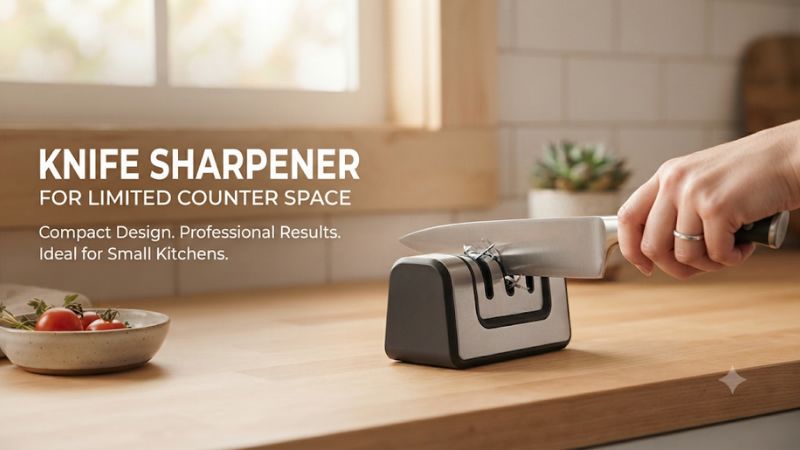
Compact Manual Pull-Through Sharpeners
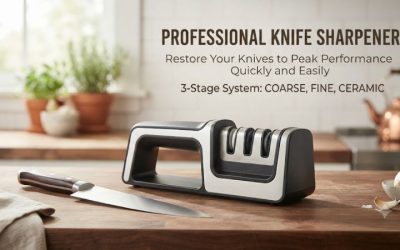
Manual pull-through sharpeners are among the most approachable options for small kitchens because they frequently combine several sharpening functions within a relatively compact housing. Their design eliminates the need for electrical cords and generally requires minimal setup.
These systems are particularly attractive to households that perform occasional maintenance on compatible everyday kitchen knives. A compact model can often fit inside an existing utensil drawer without requiring additional storage furniture.
Advantages
- Small storage footprint.
- No electrical outlet required.
- Straightforward operating design.
- Convenient for occasional maintenance.
- Generally easy to retrieve and store.
Disadvantages
- Fixed sharpening configurations may limit compatibility.
- Smaller products may provide inadequate grip areas.
- Abrasive aggressiveness varies by design.
- Less suitable for specialized blade geometry.
When evaluating this category, prioritize a stable base and comfortable hand placement. An extremely small sharpener may become difficult to control if it lacks sufficient space for secure positioning.
Compact Electric Knife Sharpeners
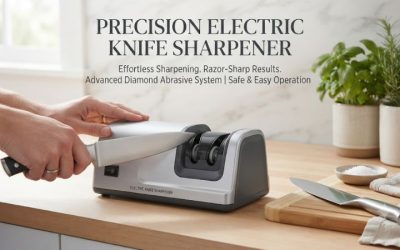
Small electric sharpeners provide powered maintenance while attempting to reduce the storage demands associated with larger sharpening stations. They are suitable for households that maintain several compatible knives and prefer a structured sharpening process.
Electric operation can make maintenance more convenient, but buyers should evaluate the complete operating footprint rather than simply comparing product housings.
Important features include:
- Cord length and storage arrangement.
- Appliance weight.
- Sharpening slot orientation.
- Number of maintenance stages.
- Supported knife geometry.
- Manufacturer cleaning requirements.
A compact electric model may provide excellent value when several compatible kitchen knives require regular maintenance. For occasional users, however, a simpler manual system may provide sufficient functionality with fewer storage requirements.
Rolling Sharpening Systems
Rolling sharpeners generally combine an abrasive cylinder with a separate angle-support component. This arrangement can provide repeatable blade positioning without requiring a motorized housing.
Many rolling systems have manageable storage dimensions because their components can be stored separately or within a dedicated container. Their attractive construction may also appeal to buyers who prefer kitchen tools with a refined appearance.
Nevertheless, operating a rolling sharpener requires sufficient space for the abrasive component to move appropriately along a compatible blade.
Potential advantages include:
- Compact individual components.
- Manual operation.
- Repeatable positioning.
- No electrical cord.
- Convenient storage in suitable drawers.
Potential limitations include:
- Additional working clearance.
- Blade geometry restrictions.
- Compatibility requirements for magnetic supports.
- Higher purchase cost for some premium models.
Compact Whetstones
A sharpening stone can offer an effective manual maintenance solution while occupying relatively little storage space. Its rectangular construction often allows it to fit inside a cabinet or drawer without interfering with other kitchen tools.
However, the storage footprint does not represent the complete setup. Whetstones may require an appropriate base, water, cleaning materials, and additional space for controlled blade movement.
This category is best suited to buyers who value manual control and are willing to spend time developing appropriate sharpening technique.
Compact stones may be convenient for smaller knives, while longer kitchen blades can benefit from a larger abrasive surface. Selecting an excessively small stone simply to minimize storage may make maintenance less practical.
Portable Guided Sharpening Tools
Portable sharpening tools combine abrasive surfaces and angle references within a small housing. Their compact construction is particularly appealing when available storage is extremely limited.
These products can be useful for compatible small knives and occasional maintenance. Some are designed primarily for outdoor or utility applications, so buyers should verify their suitability for kitchen cutlery.
A portable system may not provide the same convenience as a dedicated kitchen sharpening appliance when maintaining multiple long chef’s knives.
The best approach is to match the product’s intended blade size to the knives you actually use rather than selecting a portable sharpener exclusively because it is easy to store.
How to Measure Your Kitchen Before Buying a Sharpener
Measuring the intended storage and operating areas is one of the simplest ways to avoid purchasing an inconvenient sharpening system. Small differences in product dimensions can determine whether equipment fits comfortably inside a drawer or requires additional storage arrangements.
Begin by identifying where the sharpener will remain when not in use and where knife maintenance will take place.
Measure Internal Drawer Dimensions
Kitchen drawers frequently have less usable space than their external appearance suggests. Drawer slides, organizers, dividers, and structural components can reduce available dimensions.
Measure the actual internal space, including:
- Usable drawer width.
- Maximum internal depth.
- Vertical clearance when closing the drawer.
- Existing organizer compartments.
- Space occupied by other utensils.
If the sharpening system includes several components, account for all of them rather than measuring only the main housing.
Leave sufficient space to retrieve the equipment without moving sharp knives or other potentially hazardous utensils.
Evaluate Cabinet Storage Options
Cabinets may provide greater vertical storage capacity than drawers, making them appropriate for electric sharpeners or guided systems with detachable components.
Consider how frequently the equipment will be used. Storing a regularly used sharpener behind several heavy appliances can make maintenance inconvenient, even when sufficient physical space exists.
A suitable cabinet location should allow easy retrieval while protecting abrasive surfaces from moisture, food debris, and accidental impacts.
For households with children, choose secure storage that prevents unsupervised access to sharpening equipment and kitchen knives.
Assess the Available Working Surface
The operating area must accommodate the sharpening system, the knife, and appropriate hand positioning. A cluttered countertop can make it difficult to maintain stable operation.
Before sharpening, remove unnecessary appliances, dishes, and food preparation containers from the working surface.
The available area should provide:
- A stable horizontal surface.
- Sufficient clearance for blade movement.
- Appropriate lighting.
- Space for secure equipment positioning.
- Separation from other household activities.
Avoid attempting knife maintenance inside a storage drawer or on an unstable improvised surface.
Account for the Longest Kitchen Knife
The longest compatible knife in your collection may determine the operating clearance required by the sharpening system. A product that works comfortably with a small paring knife may need significantly more surrounding space when used with a full-sized chef’s knife.
Review the manufacturer’s operating instructions and blade compatibility information before purchasing.
If the available countertop cannot safely accommodate the required movement, consider using another suitable stable working surface or selecting a different maintenance method.
Essential Features for Space-Saving Knife Sharpeners
Compact dimensions should not come at the expense of fundamental operating characteristics. A space-saving product needs to provide suitable blade compatibility, stable positioning, and reliable access to its maintenance functions.
The following features deserve particular attention when comparing sharpening systems for small kitchens.
Stable Base Construction
A compact sharpener can become difficult to control if it moves unexpectedly during operation. Stable construction is therefore especially important when selecting smaller products.
Look for manufacturer-designed nonslip features, suitable base geometry, and clear instructions concerning equipment positioning.
A lightweight product may be convenient to store, but its operating stability should remain sufficient for the intended sharpening procedure.
Avoid modifying a sharpener or creating improvised mounting arrangements that are not recommended by the manufacturer.
Comfortable Grip and Hand Placement
Manual sharpening systems should provide appropriate separation between gripping areas and the movement of the cutting blade. Compact construction can reduce available handle space, making this consideration particularly important.
Evaluate product photographs and instructions to determine whether the handle provides a practical gripping position.
Useful characteristics include:
- Clearly defined gripping areas.
- Comfortable handle geometry.
- Appropriate nonslip surfaces.
- Stable blade positioning.
- Sufficient separation from the cutting path.
A slightly larger product with comfortable handling may provide better practical value than a miniature alternative that is difficult to stabilize.
Correct Sharpening Geometry
Compactness is only beneficial when the sharpening system supports your existing kitchen knives. Fixed-angle models may work well with compatible blades but offer limited flexibility for specialized geometries.
Determine the original edge configuration of frequently used knives before selecting a sharpener.
Consider:
- Edge angle per side.
- Single-bevel or double-bevel construction.
- Blade thickness.
- Serrated edge compatibility.
- Ceramic blade compatibility.
Do not sacrifice correct maintenance requirements simply to purchase a smaller product.
Multiple Abrasive Stages
Some compact sharpeners incorporate different abrasive surfaces within one housing. This can reduce the need for separate maintenance tools while allowing users to select appropriate stages according to blade condition.
A finer maintenance stage may be useful when a knife only needs light attention, while more aggressive abrasives may be necessary for substantial restoration.
However, the number of advertised stages does not independently determine sharpening quality. Compatibility, abrasive construction, and appropriate operating procedures remain essential.
Straightforward Cleaning Requirements
Sharpening equipment should be maintained according to manufacturer instructions. Products that are difficult to clean or require numerous detachable components may become inconvenient in kitchens with limited working space.
Consider whether the product can be maintained without creating excessive cleanup requirements.
For electric systems, follow instructions concerning disconnection from electrical power and appropriate cleaning methods. Do not immerse motorized equipment unless the manufacturer explicitly identifies a component as washable.
Store sharpening equipment only after completing any required cleaning and drying.
Choosing Compact Sharpeners for Different Kitchen Layouts
The most suitable sharpening system depends on how a particular kitchen is organized. A studio apartment may have very different storage requirements from a small family kitchen, even when both provide limited countertop space.
Identifying the challenges associated with your household helps narrow the available options.
Studio Apartments and Single-Person Households
Studio apartments frequently combine living and cooking areas within a compact environment. Appliances used only occasionally can create unnecessary visual and physical clutter when left permanently on the countertop.
A compact manual sharpener may be appropriate for someone maintaining one or two compatible everyday knives. Its lack of electrical requirements and relatively small storage footprint can make it particularly practical.
Recommended priorities include:
- Easy drawer storage.
- Simple maintenance procedures.
- Compatibility with existing knives.
- Reliable operating stability.
- Minimal detachable accessories.
A larger electric appliance may provide limited additional value unless the household performs knife maintenance frequently.
Shared Apartment Kitchens
Shared kitchens introduce additional organizational challenges because several people may use the same preparation surfaces and storage areas. Portable equipment can help individuals maintain their own cutlery without occupying communal countertop space.
A compact sharpening system with dedicated storage may be preferable to equipment requiring permanent placement.
Consider whether the product can be transported conveniently between suitable working surfaces and whether its components remain organized when stored.
Shared households should also establish clear expectations concerning knife compatibility. Someone should not use an unfamiliar sharpening system on another person’s premium or specialized knife without appropriate knowledge and permission.
Small Family Kitchens
Families may own several kitchen knives despite having limited available countertop space. A compact electric sharpener or versatile manual system can provide useful maintenance capabilities when the equipment supports the household’s knife collection.
The main consideration is balancing convenience with storage efficiency. A product that can maintain several compatible knives may justify slightly larger dimensions if it eliminates the need for multiple sharpening tools.
Family kitchens should also prioritize secure storage, stable operation, and appropriate separation from other cooking activities.
Galley Kitchens and Narrow Countertops
Galley kitchens often provide long but relatively narrow preparation surfaces. This layout may accommodate some sharpening systems conveniently while making others difficult to operate.
Examine the direction in which the knife or abrasive component must move during sharpening. Equipment with a relatively compact housing may still require considerable clearance along the countertop.
A suitable sharpener should fit within the available working area without placing the blade near walls, nearby appliances, or the edge of the counter.
Kitchens With Premium Japanese Cutlery
Owners of premium Japanese knives should prioritize appropriate edge maintenance over achieving the smallest possible sharpening footprint. Specialized blade geometry may require compatible stones, guided systems, or professional maintenance.
A compact whetstone may offer useful storage efficiency when the owner has appropriate sharpening knowledge. Adjustable guided systems may also be suitable for certain compatible knives.
Avoid purchasing a basic fixed-angle pull-through sharpener solely because it fits inside a small drawer. Incorrect maintenance can undermine the value of premium cutlery.
Manual Versus Electric Sharpeners for Small Kitchens
Both manual and electric sharpening systems can be appropriate for limited kitchen spaces. Their suitability depends on maintenance frequency, blade compatibility, available storage, and the user’s preferred operating experience.
Manual models generally reduce electrical and storage requirements, while powered sharpeners may provide greater convenience for households maintaining several compatible knives.
| Consideration | Manual Sharpener | Compact Electric Sharpener |
|---|---|---|
| Storage footprint | Often smaller | Depends on construction |
| Electrical outlet | Not required | Required |
| Setup requirements | Usually minimal | Cord and operating placement |
| Sharpening speed | Depends on system and user | Often convenient |
| Noise | Generally low | Motor noise |
| Replacement components | Product-dependent | Product-dependent |
| Angle flexibility | Varies by design | Varies by design |
| Initial investment | Broad price range | Often higher |
When a Manual Sharpener Makes More Sense
Manual equipment can be particularly practical when the household only occasionally sharpens knives and wants to minimize storage requirements. A compact product can often be retrieved, operated on an appropriate surface, and returned to storage without extensive setup.
Manual systems are also attractive to buyers who prefer avoiding electrical cords and powered appliances.
However, some products require additional technique or provide only fixed sharpening geometry. Evaluate these limitations before purchasing.
When an Electric Sharpener Is Worth the Extra Space
An electric sharpener may justify its additional storage requirements when several compatible knives require frequent maintenance. Its guided construction can simplify repeated procedures and make routine sharpening more convenient.
Buyers should ensure sufficient operating clearance and access to an appropriate electrical outlet.
A compact electric model should be evaluated as an occasional-use appliance rather than something that necessarily requires permanent countertop placement.
How to Organize and Store Sharpening Equipment Efficiently
Effective storage allows homeowners to maintain useful kitchen tools without unnecessarily sacrificing preparation space. A designated storage location can also protect sharpening surfaces and make equipment easier to retrieve whenever maintenance is necessary.
The ideal arrangement depends on the sharpener’s dimensions, components, and cleaning requirements.
Create a Dedicated Drawer Compartment
A dedicated drawer compartment provides a predictable storage location for compact sharpening equipment. Keeping the sharpener separate from loose utensils can help protect abrasive surfaces and prevent unnecessary contact with exposed knife edges.
Use a suitable organizer that accommodates the complete product without placing pressure on delicate components.
Ensure the equipment is clean and dry before returning it to storage.
Use a Small Storage Container for Accessories
Rolling sharpeners and guided systems may include separate angle supports, abrasive components, or maintenance accessories. These items can become difficult to locate when stored individually among unrelated kitchen utensils.
A suitable storage container can keep associated components together. Select a container that provides adequate protection without occupying significantly more space than necessary.
Avoid storing damp sharpening stones or recently cleaned components inside sealed containers unless the manufacturer recommends that arrangement.
Manage Electrical Cords Properly
Electric sharpeners should be disconnected from electrical power before storage. Manage cords according to manufacturer instructions and avoid creating tight bends or placing excessive pressure on connection points.
A convenient cord arrangement makes it easier to retrieve the appliance without tangling it around other kitchen equipment.
Do not wrap cords around sharp edges or store an appliance where heavy items can damage its electrical components.
How Much Should You Spend on a Compact Knife Sharpener?
A space-saving sharpening system does not need to be expensive to provide practical value. The appropriate purchase budget depends on knife compatibility, maintenance frequency, and the importance of additional sharpening features.
Rather than selecting a product solely because of its price, consider whether it addresses your actual household requirements.
Affordable Manual Sharpening Systems
Basic manual sharpeners can be appropriate for households maintaining a small number of compatible kitchen knives. Their limited operating complexity and compact construction make them attractive to occasional users.
Prioritize stable design, appropriate blade compatibility, and clear manufacturer instructions.
An inexpensive product that fails to support your existing knives may ultimately cost more through unnecessary blade wear or replacement.
Midrange Compact Sharpeners
Midrange options may provide additional abrasive stages, improved construction, or more flexible sharpening geometry. These products can be attractive to households that maintain knives regularly but want to avoid a large sharpening station.
Evaluate whether the additional features reduce maintenance effort or replace the need for other sharpening tools.
Premium Rolling and Guided Systems
Premium systems may provide advanced angle support, interchangeable abrasives, or distinctive construction. Their purchase price can be justified when those features meaningfully improve the user’s maintenance experience.
However, premium positioning does not guarantee compatibility with every knife. Buyers should assess the actual operating requirements and whether the complete system fits their available storage.
Common Buying Mistakes in Small Kitchens
Space-conscious buyers sometimes focus so heavily on dimensions that they overlook other important product characteristics. A sharpener that is exceptionally easy to store may become inconvenient or unsuitable during actual operation.
Avoiding common purchasing mistakes can help ensure the selected equipment remains useful over the long term.
Ignoring Operating Clearance
A common mistake involves measuring only the sharpener’s housing. Blade movement and hand positioning can require substantially more space than the product occupies during storage.
Always evaluate the working area before purchasing.
Selecting an Unstable Miniature Sharpener
Extremely compact equipment may provide limited gripping space or inadequate stability. These characteristics can interfere with controlled operation.
Choose a product that provides reliable positioning even if it occupies slightly more storage space.
Assuming All Kitchen Knives Are Compatible
Knife sharpeners support different blade materials and geometries. A small universal-looking device may not be suitable for ceramic, serrated, or specialized single-bevel blades.
Check compatibility before purchase and before using the sharpener on unfamiliar cutlery.
Frequently Asked Questions
Small kitchen owners frequently face questions involving storage capacity, maintenance convenience, and product compatibility. Understanding these considerations helps buyers select equipment that fits their household without introducing unnecessary clutter.
What Type of Knife Sharpener Takes Up the Least Space?
Compact manual sharpeners and portable sharpening tools generally offer the smallest storage footprints. However, actual dimensions and operating clearance vary considerably between products.
Can an Electric Sharpener Fit Inside a Kitchen Drawer?
Some compact electric models may fit inside appropriately sized drawers. Measure internal dimensions and account for cord storage before purchasing.
Are Rolling Sharpeners Suitable for Small Kitchens?
Rolling sharpeners can be suitable because their components are relatively compact during storage. They still require adequate working clearance and compatible blade positioning.
Should I Store a Sharpener on the Countertop?
Permanent countertop placement is generally unnecessary for occasional sharpening equipment. Dedicated drawer or cabinet storage can preserve valuable preparation space.
Is a Whetstone Better for Limited Space?
A whetstone can provide compact storage and flexible maintenance, but it may require additional operating space, preparation, and cleanup. Its suitability depends on your sharpening skills and kitchen arrangement.
Conclusion
A knife sharpener for limited counter space should combine compact storage, reliable stability, and suitable blade compatibility. Manual models offer simplicity, while electric and rolling systems provide convenient alternatives. Measure both storage and working areas before selecting the right sharpening solution.





Write Your Review
No reviews yet. Be the first to share your experience!