
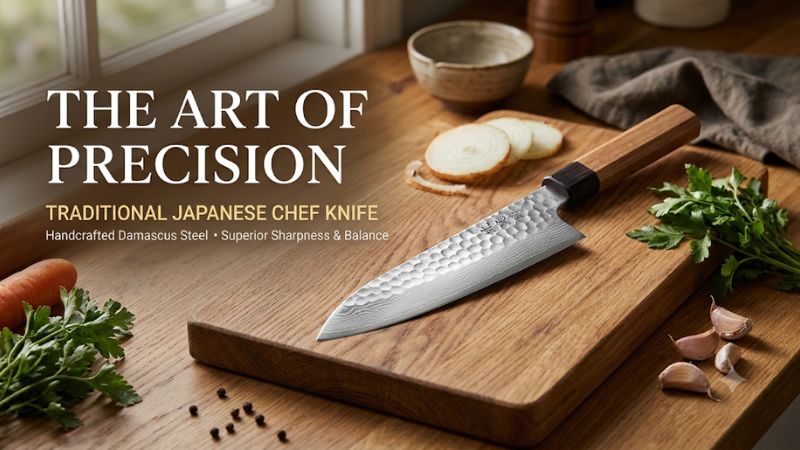
A Japanese chef knife can be an excellent choice for home cooks who value precise vegetable preparation, controlled slicing, and a comfortable cutting rhythm. Gyuto knives come in different steels, blade lengths, handles, and price categories, so the best option depends on your habits rather than appearance alone. This guide compares six established Japanese-made knives and explains their practical trade-offs.
- Quick Verdict: Six Japanese Chef Knives Worth Comparing
- Quick Comparison Table
- How We Selected These Japanese Chef Knives
- Detailed Reviews of Six Japanese Chef Knives
- Buying Guide: Choosing a Japanese Chef Knife
- How to Use and Care for a Japanese Gyuto
- Common Mistakes When Buying Japanese Kitchen Knives
- Frequently Asked Questions
- Conclusion
Quick Verdict: Six Japanese Chef Knives Worth Comparing
Japanese chef’s knives often attract attention for refined cutting geometry, distinctive blade finishes, and carefully developed steel choices. However, terms such as Damascus, high-carbon, powdered steel, and razor-sharp are not substitutes for understanding the knife’s intended use. A gyuto should handle everyday ingredients with control while remaining realistic to maintain in a home kitchen.
Our six recommended options:
- Best value-oriented Japanese gyuto: Tojiro Classic Chef Knife 210mm, F-808.
- Best practical professional-style alternative: MAC Professional MTH-80.
- Best distinctive all-stainless design: GLOBAL G-2 8-Inch Chef’s Knife.
- Best decorative Damascus-style option: Shun Classic 8-Inch Chef’s Knife.
- Best premium steel and handle combination: MIYABI Birchwood SG2 8-Inch Chef’s Knife.
- Best traditional Western-handle gyuto: Misono UX10 Gyuto 210mm, No. 712.
The Tojiro Classic is an appealing starting point for shoppers who want a recognizable Japanese gyuto with a VG10 core and a conventional Western-style handle.
MAC offers a different blade design with dimples, while GLOBAL emphasizes a stainless steel handle and streamlined construction.
Shun is notable for its layered blade presentation and VG-MAX cutting core. MIYABI Birchwood SG2 offers a premium powdered-steel configuration, while the Misono UX10 provides a relatively restrained professional-style design.
These are not identical knives at different prices. They differ in steel selection, geometry, handle construction, and maintenance expectations.
Quick Comparison Table
A Japanese gyuto is typically a versatile double-bevel chef’s knife, but there is substantial variation between individual models. Blade length alone cannot explain the cutting experience. A knife with a thin edge may glide through soft vegetables differently from one with thicker geometry, and a very hard steel may require more careful handling than a more forgiving alternative.
| Knife | Blade Length | Notable Construction | Best For | Main Trade-Off |
|---|---|---|---|---|
| Tojiro Classic F-808 | 210 mm | VG10 core with stainless cladding | Accessible Japanese gyuto | Requires careful edge use |
| MAC MTH-80 | About 8 in | Dimpled blade | Everyday precise prep | Food release varies by ingredient |
| GLOBAL G-2 | 8 in | CROMOVA 18 steel and metal handle | Streamlined handling | Grip preference is personal |
| Shun Classic DM0706 | 8 in | VG-MAX core, Damascus-style cladding | Refined home preparation | Decorative finish requires appropriate care |
| MIYABI Birchwood SG2 | 8 in | SG2 powdered-steel core, birch handle | Premium knife enthusiasts | Higher maintenance expectations |
| Misono UX10 No. 712 | 210 mm | UX10 stainless steel, Western handle | Experienced general-purpose cutting | Handle and edge characteristics require consideration |
These knives are all relevant to everyday food preparation, but different users may prefer different blade profiles.
A cook accustomed to forceful rocking movements should not assume that a thin Japanese edge can be used exactly like a heavy Western knife.
The blade should be matched to the intended motion and ingredients.
How We Selected These Japanese Chef Knives
The shortlist emphasizes identifiable Japanese-made models with manufacturer or specialist-retailer documentation. We evaluated intended cutting tasks, blade length, steel information, handle format, maintenance needs, and meaningful differences between models. The recommendations are editorial comparisons; they do not claim that six knives were independently researched for sharpness, corrosion resistance, or edge retention.
Selection criteria
- Gyuto versatility: Suitability for common vegetables and boneless proteins.
- Blade geometry: Cutting profile and expected handling.
- Steel: Published core and cladding information.
- Length: Practicality for ordinary kitchen preparation.
- Handle: Western, composite, wood, or stainless steel.
- Maintenance: Sharpening and corrosion-care expectations.
- Availability: Recognizable product lines relevant to US shoppers.
- Value: Whether particular design features justify the intended purchase.
We did not assign fabricated hardness values where the exact variant was not confirmed.
Similarly, an attractive Damascus pattern does not guarantee that a knife cuts better than a simpler blade.
Detailed Reviews of Six Japanese Chef Knives
The following reviews consider how each knife might serve an ordinary home kitchen, from affordable vegetable preparation to more demanding precision work. Each section distinguishes manufacturer-described features from realistic purchasing judgments. A knife’s actual cutting performance depends on the condition of the edge, the ingredient, the user’s technique, and the cutting surface.
Tojiro Classic Chef Knife 210mm F-808
The Tojiro Classic Chef Knife 210mm, model F-808, is a Japanese gyuto built around a VG10 cutting core clad with stainless steel. The manufacturer identifies a conventional Western-style handle and bolster, making the knife familiar to users transitioning from German-style chef’s knives. Its 210mm blade provides versatile length for home vegetable preparation and boneless meat slicing.
Key Specifications
- Brand: Tojiro.
- Current product designation: Tojiro Classic Chef Knife.
- Model: F-808.
- Blade length: 210 mm, approximately 8.3 inches.
- Core steel: VG10.
- Cladding: 13-chrome stainless steel.
- Handle: Western-style.
- Intended use: General-purpose gyuto preparation.
Why We Picked It
The Tojiro Classic provides a clear example of a Japanese gyuto without requiring a custom handcrafted purchase.
Its steel construction is identified by the manufacturer, and the blade length suits common home cooking.
The familiar handle format may also ease the transition for cooks accustomed to Western knives.
Features and Practical Performance
A 210mm blade gives the cook enough length for chopping medium-size vegetables, slicing boneless meat, and preparing ingredients for soups or stir-fries.
The VG10 core is intended to provide a sharp cutting edge, but it should not be used on bones or frozen foods.
The user should avoid twisting the blade while cutting.
The stainless cladding provides a measure of corrosion resistance, although the knife must still be cleaned and dried after use.
A proper cutting board and suitable sharpening method are essential.
Pros
- Identifiable VG10 core.
- Useful 210mm blade length.
- Western-style handle.
- Recognized Japanese manufacturer.
- Versatile everyday application.
Cons
- Not intended for heavy bone cutting.
- Requires proper sharpening.
- Fine edge should be protected from twisting.
Buy If
You want an established Japanese gyuto with a conventional handle and a well-documented steel configuration.
Skip If
You need a heavy chopping knife or prefer a shorter blade for a very compact kitchen.
MAC Professional MTH-80
The MAC Professional MTH-80 is a Japanese-made chef’s knife with an approximately eight-inch blade and distinctive side dimples. Its design emphasizes versatile kitchen preparation with a relatively refined cutting profile. The MTH-80 appeals to cooks who regularly slice vegetables, prepare herbs, and portion boneless proteins while preferring a blade with a different feel from heavier traditional Western knives.
Key Specifications
- Brand: MAC Knife.
- Series: Professional.
- Model: MTH-80.
- Blade length: Approximately 8 inches.
- Blade: Dimpled construction.
- Handle: Composite wood-style construction.
- Country of manufacture: Japan.
- Intended use: General kitchen preparation.
Why We Picked It
The MTH-80 is useful to compare because it does not emphasize ornate Damascus finishing or an unusual handle.
Its appeal lies in a recognizable professional-style cutting design and practical multipurpose use.
That makes it relevant to cooks who value food preparation over decorative presentation.
Features and Practical Performance
The dimpled blade may reduce adhesion for some foods, but wet potatoes, cucumbers, and other ingredients can still stick.
Actual release depends on blade movement and surface moisture.
The knife is suitable for making thin vegetable slices and controlled cuts through boneless proteins.
It should not be used as a cleaver or for cutting frozen foods.
A fine edge benefits from careful handwashing, immediate drying, and suitable sharpening tools.
Pros
- Refined everyday cutting profile.
- Dimpled blade.
- Practical eight-inch length.
- Japanese manufacture.
- Suitable for vegetable-heavy cooking.
Cons
- Dimples do not guarantee food release.
- Requires careful maintenance.
- Not designed for abusive cutting tasks.
Buy If
You want a Japanese-made chef’s knife focused on controlled everyday food preparation.
Skip If
You prefer a heavy traditional chopping profile or need a bone-cutting tool.
GLOBAL G-2 8-Inch Chef’s Knife
The GLOBAL G-2 is an eight-inch Japanese chef’s knife made with CROMOVA 18 stainless steel and a distinctive metal handle. Its streamlined appearance differs from Western knives that use separate synthetic or wooden handle scales. The knife is relevant to cooks who prefer a compact, integrated-feeling design and want a versatile blade for vegetables, herbs, and boneless ingredients.
Key Specifications
- Brand: GLOBAL.
- Model: G-2.
- Blade length: Approximately 8 inches.
- Steel: CROMOVA 18 stainless steel.
- Handle: Stainless steel with dimple pattern.
- Country of manufacture: Japan.
- Intended use: Multipurpose chef’s knife tasks.
Why We Picked It
GLOBAL’s handle design creates a noticeably different ownership experience.
It avoids the visual bulk of traditional riveted handles and offers an all-metal aesthetic that some cooks appreciate.
However, this construction should be evaluated for personal grip comfort rather than treated as universally superior.
Features and Practical Performance
A G-2 can be used for dicing onions, slicing peppers, cutting boneless proteins, and other common preparation tasks.
Its handle requires a secure grip and careful drying.
Some users may prefer a synthetic handle with more pronounced texture, while others like the metal construction.
Neither preference can be established by specifications alone.
The knife must also be sharpened and stored appropriately.
A streamlined handle does not eliminate ordinary blade maintenance.
Pros
- Distinctive stainless steel construction.
- Versatile blade length.
- Japanese manufacture.
- Dimpled handle.
- Recognizable established model.
Cons
- Metal handle may feel unfamiliar.
- Grip preference is highly personal.
- Not intended for heavy-duty bone cutting.
Buy If
You want a Japanese chef’s knife with a distinctive metal handle and streamlined profile.
Skip If
You prefer a warm wooden or strongly textured synthetic handle.
Shun Classic 8-Inch Chef’s Knife DM0706
The Shun Classic 8-Inch Chef’s Knife, model DM0706, features a VG-MAX cutting core with layered Damascus-style stainless cladding and an ebony-finished Pakkawood handle. The manufacturer describes the knife as handcrafted in Japan and suitable for general slicing, chopping, and dicing. Its decorative appearance makes it relevant to buyers seeking both a capable kitchen tool and a more refined presentation.
Key Specifications
- Brand: Shun.
- Series: Classic.
- Model: DM0706.
- Blade length: 8 inches.
- Cutting core: VG-MAX.
- Cladding: Layered Damascus-style stainless steel.
- Handle: Ebony-finished Pakkawood.
- Country of manufacture: Japan.
- Edge: Manufacturer describes a 16-degree edge per side.
Why We Picked It
The Shun Classic combines recognizable Japanese craftsmanship, a defined blade construction, and decorative layering.
Its appeal is not solely visual; the profile is intended for everyday kitchen preparation.
However, buyers should understand that a Damascus pattern is not itself a measurement of cutting performance.
Features and Practical Performance
The knife is appropriate for slicing vegetables, mincing herbs, and portioning boneless meat.
The relatively fine edge should be protected from lateral force, impacts, and hard cutting surfaces.
Use a suitable board and controlled slicing technique.
The Pakkawood handle should be cleaned and dried according to the manufacturer’s instructions.
Dishwasher cleaning is not appropriate for maintaining a quality blade and handle.
The Shun Classic can be a rewarding purchase for a cook who enjoys careful equipment maintenance.
It may be less appropriate for someone who routinely leaves knives wet or uses them for frozen food.
Pros
- VG-MAX cutting core.
- Recognizable Damascus-style cladding.
- Pakkawood handle.
- Japanese manufacture.
- Versatile eight-inch design.
Cons
- Decorative finish requires appropriate care.
- Fine edge should be handled carefully.
- Premium features may be unnecessary for occasional users.
Buy If
You want a refined Japanese chef’s knife and are comfortable with careful cleaning, sharpening, and storage.
Skip If
You need a low-maintenance utility knife for rough or inappropriate cutting tasks.
MIYABI Birchwood SG2 8-Inch Chef’s Knife
The MIYABI Birchwood SG2 8-Inch Chef’s Knife is a premium Japanese-made gyuto featuring an SG2 powdered-steel core and a birchwood handle. Its layered blade design and distinctive handle make it one of the more visually elaborate options in this comparison. The knife is intended for precise slicing and chopping by users who understand that high-performance cutting geometry requires careful handling.
Key Specifications
- Brand: MIYABI.
- Series: Birchwood SG2 / 5000MCD.
- Example model: 34373-203.
- Blade length: 8 inches.
- Core steel: SG2 powdered steel.
- Blade: Layered Damascus-style construction.
- Handle: Birchwood.
- Manufacture: Seki, Japan.
Why We Picked It
The Birchwood SG2 demonstrates a different purchasing category from more accessible gyuto models.
Its powdered-steel core and distinctive handle appeal to knife enthusiasts who are interested in premium materials and refined manufacturing.
However, these features do not guarantee that every home cook will achieve better results.
Features and Practical Performance
The knife is well suited to careful preparation of vegetables, herbs, and boneless proteins.
Its fine cutting edge should not be exposed to twisting, prying, or hard impact.
High-hardness steels can offer attractive edge characteristics, but they may be less forgiving of improper technique.
The birchwood handle also requires attention to moisture and storage.
After use, clean the knife by hand and dry it promptly.
Avoid allowing the handle to soak in water.
The purchase makes most sense when the owner already values sharpening and knife-care routines.
Pros
- SG2 powdered-steel core.
- Distinctive layered blade.
- Birchwood handle.
- Japanese manufacture.
- Premium material combination.
Cons
- Requires careful edge handling.
- Wood handle needs appropriate care.
- Significant investment for ordinary home tasks.
- Not intended for rough chopping.
Buy If
You are an enthusiast seeking a premium Japanese gyuto and are willing to maintain it carefully.
Skip If
You prefer a simple low-cost workhorse or frequently use knives on hard ingredients.
Misono UX10 Gyuto 210mm No. 712
The Misono UX10 Gyuto 210mm, No. 712, is a Japanese-made Western-handle chef’s knife designed for versatile kitchen preparation. Specialist retailers identify its UX10 stainless steel construction and approximately 210mm blade length, with a conventional riveted handle. Its restrained appearance and professional-oriented design make it worth comparing with more decorative Japanese gyuto knives.
Key Specifications
- Brand: Misono.
- Series: UX10.
- Model: No. 712.
- Blade length: 210 mm.
- Overall length: Approximately 340 mm.
- Blade thickness: Approximately 2.1 mm.
- Approximate published weight: 160 g.
- Blade: UX10 stainless steel.
- Handle: Reinforced Western-style construction.
Why We Picked It
The Misono UX10 represents a straightforward Japanese gyuto format without a highly decorative blade finish.
The design focuses on general-purpose kitchen cutting, making it relevant to cooks who prioritize handling and blade geometry over appearance.
Features and Practical Performance
A 210mm blade provides useful length for onions, peppers, carrots, and boneless proteins.
Its relatively slim published profile may appeal to users seeking controlled cuts.
However, the exact edge geometry and personal handling preference matter more than any single thickness measurement.
The knife should be used with a suitable cutting board and sharpened using methods appropriate to the steel and edge.
Some specialist sellers offer handed sharpening configurations or specify edge characteristics, so buyers should review the exact listing.
A right-handed version should not automatically be assumed ideal for every left-handed user.
Pros
- Recognized Japanese gyuto model.
- Published dimensions.
- Traditional Western handle.
- Professional-oriented appearance.
- Versatile 210mm blade.
Cons
- Edge configuration may require buyer attention.
- Fine blade needs careful technique.
- Handle fit should be evaluated personally.
Buy If
You want a Japanese gyuto with a relatively understated design and conventional Western handle.
Skip If
You prefer a highly decorative blade or want a knife that requires very little maintenance.
Buying Guide: Choosing a Japanese Chef Knife
A Japanese gyuto can be a practical all-purpose kitchen tool, but shopping terminology can make the choice confusing. Steel names, hardness ratings, layered finishes, and handle types are often presented as if one specification determines quality. A better approach considers how the knife cuts, how it feels in the hand, which ingredients it will handle, and how it will be maintained.
Understand What Makes a Gyuto Different
A gyuto is a Japanese-style all-purpose chef’s knife generally intended for vegetables, herbs, and boneless proteins. Many models have a narrower cutting profile than traditional heavy Western knives, but there is considerable variation. The familiar pointed tip and versatile blade length make a gyuto suitable for a wide range of home cooking rather than one narrow specialty task.
Typical gyuto applications
- Slicing vegetables.
- Dicing onions.
- Chopping herbs.
- Preparing boneless poultry.
- Portioning boneless meat.
- Cutting fruit.
- Preparing fine garnishes.
A gyuto is not the same as a heavy cleaver or traditional single-bevel fish knife.
Use the blade only for tasks supported by its construction.
Choose Between 180mm, 210mm, and 240mm
Japanese chef’s knives are commonly described by blade length in millimeters. A 210mm gyuto is a versatile starting point for many home cooks, while a 180mm model can suit compact kitchens. A 240mm blade offers additional cutting length but requires more board space and more confident handling.
Common sizes
- 180mm: Small cutting areas and compact ingredients.
- 200–210mm: Versatile home kitchen preparation.
- 240mm: Larger cutting boards and more substantial preparation.
- 270mm and above: Specialized large-scale work.
Do not choose the longest possible blade based on professional-kitchen photographs.
The appropriate length should match the user’s space and technique.
Compare VG10, VG-MAX, SG2, and Other Steels
Steel selection influences edge maintenance, corrosion behavior, and potential wear resistance. However, the steel name does not independently determine cutting performance. Heat treatment, blade geometry, sharpening, and the user’s habits all contribute to the final experience.
Common steel descriptions
- VG10: Stainless cutlery steel used in many Japanese knives.
- VG-MAX: Shun’s proprietary cutting-core steel.
- SG2: Powdered steel used in certain premium Japanese knives.
- CROMOVA 18: GLOBAL’s named stainless steel formulation.
- UX10: Steel designation associated with Misono’s UX10 line.
A harder edge may offer benefits when used correctly, but high hardness can also increase the importance of avoiding impacts and twisting.
Choose according to maintenance expectations rather than a steel ranking alone.
Decide Between Western and Japanese Handles
Japanese kitchen knives may feature Western riveted handles or traditional Japanese-style handles. Both can be practical, and personal comfort is more important than appearance. The handle affects grip, balance, and how naturally the knife can be guided through an ingredient.
Handle considerations
- Grip circumference.
- Surface texture.
- Balance point.
- Pinch-grip comfort.
- Wood or composite maintenance.
- Left- or right-handed suitability.
- Moisture resistance.
- Control during repeated slicing.
Do not assume that one handle style is automatically safer.
Choose a knife you can hold securely without excessive force.
Pay Attention to Single- and Double-Bevel Edges
Many gyuto knives use double-bevel edges, but edge symmetry and sharpening conventions can vary. Traditional Japanese specialty knives may use single-bevel construction designed for particular tasks and handed use. These details matter because an inappropriate sharpening method can change the geometry and affect performance.
Before buying
- Confirm the edge type.
- Check whether the knife is suited to your dominant hand.
- Review sharpening recommendations.
- Avoid assuming a universal angle.
- Consider access to specialist sharpening.
- Do not use inappropriate electric sharpeners without approval.
The best knife is one you can maintain accurately.
How to Use and Care for a Japanese Gyuto
Japanese chef’s knives reward controlled cutting and careful maintenance. Even a premium blade can chip or dull if subjected to twisting, frozen ingredients, hard cutting boards, or careless storage. A practical routine should protect the edge while allowing the knife to remain available for ordinary cooking rather than becoming an object that is too delicate to use.
Recommended care routine
- Use a suitable wooden or compatible synthetic cutting board.
- Stabilize the ingredient before cutting.
- Maintain a secure pinch grip where appropriate.
- Use controlled slicing or chopping movements.
- Avoid bones, frozen foods, and prying.
- Wash the knife by hand.
- Dry it promptly.
- Protect the edge in storage.
- Sharpen using the manufacturer’s appropriate guidance.
- Inspect the blade and handle periodically.
Never leave a sharp knife loose in a sink or crowded utensil drawer.
For food safety, clean knives and boards properly after preparing raw animal ingredients.
Common Mistakes When Buying Japanese Kitchen Knives
Japanese knives are often marketed through dramatic product photographs and technical descriptions. Buyers can become overly focused on the hardness rating, layered blade count, or exotic handle material without considering whether the knife is suitable for their cooking style. Avoiding these mistakes helps produce a more realistic purchase decision and reduces the risk of damaging a carefully finished edge.
Mistakes to avoid
- Choosing Damascus decoration as proof of cutting quality.
- Assuming harder steel is always better.
- Purchasing a blade too long for the board.
- Using a gyuto as a cleaver.
- Twisting the edge inside dense ingredients.
- Cutting bones or frozen foods.
- Ignoring handle comfort.
- Assuming every gyuto uses identical sharpening angles.
- Buying without a storage plan.
- Putting the knife in a dishwasher.
- Neglecting corrosion care.
- Choosing solely by country-of-origin marketing.
A suitable knife should make everyday preparation easier, not require the cook to adopt unnecessarily complicated habits.
Frequently Asked Questions
Japanese chef’s knives can be confusing to first-time buyers because several types of knives are marketed as all-purpose Japanese blades. Gyuto, Santoku, Nakiri, and Kiritsuke designs have different shapes and intended applications. The following answers clarify the role of a gyuto and the practical differences shoppers should understand before purchasing.
What Is the Best Japanese Chef Knife for Beginners?
A 200–210mm stainless gyuto with a comfortable handle is a practical starting point for many beginners. It offers versatile length without requiring an unusually large board. A recognizable model such as the Tojiro Classic F-808 is worth considering when its specifications and maintenance needs fit the user.
Choose a knife you can sharpen and store correctly.
Avoid purchasing solely on decorative appearance.
Is a Japanese Gyuto Better Than a German Chef’s Knife?
Neither style is universally better. Some gyuto knives emphasize thinner cutting geometry and precise slicing, while many German-style knives have profiles suited to familiar rocking techniques. Individual knives vary considerably.
The most important factors are control, comfort, ingredients, and maintenance.
A well-maintained knife suited to the cook is generally preferable to an expensive blade used incorrectly.
Do Japanese Chef Knives Chip Easily?
Some fine, hard Japanese edges can be more sensitive to impacts or twisting than certain heavier designs. However, chipping risk depends on the specific steel, geometry, sharpening, and handling.
Avoid cutting bones and frozen foods unless the manufacturer specifically approves such tasks.
Use controlled technique and appropriate cutting surfaces.
What Is the Best Gyuto Length for Home Cooking?
A 210mm blade is a versatile choice for many home kitchens. A 180mm knife may suit compact spaces, while a 240mm model provides additional length for larger ingredients and boards.
Choose according to your cutting area and comfort.
A longer blade does not automatically produce better results.
Are Japanese Chef Knives Dishwasher-Safe?
Handwashing and immediate drying are generally appropriate for high-quality Japanese kitchen knives. Dishwasher conditions can expose the edge and handle to impacts, detergents, and prolonged moisture.
Follow the specific manufacturer’s instructions.
Protect the cutting edge during storage.
Conclusion
The best Japanese chef knife should provide controlled cutting, a comfortable handle, and maintenance requirements that fit your kitchen habits. Tojiro Classic F-808 is a practical entry point into gyuto knives, while MAC MTH-80 and GLOBAL G-2 offer distinct handling approaches. Shun Classic emphasizes layered construction and refined presentation, MIYABI Birchwood SG2 appeals to enthusiasts interested in premium materials, and Misono UX10 offers a traditional professional-style option. Focus on blade geometry, length, sharpening, and safe technique rather than assuming the most decorative or hardest steel will perform best for everyone.



Write Your Review
No reviews yet. Be the first to share your experience!