
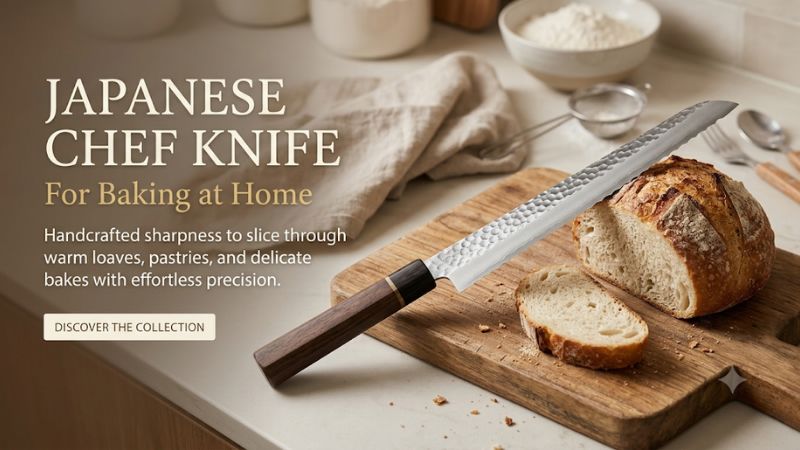
A Japanese chef knife for baking at home can be useful for preparing fruit fillings, chopping suitable nuts, slicing vegetables for savory pastries, and portioning ingredients before baking. However, a gyuto is not a substitute for a bread knife, bench scraper, or pastry cutter. This guide explains where a Japanese chef’s knife fits into a baker’s toolkit and which features matter most.
- Quick Answer: Does a Home Baker Need a Japanese Chef Knife?
- Why a Japanese Chef Knife Can Help With Baking Preparation
- How to Choose a Japanese Chef Knife for Home Baking
- Japanese Knife Models Worth Considering for Home Bakers
- Practical Baking Tasks and the Right Cutting Tools
- Cleaning and Maintaining a Japanese Knife in a Baking Kitchen
- Common Mistakes When Buying a Japanese Knife for Baking
- Frequently Asked Questions
- Conclusion
Quick Answer: Does a Home Baker Need a Japanese Chef Knife?
A Japanese gyuto can be a valuable preparation knife for a home baker who frequently handles fresh fruit, savory ingredients, herbs, or other foods that need clean, controlled cuts. For many people, a 180–210mm stainless gyuto offers versatile length without taking up too much countertop space. The best choice should be comfortable, easy to maintain, and appropriate for the ingredients being prepared.
Useful baking-related tasks
- Dicing apples for pie filling.
- Slicing strawberries for cake decoration.
- Preparing peaches or pears.
- Chopping herbs for savory pastry fillings.
- Cutting cooked vegetables for quiche.
- Slicing cheese when appropriate.
- Preparing mushrooms and onions.
- Portioning soft ingredients before mixing.
- Making fruit and vegetable garnishes.
A gyuto is less appropriate for cutting through hard frozen ingredients, splitting very hard nuts, opening shellfish, or slicing crusty bread.
For those tasks, use suitable specialized tools.
Home baking also involves mixing, measuring, rolling, and shaping dough. None of those operations automatically requires a chef’s knife.
A gyuto is most useful during ingredient preparation, particularly when the baker also cooks ordinary meals.
Why a Japanese Chef Knife Can Help With Baking Preparation
Baking accuracy is often discussed in terms of ingredient weights, oven temperature, and mixing technique, but the preparation of fruit, vegetables, nuts, and savory fillings can also affect the finished result. Uneven fruit pieces may soften at different rates, while large vegetable chunks can create inconsistent texture inside a tart or pastry. A suitable knife helps the baker produce pieces with more consistent dimensions.
Examples of ingredient preparation
- Even apple pieces for pies.
- Thin pear slices for tarts.
- Uniform strawberry halves for decoration.
- Finely chopped onions for savory fillings.
- Small vegetable pieces for hand pies.
- Herbs for cheese pastries.
- Sliced citrus for selected desserts.
- Prepared fruit for compotes.
The knife does not determine baking performance by itself.
Recipe proportions, moisture management, mixing, and baking technique remain essential.
However, controlled cutting can improve ingredient consistency and make recipes easier to assemble.
For a home baker who also cooks dinner, a Japanese gyuto offers practical versatility beyond desserts.
How to Choose a Japanese Chef Knife for Home Baking
Selecting a Japanese chef’s knife for baking preparation begins with identifying the ingredients you cut most often. A baker focused on fruit pies may prioritize controlled slicing and a manageable blade length, while someone preparing savory pastries might need a knife that handles onions, mushrooms, herbs, and boneless proteins. These factors are more relevant than decorative finishes or the highest advertised hardness rating.
Start With the Baking Recipes You Make Most Often
A knife purchase should reflect actual recipes rather than an idealized baking workstation. Fruit-heavy desserts, savory pastries, and homemade bread involve different preparation tasks. A gyuto is highly relevant when cutting fruit and vegetables but may play only a minor role when the baker primarily prepares cookies, cakes, and bread using mixers and bench tools.
For fruit desserts
- Slice apples and pears.
- Cut strawberries and peaches.
- Prepare citrus segments when appropriate.
- Chop fruit for cooked fillings.
- Maintain reasonably consistent sizes.
For savory baking
- Chop onions and mushrooms.
- Prepare spinach or herbs.
- Cut vegetables for quiches.
- Portion boneless ingredients.
- Prepare cheese and other suitable fillings.
For bread and pastry
- Use a bench scraper for dough division.
- Use a serrated knife for many finished loaves.
- Use a pastry cutter for appropriate dough tasks.
- Use the gyuto mainly for added ingredients.
A home baker who mostly makes chocolate chip cookies may not need a premium Japanese knife solely for that activity.
Buying recommendation: Choose a gyuto when fruit, vegetable, and savory ingredient preparation is a recurring part of your baking routine.
Choose Between 180mm and 210mm Blades
Blade length affects precision, working space, and the size of ingredients that can be prepared comfortably. A 180mm gyuto may suit compact baking counters and smaller fruit, while a 210mm blade provides more reach for larger vegetables and multipurpose cooking. Neither size is automatically superior because safe handling depends on the user’s grip and available board.
Common options
- 150–165mm: Better represented by petty or smaller utility designs.
- 180mm: Compact gyuto for smaller preparation areas.
- 200–210mm: Versatile all-purpose home preparation.
- 240mm: Larger cutting boards and more extensive ingredient preparation.
Consider the size of the cutting board.
A 210mm gyuto can feel crowded when used on a narrow mat beside a stand mixer.
On the other hand, a very short blade may require several strokes to slice larger fruit.
Buying recommendation: Start around 180–210mm, choosing the length that allows comfortable control on your actual cutting board.
Prioritize Thin, Controlled Cuts Over Aggressive Chopping
Many Japanese gyuto designs emphasize controlled slicing and relatively refined cutting geometry. This can be useful for delicate fruit, vegetables, and garnishes. However, a fine edge should not be treated as a tool for splitting hard ingredients or making forceful twisting cuts. The best blade for a home baker should move through suitable ingredients with control rather than relying on excessive downward pressure.
Tasks that reward precision
- Thin pear slices.
- Even apple wedges.
- Small onion dice.
- Decorative fruit cuts.
- Finely chopped herbs.
- Thin vegetable slices for tart toppings.
A sharp, appropriate edge can help reduce unnecessary crushing of delicate ingredients, although actual results depend on technique and the specific food.
Do not assume that every Japanese knife cuts identically.
Blade thickness, shape, steel, and sharpening all influence cutting behavior.
Buying recommendation: Choose a versatile gyuto intended for everyday slicing rather than a specialty blade designed for a narrow professional task.
Understand Stainless, High-Carbon, and Powdered Steels
Japanese chef’s knives are available in different steel configurations, including stainless cores such as VG10, proprietary steels, powdered steels such as SG2, and reactive high-carbon varieties. These materials differ in corrosion behavior and maintenance demands. For a home baking environment involving acidic fruit and frequent cleanup, care requirements deserve particular attention.
Common steel choices
- VG10 stainless: Common in established Japanese kitchen knives.
- VG-MAX: Proprietary cutting core used in Shun Classic knives.
- SG2 powdered steel: Used in some premium MIYABI and other knives.
- CROMOVA 18: Stainless formulation associated with GLOBAL.
- Reactive carbon steel: May require more immediate cleaning and drying.
Citrus, pineapple, and other acidic ingredients can increase the importance of corrosion care, particularly with reactive steels.
Some knives develop a patina through use.
That is a characteristic of certain steels rather than proof that the blade is defective.
For a first Japanese chef’s knife, a stainless model may provide simpler everyday maintenance.
Buying recommendation: Prioritize realistic care requirements rather than selecting steel solely by hardness or decorative appearance.
Consider Fruit Texture and Moisture
Baking ingredients vary widely in texture. A firm apple behaves differently from a ripe peach, and a moist strawberry is different from a cooked fruit filling. The knife’s geometry and sharpness can influence how cleanly an ingredient is cut, but the baker must also use suitable techniques and handle delicate produce carefully.
Ingredient examples
- Apples: Benefit from stable wedges and controlled cuts.
- Pears: Require care when very ripe.
- Peaches: May need a smaller knife for pitting.
- Strawberries: Often suit a short utility or paring knife.
- Citrus: May require specialty trimming techniques.
- Bananas: Usually need only simple controlled slicing.
- Mushrooms: Benefit from an appropriate slicing motion.
An eight-inch gyuto is not necessarily the easiest tool for every small piece of fruit.
A paring knife may provide better control for hulling strawberries or removing blemishes.
Similarly, do not force a large chef’s knife into a difficult fruit-pitting task.
Buying recommendation: Use the gyuto for general slicing and keep a smaller knife available for detailed fruit work.
Choose a Handle That Works in a Baking Workspace
Baking workstations may contain flour, water, fruit juices, butter, and other ingredients that can affect grip. A Japanese chef’s knife should be held with clean, dry hands and a secure technique. Handle design can influence comfort, but no material guarantees safe control when coated with grease or sticky batter.
Handle characteristics to compare
- Western-style riveted construction.
- Traditional Japanese-style handle.
- Composite wood.
- Natural wood.
- Synthetic material.
- Stainless steel.
- Handle circumference.
- Grip position near the blade.
A natural wood handle may require additional care around moisture.
A metal handle can feel different from a synthetic grip.
A Western-style handle may be familiar to cooks transitioning from conventional chef’s knives.
Try to assess how naturally the knife sits in your hand.
Buying recommendation: Choose a grip that supports controlled preparation and is easy to clean after handling baking ingredients.
Plan for Chocolate and Nut Preparation Carefully
Some baking recipes require chopped chocolate, nuts, or other dense ingredients. These tasks deserve caution because ingredient hardness varies substantially. A suitable chef’s knife can chop relatively manageable chocolate pieces or certain nuts, but a fine Japanese edge should not be forced through an unusually hard block or used to crack shells.
Practical alternatives
- Use smaller chocolate pieces intended for baking.
- Choose a suitable chocolate-chopping tool for dense blocks.
- Use a food processor for compatible chopping tasks.
- Crack nuts with a proper nutcracker.
- Avoid striking the knife against hard surfaces.
- Do not use the blade as a lever.
- Protect the edge from twisting.
A thick chocolate slab can require considerable force.
It may be safer to use a tool or ingredient format intended for that task rather than risking damage to an expensive gyuto.
Likewise, never attempt to cut through nut shells with a fine kitchen knife.
Buying recommendation: Treat dense ingredient preparation as a separate task rather than assuming a premium Japanese blade can cut every hard baking ingredient.
Understand Why a Gyuto Is Not a Bread Knife
A Japanese gyuto generally has a straight cutting edge intended for controlled slicing and chopping. A serrated bread knife uses a different edge geometry that is particularly useful for cutting through crusty loaves without excessive pressure. The two tools are complementary rather than interchangeable in a baking kitchen.
Use a serrated knife for:
- Crusty sourdough.
- Many artisan bread loaves.
- Bagels.
- Certain delicate cakes.
- Baked goods with firm crusts and soft interiors.
Use a gyuto for:
- Fruit preparation.
- Vegetable fillings.
- Herbs.
- Suitable boneless ingredients.
- Everyday food preparation.
A gyuto may cut certain soft baked foods, but there is no compelling reason to risk damaging the edge on hard crusts when a serrated knife is available.
Buying recommendation: Budget for a serrated bread knife before purchasing an expensive gyuto if your primary goal is slicing finished bread.
Japanese Knife Models Worth Considering for Home Bakers
A buying guide for baking should not automatically recommend the most expensive Japanese knife. The right product depends on whether the owner primarily needs controlled fruit slicing, broad everyday cooking versatility, or premium material construction. The following model examples provide useful reference points without implying that any knife is specifically designed for baking rather than general food preparation.
| Knife | Main Advantage | Best Baking-Related Tasks | Main Limitation |
|---|---|---|---|
| Tojiro Classic F-808 | VG10 gyuto with conventional handle | Apples, pears, savory fillings | Fine edge requires care |
| MAC Professional MTH-80 | Refined slicing-oriented design | Fruit and vegetable preparation | Not for very hard ingredients |
| GLOBAL G-2 | Streamlined stainless steel handle | General prep near baking station | Metal grip preference |
| Shun Classic 8-Inch | VG-MAX core and refined construction | Controlled fruit cuts and garnishes | Requires careful maintenance |
| MIYABI Birchwood SG2 | Premium materials and fine edge | Experienced precise preparation | More demanding ownership |
| Misono UX10 210mm | Traditional gyuto handling | Vegetable and savory pastry prep | Edge configuration and care |
These are all general-purpose kitchen knives.
None should be described as a dedicated dough-cutting, pastry-trimming, or bread-slicing tool.
The correct purchase depends on how often the baker also prepares fruits, vegetables, or savory ingredients.
Practical Baking Tasks and the Right Cutting Tools
A well-organized baking station typically benefits from several complementary tools rather than one knife expected to handle everything. The following examples distinguish where a Japanese gyuto can genuinely help and where a more specialized tool improves control or protects the blade.
Fruit Pies and Tarts
Fruit pies and tarts often require apples, pears, peaches, or other fruit to be sliced or diced before assembly. A Japanese gyuto can be useful for creating evenly sized pieces when the fruit is stable on the cutting board. However, the size and ripeness of the fruit determine whether a smaller paring knife is also needed.
Useful workflow
- Wash and prepare fruit appropriately.
- Stabilize larger pieces.
- Use the gyuto for controlled slices.
- Switch to a paring knife for small detailed work.
- Follow the recipe’s cutting size.
- Transfer fruit to the filling bowl.
- Clean the knife after preparation.
Consistent size can help ingredients cook more uniformly, but it does not replace correct baking time or filling preparation.
Savory Pastry Fillings
Savory tarts, quiches, and hand pies frequently include onions, mushrooms, peppers, spinach, herbs, or cooked proteins. A gyuto can handle many of these ingredients efficiently, particularly when the recipe calls for controlled dice or thin slices. The cutting station should remain separate from pastry dough to prevent unnecessary mess and contamination.
Useful workflow
- Prepare clean vegetables first.
- Chop onions and aromatics.
- Slice mushrooms.
- Mince herbs.
- Use separate safe handling for raw proteins.
- Cook or cool fillings as directed.
- Clean and dry the knife.
A broad chef’s knife may make vegetable preparation faster than repeatedly switching among several small specialty blades.
However, knife safety and food hygiene must remain the priority.
Cake Decorations and Fresh Fruit Garnishes
Fresh fruit decorations require a combination of accurate cutting and gentle handling. A gyuto can slice larger fruit into uniform pieces, while a paring knife is often more suitable for hulling berries or making detailed cuts. The goal is to preserve attractive shapes without crushing ripe ingredients or using more force than necessary.
Useful workflow
- Choose ripe but manageable fruit.
- Wash and dry appropriately.
- Cut larger pieces with a gyuto.
- Use a paring knife for fine detail.
- Keep slices organized.
- Add garnishes at the appropriate stage.
- Clean the knife before switching ingredients.
A very large chef’s knife may be unnecessarily awkward when decorating small cupcakes or individual pastries.
Use the tool that provides the most control.
Bread, Pastry Dough, and Chocolate Work
Bread and pastry tasks demonstrate why a gyuto cannot replace every baking tool. Dough is often divided with a bench scraper, finished crusty loaves benefit from a serrated bread knife, and dense chocolate may require a specialized chopping approach. The baker should select tools according to material resistance and the amount of force required.
Better tool choices
- Dough division: Bench scraper.
- Crusty bread: Serrated bread knife.
- Layer cake trimming: Suitable long serrated knife.
- Dense chocolate: Appropriate chopping tool or smaller pieces.
- Nut shells: Nutcracker.
- Fruit slicing: Gyuto or paring knife.
- Savory vegetables: Gyuto.
A premium Japanese edge should never be used as a wedge or lever.
Cleaning and Maintaining a Japanese Knife in a Baking Kitchen
Baking ingredients can leave sugar residue, flour paste, fruit acids, oils, and other substances on the blade. These should be removed according to the knife manufacturer’s care instructions rather than left to dry around the handle or cutting edge. Regular cleaning also prevents ingredients from one preparation task contaminating foods used in another.
Recommended care routine
- Clear the workstation before washing.
- Keep the sharp edge visible and controlled.
- Wash the blade by hand with appropriate soap and water.
- Clean residue from the handle transition.
- Rinse carefully.
- Dry promptly.
- Protect wooden or composite handles from prolonged moisture.
- Store the edge in a suitable sheath or knife block.
- Sharpen according to manufacturer guidance.
- Inspect the blade before the next baking session.
Avoid soaking knives in a sink or leaving them beneath other dishes.
Do not use the dishwasher for a knife whose manufacturer recommends handwashing.
For reactive carbon steel, prompt cleaning after acidic fruit preparation is particularly important.
Common Mistakes When Buying a Japanese Knife for Baking
A Japanese knife can be a useful addition to a baking kitchen, but shoppers may be misled by marketing that presents one blade as the solution to every pastry task. In reality, blade geometry and ingredient hardness matter more than decorative steel patterns. Choosing the wrong tool can damage the edge or make otherwise simple tasks unnecessarily difficult.
Mistakes to avoid
- Buying a gyuto primarily to slice crusty bread.
- Using a fine edge as a dough scraper.
- Cutting very hard chocolate blocks with excessive force.
- Cracking nut shells with a chef’s knife.
- Selecting an oversized blade for a tiny workstation.
- Ignoring handle comfort.
- Cutting frozen fruit blocks.
- Treating Damascus layers as proof of performance.
- Letting acidic fruit residue dry on reactive steel.
- Putting a premium knife in the dishwasher.
- Storing the knife loose among baking tools.
- Using the blade to pry containers open.
- Neglecting a separate cutting board.
- Failing to wash after raw animal ingredients.
The best baking toolkit uses the right blade for each task rather than relying on one expensive purchase.
Frequently Asked Questions
Home bakers often wonder whether a Japanese chef’s knife offers meaningful benefits beyond an ordinary kitchen knife, particularly when most baking involves dough rather than vegetables. The answers below clarify where gyuto designs are useful, which tools remain necessary, and how to protect a fine cutting edge during ingredient preparation.
Is a Japanese Chef Knife Good for Baking?
It can be useful for preparing fruit fillings, vegetables, herbs, and savory ingredients used in baking recipes. A gyuto provides a versatile blade for these tasks, but it is not primarily designed for dough shaping or cutting finished crusty bread.
Choose it when ingredient preparation is a regular part of your baking routine.
Use specialized pastry tools for other jobs.
Can a Japanese Chef Knife Slice Bread?
A gyuto may cut some soft bread, but a serrated bread knife is generally more appropriate for crusty loaves and many baked goods. The serrations help cut the crust without requiring excessive downward pressure.
Avoid using a fine Japanese edge for hard bread crusts when a suitable serrated knife is available.
What Japanese Knife Is Best for Cutting Fruit?
A 180–210mm gyuto is useful for many medium and large fruits, while a smaller petty or paring knife can be better for detailed trimming. The correct tool depends on fruit size, ripeness, and the cut required.
Prioritize a sharp, controllable blade.
A larger knife is not always better for delicate fruit decorations.
Can I Use a Gyuto to Chop Chocolate?
It may be suitable for manageable pieces when the manufacturer approves ordinary ingredient chopping, but dense chocolate blocks can require substantial force. Avoid twisting the edge or using it as a wedge.
For hard chocolate, use an appropriate chopping method or ingredient format.
Do not risk damaging a fine Japanese blade.
Is Stainless Steel Better for a Home Baking Knife?
Stainless steel can be convenient when frequently preparing acidic fruit or cleaning between ingredients. However, stainless knives still require washing, drying, and sharpening. Reactive carbon steel can also be useful for knowledgeable cooks willing to maintain it carefully.
Choose according to your care habits rather than the material label alone.
Conclusion
The best Japanese chef knife for baking at home is a comfortable gyuto that helps prepare fruit, vegetables, herbs, and savory fillings with controlled cuts. A 180–210mm stainless blade is a practical starting point for many home bakers, particularly those who also cook everyday meals. Choose the knife according to your cutting board, handle preferences, and maintenance routine rather than decorative steel alone. Keep a paring knife, serrated bread knife, and bench scraper available for their specialized tasks. A Japanese chef’s knife is a versatile ingredient-preparation tool, not a replacement for the full baking toolkit.




Write Your Review
No reviews yet. Be the first to share your experience!