
A cleaver knife for beginners can be a useful addition to a home kitchen, but choosing the correct type matters more than buying the biggest blade. Chinese vegetable cleavers and heavy meat cleavers look similar while serving different tasks. This guide explains their differences, beginner-friendly features, cutting-board requirements, safe handling, and maintenance before your first purchase.
- Quick Answer: Which Cleaver Should a Beginner Buy?
- Understand the Different Types of Cleaver Knives
- What Makes a Cleaver Beginner-Friendly?
- Beginner-Friendly Cleaver Options to Consider
- How to Choose Your First Cleaver on a Budget
- Choosing the Right Cutting Board
- How to Learn Basic Vegetable-Cleaver Technique
- Why Heavy Meat Cleavers Require Additional Caution
- Cleaning and Maintaining Your First Cleaver
- Common Beginner Buying Mistakes
- Frequently Asked Questions
- Conclusion
Quick Answer: Which Cleaver Should a Beginner Buy?
Most beginners who want a broad rectangular kitchen knife should start by considering a Chinese-style vegetable cleaver rather than a heavy meat cleaver. A vegetable cleaver is designed for everyday chopping and slicing of suitable ingredients, while a meat cleaver is a more specialized tool associated with substantial meat preparation. The correct choice depends on what you cook and whether you have the skills and workspace for that knife.
Beginner priorities:
- For everyday vegetables: Chinese chef’s knife or vegetable cleaver.
- For boneless meat and stir-fries: Suitable broad Chinese chef’s knife.
- For heavy meat preparation: Dedicated meat cleaver only when justified by the task and appropriate experience.
- For a small kitchen: Manageable blade length and secure storage.
- For first-time knife buyers: Comfortable handle and clear manufacturer instructions.
- For easier maintenance: Appropriate stainless steel with straightforward care requirements.
- For safe use: Stable cutting board and controlled technique.
A heavy meat cleaver is not automatically a better all-purpose knife because it is larger or heavier. Beginners should first understand blade purpose and practice normal cutting technique before attempting any task involving significant chopping force.
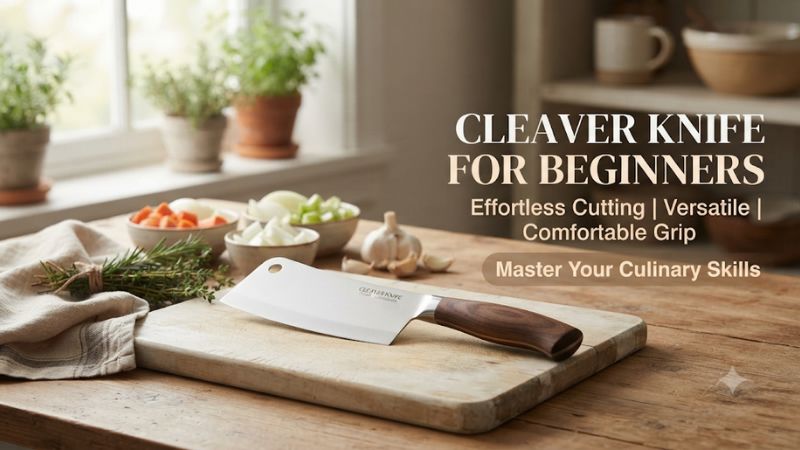
Understand the Different Types of Cleaver Knives
The word cleaver is used for several kitchen tools with broad, rectangular blades. This creates confusion because a Chinese chef’s knife can resemble a butcher cleaver even though its blade geometry is intended for different cutting tasks. A beginner needs to identify the type before evaluating brands, materials, or price.
Chinese Vegetable Cleavers
A Chinese vegetable cleaver, often called a Chinese chef’s knife, generally has a broad blade with a comparatively thin cutting edge. It is intended for slicing, chopping, and preparing vegetables and other suitable boneless foods. The wide blade also provides a convenient surface for gathering prepared ingredients when handled correctly.
Best For: Everyday home cooking and vegetable preparation.
Common tasks:
- Chopping cabbage.
- Dicing onions.
- Slicing cucumbers.
- Preparing peppers.
- Chopping leafy greens.
- Cutting suitable boneless proteins.
- Preparing ingredients for stir-fries.
Advantages:
- Broad useful blade surface.
- Versatile vegetable preparation.
- Can replace some general slicing tasks.
- Recognizable chopping format.
- Different handle options.
Limitations:
- Not intended for forceful bone chopping.
- Broad shape takes adjustment.
- Requires sufficient cutting-board space.
- Sharp edge needs regular maintenance.
Buy If: You want a broad kitchen knife for normal food preparation.
Skip If: Your primary need involves chopping hard bones.
The most important distinction is blade purpose, not appearance. A vegetable cleaver can be damaged by impact work outside the manufacturer’s intended use.
Heavy Meat Cleavers
Heavy meat cleavers are purpose-built for selected substantial meat-preparation tasks. They typically have thicker blades and greater mass than vegetable cleavers. Their intended work may include processing appropriate joints or bones, subject to manufacturer limitations, but their weight and cutting action demand additional care.
Best For: Experienced users performing specific heavy-duty meat tasks.
Common characteristics:
- Substantial blade construction.
- Greater overall weight.
- Thick chopping-oriented geometry.
- Specialized task focus.
- Robust handle requirements.
- Need for an appropriate chopping surface.
Advantages:
- Designed for certain heavy chopping tasks.
- Specialized butcher-style function.
- Available in several blade lengths.
- Can serve specific meat-preparation routines.
Limitations:
- More demanding to control.
- Higher injury risk when mishandled.
- Not ideal for delicate vegetable slicing.
- Requires appropriate technique.
- Not suitable for every bone or frozen ingredient.
Buy If: You have a legitimate repeated-use need and appropriate instruction.
Skip If: You are buying your first general-purpose kitchen knife.
A meat cleaver should not be purchased simply because it looks powerful. Many households can ask their butcher to portion bone-in cuts instead of performing heavy chopping at home.
Chinese Chef’s Knives Versus Heavy Butcher Tools
Both categories use broad blades, but they are designed for different cutting movements. The Chinese chef’s knife emphasizes controlled slicing and chopping, while a heavy butcher cleaver is a specialized impact-oriented tool.
Chinese chef’s knife:
- Thinner cutting geometry.
- Everyday food preparation.
- Often seven or eight inches long.
- Suitable for vegetables and boneless foods.
- Not a general bone-chopping tool.
Heavy meat cleaver:
- Thicker chopping geometry.
- Dedicated heavy tasks.
- Often substantial weight.
- Requires appropriate chopping support.
- Should be used only within stated limitations.
The correct purchase depends on the type of food being prepared.
Do not assume that two knives of identical blade length can safely perform the same tasks.
Why a Nakiri Is Not the Same Thing
A nakiri is another broad Japanese-style vegetable knife, but its profile and typical cutting characteristics differ from a Chinese chef’s knife. Both are intended mainly for vegetables, yet they may vary in blade height, handle configuration, and cutting technique.
Nakiri characteristics:
- Broad rectangular profile.
- Vegetable-focused design.
- Often around 165mm to seven inches.
- Comparatively straight cutting edge.
- Usually lighter than a heavy butcher cleaver.
Chinese vegetable cleaver characteristics:
- Taller broad blade.
- Useful for varied chopping and slicing.
- Wide surface for food preparation.
- Different blade lengths and weights.
- Traditional Chinese chef’s-knife format.
Neither should be mistaken for a heavy meat cleaver.
Choose according to the cutting style that feels comfortable and the foods you prepare most often.
What Makes a Cleaver Beginner-Friendly?
A beginner-friendly cleaver should be manageable, clearly intended for the planned tasks, and easy to maintain. Large blade dimensions may feel intimidating at first, so comfort and predictable movement are important. The knife should work with a suitable cutting board and storage arrangement without encouraging forceful techniques.
Choose Manageable Blade Weight
Weight has a substantial effect on how a cleaver feels. Chinese vegetable knives are often comparatively easier to maneuver than heavy-duty meat cleavers, but weights vary across individual products.
Important considerations:
- Overall knife weight.
- Blade-to-handle balance.
- Comfortable lifting movement.
- Wrist position.
- Cutting-board size.
- Intended cutting method.
- Duration of normal food preparation.
A heavier knife is not automatically better.
For ordinary vegetables, excessive mass can increase fatigue or make control more difficult.
Beginners should prioritize a blade they can handle predictably rather than selecting the heaviest available option.
Select an Appropriate Blade Length
Broad kitchen knives commonly range from approximately six to eight inches in cutting length, although specialized models can differ.
Six-inch blades may suit:
- Smaller workspaces.
- Compact specialty knives.
- Users preferring shorter reach.
- Certain meat-cleaver categories.
Seven-inch blades may suit:
- General vegetable preparation.
- Moderate cutting boards.
- Everyday Chinese chef’s-knife use.
- Versatile chopping tasks.
Eight-inch blades may suit:
- Larger vegetables.
- Frequent batch preparation.
- More spacious work areas.
- Cooks comfortable with longer blades.
Blade length should be evaluated alongside height and weight.
A tall eight-inch Chinese chef’s knife may require substantially more storage space than a narrow eight-inch Western chef’s knife.
Prioritize Handle Comfort and Grip
A broad blade should have a handle that feels secure during ordinary movements. Some cleavers use traditional wooden handles, while others use riveted synthetic designs.
Look for:
- Secure blade attachment.
- Comfortable handle thickness.
- Suitable grip texture.
- No sharp handle edges.
- Appropriate hand clearance.
- Balanced feel.
- Easy cleaning.
Wooden handles:
- Traditional appearance.
- Distinct hand feel.
- Require moisture care.
Synthetic handles:
- Available in textured forms.
- Often straightforward to clean.
- Vary in shape and grip feel.
No handle material guarantees safe use when technique or the cutting surface is unsuitable.
If possible, assess the handle safely in person.
Check Blade Thickness and Intended Edge
A broad blade’s thickness and cutting geometry reveal more about its purpose than its rectangular outline.
A thin vegetable cleaver is designed for slicing, while a thick meat cleaver is associated with different cutting forces.
Check product information for:
- Intended food categories.
- Blade thickness where provided.
- Edge geometry.
- Steel material.
- Manufacturer use limitations.
- Sharpening recommendations.
- Prohibited tasks.
Do not attempt to use a thin vegetable cleaver for heavy bone cutting.
The purchase should match the intended task from the beginning.
Beginner-Friendly Cleaver Options to Consider
Established manufacturers offer both Chinese-style chef’s knives and heavy meat cleavers. Beginners should focus first on the vegetable-preparation models because these are more relevant to everyday chopping. Heavy-duty models should be evaluated separately and only when the user has an appropriate need and safe working setup.
ZWILLING Gourmet 7-Inch Chinese Chef’s Knife
The ZWILLING Gourmet seven-inch Chinese Chef’s Knife is a broad vegetable-focused knife intended for ordinary kitchen food preparation. Its recognizable product configuration provides a useful starting point for buyers comparing Chinese chef’s knives with more specialized heavy cleavers.
Best For: Beginners interested in vegetable preparation.
Key Features:
- Seven-inch blade.
- Broad rectangular profile.
- Recognizable Gourmet series.
- Suitable for many vegetables.
- General kitchen-use design.
Pros:
- Relevant to everyday cooking.
- Established manufacturer.
- Practical cutting length.
- Clear product identity.
Cons:
- Broad blade requires adaptation.
- Not intended for heavy bone work.
- Needs sufficient board space.
- Must be stored with the edge protected.
Buy If: You regularly prepare vegetables and want to learn a Chinese-style chopping format.
Skip If: You mainly need a tool for cutting bones.
The best starting knife is one that matches ordinary cooking needs and can be handled without unnecessary force.
ZWILLING Pro 7-Inch Chinese Chef’s Knife
The ZWILLING Pro seven-inch Chinese Chef’s Knife is a separate premium-series option designed for vegetable and suitable boneless-food preparation. It provides a broad blade format for buyers who appreciate the Pro series construction and handle arrangement.
Best For: Buyers wanting a premium Chinese-style kitchen knife.
Key Features:
- Seven-inch blade.
- Pro series design.
- Broad rectangular cutting surface.
- Vegetable-focused function.
- Suitable for controlled daily chopping.
Pros:
- Familiar premium brand.
- Broad food-preparation profile.
- Recognizable model.
- Versatile within its intended tasks.
Cons:
- Higher purchase commitment.
- Not a heavy meat cleaver.
- Handle preference is personal.
- Requires maintenance and proper storage.
Buy If: You already enjoy the Pro series or want a more premium kitchen tool.
Skip If: You are unsure whether you will regularly use the broad blade.
An expensive knife is not necessarily easier for a beginner. Grip and cutting technique remain the most important considerations.
Dexter-Russell Traditional Chinese Chef’s Knife
Dexter-Russell offers traditional Chinese chef’s knives, including the S5198 eight-inch model. This type of knife provides a substantial broad blade for food preparation while remaining distinct from the company’s heavy-duty cleaver products.
Best For: Home cooks preparing vegetables and suitable boneless foods in larger quantities.
Key Features:
- Eight-inch blade in the S5198 configuration.
- Broad rectangular profile.
- Traditional Chinese chef’s-knife format.
- Recognizable model identity.
- Dedicated food-preparation design.
Pros:
- Useful cutting length.
- Broad chopping surface.
- Established manufacturer.
- Suitable for repeated vegetable preparation.
Cons:
- Large blade footprint.
- May feel cumbersome in a small kitchen.
- Not intended for heavy bone chopping.
- Requires protected storage.
Buy If: You have a suitable cutting area and want a traditional broad Chinese chef’s knife.
Skip If: You prefer a compact knife or rarely prepare vegetables.
Beginners should not assume an eight-inch rectangular knife is automatically better than a seven-inch version. Choose according to comfort and workspace.
How to Choose Your First Cleaver on a Budget
A first cleaver purchase should be based on realistic cooking needs, not dramatic appearance or advertising claims. The total cost includes the knife, suitable cutting board, storage, and maintenance. A simple, identifiable vegetable cleaver may provide better long-term value than a heavy specialized butcher tool that remains unused.
Set Priorities Before Comparing Prices
Budget shoppers should first identify the type of food they prepare.
Spend on:
- Appropriate blade category.
- Secure handle.
- Reliable construction.
- Correct blade length.
- Suitable cutting board.
- Protective storage.
- Sharpening support.
Avoid paying extra solely for:
- Decorative steel patterns.
- Oversized knife sets.
- Unnecessary packaging.
- Claims of indestructibility.
- Features unrelated to normal cooking.
The most useful purchase is the knife you can safely use and maintain consistently.
Consider Whether You Need a Cleaver at All
A regular chef’s knife may be sufficient for a household preparing ordinary vegetables, chicken breasts, and packaged meat.
A Chinese chef’s knife is a reasonable alternative when the cook prefers a broad blade, but it is not a required kitchen purchase.
A cleaver may be worthwhile when:
- You frequently chop vegetables.
- You prefer a broad cutting profile.
- You prepare large batches of ingredients.
- You have a stable cutting surface.
- You can store the blade appropriately.
You may not need one when:
- Your chef’s knife already meets your needs.
- Counter space is very limited.
- You rarely perform the intended tasks.
- You dislike the broad handle-and-blade arrangement.
Do not buy an additional knife unless it solves a real problem.
Budget for Safe Storage
A cleaver needs appropriate storage because its blade is broader than many standard kitchen knives.
Useful options:
- Compatible wide blade guard.
- Suitable knife drawer organizer.
- Secure purpose-built knife block.
- Appropriate covered storage system.
Avoid leaving the blade exposed in a drawer.
A protective storage accessory is more important than decorative packaging.
Choosing the Right Cutting Board
A broad knife requires a stable cutting surface that accommodates the ingredient and the knife’s movement. Cutting-board selection is especially important for beginners because a large blade can be difficult to control on a cramped or unstable surface. Heavy meat cleaver work has additional support requirements beyond ordinary vegetable chopping.
Use a Stable Board for Vegetables
A Chinese vegetable cleaver works best on a food-preparation board with enough room for safe hand placement.
Board features to look for:
- Stable base.
- Appropriate wood or polymer material.
- Sufficient width.
- Flat working surface.
- Easy cleaning.
- No severe damage.
- Enough room for prepared ingredients.
Avoid glass, stone, and ceramic cutting surfaces.
These can damage knife edges and may be unsuitable for controlled chopping.
Avoid Thin Boards for Heavy Chopping
A heavy meat cleaver should be used only with a suitable robust surface and appropriate instruction.
A thin lightweight board may shift or become damaged during heavy work.
Do not attempt impact chopping on an unstable countertop arrangement.
The cutting surface must be appropriate for the specific knife and task.
When unsure, seek advice from a qualified instructor or butcher rather than improvising.
Keep the Board Clean and Food-Safe
Raw meat preparation requires careful attention to contamination.
Basic practices:
- Wash hands before and after handling raw meat.
- Keep raw animal foods separate.
- Clean boards and utensils.
- Avoid transferring raw juices to ready-to-eat foods.
- Refrigerate ingredients promptly.
- Use a food thermometer for safe cooking.
- Replace severely damaged boards.
A good knife does not reduce the need for food safety.
How to Learn Basic Vegetable-Cleaver Technique
A Chinese chef’s knife can be a useful learning tool for ordinary vegetable preparation when handled deliberately. Beginners should start with manageable ingredients, a stable board, and an appropriate grip. The objective is safe, consistent control rather than rapid chopping or dramatic technique.
Begin With Easy-to-Control Ingredients
Start with ingredients that can rest securely on a cutting board and do not require excessive force.
Suitable practice foods:
- Cucumbers.
- Zucchini.
- Bell peppers.
- Onions.
- Leafy greens.
- Mushrooms.
- Suitable boneless ingredients.
Avoid very hard or unstable ingredients during initial practice.
Use controlled movements and maintain adequate space around the cutting area.
Keep the Guiding Hand Protected
A sharp cleaver has a broad edge that requires careful hand placement.
Do not place fingers in the cutting path.
Use a controlled guiding-hand position appropriate to the task.
Avoid attempting fast chopping movements before developing reliable control.
Beginner principles:
- Keep the board stable.
- Move deliberately.
- Maintain a clear view of the edge.
- Never cut toward the guiding hand.
- Stop when the ingredient shifts.
- Avoid distractions.
- Put the knife down safely between tasks.
Speed is not necessary for effective home cooking.
Use a Controlled Chopping Motion
Chinese vegetable cleavers can support chopping and slicing movements, but the exact technique depends on blade geometry.
A smooth deliberate motion is generally preferable to forceful striking.
Do not attempt to crush bones or frozen food with a thin vegetable cleaver.
The edge should perform the cutting.
If excessive force is needed, reassess the ingredient, knife choice, and technique.
Transfer Chopped Food Safely
The broad blade can help gather ingredients, but scraping sideways with the sharp edge may unnecessarily wear it.
Use a bench scraper or an appropriate safe technique.
Avoid lifting large amounts of food on an exposed sharp blade near other people.
Keep the working area clear and move prepared ingredients into suitable containers.
This routine can make batch vegetable preparation more organized.
Why Heavy Meat Cleavers Require Additional Caution
A heavy meat cleaver is a specialized cutting tool with substantial weight and a different intended movement from a thin vegetable knife. Beginners should not attempt difficult bone-chopping tasks without appropriate instruction. Safe handling requires understanding the specific knife’s limitations, the nature of the ingredient, and the work surface.
Do Not Assume Every Cleaver Cuts Bone
A broad blade does not establish bone-cutting suitability.
Some models are designed only for vegetables and boneless ingredients.
Others are built for selected meat-cleaver tasks.
Check the exact product specification.
Never strike hard bones with a thin Chinese chef’s knife.
Respect Manufacturer Limitations
Even a heavy-duty cleaver may have restrictions involving bone size, frozen food, or cutting technique.
Before considering heavy work:
- Identify the task.
- Verify product suitability.
- Inspect the blade and handle.
- Use an approved stable surface.
- Keep bystanders away.
- Obtain appropriate instruction.
- Avoid damaged equipment.
A heavy knife should never be treated as indestructible.
Use Prepared Meat When Appropriate
Many home cooks can purchase meat already portioned by a butcher.
This can eliminate the need for heavy chopping equipment.
If you only need chicken pieces or bone-in cuts for recipes, professionally prepared portions may be more convenient and safer than learning specialized butcher work at home.
Choose a meat cleaver only when its repeated use justifies the additional risk and equipment requirements.
Cleaning and Maintaining Your First Cleaver
A cleaver should be cleaned and stored carefully after each use. Broad blades can collect food residue across a large surface, while handle materials may require specific care. Proper maintenance also protects the cutting edge and reduces the chance of encountering a damaged knife during later use.
Wash and Dry After Cooking
Follow the manufacturer instructions for the exact model.
Basic cleaning routine:
- Remove food residue.
- Wash carefully with appropriate detergent.
- Keep fingers away from the edge.
- Rinse safely.
- Dry the blade and handle.
- Check for damage.
- Store securely.
Do not leave a large sharp blade submerged in a sink.
Another person may not see it beneath dishes or cloudy water.
Maintain the Appropriate Edge
Vegetable cleavers and heavy meat cleavers may require different sharpening approaches.
A thin slicing edge should not be treated like a thick chopping edge.
Sharpening considerations:
- Steel type.
- Intended use.
- Edge angle.
- Manufacturer recommendations.
- Appropriate sharpening tools.
- Professional support when needed.
Avoid aggressive sharpening without understanding the blade.
A damaged or chipped edge should be assessed before continued use.
Inspect the Handle and Blade
A loose handle or damaged edge can create additional hazards.
Inspect for:
- Cracks.
- Loose rivets.
- Corrosion.
- Chips.
- Bent or damaged sections.
- Worn protective guards.
- Unsafe storage conditions.
Do not continue using a damaged cleaver without appropriate repair or replacement.
Store the Cleaver Securely
A cleaver should not be left loose among everyday utensils.
Choose storage appropriate to the broad blade.
Safety priorities:
- Full edge protection.
- Stable location.
- No loose contact with other knives.
- Child access control.
- Dry storage.
- Suitable guard dimensions.
A conventional narrow knife sheath may not fit a wide cleaver correctly.
Common Beginner Buying Mistakes
First-time buyers often choose the wrong cleaver category, underestimate blade weight, or assume an oversized knife will handle every task. These mistakes can create unnecessary expense and poor cutting control. A careful purchase begins with food-preparation needs and realistic comfort rather than appearances.
Choosing a Meat Cleaver for Vegetable Chopping
A heavy-duty meat cleaver is usually unnecessary for ordinary vegetables.
Its weight and geometry may be less convenient than a thinner Chinese chef’s knife.
Choose the appropriate food-preparation tool instead of purchasing a specialized butcher blade for general cooking.
Using a Vegetable Cleaver for Bones
A thin vegetable-cleaver edge is not designed for heavy bone impact.
Using it incorrectly can damage the blade and create injury risk.
Follow the product’s intended application and never assume rectangular shape establishes bone-cutting capability.
Buying the Heaviest Knife Available
Weight does not automatically mean quality or versatility.
A heavy cleaver may become tiring and difficult to control.
Beginners should prioritize manageable balance and suitable function.
If the knife feels intimidating or unstable, choose another design.
Ignoring Storage Space
Broad knives require protected storage that accommodates blade height and length.
Measure the drawer or knife guard before buying.
Do not let the cleaver remain exposed on the counter because it does not fit the existing knife block.
Practicing Without a Suitable Board
An unstable cutting board creates unnecessary risk.
Do not attempt to compensate by holding the board with one hand while chopping.
Use a suitable stable surface.
If the kitchen cannot accommodate the required workspace, choose another preparation method.
Frequently Asked Questions
Beginners often want to know whether cleavers are difficult to use, which type is best for ordinary cooking, and whether a heavy blade provides more cutting power. These questions require distinguishing the actual intended tasks. A Chinese vegetable cleaver and a heavy butcher cleaver may share a rectangular silhouette, but they belong to different functional categories.
What Type of Cleaver Is Best for Beginners?
A Chinese-style vegetable cleaver is often the better option for beginners interested in everyday kitchen chopping. It is intended for vegetables and suitable boneless foods rather than heavy bone work. A dedicated meat cleaver is more specialized and requires additional technique and appropriate equipment. Choose according to the food you prepare rather than appearance.
Can Beginners Use a Chinese Cleaver Safely?
Yes, with suitable instruction, a stable cutting board, and controlled technique. Start with manageable vegetables and focus on safe hand placement rather than speed. Keep the blade sharp, clean, and properly stored. Do not use a thin Chinese chef’s knife for chopping bones or other tasks outside its intended application.
Is a Cleaver Better Than a Chef’s Knife?
Neither is universally better. A Chinese chef’s knife offers a broad blade and useful vegetable-chopping profile, while a Western chef’s knife has different curvature and handling characteristics. A heavy meat cleaver serves a separate specialized purpose. The best tool depends on ingredients, cutting technique, available space, and personal comfort.
What Size Cleaver Should a Beginner Buy?
For ordinary Chinese-style vegetable preparation, a seven-inch blade may be a practical starting point for many home cooks. However, blade height, weight, handle dimensions, and cutting-board space also matter. A six-inch heavy meat cleaver can feel substantially more demanding than a seven-inch vegetable knife. Choose the intended type before comparing length.
Can a Cleaver Replace All My Kitchen Knives?
No single cleaver is ideal for every kitchen task. A Chinese vegetable cleaver can handle many chopping and slicing jobs, but filleting fish, cutting crusty bread, detailed peeling, and bone-related work may require different tools. A heavy meat cleaver is even more specialized. Build a knife collection around actual tasks rather than assuming one broad blade does everything.
Do I Need a Heavy Cleaver to Cut Chicken?
Not necessarily. Many chicken-preparation tasks can be handled with suitable kitchen knives, and meat can also be purchased already portioned. A heavy cleaver may be appropriate for certain specialized tasks, but bone-chopping requires proper equipment and technique. Beginners should avoid unnecessary heavy cutting and consider asking a butcher to prepare portions.
How Should I Sharpen a Cleaver Knife?
Follow the exact manufacturer recommendations because different cleaver categories can have different edge geometries and steel characteristics. Thin vegetable knives may require a different approach from heavy-duty chopping tools. Use suitable sharpening equipment or professional services. Avoid applying aggressive or inappropriate sharpening methods without understanding the blade.
Are Expensive Cleavers Worth Buying for Beginners?
Not automatically. A recognizable, suitable vegetable cleaver with comfortable handling and manageable maintenance can be a better first purchase than an expensive specialized knife. Higher prices may reflect materials or construction that are not essential for learning basic technique. Prioritize correct category, safe handling, and storage before premium features.
Conclusion
A cleaver knife for beginners should be selected according to intended use, not its intimidating rectangular shape. For everyday vegetables and suitable boneless foods, a manageable Chinese chef’s knife is generally a more practical starting point than a heavy meat cleaver. Choose comfortable blade weight, secure handle construction, suitable cutting-board space, and proper protective storage. Learn controlled techniques, follow manufacturer limitations, and avoid heavy bone chopping without appropriate instruction. The right first cleaver should make ordinary cooking easier without encouraging unsafe use.










Write Your Review
No reviews yet. Be the first to share your experience!