
A Santoku knife for travel can be useful for culinary trips, vacation rentals, and cooking away from your usual kitchen, but selecting a blade is only part of the decision. Transportation restrictions, protective storage, and the available preparation space matter just as much. This guide explains when bringing a Santoku makes sense, what features to prioritize, and how to transport and use it responsibly.
- Quick Answer: Should You Travel With a Santoku Knife?
- What Makes a Santoku Useful for Cooking Away From Home?
- How to Choose the Right Santoku Knife for Travel
- Understanding Travel Restrictions and Legal Responsibilities
- Packing and Storing a Santoku Responsibly
- Using a Santoku Safely in an Unfamiliar Kitchen
- Budget and Buying Considerations
- Common Mistakes to Avoid
- Frequently Asked Questions
- Conclusion
Quick Answer: Should You Travel With a Santoku Knife?
A Santoku can be a practical all-purpose food-preparation knife when you plan to cook regularly at a permitted destination. Its relatively compact blade, broad profile, and suitability for vegetables and boneless ingredients make it useful in many temporary kitchens. However, a kitchen knife is not an ordinary travel accessory, and legal transport, accommodation rules, and secure storage should be checked before packing.
The most practical approach depends on your trip:
- Vacation rental: Bring a properly protected kitchen knife only when permitted and genuinely necessary.
- Culinary class: Follow the instructor’s equipment and transport instructions.
- Road trip with planned cooking: Keep the knife protected, secured, and stored according to applicable laws.
- Air travel: Check airline, airport security, destination, and baggage restrictions before departure.
- Hotel without cooking facilities: Leave the knife at home.
- Shared accommodation: Confirm that kitchen knives are permitted and can be stored securely.
For many travelers, using the kitchen equipment already provided by a rental or purchasing groceries that require little cutting is the simpler option. The best travel Santoku is not necessarily the smallest knife available; it is one that can be transported lawfully, protected reliably, and used safely in an appropriate kitchen.
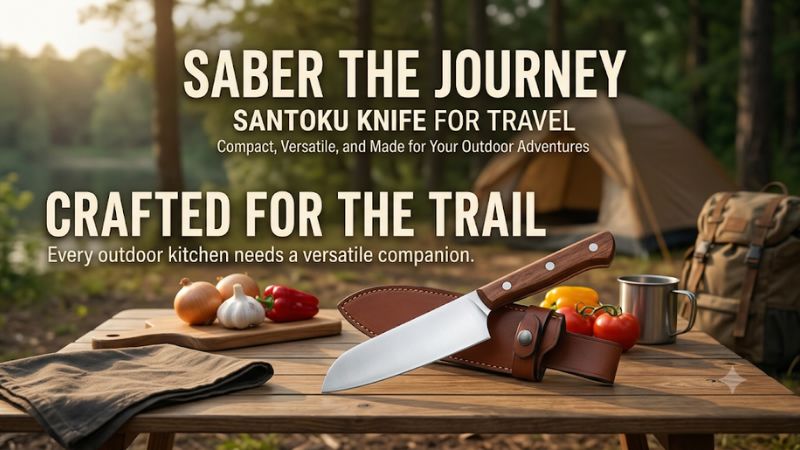
What Makes a Santoku Useful for Cooking Away From Home?
Santoku knives are commonly used for slicing, dicing, and chopping. Their broad blades and relatively straight cutting edges make them particularly useful for vegetables and other everyday ingredients. For people who prepare meals while traveling, a Santoku may cover several kitchen tasks without requiring a complete collection of specialized knives.
Understand the Santoku Blade Shape
A Santoku typically has a broad blade, a gently curved or relatively straight edge, and a downward-sloping tip. Common blade lengths are around five to seven inches, although specific products vary. Compared with many eight-inch Western chef’s knives, a shorter Santoku can feel manageable on a compact cutting board.
Practical characteristics include:
- Broad blade for chopping vegetables.
- Relatively straight cutting edge.
- Shorter blade options.
- Comfortable height for suitable chopping tasks.
- Versatility with boneless foods.
- Different handle shapes and balance points.
The shape favors controlled chopping and slicing rather than heavy rocking cuts.
It is not intended for splitting bones, opening packaging, or cutting on hard surfaces.
A travel knife should remain a food-preparation tool rather than become a multipurpose utility blade.
Know Which Foods a Santoku Handles Well
A Santoku can be useful when a traveler plans to prepare simple meals such as salads, sandwiches, stir-fries, and vegetable-based dishes. Its cutting edge can handle a broad range of ingredients when used with a stable board and appropriate technique.
Suitable kitchen tasks:
- Chopping onions and peppers.
- Slicing tomatoes and cucumbers.
- Preparing fruit.
- Cutting boneless meat.
- Chopping herbs.
- Preparing vegetables for roasting.
- Portioning boneless cooked foods when appropriate.
Tasks to avoid:
- Cutting through bones.
- Splitting frozen ingredients.
- Prying containers open.
- Using the knife as a screwdriver.
- Cutting on glass or stone surfaces.
- Attempting heavy cleaver work.
The most important advantage is versatility within ordinary cooking tasks.
A Santoku is less suitable when the trip primarily involves cutting crusty bread, filleting fish, or other jobs requiring specialized blades.
Consider Whether You Need a Knife at All
Bringing kitchen equipment creates responsibilities that do not apply to an ordinary spatula or measuring cup. A knife must be transported under applicable rules, protected from accidental contact, and stored away from unauthorized users at the destination.
Before purchasing a dedicated travel Santoku, ask whether the accommodation already provides a serviceable kitchen knife.
If you only prepare breakfast and cold snacks, a knife may be unnecessary.
Reasons to leave it at home:
- No permitted kitchen at the destination.
- Uncertain local transport rules.
- Airline baggage limitations.
- Restricted accommodation policies.
- Inadequate secure storage.
- Very short travel duration.
- No regular food-preparation plans.
A high-quality Santoku makes sense for culinary travel only when its use is predictable and its transport can be managed responsibly.
How to Choose the Right Santoku Knife for Travel
The best selection depends on the kitchen tasks planned, the size of the available cutting surface, and the method of lawful transportation. Blade length, handle grip, weight, corrosion resistance, and protective storage all influence practical usefulness. The goal is not to choose an unusually aggressive or tactical design, but an ordinary kitchen knife appropriate for preparing food.
Choose a Manageable Blade Length
A shorter Santoku can be convenient on a small cutting board, particularly when a vacation rental has limited preparation space. Blades around five to six inches may be enough for vegetables, fruit, and simple meals. A longer six-and-a-half- or seven-inch Santoku can offer more cutting length for larger ingredients.
Shorter Santoku advantages:
- Easier to use on compact cutting boards.
- More manageable for small ingredients.
- Usually requires less storage space.
- May feel less cumbersome for occasional cooking.
Longer Santoku advantages:
- More cutting length for larger vegetables.
- Fewer repeated cuts on some ingredients.
- Useful for varied meal preparation.
- Familiar feel for cooks accustomed to larger knives.
Potential limitations:
- Longer blades need larger cutting boards.
- Very short blades may feel restrictive.
- Knife weight and balance vary by model.
- Handle size can matter more than a small difference in blade length.
Choose the length that matches normal cooking needs.
Do not assume a shorter blade is automatically unrestricted by transportation or accommodation rules. Restrictions generally depend on the type of item and governing policy, not merely whether it seems compact.
Prioritize a Comfortable, Secure Handle
Handle comfort matters when preparing meals in an unfamiliar kitchen. The cutting surface may be smaller than usual, lighting may be different, and food preparation may happen at a counter that is not ergonomically ideal.
A handle should provide a secure grip without requiring excessive force.
Features to evaluate:
- Comfortable handle dimensions.
- Suitable grip texture.
- Secure blade-to-handle construction.
- Balanced feel.
- No sharp handle transitions.
- Easy cleaning.
- Compatibility with both your grip and cutting technique.
Handle materials include polymer, composite, and various woods.
None is universally better for travel. A textured polymer handle may be easier to maintain in a shared kitchen, while a wooden handle may appeal to cooks comfortable with careful moisture management.
Try to handle a knife safely before buying when possible.
Compare Steel and Maintenance Requirements
Santoku knives are made from different stainless and carbon steel constructions. Some prioritize corrosion resistance and routine maintenance, while others use harder steels intended to support a fine cutting edge. Blade care and sharpening requirements can vary substantially.
Common considerations:
- Stainless steel: Often practical for ordinary kitchen maintenance.
- High-carbon stainless steel: Available across many quality levels.
- Carbon steel: May require greater attention to moisture and corrosion.
- Harder steel: Can require appropriate sharpening technique and care.
- Decorative finishes: Do not automatically indicate better cutting performance.
For temporary kitchens, a manageable care routine is valuable.
Choose a knife you can clean, dry, and store correctly without relying on specialized equipment that will not be available at your destination.
Avoid making travel purchases based solely on steel marketing claims or dramatic hardness ratings.
Look for Suitable Blade Protection
A fitted blade guard or protective sheath is essential when a kitchen knife must be packed or stored. The purpose is to prevent accidental contact with the cutting edge and protect surrounding items from damage.
Useful protective features:
- Complete coverage of the cutting edge.
- Secure fit appropriate to the blade.
- Protection for the pointed tip.
- No loose exposed sections.
- Material that will not damage the blade.
- Easy removal by an authorized adult.
- Compatibility with the knife’s shape.
A loose cardboard sleeve or improvised soft wrapping is not automatically suitable for secure transportation.
Use a purpose-designed guard where appropriate, and follow transport-provider requirements.
Do not store a bare Santoku in an ordinary backpack, handbag, or suitcase.
Understanding Travel Restrictions and Legal Responsibilities
Traveling with a kitchen knife requires attention to rules that vary by country, airline, transportation mode, and destination. A knife that is lawful to own in a home kitchen may still be prohibited in certain public places or accommodations. Travelers should distinguish lawful transport for culinary use from carrying a knife for immediate access in public.
Air Travel With a Kitchen Knife
For flights departing from the United States, ordinary kitchen knives are generally prohibited in carry-on baggage under TSA rules. They may be permitted in checked baggage when appropriately sheathed or securely wrapped to prevent injury, subject to applicable requirements. Airlines and international destinations can impose additional restrictions, so the traveler must confirm the rules for the entire itinerary.
Before flying:
- Verify current airport security requirements.
- Check the airline’s prohibited-items policy.
- Confirm checked-baggage eligibility.
- Review destination and transit-country restrictions.
- Use appropriate protective packaging.
- Keep the blade inaccessible to accidental handling.
- Follow inspection and declaration instructions when applicable.
Never assume that a short Santoku can be carried through airport security simply because it is used for cooking.
Do not attempt to disguise or conceal the nature of a restricted item.
If the travel rules are unclear, leaving the knife at home is the safer choice.
Road Trips and Private Transportation
Road-trip travelers may have more control over luggage than airline passengers, but local laws still matter. Vehicle possession and transport rules can vary, especially when crossing state or national boundaries.
The knife should be treated as packed culinary equipment rather than an item kept immediately accessible.
Practical precautions:
- Check relevant local laws.
- Keep the blade properly covered.
- Secure the knife within appropriate luggage.
- Prevent it from shifting during transport.
- Do not leave it exposed in the passenger area.
- Keep it away from children.
- Avoid unnecessary handling during stops.
Do not assume every roadside location, campground, or shared public space permits knife use.
Follow the rules of the specific destination.
Vacation Rentals, Hotels, and Shared Kitchens
Accommodation rules can be stricter than ordinary household expectations. Some rentals provide a full cooking area, while certain hotels do not permit food preparation in rooms. Shared accommodations may also have policies regarding sharp kitchen tools.
Confirm before packing:
- Whether cooking is permitted.
- Whether guests may bring kitchen equipment.
- Whether a suitable cutting board is provided.
- Whether secure storage is available.
- Whether children or other guests can access the kitchen.
- Whether the knife must remain in a designated cooking area.
When the accommodation already provides appropriate utensils, using them may be more convenient than transporting your own.
Never leave a sharp knife unattended in a shared living area.
Packing and Storing a Santoku Responsibly
Proper packing should protect the blade, luggage handlers, and anyone who may open the bag. The exact requirements depend on the transportation provider and applicable law. A protective guard is only one element; the knife must also remain secured and be accessible only when its lawful use is appropriate.
Prepare the Knife Before Packing
Clean and dry the knife thoroughly before storing it. Residual food or moisture can damage the blade and create hygiene concerns, particularly during longer journeys.
Preparation checklist:
- Clean the knife according to its care instructions.
- Dry the blade and handle.
- Inspect the blade guard.
- Fit the guard securely.
- Place the protected knife in appropriate luggage.
- Keep it separate from items that could dislodge the guard.
- Follow the transportation provider’s packing instructions.
If the protective guard does not fit securely, replace it before traveling.
Do not pack a bare blade or rely on a loose kitchen towel as the only protection.
Avoid Damage During Transportation
Movement inside luggage can cause a knife to contact other objects even when it begins the journey in a safe position. A protective case or suitable packing arrangement should limit shifting and maintain coverage over the cutting edge.
Keep the knife away from fragile objects that could break against it.
Avoid packing wet accessories around the blade.
A purpose-designed culinary knife roll may be suitable when used with appropriate individual blade protection and when permitted by the transport provider.
The goal is safe transport, not quick access.
Store the Knife Safely at the Destination
Temporary kitchens may lack a knife block or dedicated drawer organizer.
A protected knife should be stored in a suitable secure place when not being used.
Storage priorities:
- Keep the guard fitted when appropriate.
- Avoid leaving knives loose in drawers.
- Do not store near the edge of a counter.
- Keep away from children.
- Prevent access by unauthorized guests.
- Store separately from ordinary cutlery.
- Follow accommodation rules.
After using the knife, clean and dry it before returning it to protected storage.
Never leave it in a sink full of water where another person could reach in without seeing the blade.
Using a Santoku Safely in an Unfamiliar Kitchen
A familiar knife can still be risky in an unfamiliar preparation area. Cutting boards may be small, counters may move, and kitchen lighting can be inadequate. The safest approach is to establish a stable cooking surface before beginning meal preparation and avoid tasks the Santoku was not designed to perform.
Choose a Stable Cutting Board
A Santoku should be used on a suitable food-preparation board rather than directly against stone, glass, ceramic, or metal countertops.
Suitable board considerations:
- Flat, stable support.
- Sufficient area for the ingredients.
- Appropriate food-contact surface.
- Clean condition.
- No severe warping or deep damage.
- Adequate space for hands.
If the board slides, address the instability using a suitable approved non-slip method.
Do not continue cutting on an unstable surface.
The knife’s versatility does not compensate for poor workspace setup.
Use Controlled Cutting Techniques
A Santoku often performs well with controlled push cuts and straight chopping motions. The exact technique depends on its edge geometry and the food being prepared.
Keep the guiding hand safely away from the cutting edge.
Use deliberate movements rather than excessive force.
Everyday tasks:
- Slice vegetables on a stable board.
- Chop herbs carefully.
- Dice onions in manageable portions.
- Prepare fruit for meals.
- Cut boneless ingredients.
- Transfer food with a suitable scraper or safe technique.
Avoid using the sharp cutting edge to scrape across the board, which can unnecessarily wear the edge.
A separate bench scraper is often a better tool for transferring chopped ingredients.
Clean the Knife After Every Use
Most quality kitchen knives benefit from careful handwashing and prompt drying, although specific manufacturer instructions vary.
Care routine:
- Clean with appropriate mild detergent.
- Avoid leaving the blade submerged.
- Handle the edge carefully.
- Dry with a suitable towel.
- Inspect the protective guard.
- Store only when dry.
- Follow the manufacturer’s sharpening guidance.
Do not assume a premium Santoku belongs in a dishwasher.
Dishwasher heat, detergents, and movement can damage knife edges or handles even when the steel itself resists corrosion.
Budget and Buying Considerations
A dedicated travel knife does not need to be expensive. For occasional cooking away from home, ease of maintenance and secure protection often matter more than decorative blade finishes. The overall cost includes any necessary storage guard, suitable packing case, and maintenance accessories rather than just the knife’s retail price.
Decide Whether a Separate Travel Knife Is Necessary
If you already own a suitable Santoku and travel rarely, purchasing another knife may provide little benefit. The better investment could be an appropriate protective guard for lawful transport and secure storage.
A dedicated travel knife may be justified for someone who regularly attends cooking classes or prepares food at permitted temporary kitchens.
Buy a separate knife when:
- Culinary travel is frequent.
- Existing equipment is unsuitable.
- You need a manageable blade size.
- A compatible storage system is available.
- The destination permits its use.
Skip the purchase when:
- Travel cooking is rare.
- Rental equipment is adequate.
- Transportation rules are uncertain.
- Secure storage is unavailable.
An unnecessary knife is extra equipment to transport, maintain, and safeguard.
Avoid Choosing Only by Weight
A lightweight knife can be convenient, but low weight does not automatically mean greater control.
Balance, handle dimensions, and blade shape influence how the knife feels during chopping.
A very light blade may not suit everyone, while a heavier forged knife may be inconvenient for temporary kitchens.
Choose a model appropriate to your normal cutting technique.
The best travel-oriented kitchen tool is comfortable and predictable in use.
Plan for Long-Term Maintenance
Before buying, consider whether you can sharpen and maintain the selected blade properly.
Specialized steels, unusual bevels, and decorative finishes may require extra attention.
A straightforward stainless Santoku with conventional care requirements can be a practical choice for occasional travel cooking.
Do not purchase advanced sharpening equipment solely for a few vacation meals.
If a knife becomes damaged or dull, use appropriate professional maintenance rather than improvising with unsuitable tools.
Common Mistakes to Avoid
Travel-specific knife purchases can go wrong when buyers prioritize compactness over rules, protection, or actual cooking needs. A short blade is still a sharp kitchen knife, and a protective sleeve does not override transportation restrictions. The following mistakes are worth addressing before making a purchase.
Assuming Small Kitchen Knives Are Allowed Everywhere
Blade length alone does not establish whether a knife is permitted in an airport, hotel, campus, or public location.
Check the actual rules.
Never assume that culinary purpose grants unrestricted possession or carrying rights.
If permission or legality is uncertain, leave the knife behind.
Packing a Knife Without Proper Protection
An unprotected knife can injure anyone handling luggage and can damage other belongings.
Use a fitted guard and follow the transport provider’s requirements.
Inspect protective equipment before departure.
Do not pack a knife loosely among clothing or toiletries.
Using a Santoku for Unsuitable Tasks
The wide blade may resemble a small cleaver, but a Santoku is not designed for chopping through bones or frozen ingredients.
Do not pry, twist, or strike hard objects with the blade.
Use the knife only for appropriate food-preparation tasks.
This helps protect both the cutting edge and the person using it.
Frequently Asked Questions
Travelers considering a Santoku often want to know whether the knife is portable, useful in vacation kitchens, and permitted during different kinds of travel. These questions do not have universal legal answers because rules vary by location and transportation provider. Practical cooking suitability and lawful transport should always be evaluated separately.
Can I Bring a Santoku Knife on a Plane?
For flights departing from the United States, ordinary kitchen knives generally cannot be carried in cabin baggage under TSA rules. They may be transported in checked baggage when appropriately protected and when applicable airline and destination rules permit. International and connecting flights may impose different requirements. Verify the entire itinerary before packing and do not assume that a short Santoku is exempt.
Is a Five-Inch Santoku Good for Travel Cooking?
A five-inch Santoku may be convenient for compact cutting boards and smaller vegetables. However, blade length alone does not determine whether the knife is suitable for travel or lawful to transport. Consider handle comfort, safe storage, planned cooking tasks, and destination restrictions. A longer six- or seven-inch blade may be more useful for larger ingredients when appropriate.
Do I Need a Blade Guard for Travel?
A properly fitted protective guard is strongly recommended whenever a kitchen knife must be transported or stored. It should cover the cutting edge and tip securely. However, a guard does not make a prohibited item permissible in carry-on baggage or restricted locations. Follow the actual legal and carrier requirements, and do not use improvised packaging that leaves sharp areas exposed.
Are Santoku Knives Better Than Chef’s Knives for Trips?
Neither is universally better. A Santoku can feel manageable on smaller boards and is particularly useful for vegetables and everyday chopping. A Western chef’s knife may offer more rocking-cut versatility and cutting length. The best option depends on cooking habits and safe transport arrangements. Both are kitchen knives subject to applicable restrictions.
Can I Store a Santoku in a Vacation Rental Drawer?
Only if the accommodation permits the knife and the drawer provides secure, appropriate storage. Never place an exposed sharp blade loose among ordinary utensils. Use a compatible protective guard and keep the knife inaccessible to children or unauthorized users. Follow the property’s rules and remove all personal equipment when leaving.
Conclusion
A Santoku knife for travel is worthwhile only when you have a genuine culinary reason to bring it, a permitted cooking environment, and a lawful way to transport and store it. Choose a manageable blade, comfortable handle, maintainable steel, and secure protective guard. Check airline, destination, and accommodation rules before packing, and never treat a compact kitchen knife as exempt from restrictions. For occasional trips, using the equipment already provided may be the simplest and safest choice.










Write Your Review
No reviews yet. Be the first to share your experience!