
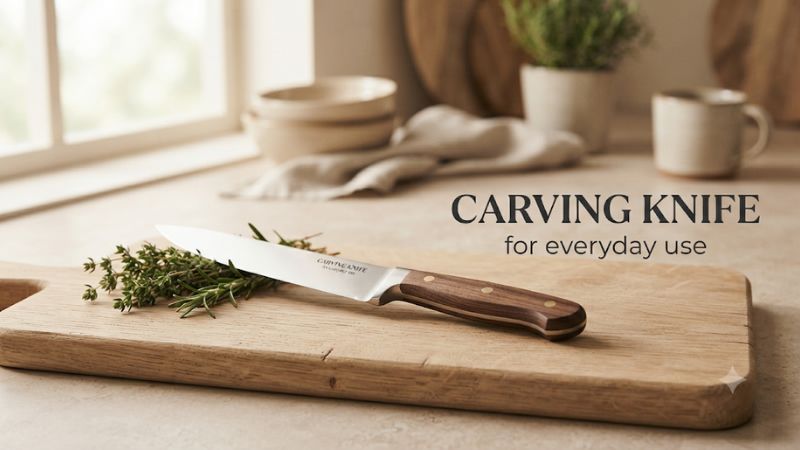
A carving knife for everyday use can make weeknight dinners easier when your family regularly serves roast chicken, pork loin, turkey breast, or other cooked meats. Unlike a broad chef’s knife, a narrow carving blade is designed for controlled slicing. This guide explains how to choose practical length, handle comfort, steel, and maintenance features without buying an oversized holiday-only tool.
- Quick Answer: What Makes a Good Everyday Carving Knife?
- Do You Really Need a Carving Knife for Weeknight Cooking?
- How to Choose a Carving Knife for Everyday Use
- Everyday Carving Knives Worth Considering
- Everyday Carving Scenarios
- How to Keep an Everyday Carving Knife Sharp
- Common Mistakes When Choosing a Daily Carving Knife
- Frequently Asked Questions
- Conclusion
Quick Answer: What Makes a Good Everyday Carving Knife?
For many home kitchens, an eight-inch fine-edge carving knife is a sensible everyday choice. It provides enough reach for typical roast portions and cooked boneless proteins while remaining manageable on ordinary cutting boards. A secure handle, practical blade geometry, and straightforward maintenance are more valuable than decorative construction or unusually long cutting reach.
Recommended everyday features
- Blade length around eight inches.
- Narrow slicing profile.
- Fine straight cutting edge.
- Comfortable handle.
- Reliable grip near the bolster.
- Stainless steel construction where appropriate.
- Easy handwashing.
- Simple sharpening requirements.
- Protected storage.
- Suitable size for your cutting board.
A household that cooks roast beef or pork loin several times a month may benefit from a dedicated carving blade.
However, someone who primarily cuts vegetables or buys thinly sliced deli meat may not need a separate knife.
A well-maintained chef’s knife can handle many small cooked-meat portions, although it may not provide the same controlled slicing experience for larger roasts.
The buying decision should therefore begin with how often you actually carve food.
Do You Really Need a Carving Knife for Weeknight Cooking?
An everyday carving knife should solve a recurring cooking problem rather than become another specialty tool stored in a drawer. It is most useful when meals involve cooked meats that benefit from consistent slices. The narrower blade can help with portioning and presentation, but the advantage becomes less significant for small ingredients that are already easy to cut with a chef’s knife.
When a Dedicated Carving Knife Makes Sense
A carving knife earns its place in a kitchen when the household frequently prepares cuts that are large enough to benefit from long, continuous slicing strokes. The main improvement is controlled portioning rather than faster chopping. It can be particularly useful for families that cook once and divide a roast into several meals.
Common situations
- Slicing pork tenderloin after cooking.
- Portioning roasted turkey breast.
- Cutting roast beef for sandwiches.
- Preparing boneless chicken for meal prep.
- Slicing cooked ham.
- Dividing pork loin for family dinners.
- Serving grilled beef.
- Preparing thin slices for lunch leftovers.
For example, a cook may roast a pork loin on Sunday, serve part of it for dinner, and refrigerate the remainder for sandwiches.
A narrow slicing blade can produce manageable portions without requiring repeated chopping motions.
The knife can also be useful for carving a cooked turkey breast during ordinary family meals rather than only at Thanksgiving.
Buying takeaway: Purchase a dedicated carver when you regularly slice substantial cooked proteins.
When Your Chef’s Knife Is Already Enough
A chef’s knife remains one of the most versatile kitchen tools and can handle many cooked-meat portions. It is particularly practical for a household with limited drawer space, a small cutting board, or a modest cooking schedule. Buying a carving knife may provide little benefit when the largest meat portion you normally cut is a small boneless chicken breast.
A chef’s knife may be sufficient for:
- Small cooked chicken portions.
- Everyday vegetables.
- Dicing cooked meat.
- Cutting small boneless pieces.
- General preparation before cooking.
- Occasional roast dinners.
A carving knife generally offers less versatility for chopping vegetables because its narrow blade is not designed around the same range of rocking and board-contact movements.
If your kitchen has room for only one substantial knife, a chef’s knife may provide better overall value.
Buying takeaway: Do not purchase a carver solely because a knife set describes it as essential.
How to Choose a Carving Knife for Everyday Use
The best everyday carving knife should be easy to retrieve, comfortable to handle, and appropriate for the foods you prepare repeatedly. Specialized holiday knives may be longer or more decorative than necessary, while short utility knives may not provide enough reach for serving roasts. The following features help identify a practical middle ground.
Choose an Eight-Inch Blade as a Starting Point
Blade length determines how far the edge can travel through meat during a controlled stroke. Eight inches provides enough reach for many ordinary roasts without requiring the space associated with a long brisket slicer. However, actual comfort also depends on handle length, knife balance, and cutting-board size.
Length comparison
| Blade Length | Everyday Use | Main Advantage | Main Limitation |
|---|---|---|---|
| 6–7 inches | Small cooked portions | Compact handling | Limited reach |
| 8 inches | Family dinners and meal prep | Balanced general carving | May require multiple strokes on large roasts |
| 9 inches | Larger roasts and mixed use | Additional cutting reach | More storage space |
| 10 inches | Large boneless meats | Longer continuous cuts | Less convenient for small foods |
| 11–12 inches | Brisket and specialized slicing | Extended reach | Often unnecessary daily |
The right choice depends on your largest frequently prepared food.
A nine-inch blade may make sense for a family that cooks large roasts weekly.
For a small apartment kitchen, an eight-inch knife may be easier to manage.
Buying takeaway: Choose the shortest blade that comfortably handles the meats you prepare most often.
Prioritize a Narrow Blade With Controlled Geometry
The blade profile matters because carving is mainly a slicing task, not a chopping task. A narrow blade can pass through cooked meat with less side contact than a broad chef’s knife, which may help create more controlled cuts. However, actual performance depends on sharpening, the roast’s texture, and how the user moves the blade.
Features to look for
- Relatively narrow profile.
- Smooth fine edge.
- Suitable blade thickness.
- Tip appropriate for controlled cuts.
- No excessive blade flex.
- Stable connection to the handle.
- Manufacturer guidance for sharpening.
Some carving knives are rigid, while others have a degree of flexibility.
A very flexible blade may be useful for certain thin slicing tasks but can feel less stable to someone accustomed to a conventional chef’s knife.
For general daily use, a controlled, moderately narrow slicing blade is a practical choice.
Buying takeaway: Favor predictable handling over specialized extreme thinness.
Choose Between Straight and Hollow-Edge Blades
Hollow-edge carving knives have scalloped indentations on the blade’s sides. These are intended to reduce surface contact between the knife and certain foods. Straight-edge blades have a simpler uninterrupted blade surface. Both can work well for routine meat slicing, and neither format guarantees superior performance under every condition.
Straight-edge benefits
- Familiar cutting profile.
- Straightforward blade geometry.
- Useful for many cooked meats.
- Suitable for conventional sharpening approaches.
Hollow-edge benefits
- May reduce adhesion in some foods.
- Offers a different slicing feel.
- Available in several premium product lines.
The hollow-edge indentations do not create a serrated cutting edge.
Food may still stick, particularly when it is moist or soft.
For daily use, a properly maintained straight-edge carving knife may be completely sufficient.
Buying takeaway: Treat hollow-edge construction as an optional feature, not an essential requirement.
Evaluate Handle Comfort During Repeated Cuts
Everyday carving usually involves a series of similar slicing movements. A knife that feels comfortable for one cut may become less pleasant during a complete meal-prep session if the handle is too bulky, slippery, or poorly balanced. A secure grip is especially important when cutting cooked meats that release juices.
Handle features
- Comfortable diameter.
- Suitable grip texture.
- Secure blade-to-handle transition.
- Adequate finger clearance.
- Balanced construction.
- Easy cleaning.
- Durable attachment.
- Compatible with your cutting technique.
Traditional riveted handles provide a familiar Western feel.
Molded synthetic handles offer another approach that may appeal to users who prefer smooth ergonomic curves.
Natural wood handles can be attractive but require appropriate moisture care.
No handle material automatically guarantees control.
Buying takeaway: Choose a handle you can hold securely with clean, dry hands.
Consider Knife Weight and Balance
A carving knife should move smoothly through cooked food without requiring exaggerated force. Weight and balance influence how naturally the blade follows the intended path. Some cooks prefer a substantial forged knife, while others find a lighter stamped or utility-oriented design more comfortable for frequent slicing.
Practical considerations
- Total weight.
- Balance point.
- Handle shape.
- Blade length.
- Cutting motion.
- Wrist comfort.
- Ease of repositioning.
Do not assume that a heavy knife is more effective simply because it feels substantial.
Carving is about controlled movement, not chopping with the knife’s mass.
Similarly, a lightweight blade should not feel unstable or require the user to squeeze the handle excessively.
If possible, safely assess the grip and balance before purchase.
Buying takeaway: Select the weight that supports controlled slicing without unnecessary fatigue.
Choose Steel You Can Maintain Reliably
Most everyday carving knives use stainless or corrosion-resistant cutlery steel. This is convenient in kitchens where knives are washed regularly and used with moist foods. However, stainless steel does not eliminate maintenance, and steel hardness alone is not a reliable predictor of how convenient the knife will be.
Important factors
- Manufacturer-described steel.
- Edge geometry.
- Recommended sharpening method.
- Corrosion behavior.
- Handle maintenance.
- Cleaning requirements.
- Appropriate cutting surfaces.
- Availability of sharpening services.
An advanced powdered-steel knife may appeal to enthusiasts, but a conventional stainless blade can be a sensible daily workhorse.
The owner must still sharpen or maintain the edge appropriately.
A dull carving knife can require additional force and produce ragged slices.
Buying takeaway: Choose reliable maintenance over impressive technical terminology.
Pay Attention to Cleaning and Food Hygiene
Everyday carving involves repeated contact with cooked meats, cutting boards, and serving equipment. A knife should be easy to clean between uses, especially when preparing meals for several people. The handle-to-blade transition and any decorative grooves may collect residue if neglected.
Cleaning priorities
- Handwash when recommended.
- Remove meat juices and food particles.
- Clean around the bolster.
- Rinse appropriately.
- Dry the knife promptly.
- Avoid prolonged soaking.
- Inspect handle joints.
- Store only after cleaning.
Do not place cooked meat on a board previously used for raw animal food unless the board has been properly cleaned.
The same applies to knives and carving forks.
Buying takeaway: Easy cleaning is more important for daily use than elaborate decorative finishes.
Plan Compact and Safe Storage
A carving knife may be one of the longest blades in a home kitchen. Its full dimensions can make it difficult to store in an ordinary cutlery drawer or a block designed for smaller knives. Storage planning is especially important when the blade will be used several times each week.
Storage options
- Correctly fitted blade guard.
- Dedicated knife block slot.
- Secure in-drawer organizer.
- Properly installed magnetic strip.
- Protective knife roll.
A blade guard should match the knife’s length and shape.
Do not force an oversized blade into a short sheath.
Never store the edge loose among forks, spoons, or other tools.
Buying takeaway: Choose a knife that fits your actual storage arrangement.
Everyday Carving Knives Worth Considering
Not every household needs an extensive product roundup to choose a carving knife, but several established models illustrate useful differences. The following options show how a practical buyer might compare handle construction, blade length, and premium features. These are model examples rather than claims of personal testing or exact current prices.
Victorinox Fibrox 8-Inch Carving Knife
The Victorinox Fibrox 8-Inch Carving Knife is a practical option for frequent household slicing. Its Swiss-made stainless steel blade and ergonomic synthetic handle are intended for roast meat, poultry, ham, and selected produce. The simple construction makes it especially relevant to cooks who want a dedicated slicing knife without paying primarily for decorative details.
Why it suits everyday use
- Eight-inch practical length.
- Synthetic handle.
- General cooked-meat applications.
- Straightforward care.
- Familiar utility design.
Important limitations
- Not intended for cutting bones.
- Does not replace a chef’s knife.
- Requires regular edge maintenance.
This is a sensible comparison point when evaluating whether premium features are necessary.
ZWILLING Pro 8-Inch Slicing/Carving Knife
The ZWILLING Pro 8-Inch Slicing/Carving Knife combines forged German construction with a narrow slicing blade and curved bolster. It can suit home cooks who prefer substantial traditional cutlery and a grip designed around controlled blade positioning. Its length remains manageable for many weeknight meals.
Why it suits everyday use
- Eight-inch blade.
- Forged construction.
- Curved bolster.
- Fine-edge slicing profile.
- Traditional handle.
Important limitations
- Higher investment.
- Handle fit is personal.
- Large roasts may benefit from extra length.
Choose it when the grip and construction genuinely matter to your cooking routine.
ZWILLING Four Star 8-Inch Slicing/Carving Knife
The ZWILLING Four Star is another practical German-made option, distinguished by its molded polypropylene handle rather than the Pro’s traditional riveted design. Its fine-edge carving blade is intended for controlled slicing of appropriate cooked meats. The handle shape may appeal to cooks seeking an ergonomic alternative.
Why it suits everyday use
- Molded handle.
- Forged German blade.
- Manageable length.
- Conventional fine edge.
- Familiar daily applications.
Important limitations
- Grip preference varies.
- Still requires sharpening.
- Not a cleaver or boning knife.
This is a useful alternative when comparing forged knives with different handle designs.
Everyday Carving Scenarios
A carving knife becomes more useful when it supports the meals a household already cooks. Rather than reserving the tool for major holidays, a home cook can use it for portioning cooked meats for dinner, preparing leftovers for lunches, and presenting sliced dishes neatly. The following situations show where a dedicated blade adds practical value.
Slicing Roast Chicken for Dinner
A roast chicken is a common family meal that combines presentation and practical portioning. A carving knife can help slice the breast after suitable sections have been separated from the bird. However, a narrow carving blade should not be used to chop through hard bones or forcefully separate joints.
Suggested workflow
- Cook the chicken to the appropriate safe temperature.
- Allow suitable resting.
- Position it on a stable board.
- Separate sections using appropriate technique and tools.
- Slice the breast with controlled strokes.
- Transfer portions to a clean platter.
- Clean the knife afterward.
A carving fork may help stabilize cooked sections, but the user’s supporting hand must remain outside the cutting path.
Preparing Pork Loin for Meal Prep
A boneless pork loin can be portioned into consistent slices for dinner and subsequent meals. A long narrow carving blade helps the cook work across the roast without making repeated chopping movements. Uniform thickness also makes it easier to divide portions according to the household’s meal plan.
Suggested workflow
- Follow the recipe’s cooking and resting guidance.
- Place the roast on a stable board.
- Identify the grain.
- Make controlled slices.
- Set aside meal portions.
- Refrigerate leftovers promptly.
- Label stored portions.
Do not leave cooked meat at room temperature for an extended period while preparing containers.
Making Roast Beef Sandwiches
Leftover roast beef can be useful for sandwiches when handled and stored properly. A narrow slicing blade helps create thin portions that fit bread more evenly than irregular thick chunks. However, the quality of the cut still depends on edge sharpness and the meat’s texture.
Suggested workflow
- Use properly refrigerated cooked beef.
- Prepare a clean board.
- Keep the roast stable.
- Slice across the grain where appropriate.
- Avoid excessive pressure.
- Return unused portions to refrigeration.
- Clean and dry the blade.
A carving knife should not be used to cut frozen solid meat.
How to Keep an Everyday Carving Knife Sharp
Frequent use gradually changes the condition of a knife’s edge. Proper maintenance preserves controlled slicing and reduces the temptation to force a dull blade through food. The correct sharpening approach depends on the manufacturer’s recommendations, the blade geometry, and the owner’s skill level.
Maintenance routine
- Inspect the edge before use.
- Use a suitable cutting board.
- Avoid glass, stone, and ceramic cutting surfaces.
- Clean the blade after carving.
- Dry promptly.
- Store with edge protection.
- Hone only when appropriate for the model.
- Sharpen when the edge needs restoration.
- Avoid removing excessive metal.
- Seek professional maintenance when necessary.
A ceramic dinner plate is not an appropriate cutting board for a fine carving knife.
Even a premium blade can lose its edge when used against hard surfaces.
Common Mistakes When Choosing a Daily Carving Knife
The most common purchasing mistake is buying a long ceremonial carving knife for meals that rarely require its reach. Other problems include overlooking handle comfort, assuming hollow-ground indentations prevent all sticking, and failing to plan storage. Avoiding these errors can make a relatively modest purchase more useful.
Mistakes to avoid
- Buying a twelve-inch blade for small meals.
- Ignoring cutting-board dimensions.
- Choosing steel based only on hardness.
- Paying for decoration without practical benefit.
- Assuming every hollow-edge blade is nonstick.
- Using the knife to split bones.
- Cutting frozen ingredients.
- Ignoring sharpening requirements.
- Washing contrary to manufacturer instructions.
- Storing the blade unprotected.
- Using raw-meat-contaminated surfaces for cooked food.
- Confusing a carving knife with a bread knife.
A good everyday tool should be easy to use repeatedly without requiring special preparation.
Frequently Asked Questions
Everyday carving knives occupy a middle ground between general chef’s knives and long specialized slicers. Buyers often wonder whether eight inches is sufficient, whether one is necessary for ordinary meals, and how it should be maintained. These answers focus on practical household decisions rather than professional-kitchen requirements.
Is a Carving Knife Worth Buying for Everyday Use?
It can be worthwhile when your household regularly cooks roasts, turkey breast, pork loin, or other meats that benefit from controlled slicing. The narrower blade may make portioning easier than using a broad chef’s knife.
If you rarely carve large portions, your existing chef’s knife may be sufficient.
What Length Is Best for a Daily Carving Knife?
An eight-inch blade is a versatile starting point for many household meals. Nine inches provides additional reach, while ten inches or more may suit large roasts and specialized slicing.
Choose the length according to your normal food size.
Can I Use a Carving Knife to Prepare Vegetables?
Some carving knives can slice suitable fruits and vegetables, but their narrow shape is not optimized for every chopping task. A chef’s knife generally offers broader versatility for routine vegetable preparation.
Use the carving knife primarily where its slicing profile provides a meaningful advantage.
Does a Hollow Edge Make Carving Easier?
Hollow-edge indentations may reduce adhesion between the blade and certain foods, but they cannot guarantee that all slices release cleanly. Moisture, food texture, sharpening, and technique also influence results.
A straight-edge knife can perform very well when properly maintained.
Do I Need a Carving Fork?
A carving fork may help stabilize large cooked meat portions, but it is not necessary for every household cut. A stable cutting board and safe handling remain essential.
Do not position the fork or supporting hand in the blade’s cutting path.
Can a Carving Knife Go in the Dishwasher?
Many quality carving knife manufacturers recommend handwashing to protect the edge, handle, and finish. Some models may be described as dishwasher-safe, but manufacturer instructions should take priority.
Handwashing and prompt drying are generally sensible daily habits.
Conclusion
A carving knife for everyday use should be comfortable, practical to store, and long enough for the cooked meats your household prepares regularly. An eight-inch fine-edge blade is an excellent starting point for many home kitchens, while larger roasts may justify nine inches or more. Victorinox Fibrox offers straightforward practicality, and ZWILLING Pro and Four Star provide distinct forged handle options. Focus on controlled slicing, easy cleaning, and safe storage instead of purchasing a decorative specialty knife that rarely leaves the drawer










Write Your Review
No reviews yet. Be the first to share your experience!