
A boning knife for beginners on a budget should make basic meat preparation easier without demanding professional-level skills or expensive equipment. The best first knife has an appropriate blade shape, a secure handle, and manageable maintenance requirements. This guide explains flexible versus stiff blades, affordable buying options, safe cutting techniques, and the features worth paying for when learning to debone meat.
- Quick Answer: What Should Beginners Look For?
- Why a Boning Knife Can Be Useful for Beginners
- Choose the Right Blade Flexibility
- Blade Length and Shape: What Matters Most?
- Affordable Boning Knife Options Worth Considering
- How Much Should a Beginner Spend?
- Safe Beginner Boning Techniques
- Cleaning, Sharpening, and Storage
- Common Mistakes Budget Beginners Should Avoid
- Frequently Asked Questions
- Conclusion
Quick Answer: What Should Beginners Look For?
For most beginners preparing ordinary cuts of chicken, pork, or beef, a six-inch boning knife with a comfortable handle is a practical starting point. A semi-flexible blade may offer useful versatility, while a stiff blade is often easier to control when working around firmer joints and larger cuts. The correct choice depends on what you prepare most frequently, not the number of features advertised.
Prioritize these features:
- Blade length: Approximately five to six inches for common home kitchen tasks.
- Blade flexibility: Stiff or semi-flexible for many beginners.
- Handle: Secure, comfortable, and easy to clean.
- Steel: Appropriate stainless cutlery steel with manageable care requirements.
- Blade shape: Narrow enough for working around joints and connective tissue.
- Storage: Compatible blade guard or protective knife organizer.
- Maintenance: Straightforward handwashing and suitable sharpening options.
A boning knife is designed to separate meat from bones and trim connective tissue. It is not a bone-cutting cleaver. Avoid twisting, prying, or striking bones with its narrow blade, regardless of the knife’s price.
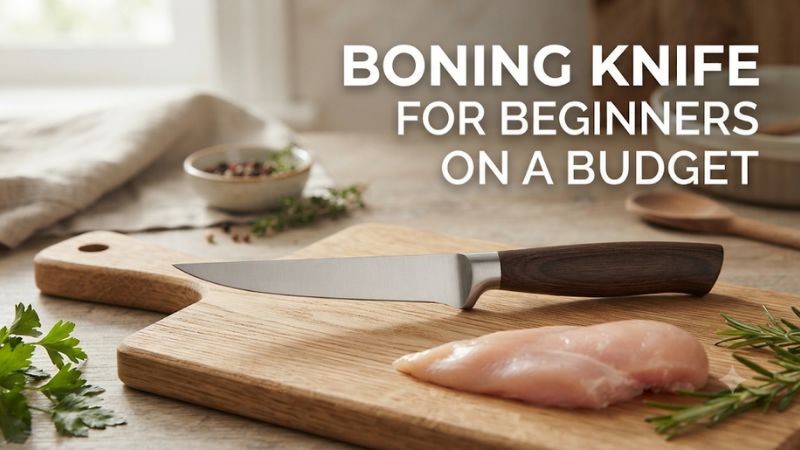
Why a Boning Knife Can Be Useful for Beginners
A boning knife is more specialized than a chef’s knife because its narrow blade is designed to work around the natural shapes of meat and joints. Beginners who purchase whole chicken pieces, bone-in pork cuts, or larger meat portions may benefit from greater control during trimming. However, the knife is only worthwhile when those tasks happen often enough to justify a separate tool.
Understand What a Boning Knife Actually Does
Boning knives are used to separate meat from bones, remove connective tissue, and trim unwanted fat. Their narrow blades can follow the contours of ingredients more closely than a broad chef’s knife in certain situations. Different blade shapes support different tasks, so it is important to understand the knife’s intended use before making a purchase.
Common tasks include:
- Removing meat from chicken bones.
- Trimming silver skin from suitable cuts.
- Separating meat around joints.
- Removing excess fat.
- Preparing boneless portions from certain larger cuts.
- Trimming connective tissue.
- Working around irregular meat shapes.
A boning knife should not be used to split hard bones or frozen meat. Those activities require other suitable equipment and appropriate experience.
Beginners should start with manageable preparation tasks rather than attempting complicated butchery immediately.
Know When a Chef’s Knife Is Sufficient
A chef’s knife can handle many everyday kitchen tasks, including slicing boneless meat and portioning ingredients. If the household only buys packaged boneless chicken breasts or prepared steaks, a separate boning knife may provide limited additional value. The specialist blade becomes more useful when the cook regularly works around bones or removes silver skin.
A boning knife is worth considering when:
- You buy bone-in cuts.
- You prepare whole chickens.
- You trim larger meat portions.
- You want better control around connective tissue.
- You cook meat frequently enough to practice proper technique.
You may not need one when:
- You primarily buy boneless meat.
- You rarely trim raw proteins.
- You have very limited kitchen storage.
- Your existing knife handles the required preparation safely.
A budget-conscious beginner should avoid buying specialized cutlery solely because it appears in professional knife sets.
Separate Boning From Filleting
Boning and filleting knives overlap in shape, but their typical uses differ. Boning knives often focus on meat removal around bones and joints, while fish fillet knives commonly feature longer, thinner, more flexible blades intended to follow a fish’s structure.
A flexible boning knife can sometimes perform fish preparation, and a fillet knife can handle certain trimming tasks. However, these tools are not interchangeable in every situation.
Boning knife priorities:
- Control near meat joints.
- Narrow blade geometry.
- Stiff or semi-flexible options.
- Meat and connective-tissue trimming.
Fillet knife priorities:
- Flexibility along fish contours.
- Longer smooth cutting strokes.
- Skin separation.
- Delicate fish flesh handling.
If you mostly cook fish, a dedicated fillet knife may be the more useful purchase.
Choose the Right Blade Flexibility
Blade flexibility is one of the most important differences between boning knives. A stiff knife maintains its shape more firmly during cutting, while a flexible blade bends to follow contours. Semi-flexible knives fall between these approaches. Beginners should understand the trade-offs rather than assuming that maximum flexibility makes a knife easier or safer.
Stiff Boning Knives
A stiff boning knife provides relatively firm blade support, making it useful for working around tougher connective tissue and certain larger meat cuts. It can feel more predictable to beginners because the blade does not bend substantially under normal cutting pressure. However, the correct technique still requires controlled movement and careful identification of bones and joints.
Best For: Beef, pork, and tasks where firm blade guidance is useful.
Advantages:
- Predictable blade position.
- Useful near firmer joints.
- Less bending under ordinary cutting pressure.
- Suitable for certain trimming tasks.
Limitations:
- Less adaptable to tight contours.
- May require additional cuts around irregular shapes.
- Not ideal for every fish-filleting task.
Buy If: You primarily prepare pork, beef, and larger bone-in cuts.
Skip If: Your main task is delicate fish filleting that benefits from greater flexibility.
A stiff knife is not designed for forceful bone chopping. Its rigidity should be used for control, not for prying apart hard structures.
Flexible Boning Knives
Flexible boning knives can follow curved surfaces and irregular contours, making them useful for delicate trimming and some poultry or fish preparation. Their movement requires controlled pressure because excessive bending or sudden changes in direction can make precise positioning more difficult for inexperienced cooks.
Best For: Delicate trimming and selected poultry or fish tasks.
Advantages:
- Follows curved surfaces.
- Useful for thin trimming cuts.
- Can reduce unnecessary meat removal.
- Adaptable to irregular shapes.
Limitations:
- Requires familiarity with blade movement.
- May feel less stable under pressure.
- Not suitable for forceful cutting.
- Can be frustrating around harder joints.
Buy If: You regularly handle delicate proteins and want to learn controlled flexible-blade techniques.
Skip If: You prefer a firmer blade for your first boning knife.
Flexibility is a characteristic of the blade, not evidence that the knife should be bent aggressively. Follow the manufacturer’s intended use and avoid forcing the edge into resistant material.
Semi-Flexible Boning Knives
Semi-flexible blades provide a compromise between firm guidance and contour-following movement. For beginners preparing several types of meat, this format can provide useful versatility. However, manufacturers do not always use identical definitions of semi-flexibility, so the actual construction and intended application matter more than the product label alone.
Best For: Mixed home meat preparation.
Advantages:
- Balanced flexibility.
- Useful across several protein types.
- Can feel manageable during ordinary trimming.
- Less specialized than extremely flexible designs.
Limitations:
- May not match the firmness needed for some tasks.
- Less flexible than dedicated fish-filleting knives.
- Actual stiffness varies by brand.
Buy If: You want one reasonably versatile meat-preparation knife.
Skip If: You need a highly specialized tool for a consistent professional task.
For many first-time buyers, a moderate blade profile is easier to incorporate into daily cooking than an extremely specialized design.
Blade Length and Shape: What Matters Most?
Budget boning knives commonly have blades around five or six inches long. This range is useful for ordinary home tasks because it offers sufficient reach without requiring the handling space associated with longer butcher knives. Blade width, curvature, and tip design also influence how the knife works around meat.
Five-Inch Boning Knives
A five-inch boning knife may suit smaller hands or compact cutting boards when the intended tasks involve small poultry portions and detailed trimming. Its shorter cutting edge can provide a manageable feel, although more strokes may be needed for larger meat cuts.
Advantages:
- Compact dimensions.
- Useful for smaller pieces.
- Manageable on a limited cutting surface.
- Easier storage.
Limitations:
- Less cutting length for large portions.
- May require repositioning.
- Not necessarily ideal for substantial trimming jobs.
A short knife should not be selected solely because it appears safer. Sharpness, grip, and correct technique are more important than reducing blade length by an inch.
Six-Inch Boning Knives
A six-inch blade is a common practical option for home deboning. It offers enough length for many chicken and pork tasks while remaining narrow and maneuverable. Many recognizable manufacturers offer boning knives in this size, making it easier to compare handle styles and different flexibility levels.
Advantages:
- Versatile length.
- Suitable for many common meat cuts.
- Widely available.
- Several blade-flexibility choices.
- Practical first-knife format.
Limitations:
- May feel long for very detailed work.
- Cannot replace a heavy cleaver.
- Requires suitable storage and sharpening.
For a beginner purchasing one dedicated boning knife, this size is a sensible starting point unless the planned ingredients suggest otherwise.
Straight Versus Curved Blades
Some boning knives have straight blades, while others curve upward toward the tip. Curved profiles can help during particular trimming movements, whereas straight blades may feel familiar to users accustomed to ordinary kitchen knives.
Straight blades may appeal to:
- Beginners wanting predictable geometry.
- General meat trimming.
- Users transitioning from small utility knives.
Curved blades may appeal to:
- Cooks working around rounded joints.
- Repeated trimming.
- Specific butchery techniques.
Neither profile automatically provides better results for every task.
Choose according to the foods you prepare and the technique you can control safely.
Affordable Boning Knife Options Worth Considering
Budget shoppers do not need to rely on anonymous cutlery with unclear construction. Several established manufacturers offer practical boning knives intended for professional food preparation and home use. The most important buying factors are blade type, handle fit, correct length, and ease of maintenance rather than a decorative finish or unnecessary accessories.
Victorinox Fibrox Six-Inch Boning Knife
The Victorinox Fibrox six-inch boning knife is a recognizable option with a synthetic handle and a narrow blade intended for meat preparation. The product family includes different blade shapes, so buyers should verify whether the selected version is straight, curved, flexible, or comparatively stiff.
Best For: Buyers wanting an established basic boning-knife design.
Why Consider It:
- Common six-inch working length.
- Fibrox handle.
- Narrow meat-preparation blade.
- Several identifiable variants.
- Suitable for ordinary home trimming.
Check Before Buying:
- Exact blade flexibility.
- Straight or curved profile.
- Handle comfort.
- Current seller and warranty terms.
- Whether a protective guard is included.
The main advantage is the ability to choose a known model rather than an unspecified generic knife.
However, the Fibrox name covers different configurations, so the product title alone is not enough to establish blade stiffness.
Mercer Culinary Millennia Boning Knives
Mercer Culinary’s Millennia range includes professional-style cutlery with synthetic handles and task-specific blades. Boning configurations can be suitable for buyers who want a practical working knife rather than a decorative premium product. Exact model, blade length, and flexibility should be checked before purchase.
Best For: Home cooks prioritizing functional design.
Useful features:
- Synthetic grip construction.
- Task-specific blade profiles.
- Commercial-kitchen design approach.
- Straightforward appearance.
- Recognizable manufacturer.
Potential limitations:
- Different models suit different cuts.
- Product listings may not clearly distinguish flexibility.
- No single handle design suits every user.
A basic boning knife can be a good value when the blade and handle match your needs. Do not pay extra solely for package accessories you will not use.
Dexter-Russell Sani-Safe Boning Knives
Dexter-Russell produces a broad selection of food-processing knives, including six-inch boning configurations and different blade shapes. The Sani-Safe line is associated with synthetic handles and practical food-service applications.
Best For: Buyers wanting a utilitarian meat-preparation tool.
Consider:
- Blade profile and length.
- Stiff or flexible construction.
- Handle shape.
- Cleaning requirements.
- Exact model designation.
- Availability from a reliable seller.
Main trade-off: The product range is broad enough that similar-looking knives may have very different intended uses.
Read the full specifications instead of choosing by brand name alone.
How Much Should a Beginner Spend?
An inexpensive boning knife can perform useful work when its blade geometry and handle suit the task. Spending more may provide different steel, finish, handle materials, or construction, but those features are not automatically necessary for learning basic deboning. A responsible budget includes safe storage and sharpening rather than treating the knife as the only purchase.
Prioritize Function Over Decoration
A premium forged knife may be attractive, but a simpler professional-style model can be more appropriate for a beginner who is still learning technique.
Spend money on:
- A suitable blade.
- Comfortable handle.
- Reliable construction.
- Correct flexibility.
- Safe storage.
- Appropriate sharpening.
Avoid paying extra for:
- Decorative patterns without practical benefit.
- Oversized knife sets.
- Unnecessary specialty accessories.
- Unsupported claims of permanent sharpness.
- Features unrelated to your intended tasks.
The best value is a knife that can be used confidently and maintained properly.
Account for Essential Accessories
A boning knife should be paired with an appropriate cutting board and protective storage.
Useful additions:
- Stable cutting board.
- Compatible blade guard.
- Suitable sharpening method.
- Clean towels.
- Food-safe cleaning supplies.
- Appropriate containers for raw meat.
You do not need an elaborate collection of professional butcher tools to begin practicing basic trimming.
Start with essentials and add equipment only when a genuine need appears.
Safe Beginner Boning Techniques
A boning knife is narrow and sharp, so learning safe handling matters more than speed. Beginners should work on stable boards, keep fingers away from the edge, and use short controlled movements rather than forcing the knife through resistance. Complex deboning techniques are best learned through qualified instruction and careful practice.
Prepare a Safe Workstation
Raw meat preparation should take place on a clean, stable cutting board with enough room to control the knife and ingredient.
Preparation checklist:
- Clear the counter.
- Use a stable cutting board.
- Keep the knife clean and sharp.
- Position the meat securely.
- Maintain adequate lighting.
- Keep fingers outside the cutting path.
- Prepare a clean container for trimmed material.
- Keep ready-to-eat foods separate.
Avoid placing raw meat where liquids can reach vegetables, bread, or other foods that will not be cooked.
Wash hands and clean surfaces according to safe food-handling guidance.
Use Controlled Cuts Instead of Force
Boning knives are designed to work near natural joints and connective tissue, not to break through hard bones.
Use light, deliberate movements and stop if the blade encounters unexpected resistance.
Beginner principles:
- Identify the intended cutting path.
- Keep the blade under control.
- Avoid twisting against bone.
- Use short cuts when appropriate.
- Reposition the ingredient safely.
- Never cut toward a supporting hand.
- Do not rush.
If the technique becomes confusing or unsafe, stop and seek instruction rather than using more force.
Avoid Common Raw-Meat Hygiene Errors
Raw poultry and meat can carry harmful microorganisms.
Important practices:
- Do not wash raw chicken.
- Separate raw meat from ready-to-eat foods.
- Clean utensils and boards after contact.
- Wash hands with soap and water.
- Refrigerate perishable meat promptly.
- Cook food to appropriate safe internal temperatures.
- Use a food thermometer when needed.
A boning knife makes cutting more convenient, but it does not reduce the need for proper food safety.
Cleaning, Sharpening, and Storage
An affordable boning knife can remain useful when handled correctly. A narrow blade should be protected from unnecessary contact, cleaned after raw-meat preparation, and sharpened according to its steel and edge design. Even a budget model should not be left loose in a drawer or submerged among dishes.
Clean the Knife After Every Use
Boning knives should be cleaned carefully after preparing raw meat.
Routine care:
- Follow manufacturer instructions.
- Wash with appropriate detergent.
- Keep fingers clear of the edge.
- Rinse safely.
- Dry the knife completely.
- Clean the handle and blade junction.
- Return it to protected storage.
Avoid leaving sharp knives in a sink filled with water.
Dishwashers may damage certain handles or edges, so check the exact model’s instructions.
Maintain a Suitable Cutting Edge
A dull boning knife can encourage excessive pressure and reduce cutting control.
Sharpening requirements depend on the knife.
Options include:
- Appropriate sharpening stones.
- Manufacturer-approved sharpeners.
- Professional sharpening services.
- Suitable honing methods where recommended.
Avoid aggressive sharpening without understanding the blade angle.
A budget knife still deserves appropriate maintenance.
Store the Knife Securely
A boning knife should have a dedicated storage position.
Suitable choices:
- Properly fitted blade guard.
- Compatible knife block.
- Protected drawer organizer.
- Secure designated storage.
Do not mix an uncovered boning knife loosely with ordinary silverware.
In households with children, consider appropriate access restrictions.
Common Mistakes Budget Beginners Should Avoid
The most frequent problems are choosing the wrong flexibility, buying an unnecessarily expensive knife, ignoring handle comfort, and using the tool for cutting tasks it cannot safely perform. A beginner benefits more from learning the knife’s limitations than from purchasing advanced materials before mastering basic technique.
Buying an Extremely Flexible Blade Without a Clear Need
A highly flexible knife can be useful for particular tasks, but it may feel unpredictable to someone learning basic trimming.
Choose a stiffness level that matches the intended meat.
For mixed everyday preparation, moderate flexibility may be worth considering.
Do not assume maximum bend automatically means easier use.
Using a Boning Knife to Chop Bones
A boning knife is not a heavy cleaver.
Its thin blade is intended to cut meat and connective tissue.
Using it to strike or pry hard bones can damage the edge and create injury risk.
Choose appropriate equipment for the actual task and seek instruction when needed.
Ignoring Handle Comfort
A narrow blade with a slippery or uncomfortable handle is not a good bargain.
Grip comfort matters during careful trimming.
If possible, assess how the handle fits your hand.
Avoid buying solely because the knife is inexpensive or has an impressive-looking blade.
Frequently Asked Questions
Beginners often want to know whether a boning knife is necessary, which blade style is easiest to learn, and whether inexpensive models can perform practical kitchen work. The right answers depend on how frequently bone-in meat is prepared and what skills the buyer wants to develop. An affordable knife can be useful when its design matches the task and the cook follows safe handling practices.
What Is the Best Boning Knife Size for a Beginner?
A six-inch blade is a practical starting point for many common home meat-preparation tasks. It offers enough length for trimming chicken, pork, and selected beef cuts without becoming excessively long. Smaller blades can suit detailed work, while longer specialist knives may serve different purposes. Choose according to the cuts you prepare and the blade control you find comfortable.
Should Beginners Choose a Stiff or Flexible Boning Knife?
A stiff blade can feel predictable when working near firmer joints and larger cuts, while a flexible blade can follow delicate contours. Semi-flexible models offer a compromise for varied tasks. There is no universal choice because different meats require different handling. Beginners should prioritize control and match flexibility to intended use rather than buying the most flexible model available.
Can a Cheap Boning Knife Be Good?
Yes. A practical inexpensive model from an identifiable manufacturer can be appropriate for home use when it has suitable blade geometry, a comfortable handle, and clear maintenance instructions. Higher prices may reflect construction or materials that are not necessary for basic trimming. Evaluate fit, intended use, and safe storage before paying extra for decorative features.
Can I Use a Boning Knife as a Fillet Knife?
Some flexible boning knives can handle certain fish preparation tasks, but a dedicated fillet knife is typically shaped for working along fish bones and separating delicate flesh. A stiff meat boning knife may not provide suitable flexibility for fine filleting. If fish is your primary ingredient, compare fillet knives before purchasing a boning knife.
Is a Boning Knife Safe for Beginners?
It can be used responsibly with proper training, a stable work surface, and controlled cutting technique. However, its narrow sharp blade requires careful handling, and it should never be used for forceful bone chopping or prying. Beginners should start with simple tasks, keep fingers outside the cutting path, and maintain the edge appropriately.
Do I Need a Boning Knife if I Already Own a Chef’s Knife?
Not always. A chef’s knife handles many general meat-cutting tasks, especially when ingredients are already boneless. A boning knife becomes useful when you regularly separate meat from bones or trim connective tissue around joints. Consider how often those tasks occur before adding another specialized knife to your kitchen.
Conclusion
A boning knife for beginners on a budget should offer a manageable blade, secure grip, and maintenance routine that fits ordinary home cooking. A six-inch stiff or semi-flexible design is a practical starting point for many meat-preparation tasks, while more flexible blades suit particular delicate work. Compare identifiable models from Victorinox, Mercer, or Dexter-Russell according to their exact blade configuration rather than appearance alone. Use a stable board, avoid bone chopping, maintain food safety, and invest in protective storage before purchasing unnecessary premium features.










Write Your Review
No reviews yet. Be the first to share your experience!