
A reliable boning knife helps home cooks trim fat, remove connective tissue, and separate meat from bones with greater control than a broad chef’s knife. The best choice depends on whether you prepare poultry, pork, beef, or fish, because blade stiffness and flexibility affect how the knife follows different contours. This guide compares six established options for practical meat preparation.
- Quick Verdict: Which Boning Knife Should You Buy?
- Quick Comparison Table
- How We Selected These Boning Knives
- Detailed Reviews of Six Boning Knives
- Buying Guide: What Makes a Good Boning Knife?
- Choosing the Right Boning Knife for Different Foods
- Safe Meat Preparation With a Boning Knife
- Cleaning, Sharpening, and Storing a Boning Knife
- Common Boning Knife Buying Mistakes
- Frequently Asked Questions
- Conclusion
Quick Verdict: Which Boning Knife Should You Buy?
Boning knives differ from ordinary chef’s knives through their narrower blades, pointed tips, and specialized flexibility. A stiff blade offers control around dense meat and joints, while a flexible design can follow curved surfaces more closely during delicate trimming. Some models sit between these extremes and provide a versatile compromise for household use.
Our six recommended products:
- Best practical flexible boning knife: Victorinox Fibrox 6-Inch Curved Flexible Boning Knife.
- Best ergonomic forged option: ZWILLING Pro 5.5-Inch Flexible Boning Knife.
- Best accessible curved workhorse: Mercer Culinary Millennia 6-Inch Curved Boning Knife.
- Best premium German flexible design: WÜSTHOF Classic 6-Inch Flexible Boning Knife.
- Best professional-style utility choice: Dexter-Russell Sani-Safe 6-Inch Flexible Curved Boning Knife.
- Best rigid Japanese specialty option: Shun Classic 6-Inch Boning & Fillet Knife.
Victorinox provides a practical combination of a narrow curved blade and textured synthetic handle, making it worth considering for households that trim poultry and boneless meat regularly.
ZWILLING Pro offers forged construction with a curved bolster, while Mercer focuses on accessible professional-style cutlery.
WÜSTHOF is a premium German alternative for flexible trimming. Dexter-Russell emphasizes a work-oriented handle and food-processing design.
Shun is different from the flexible options because its Classic Boning & Fillet model uses a more rigid blade intended for controlled specialty preparation.
Choosing the right stiffness is more important than choosing the most expensive brand.
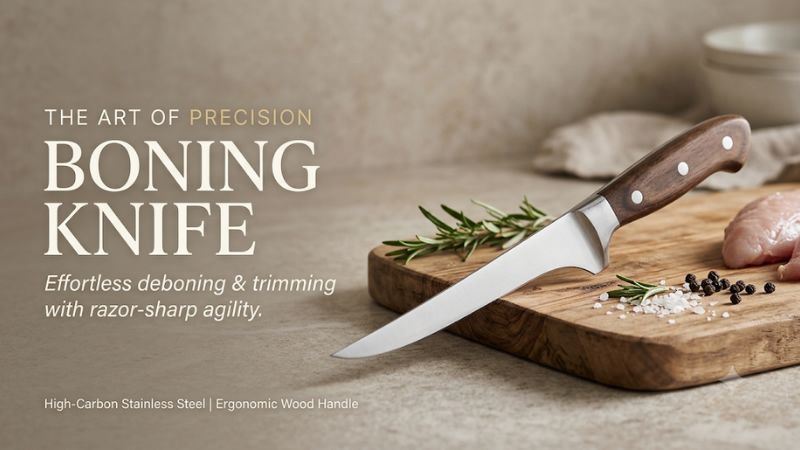
Quick Comparison Table
Boning knives may have similar blade lengths while behaving differently around meat and bone. Curvature, blade width, flexibility, grip design, and edge geometry all influence their intended applications. A knife that works well for removing silver skin from a tenderloin may not be the best option for working close to larger bones or navigating dense joints.
| Knife | Blade Length | Blade Character | Best For | Main Limitation |
|---|---|---|---|---|
| Victorinox Fibrox Flexible Curved | About 6 in | Narrow, flexible and curved | Poultry and delicate trimming | Less suited to forceful joint work |
| ZWILLING Pro Flexible Boning | 5.5 in | Flexible forged blade | Controlled trimming | Premium construction |
| Mercer Millennia Curved Boning | 6 in | Curved working blade | Everyday meat preparation | Grip preference is personal |
| WÜSTHOF Classic Flexible Boning | 6 in | Forged flexible blade | Meat trimming and filleting tasks | Requires careful flexible-edge handling |
| Dexter-Russell Sani-Safe Flexible Curved | 6 in | Flexible processing-style blade | Repeated meat-prep tasks | Utilitarian appearance |
| Shun Classic Boning & Fillet | 6 in | Relatively rigid blade | Controlled specialty boning | Not intended to flex like a fillet knife |
The table should be treated as a buying comparison, not a measured ranking of sharpness or trimming efficiency.
Actual control depends on blade condition, food shape, cutting technique, and the user’s experience.
A flexible knife can follow contours effectively, but an inappropriate bending motion can still damage the blade or cause loss of control.
How We Selected These Boning Knives
These recommendations focus on identifiable manufacturer models intended for meat trimming, boning, or related preparation. We considered published blade length, flexibility, curvature, handle construction, cleaning requirements, and intended use. The comparisons are based on manufacturer descriptions and practical editorial reasoning rather than independently measured cutting performance or unperformed detailed research.
Selection criteria
- Blade flexibility: Appropriate stiffness for intended meat preparation.
- Length: Control around bones and connective tissue.
- Curvature: Suitability for following meat contours.
- Tip: Precision during trimming.
- Handle: Secure grip and practical cleaning.
- Material: Manufacturer-described steel and construction.
- Maintenance: Sharpening and edge care.
- Food safety: Ability to clean the tool after handling raw meat.
- Versatility: Relevance to poultry, beef, pork, or suitable fish tasks.
We also considered that many home cooks do not require an entire professional meat-processing kit.
One suitable boning knife can be valuable for frequent preparation, but someone purchasing only boneless packaged meat may not need one.
Detailed Reviews of Six Boning Knives
The following knives represent different approaches to boning and trimming, from flexible professional-style designs to a more rigid specialty blade. Each review explains the relevant manufacturer-described construction, household applications, handling considerations, and reasons to choose another option. Flexibility is discussed as a task-specific feature rather than a universal measure of quality.
Victorinox Fibrox 6-Inch Curved Flexible Boning Knife — Best Everyday Option
The Victorinox Fibrox 6-Inch Curved Flexible Boning Knife is a narrow stainless steel meat-preparation tool designed to follow contours while trimming fat, sinew, and meat near bones. Its flexible curved blade and textured synthetic handle are practical features for home cooks who regularly prepare poultry or trim meat before cooking. The model is identified by Victorinox as suitable for precise boning and trimming.
Key Specifications
- Brand: Victorinox.
- Series: Fibrox.
- Example model: 5.6613.15BK.
- Blade length: Approximately 5.9 inches.
- Blade: Curved and flexible.
- Material: Stainless steel.
- Handle: Thermoplastic elastomer.
- Intended use: Boning and trimming.
- Country of manufacture: Switzerland.
Why We Picked It
The Victorinox offers a recognizable professional-style configuration without relying on decorative materials.
A curved flexible blade can be useful when following the outline of poultry bones or removing thin layers of connective tissue.
The handle is also designed for practical food-preparation work.
Features and Practical Performance
Consider a household that buys whole chickens or large boneless cuts of meat.
A narrow flexible blade can help approach areas that a broad chef’s knife would obscure.
The user should make short, controlled cuts while keeping the meat stable on an appropriate board.
Flexibility does not mean the blade should be bent sharply, twisted, or forced through bone.
The edge must remain sharp enough to cut with reasonable pressure.
After raw-meat preparation, wash the knife and all contaminated surfaces thoroughly.
Pros
- Narrow curved blade.
- Flexible construction.
- Practical synthetic handle.
- Suitable for poultry and meat trimming.
- Recognizable manufacturer model.
Cons
- Flexible blade is not ideal for forceful joint work.
- Requires careful handling around bones.
- Must be thoroughly cleaned after raw meat.
Buy If
You regularly prepare poultry or trim meat and want a practical flexible boning knife.
Skip If
You primarily need a stiff blade for dense meat or do not perform meat trimming at home.
ZWILLING Pro 5.5-Inch Flexible Boning Knife — Best Forged Design
The ZWILLING Pro 5.5-Inch Flexible Boning Knife is a German-made forged tool intended for precise trimming and separating meat from bones. Its flexible blade is combined with the Pro series’ curved bolster, which supports a controlled grip near the cutting edge. The slightly shorter length distinguishes it from many six-inch boning knives and may appeal to users who prefer compact handling.
Key Specifications
- Brand: ZWILLING.
- Series: Pro.
- Model: 38404-143.
- Blade length: 5.5 inches.
- Construction: Forged.
- Manufacturing: Made in Germany.
- Blade: Flexible boning design.
- Bolster: Curved.
- Intended use: Precise boning and trimming.
Why We Picked It
The ZWILLING Pro provides a different handle and construction approach from lightweight processing-style knives.
Its curved bolster may appeal to users who prefer a pinch grip.
The shorter length can also be useful when working around smaller poultry pieces.
Features and Practical Performance
The flexible blade can follow contours during careful trimming.
For example, a cook may use it to remove excess fat from a boneless cut or to separate appropriate meat sections around a bone.
However, the blade should not be twisted into a joint or used as a lever.
The additional control associated with a compact design depends on the user’s grip and technique.
A forged blade is not automatically more suitable for all boning tasks than a stamped alternative.
The correct choice remains the one that can be handled safely and maintained properly.
Pros
- Forged construction.
- Flexible blade.
- Curved bolster.
- Manageable 5.5-inch length.
- Recognizable premium product line.
Cons
- Premium purchase category.
- Grip preference is personal.
- Not intended for forceful bone cutting.
Buy If
You want a forged flexible boning knife and prefer a shorter blade with ZWILLING’s curved bolster.
Skip If
You prefer a longer six-inch utility blade or need a rigid boning format.
Mercer Culinary Millennia 6-Inch Curved Boning Knife — Best Accessible Workhorse
The Mercer Culinary Millennia 6-Inch Curved Boning Knife is a professional-oriented tool designed for trimming and boning meat with a narrow curved blade. Its textured handle incorporates practical grip features associated with the Millennia series. The straightforward construction makes it a useful option for home cooks who want dedicated boning functionality without investing in a highly decorative knife.
Key Specifications
- Brand: Mercer Culinary.
- Series: Millennia.
- Model: M23820.
- Blade length: 6 inches.
- Blade: Curved boning profile.
- Steel: High-carbon Japanese stainless steel.
- Handle: Santoprene and polypropylene.
- Design: Textured grip with finger guard.
- Intended use: Meat trimming and boning.
Why We Picked It
Mercer is relevant to value-focused buyers because the Millennia series emphasizes practical kitchen work.
The curved blade provides access around meat contours, while the handle is designed for secure gripping during preparation.
Features and Practical Performance
A six-inch curved boning knife can be useful for removing visible fat, trimming connective tissue, and separating meat along appropriate natural seams.
The user should distinguish this model’s exact stiffness from other Millennia boning variants, since the product family includes different blade styles.
A curved blade alone does not establish a specific flexibility rating.
The handle should be cleaned thoroughly after use, particularly around areas where residue might accumulate.
The knife is not intended for splitting bones or cutting frozen meat.
Pros
- Practical curved blade.
- Six-inch length.
- Textured synthetic handle.
- Finger guard.
- Suitable for dedicated meat preparation.
Cons
- Exact stiffness must be checked by variant.
- Utilitarian appearance.
- Not designed for hard bone cutting.
Buy If
You want an accessible curved boning knife for regular household meat trimming.
Skip If
You need a clearly specified highly flexible fish-filleting blade.
WÜSTHOF Classic 6-Inch Flexible Boning Knife — Best Premium German Option
The WÜSTHOF Classic 6-Inch Flexible Boning Knife is a forged German meat-preparation tool with a slender curved blade and traditional riveted handle. Its flexible construction is intended to help follow meat contours during trimming and filleting-related tasks. This makes it a useful option for cooks who already use WÜSTHOF Classic knives and prefer a coordinated premium cutlery collection.
Key Specifications
- Brand: WÜSTHOF.
- Series: Classic.
- Product: 6-Inch Flexible Boning Knife.
- Blade length: 6 inches.
- Construction: Forged German steel.
- Blade: Slender, curved, and flexible.
- Handle: Triple-riveted synthetic construction.
- Intended use: Boning and precision trimming.
Why We Picked It
The WÜSTHOF combines an established forged construction with a flexible blade designed for meat preparation.
It provides a premium alternative to utilitarian processing-style knives without changing the basic purpose of the tool.
Features and Practical Performance
This knife may be useful when trimming poultry or following the contours of appropriate meat cuts.
A slender blade allows precise positioning, but it also requires controlled movements.
Do not bend the blade excessively or apply lateral force against bone.
The forged construction does not mean it can be used as a cleaver.
The handle should be assessed for comfort, especially when working with slippery ingredients.
After use, handwash and dry the knife.
Store the blade in a suitable protective location away from ordinary utensils.
Pros
- Forged German construction.
- Flexible curved blade.
- Traditional handle.
- Useful six-inch length.
- Established premium cutlery line.
Cons
- Higher purchase category.
- Flexibility requires careful technique.
- Not a substitute for a stiff bone-processing knife.
Buy If
You want a premium flexible boning knife and prefer traditional WÜSTHOF construction.
Skip If
You primarily work with dense cuts requiring a stiffer blade.
Dexter-Russell Sani-Safe 6-Inch Flexible Curved Boning Knife — Best Processing Style
The Dexter-Russell Sani-Safe 6-Inch Flexible Curved Boning Knife is a professional-style meat-processing tool designed around a narrow curved blade and a practical synthetic handle. The Sani-Safe line emphasizes hygienic handle construction and secure gripping surfaces. Its six-inch blade is useful for controlled trimming tasks when the flexibility matches the meat being prepared.
Key Specifications
- Brand: Dexter-Russell.
- Series: Sani-Safe.
- Example model: S131F-6PCP.
- Blade length: 6 inches.
- Blade design: Curved and flexible.
- Steel: Manufacturer-described DEXSTEEL.
- Handle: Slip-resistant polypropylene.
- Construction: Sealed handle-to-blade interface.
- Country of manufacture: United States.
Why We Picked It
The Dexter-Russell offers a processing-oriented alternative to decorative kitchen cutlery.
Its handle construction is particularly relevant when working around raw meat, where secure grip and thorough cleaning are important.
Features and Practical Performance
The curved flexible blade can follow appropriate meat contours during trimming and portioning.
Its handle is designed for work-oriented use, but users should still keep their hands clean and manage slippery surfaces carefully.
No grip material guarantees protection against a careless cutting motion.
The knife is useful for repetitive controlled cuts rather than heavy chopping.
After use, clean the blade and handle according to the manufacturer’s instructions.
Pay attention to the transition between blade and grip and keep the knife separate from ready-to-eat preparation tools.
Pros
- Professional-style construction.
- Flexible curved blade.
- Slip-resistant handle.
- Sealed handle interface.
- Made in the United States.
Cons
- Utilitarian appearance.
- Flexible blade requires controlled technique.
- Not suitable for splitting bones.
Buy If
You frequently trim meat and want a practical processing-style boning knife.
Skip If
You prefer a traditional wooden handle or need a rigid heavy-duty blade.
Shun Classic 6-Inch Boning & Fillet Knife — Best Rigid Specialty Option
The Shun Classic 6-Inch Boning & Fillet Knife, model DM0743, is a Japanese-made specialty knife with a relatively rigid narrow blade. Its construction differs from flexible fillet knives intended to bend closely along fish bones. The Classic-series blade and Pakkawood handle make it relevant to cooks who want controlled precision work and are comfortable with the care requirements of premium Japanese cutlery.
Key Specifications
- Brand: Shun.
- Series: Classic.
- Model: DM0743.
- Blade length: 6 inches.
- Blade character: Relatively rigid.
- Construction: Manufacturer-described layered blade.
- Handle: Pakkawood.
- Country of manufacture: Japan.
- Intended use: Boning and compatible filleting tasks.
Why We Picked It
The Shun provides an important contrast to the flexible knives in this roundup.
A rigid blade can offer a more stable cutting path during certain trimming tasks, but it cannot bend around contours in the same way as a highly flexible fillet knife.
Features and Practical Performance
The knife is suitable for controlled preparation when a firmer blade is useful.
However, the user should not attempt to bend it sharply along fish bones or use it to split hard joints.
A rigid narrow knife is still a precision tool.
The Pakkawood handle also requires appropriate cleaning and moisture care.
Handwash and dry promptly.
Use a compatible sharpening method and avoid twisting the edge into dense ingredients.
The purchase is most appropriate when the buyer understands why a rigid design better matches the intended work.
Pros
- Rigid specialty blade.
- Japanese manufacture.
- Refined Classic-series construction.
- Pakkawood handle.
- Distinct alternative to flexible boning knives.
Cons
- Less adaptable to curved filleting paths.
- Premium purchase category.
- Requires careful edge and handle maintenance.
Buy If
You specifically want a more rigid narrow blade for controlled boning and trimming tasks.
Skip If
You need a flexible fillet knife that closely follows fish-bone contours.
Buying Guide: What Makes a Good Boning Knife?
Choosing a boning knife should begin with the type of meat being prepared and the cutting operations required. Unlike a chef’s knife, a boning knife is designed to work in narrower spaces and along natural seams. Blade stiffness, shape, grip, and maintenance therefore have a direct effect on whether the tool is appropriate for the job. Understanding these features helps avoid buying a flexible knife for tasks that need a stable rigid blade.
Understand Flexible, Semi-Stiff, and Stiff Blades
Boning knives are often classified according to how much the blade bends under controlled pressure. Flexible blades can follow curved meat surfaces, while stiff blades provide greater stability for certain dense cuts. Semi-stiff designs sit between these extremes and may offer useful versatility. However, manufacturers do not always use identical classification systems, so the exact product description matters.
Flexible boning knife
- Follows contours of certain bones.
- Useful for delicate trimming.
- Often suitable for filleting-related tasks.
- Requires controlled pressure.
- Not intended for heavy joint work.
Semi-stiff boning knife
- Provides some give without excessive bending.
- Can be versatile for household meat preparation.
- Useful where a fully rigid or highly flexible blade is unnecessary.
- Still requires task-specific handling.
Stiff boning knife
- Offers a more stable cutting path.
- Useful for selected dense meat-trimming tasks.
- Less able to follow highly curved fish-bone contours.
- Should not be confused with a bone chopper.
No boning knife should be used to split hard bones unless the manufacturer specifically identifies that application.
A knife with a pointed narrow blade can be damaged by forceful leverage.
Buying recommendation: Match flexibility to the meat and cutting task rather than treating more flexibility as automatically better.
Choose Between Straight and Curved Blades
Boning knife blades may be straight or curved, and this influences how the edge approaches meat surfaces. A curved design can help position the cutting edge against certain contours, while a straighter blade may offer familiar control during other trimming operations. The correct profile depends on technique, meat geometry, and how the user holds the ingredient.
Curved blade considerations
- Helps follow selected meat contours.
- Useful for trimming around irregular shapes.
- May support longer slicing movements.
- Requires accurate positioning near bone.
Straight blade considerations
- Offers a more familiar narrow cutting path.
- Can be useful for certain seam-trimming tasks.
- May simplify some controlled cuts.
- Still depends on blade stiffness and length.
Do not assume that curved always means flexible.
A manufacturer may offer both stiff and flexible versions of a curved boning knife.
Buying recommendation: Check the exact combination of curvature and flexibility before purchasing.
Select a Suitable Blade Length
Most general boning knives fall into a relatively narrow length range, often around five to six inches. A shorter blade can provide control around small poultry pieces, while a six-inch blade offers additional reach for trimming larger cuts. Extremely long fillet knives serve different tasks and should not be automatically substituted for a standard boning knife.
Practical length guide
- 5 inches: Compact precision work.
- 5.5 inches: Controlled general-purpose boning.
- 6 inches: Common household and professional-style length.
- 7 inches or more: Selected larger trimming or filleting tasks.
- Long flexible fillet knives: Specialized fish preparation.
A six-inch blade is a useful starting point for many home cooks.
However, the user’s comfort and meat-preparation habits should guide the decision.
Buying recommendation: Choose around five-and-a-half to six inches unless a specific task calls for another length.
Prioritize a Secure Handle
Raw meat preparation can involve moisture, fat, and slippery surfaces, making grip comfort especially important. A textured synthetic handle can be useful, but it does not eliminate the need for clean hands and controlled technique. Handle size, finger guards, and the transition to the blade all affect how the knife is held.
Handle features to compare
- Textured gripping surface.
- Comfortable circumference.
- Finger guard.
- Balance.
- Secure attachment.
- Easy cleaning.
- Minimal residue-trapping areas.
- Appropriate hand position.
Do not rely on a so-called nonslip handle as protection against injury.
Dry hands and use proper technique.
A handle that feels too small or large can make precise movements more difficult.
Buying recommendation: Choose a grip that allows secure control during the actual trimming tasks you perform.
Understand Boning Knives and Fillet Knives
Boning knives and fillet knives overlap in some applications, but they are not identical categories. A boning knife generally focuses on separating meat from bone and trimming connective tissue. A fillet knife often emphasizes a thin blade that can follow fish contours and help separate flesh from skin or bones. Individual products may combine elements of both designs.
Boning knife applications
- Trimming fat.
- Removing silver skin.
- Working along meat seams.
- Separating appropriate meat from bone.
- Preparing poultry and meat portions.
Fillet knife applications
- Separating fish fillets.
- Following fish-bone contours.
- Removing skin when the blade and technique are appropriate.
- Preparing delicate fish portions.
A rigid boning knife may not behave like a highly flexible fish fillet knife.
Likewise, a very flexible fillet knife may be inappropriate for dense meat or stiff joint-related work.
Buying recommendation: Choose a dedicated fillet knife if fish preparation is the main reason for purchasing.
Consider Blade Steel and Sharpening
Boning knives commonly use stainless steels intended for kitchen or meat-processing work. The steel’s exact formulation matters less to the average household than the knife’s geometry, edge maintenance, and suitability for the task. A very sharp narrow blade is useful for controlled trimming, but it must be maintained carefully.
Maintenance considerations
- Manufacturer-described steel.
- Recommended sharpening method.
- Blade flexibility.
- Edge geometry.
- Corrosion resistance.
- Handle construction.
- Cleaning and drying guidance.
- Safe storage.
A flexible blade may require different handling during sharpening than a rigid chef’s knife.
Avoid bending it forcefully against sharpening equipment.
If unsure, seek professional sharpening from someone familiar with boning and fillet knives.
Buying recommendation: Choose a knife you can maintain safely instead of relying on promises of permanent sharpness.
Evaluate How Often You Prepare Raw Meat
A dedicated boning knife is useful when a household regularly buys whole poultry, large cuts of meat, or products requiring trimming. Someone who primarily purchases boneless packaged portions may use it only occasionally. Purchasing habits should therefore influence how much to invest in a specialized blade.
Frequent-use households may include
- People preparing whole chickens.
- Home cooks trimming beef tenderloin.
- Households portioning large pork cuts.
- Cooks preparing fish regularly.
- Families buying bulk meat for freezing.
Occasional-use households may include
- People purchasing trimmed boneless cuts.
- Small kitchens with limited storage.
- Home cooks who rarely prepare raw meat.
- Households relying on a butcher for portioning.
A practical budget boning knife may be sufficient for occasional work.
Premium construction becomes more relevant when the user values a particular grip, edge, or material.
Buying recommendation: Match the purchase to your actual preparation frequency.
Choosing the Right Boning Knife for Different Foods
Different proteins require different cutting approaches because their bones, connective tissues, and muscle structures vary. Poultry may involve small curved bones and joints, while beef tenderloin trimming can focus on connective tissue rather than bone removal. Fish filleting introduces thinner flesh and different flexibility requirements. The table below connects these common tasks to useful blade characteristics.
| Food or Task | Useful Blade Character | Main Reason | Important Limitation |
|---|---|---|---|
| Poultry trimming | Flexible or semi-stiff | Follows contours | Do not force through joints |
| Beef tenderloin trimming | Narrow controlled blade | Removes silver skin | Avoid cutting too much meat |
| Pork trimming | Semi-stiff or suitable curved blade | Handles meat seams | Dense cuts may need stiffer control |
| Fish filleting | Flexible specialty blade | Follows bones and skin | Not every boning knife flexes enough |
| Fat removal | Narrow sharp blade | Supports precise trimming | Keep the meat stable |
| Dense meat sections | Stiffer blade | Better control | Not intended to chop bone |
The most versatile household knife is often one that offers a manageable compromise between flexibility and control.
However, no single blade configuration is ideal for every animal or butchery task.
Safe Meat Preparation With a Boning Knife
Boning knives have narrow sharp blades intended for close work, which makes controlled handling especially important. Working around bones and slippery raw meat can increase injury risk when the blade slips or encounters unexpected resistance. A safe preparation station should be organized before cutting begins, and the user should avoid applying excessive force.
Prepare a Stable Workstation
A stable surface supports controlled cuts and helps prevent the food from sliding while the user works. Meat should be kept at a safe temperature until preparation, and the cutting area should be cleaned and organized in advance. A narrow boning blade should never be used while the cook is reaching across clutter or holding food insecurely.
Preparation checklist
- Use a stable cutting board.
- Keep the work area clear.
- Place a nearby container for trimmings.
- Use clean hands and equipment.
- Position the knife safely.
- Keep the meat appropriately cold before use.
- Avoid crowding the cutting area.
- Keep the blade path away from the supporting hand.
A wet board or slippery countertop can create unnecessary hazards.
Use a suitable nonslip support beneath the board if required.
Use Controlled Cuts Instead of Force
A boning knife is designed for controlled separation and trimming rather than brute-force chopping. Short precise cuts can help the user work along natural meat seams, while excessive pressure increases the risk of slipping. If the blade encounters bone or resistance, the correct response is to reposition safely rather than push harder.
Safe cutting principles
- Maintain a secure grip.
- Use a sharp maintained edge.
- Keep fingers outside the cutting path.
- Avoid twisting the blade.
- Do not pry against bones.
- Reposition the meat when necessary.
- Stop when the cutting path is unclear.
- Use appropriate equipment for bone cutting.
Specialized butchery tasks may require training and tools beyond an ordinary household boning knife.
Prevent Cross-Contamination
Raw meat, poultry, and seafood can transfer harmful microorganisms to cutting boards, knives, countertops, and other foods. Proper cleaning between tasks is essential, particularly when preparing ready-to-eat vegetables or cooked food afterward. A boning knife’s small crevices and handle transition deserve careful attention during washing.
Food-safety practices
- Keep raw animal foods separate from ready-to-eat ingredients.
- Use appropriate boards and utensils.
- Wash hands after handling raw meat.
- Clean contaminated work surfaces.
- Wash knives thoroughly after use.
- Avoid using the same unwashed tools for cooked foods.
- Refrigerate perishable products promptly.
- Follow safe cooking-temperature guidance.
Do not rely on a knife’s corrosion-resistant steel or hygienic handle marketing as a substitute for washing.
Cleaning remains necessary regardless of product design.
Cleaning, Sharpening, and Storing a Boning Knife
A boning knife is exposed to fat, connective tissue, moisture, and raw protein residue, so thorough cleaning is essential. Its narrow blade should also be stored where the point and edge cannot contact other utensils. Sharpness maintenance supports controlled trimming, but the correct sharpening method depends on blade flexibility and manufacturer specifications.
Recommended care routine
- Remove residue from the blade.
- Wash according to the manufacturer’s instructions.
- Clean the handle and blade transition.
- Rinse and dry thoroughly.
- Avoid soaking wooden or composite handles.
- Inspect the cutting edge.
- Sharpen with suitable equipment when necessary.
- Use a compatible blade guard or knife block.
- Store separately from ordinary silverware.
- Keep sharp knives inaccessible to unsupervised children.
Do not leave a boning knife submerged in a sink.
The narrow point can be difficult to see beneath dishes or soapy water.
Common Boning Knife Buying Mistakes
A boning knife may look like a simple narrow blade, but purchasing the wrong stiffness or length can make meat preparation harder and less safe. Common mistakes include choosing a flexible fillet knife for dense trimming, assuming an expensive blade can cut bones, and buying without considering hand comfort. These errors can be avoided by matching the knife to the intended preparation task.
Mistakes to avoid
- Treating all boning knives as equally flexible.
- Choosing a fillet knife for tasks requiring a stiff blade.
- Using a rigid knife where a flexible fillet blade is needed.
- Buying solely by steel hardness.
- Ignoring handle grip.
- Using a boning knife to split bones.
- Applying lateral force or twisting.
- Working on unstable surfaces.
- Cutting frozen meat.
- Neglecting sharpening.
- Leaving the blade wet.
- Failing to clean raw-meat residue.
- Storing the point unprotected.
- Assuming professional branding guarantees safer use.
- Purchasing an expensive specialty knife for tasks rarely performed.
The best boning knife is one that gives the user controlled access to the meat they prepare most frequently.
Frequently Asked Questions
Boning knives can be confusing because several products share similar lengths while differing in flexibility and intended use. Home cooks also wonder whether they need a dedicated boning knife when they already own a chef’s knife or fillet knife. The following answers clarify the most common purchasing decisions.
What Is the Best Boning Knife for Home Use?
For many households, a five-and-a-half- or six-inch boning knife with a secure handle and suitable blade stiffness is a practical starting point. Flexible models are useful for selected delicate trimming tasks, while semi-stiff or stiff blades may suit other meat-preparation work.
Choose according to the food you prepare.
A professional label is not automatically a reason to buy a particular model.
Should a Boning Knife Be Flexible or Stiff?
It depends on the task. Flexible blades can follow curved contours and may help with delicate trimming or filleting. Stiff blades provide greater stability for certain dense cuts.
Semi-stiff designs can offer a useful compromise.
The correct choice depends on meat type and technique.
Can a Boning Knife Cut Through Bones?
A boning knife is generally intended to separate meat from bones rather than chop through hard bones. Using a narrow knife to split bone can damage the blade and increase injury risk.
Choose appropriate specialized equipment for bone cutting.
Never force or twist a boning knife against resistance.
Is a Boning Knife the Same as a Fillet Knife?
They overlap, but they are not identical. Boning knives focus on meat trimming and separation from bones, while fillet knives often have thinner, more flexible blades designed for fish preparation.
Some products combine both functions.
Check the blade’s actual stiffness and intended use.
Can I Use a Chef’s Knife Instead of a Boning Knife?
A chef’s knife can handle many general meat-preparation tasks, particularly when the meat is already boneless and trimmed. However, its broader blade may be less convenient for detailed work along seams or bones.
A dedicated boning knife can improve access during specialized trimming.
It is not essential for every household.
How Do I Keep a Boning Knife Sharp?
Maintain the blade using manufacturer-approved sharpening methods and suitable equipment. The sharpening technique must accommodate the knife’s steel, edge geometry, and flexibility.
Avoid excessive pressure on a flexible blade.
Professional sharpening may be appropriate for users unfamiliar with the correct method.
Conclusion
The best boning knife should match the meat you prepare and provide enough control for trimming without encouraging unsafe force. Victorinox Fibrox offers a practical flexible curved blade, while ZWILLING Pro and WÜSTHOF Classic provide forged German alternatives. Mercer Millennia and Dexter-Russell Sani-Safe focus on work-oriented meat preparation, and Shun Classic offers a more rigid specialty option. Choose blade stiffness before brand prestige, select a comfortable handle, and maintain a clean, sharp edge. A properly chosen boning knife can make specialized meat preparation more manageable, but it should never replace equipment intended for splitting hard bones.










Write Your Review
No reviews yet. Be the first to share your experience!