
A bread knife for dorm rooms can help students prepare sandwiches, bagels, and simple breakfasts, but college housing rules and safe storage must come before convenience. Many residences restrict kitchen knives or permit them only in designated cooking areas. This guide explains how to check dorm policies, select an appropriate serrated knife when allowed, and organize simple food preparation in a compact shared space.
- Quick Answer: Check Dorm Rules Before Buying a Bread Knife
- Why Dorm Kitchens Need a Different Buying Approach
- Types of Bread-Cutting Tools for Dorm Students
- How to Choose a Bread Knife When Dorm Rules Permit One
- Budget Considerations for College Students
- Choosing a Cutting Board for Dorm Bread Preparation
- Safe Bread-Slicing Technique for Beginners
- Storage Options for a Permitted Dorm Bread Knife
- Cleaning and Maintaining a Student Bread Knife
- Small-Space Storage and Organization Tips
- Common Mistakes Students Should Avoid
- Frequently Asked Questions
- Conclusion
Quick Answer: Check Dorm Rules Before Buying a Bread Knife
The best bread knife for a dorm is one that the housing policy actually permits. Some colleges allow kitchen tools in communal cooking areas but prohibit sharp knives in sleeping rooms. Others have different restrictions based on blade type, length, or storage location. Before purchasing, review the current residence hall handbook and ask housing staff when the rules are unclear.
Choose according to your living arrangement:
- Dorm without an approved kitchen: Use pre-sliced bread and avoid buying a prohibited knife.
- Dorm with a shared kitchen: Check whether students may bring and store kitchen knives.
- Apartment-style student housing: Confirm applicable housing and local rules.
- Occasional bagel preparation: Consider whether an approved serrated utility knife is sufficient.
- Frequent loaf slicing: A conventional bread knife may be worthwhile where permitted.
- Limited drawer space: Prioritize a compatible blade guard or approved secure storage.
- Shared kitchens: Keep knives protected and never leave them unattended.
A knife marketed as compact or suitable for students is not automatically permitted in a residence hall.
The safest purchase is the one that matches both the institution’s rules and the actual food-preparation needs.
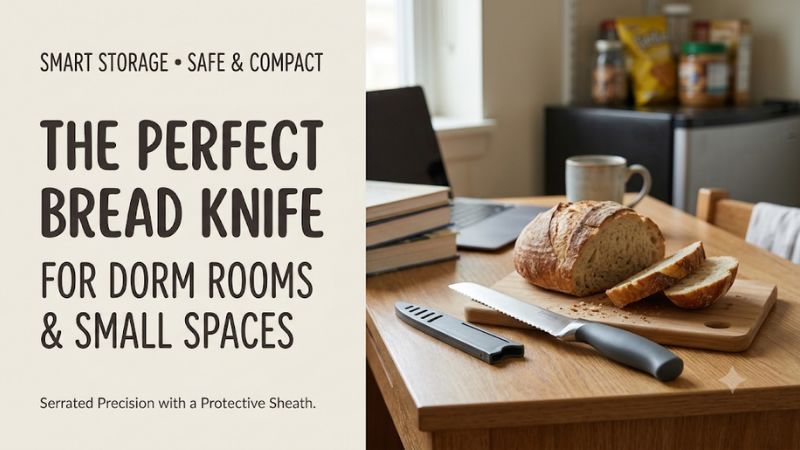
Why Dorm Kitchens Need a Different Buying Approach
Dormitory cooking is different from cooking in a private home. Students may share limited counter space, lack dedicated knife storage, and prepare meals near electrical appliances or other roommates. Some residences provide only a microwave and refrigerator, while others offer communal kitchens with varying equipment and access rules.
Understand the Limits of Dorm Cooking
Before buying cutlery, identify which cooking activities are permitted in your residence. A housing handbook may restrict open heating elements, certain appliances, sharp tools, or food preparation outside designated areas.
Questions to check:
- Is there a communal kitchen?
- Are students allowed to bring kitchen knives?
- Are knives permitted in sleeping rooms?
- Is there a designated storage area?
- Do blade-length restrictions apply?
- Can students use their own cutting boards?
- Are sharp tools allowed only under certain conditions?
- What happens when an item violates the housing policy?
Do not assume that rules at another college apply to your residence.
Policies can change between academic years and may differ among buildings on the same campus.
Decide Whether You Actually Need a Bread Knife
Students often purchase kitchen equipment before learning how frequently they will use it. A bread knife is helpful for cutting whole loaves, but many dorm meals can be prepared with pre-sliced bread and packaged ingredients.
A bread knife may be useful for:
- Whole sandwich loaves.
- Crusty sourdough.
- Bagels.
- Bread rolls.
- Certain pastries.
- Simple shared-kitchen food preparation.
You may not need one for:
- Pre-sliced sandwich bread.
- Packaged sliced bagels.
- Cereal.
- Yogurt.
- Microwave oatmeal.
- Ready-to-eat snacks.
- Meals purchased from a dining hall.
If you rarely buy unsliced bread, purchasing a dedicated knife may not provide enough value.
A simple meal plan can help identify which tools are genuinely necessary.
Consider Shared-Space Safety
Dorm kitchens often serve multiple students with different cooking experience. Knives left on counters or in common drawers can create unnecessary hazards, particularly when other people do not know they are there.
Shared-kitchen priorities:
- Use knives only where permitted.
- Keep blades protected when not in use.
- Never leave a knife hidden under towels or dishes.
- Do not store sharp tools loose in shared drawers.
- Follow the kitchen’s cleaning rules.
- Keep the preparation area clear.
- Store personal equipment securely when allowed.
The goal is not merely to prevent damage to the blade.
A responsible storage system should also protect roommates, cleaning staff, and anyone using the kitchen after you.
Types of Bread-Cutting Tools for Dorm Students
Bread-cutting options range from conventional serrated bread knives to shorter serrated utility knives. Different blade lengths and handle designs can suit different foods, but the governing housing policy determines which items are allowed. A smaller knife should never be treated as an automatic exception to a prohibition.
Compact Serrated Utility Knives
A serrated utility knife is generally shorter than a traditional bread knife and may be suitable for smaller rolls, certain bagels, tomatoes, and sandwich ingredients. It can be practical when the student needs a general kitchen tool for modest food-preparation tasks in an approved cooking area.
Best For: Small rolls and occasional food preparation where permitted.
Key Features:
- Short serrated blade.
- Manageable overall length.
- Compact handle.
- Smaller storage requirement.
- Compatible protective guard.
Pros:
- Takes less storage space.
- Useful for several small foods.
- Easier to manage on compact cutting boards.
- May be sufficient for occasional meals.
Cons:
- Too short for large loaves.
- Requires safe storage.
- Still subject to dorm restrictions.
- Can encourage unsafe cutting when the blade lacks sufficient length.
Buy If: The residence permits the knife and you mainly prepare smaller foods.
Skip If: The housing policy prohibits kitchen knives or you regularly cut wide sourdough loaves.
A compact serrated knife is a practical cooking tool, not a way to bypass institutional restrictions.
Eight-Inch Bread Knives
An eight-inch bread knife offers more cutting length than a small serrated utility knife without reaching the size of some ten-inch professional models. It can work for many standard loaves and may suit approved shared kitchens where space is limited.
Best For: Students who regularly slice bread in a permitted kitchen.
Key Features:
- Approximately eight-inch serrated blade.
- Suitable handle.
- Dedicated bread-cutting edge.
- Compatible blade protection.
- Manageable storage compared with longer models.
Pros:
- Useful for many loaves.
- More cutting length than a utility knife.
- Practical for bagels and rolls.
- May fit compact cutting boards.
Cons:
- Still a substantial sharp kitchen tool.
- Some large loaves require longer strokes.
- Requires suitable storage.
- Housing restrictions remain applicable.
Buy If: You have an approved kitchen and regularly purchase unsliced bread.
Skip If: You do not have permission to possess or store the knife.
The best blade length should match both the food and the size of the approved preparation space.
Nine- and Ten-Inch Bread Knives
Longer bread knives are useful for wide artisan loaves and repeated bread preparation. They offer more cutting length, which can make controlled slicing easier on large breads. However, they also require greater storage space and may be unnecessary for students preparing only occasional sandwiches.
Best For: Students with approved full kitchens who bake or buy whole loaves regularly.
Key Features:
- Long serrated cutting edge.
- Suitable for wide breads.
- Dedicated handle.
- Different serration patterns.
- Greater storage requirements.
Pros:
- Useful for large sourdough loaves.
- Suitable for frequent bread preparation.
- Can support pastry tasks.
- More cutting length.
Cons:
- Requires substantial protected storage.
- May be cumbersome on tiny boards.
- Higher expense on selected models.
- Not suitable for restricted dorm rooms.
Buy If: You frequently prepare whole artisan loaves in an approved student kitchen.
Skip If: You mainly eat pre-sliced bread or have very limited space.
A longer blade is not automatically more useful for everyday dorm meals.
Avoid paying extra for a large knife without a clear need.
Pre-Sliced Bread as a Practical Alternative
Pre-sliced bread is not a knife, but it often solves the actual student problem more effectively than buying cutlery. Many grocery stores offer sandwich bread, sliced bagels, and other convenient bread products that can be used for simple meals without sharp cutting tools.
Best For: Students without an approved cooking area or permitted knife storage.
Practical advantages:
- No knife purchase.
- No blade-storage issue.
- Less preparation equipment.
- Convenient for quick meals.
- Suitable for many sandwiches and breakfast foods.
Limitations:
- Fewer choices in slice thickness.
- Some artisan loaves are not sold pre-sliced.
- Packaging and freshness preferences vary.
- Certain foods still need appropriate preparation tools.
When housing restrictions prohibit kitchen knives, choose compliant food options rather than seeking an unauthorized cutting tool.
How to Choose a Bread Knife When Dorm Rules Permit One
If the residence explicitly allows kitchen knives, choose according to normal cooking needs rather than appearance. Blade length, grip, steel care, and protective storage should suit a small shared kitchen. A practical student knife should not require expensive accessories or specialized maintenance for occasional bread preparation.
Choose a Suitable Blade Length
A knife should be long enough to cut through the breads you regularly prepare without requiring unsafe movements.
Blade-length considerations:
- Small serrated utility knife: Rolls and smaller foods.
- Approximately eight inches: Many standard loaves.
- Approximately nine inches: Versatile for regular bread cutting.
- Approximately ten inches: Large loaves and some pastries.
Do not assume a shorter knife is safer in every circumstance.
A blade too short for a wide loaf may encourage awkward hand positioning and unnecessary force.
Choose a suitable blade for the task, and confirm that it is permitted before purchase.
Look for a Comfortable Handle
A bread knife often requires controlled sawing strokes. The handle should feel secure without excessive gripping effort.
Features worth checking:
- Comfortable diameter.
- Appropriate length.
- Non-slip texture where available.
- Stable blade-to-handle connection.
- Smooth edges.
- Easy cleaning.
- No loose components.
Some students may prefer lightweight synthetic handles because they are straightforward to maintain.
Others may like traditional wood, but wooden handles generally require more careful moisture management.
Choose what suits the actual user.
Consider the Serration Design
Bread knives use wavy, pointed, or specialized serration patterns. These teeth help engage bread crust and move through the interior with a controlled sawing motion.
Important considerations:
- Serration shape.
- Blade length.
- Comfort of the cutting motion.
- Bread texture.
- Maintenance requirements.
- Sharpening availability.
A more elaborate serration does not automatically make a knife better for dorm cooking.
A straightforward, identifiable model may provide all the functionality needed.
Choose Practical Materials
Blade steels vary in corrosion resistance, construction, and sharpening requirements. Most students will benefit from a knife with manageable care instructions rather than a premium design requiring specialized maintenance.
Value priorities:
- Appropriate stainless construction.
- Comfortable handle.
- Reliable manufacturer.
- Suitable edge protection.
- Easy cleaning.
- Reasonable storage requirements.
Do not select a knife solely because it has a decorative finish.
Cutting safety and practicality matter more.
Budget Considerations for College Students
Dorm cooking budgets can be limited, and buying a knife creates additional costs beyond the blade itself. A suitable cutting board, protective guard, and appropriate storage location may be required. Students should compare the total expense with how often they will actually prepare bread and whether campus dining or pre-sliced groceries already meet their needs.
Start With the Food You Regularly Eat
Before buying a bread knife, review the meals you normally prepare.
Common dorm meals:
- Sandwiches.
- Bagels.
- Toast.
- Breakfast rolls.
- Yogurt and fruit.
- Microwave meals.
- Ready-to-eat snacks.
If most bread is already sliced, a dedicated bread knife may be unnecessary.
If the student regularly cooks in a permitted shared kitchen and buys whole sourdough loaves, the purchase may be more useful.
Base the decision on actual behavior.
Avoid Paying for Features You Do Not Need
Premium forged bread knives may appeal to enthusiasts, but occasional student food preparation often does not require advanced construction.
Prioritize:
- Suitable blade length.
- Secure handle.
- Appropriate serration.
- Manufacturer care guidance.
- Protective storage.
- Reliable fit with a cutting board.
Lower priority for occasional use:
- Decorative Damascus patterns.
- Elaborate gift packaging.
- Coordinated premium knife sets.
- Unnecessary specialty accessories.
Spend money on features that improve real daily tasks.
Consider Whether Borrowing Shared Equipment Is Permitted
Some communal kitchens provide knives and cutting boards for student use.
When equipment is available and appropriately maintained, using it may eliminate the need to purchase and store a personal bread knife.
However, shared tools should be inspected before use.
Do not use damaged or unsafe equipment.
Follow kitchen rules for cleaning, storage, and checkout if applicable.
Choosing a Cutting Board for Dorm Bread Preparation
A bread knife should be paired with a stable cutting board. Cutting directly on a desk, countertop, plate, or glass surface can create stability problems and damage the knife edge. A compact food-preparation board is often sufficient for ordinary sandwiches, but large sourdough loaves need enough room for controlled cutting.
Select a Stable Board Size
The board should accommodate the bread and provide room for both hands to work safely.
Useful features:
- Flat surface.
- Appropriate food-contact material.
- Non-slip stability.
- Sufficient width for the loaf.
- Easy cleaning.
- Compact storage when not in use.
A narrow board may be suitable for a bagel but insufficient for a broad artisan loaf.
Choose according to normal groceries.
Avoid Cutting on Hard Surfaces
Glass, ceramic, and stone surfaces are generally poor choices for protecting knife edges.
Use a suitable cutting board instead.
Do not place a cutting board over an unstable appliance, open drawer, or uneven stack of books.
The cutting surface should rest securely on a proper work area.
A stable setup improves control and reduces unnecessary risk.
Keep Food Preparation Separate From Study Areas
Dorm rooms often serve as bedrooms, study areas, and social spaces.
Food preparation should occur only where permitted and where surfaces can be cleaned appropriately.
Avoid using the same cluttered desk for cutting food and storing electronics.
Practical habits:
- Use a designated approved food-preparation area.
- Clear unnecessary objects.
- Keep cords away from the board.
- Maintain adequate lighting.
- Wash hands before handling food.
- Clean surfaces after preparation.
- Store tools promptly.
If an appropriate preparation area is unavailable, choose foods that do not require cutting.
Safe Bread-Slicing Technique for Beginners
A serrated knife can be useful for bread, but it still requires careful handling. Many accidents occur when food is unstable, the user holds the bread awkwardly, or too much force is applied. Students preparing bagels or crusty loaves should prioritize controlled movements and a clear cutting area.
Slicing a Standard Loaf
Place the bread on a stable cutting board with enough clearance around the knife.
Basic steps:
- Position the loaf securely.
- Keep the guiding hand away from the cutting path.
- Place the serrated edge on the crust.
- Begin with light back-and-forth strokes.
- Continue without excessive pressure.
- Finish the cut before lifting the slice.
- Return the knife to a safe position.
Do not rush.
Allow the serration to engage the bread rather than forcing the blade downward.
Cutting Bagels Safely
Bagels can be difficult to cut because they are round, firm, and may slip.
A common unsafe habit is holding a bagel in the palm while slicing toward the hand.
Instead, use an appropriate stable board and a safe method that keeps hands away from the blade.
Safety priorities:
- Stable support.
- Controlled knife direction.
- Fingers outside the cutting path.
- No excessive pressure.
- Adequate lighting.
- Suitable blade length.
If bagel preparation is frequent, buying pre-sliced bagels can be a practical alternative.
Avoid Using a Bread Knife for Unrelated Tasks
A serrated bread knife is designed for slicing suitable foods.
Do not use it to open packages carelessly, cut hard objects, pry lids, or perform maintenance on appliances.
Avoid:
- Cutting frozen food.
- Prying open containers.
- Slicing on glass.
- Using the knife as a screwdriver.
- Cutting toward your hand.
- Leaving it inside a sink.
- Passing it carelessly to another person.
Proper use protects both the knife and the people sharing the kitchen.
Storage Options for a Permitted Dorm Bread Knife
A knife should be stored with its cutting edge protected and its location clearly controlled. Dorm rooms and communal kitchens may lack dedicated cutlery drawers, so storage must be planned before purchase. The correct method should comply with housing policy and prevent accidental contact with the blade.
Use a Proper Blade Guard
A fitted blade guard can protect the serrated edge and reduce accidental contact during permitted storage.
Features to check:
- Correct length.
- Complete edge coverage.
- Secure fit.
- Tip protection.
- Compatible width.
- Durable construction.
- Safe removal.
A loose cover is not adequate merely because it hides part of the blade.
Do not store a bare knife in an ordinary backpack or drawer.
Confirm the Approved Storage Location
Some residences may permit a knife in a shared kitchen but not in a sleeping room.
Others may have different policies.
Follow the institution’s instructions rather than creating an unauthorized storage arrangement.
Questions to ask housing staff:
- Where may knives be stored?
- Is secure or locked storage required?
- Can personal knives remain in shared kitchens?
- Are students required to remove them after use?
- Are protective guards mandatory?
- Are there limits on blade size or type?
When the policy does not permit storage, do not purchase a knife for that space.
Keep Knives Away From Shared Utensils
Sharp serrated edges should not be mixed loose with spoons, forks, cooking utensils, or cleaning supplies.
An appropriate knife organizer or protective guard can help when allowed.
Avoid leaving knives on crowded counters.
Do not conceal them under towels or dishes where another person might reach unexpectedly.
A consistent storage routine is especially important in shared facilities.
Cleaning and Maintaining a Student Bread Knife
A budget bread knife still needs proper care. Food residue can accumulate along serrations, while moisture and poor storage may affect blade or handle condition. Cleaning should follow the manufacturer’s instructions and the residence hall’s shared-kitchen requirements. A simple routine after every use is usually more practical than occasional intensive cleaning.
Wash the Knife Carefully
Many manufacturers recommend handwashing bread knives, though some models may carry dishwasher-safe designations.
General care routine:
- Wash after food preparation.
- Use suitable mild detergent.
- Keep fingers away from the serrated edge.
- Rinse carefully.
- Dry promptly.
- Inspect the handle.
- Store with the blade protected.
Do not leave knives soaking in a shared sink.
Another student may not see the blade beneath dishes or cloudy water.
Understand Serrated Blade Maintenance
Serrated knives may remain serviceable for a long time with correct use, but they can still become damaged or dull.
Sharpening differs from ordinary straight-edge knife maintenance.
Maintenance considerations:
- Follow manufacturer instructions.
- Avoid inappropriate pull-through sharpeners.
- Do not cut on hard surfaces.
- Use professional sharpening when needed.
- Inspect for damaged teeth.
- Replace the knife if it becomes unsafe.
A student does not necessarily need to buy specialized sharpening equipment for one occasional-use bread knife.
Keep the Cutting Area Clean
Shared kitchens can accumulate crumbs, food residue, and spills quickly.
After slicing bread, clean the board and surrounding preparation area according to facility rules.
Dispose of food scraps appropriately.
Return shared utensils to their designated storage.
A clean workspace makes food preparation more comfortable for the next person and helps prevent cross-contamination.
Small-Space Storage and Organization Tips
Even when a bread knife is permitted, it should not dominate limited kitchen storage. Student living spaces often have little room for accessories used only occasionally. The best arrangement keeps necessary tools easy to locate while avoiding unnecessary countertop clutter.
Keep a Minimal Approved Kitchen Kit
A student who prepares simple bread-based meals may need only a few items in an approved kitchen.
Possible essentials:
- Suitable cutting board.
- Approved bread-cutting tool when permitted.
- Protective blade guard.
- Food-storage container.
- Dishwashing supplies.
- Reusable plate and utensils.
Do not buy a large knife block set when the cooking routine involves only simple sandwiches.
Keep the kitchen equipment proportional to the space available.
Store Bread Properly
Choosing a knife is only one part of preparing bread conveniently.
Bread storage also affects quality.
Practical considerations:
- Follow package instructions.
- Keep bread in suitable storage.
- Avoid unnecessary moisture exposure.
- Freeze suitable extra bread when appropriate.
- Check for mold before use.
- Discard moldy bread rather than cutting away the visible area.
A bread knife cannot restore stale or spoiled bread.
Buying smaller quantities or freezing appropriate portions may reduce waste.
Plan Simple Meals Around Available Equipment
Students can often prepare convenient meals without extensive cutlery.
Examples:
- Pre-sliced sandwiches.
- Packaged sliced bagels.
- Toast with suitable toppings.
- Yogurt and fruit.
- Microwave oatmeal.
- Ready-to-eat wraps.
- Prepared salads.
Use approved appliances and follow food-storage instructions.
A modest meal routine may be more practical than purchasing equipment the residence does not permit.
Common Mistakes Students Should Avoid
Bread knife purchases can be unsuitable when students overlook housing policies, choose a blade too large for the available workspace, or fail to plan safe storage. Another common mistake is buying expensive kitchen tools for meals that rarely require them. A careful evaluation of actual cooking needs can prevent unnecessary spending and safety problems.
Assuming All Dorms Allow Kitchen Knives
Residence hall policies vary.
Some permit kitchen tools in designated areas; others restrict particular sharp objects or prohibit them in sleeping rooms.
Always check the current policy.
Do not assume that a knife is allowed because it is sold as a kitchen accessory.
Buying a Large Knife for Occasional Sandwiches
A ten-inch bread knife may be useful for a home baker but unnecessary for a student who mainly eats pre-sliced sandwich bread.
Choose based on normal use.
Avoid large blades when storage and preparation space are limited.
A small permitted tool—or no knife—may be the better solution.
Storing the Blade Without Protection
An uncovered serrated edge can injure anyone reaching into a shared drawer or bag.
Use approved protective storage.
Do not leave the knife loose or hidden beneath other items.
If safe storage is unavailable, the purchase is not appropriate.
Cutting on an Unstable Surface
A bread knife should be used on a stable board, not on a crowded desk or directly on a hard counter.
Avoid balancing the board over appliances or furniture.
If there is no suitable cutting location, choose a preparation method that does not require a knife.
Frequently Asked Questions
Students often want to know whether bread knives are allowed in dorm rooms, how much blade length is necessary, and whether a compact serrated tool can replace a conventional bread knife. The most important consideration is permission from the residence and safe storage. A product’s size or kitchen purpose does not automatically override institutional restrictions.
Are Bread Knives Allowed in College Dorm Rooms?
Policies vary by institution and residence building. Some colleges restrict kitchen knives in sleeping rooms while permitting certain tools in approved communal kitchens. Others have different blade or storage rules. Check the current housing handbook and obtain clarification from residence staff before purchasing. Never assume that a kitchen knife is allowed simply because it is intended for food preparation.
What Size Bread Knife Is Best for Dorm Cooking?
Where permitted, the appropriate size depends on the bread and available preparation space. A shorter serrated utility knife may be sufficient for small rolls, while an eight- or nine-inch bread knife can handle many loaves. The smallest blade is not automatically the safest or most legally permissible. Choose an appropriate kitchen tool only after confirming the housing rules.
Can I Keep a Bread Knife in My Dorm Drawer?
Only if the institution permits personal kitchen knives in the room and the drawer provides compliant secure storage. A blade guard or suitable organizer can reduce accidental contact, but it does not override a prohibition. Do not place a sharp knife loose among ordinary utensils or personal belongings. Ask housing staff about permitted storage when uncertain.
Do I Need a Bread Knife for Bagels?
Not necessarily. Pre-sliced bagels can eliminate the need for a cutting tool, which may be especially convenient in a restricted dorm environment. When knives are permitted, an appropriately sized serrated knife can be used on a stable cutting board. Never slice a bagel toward the palm while holding it in the hand.
Is an Expensive Bread Knife Worth It for a Student?
Usually not when bread preparation is occasional. A practical, permitted serrated knife with a comfortable handle and suitable storage may be sufficient. Premium construction is more relevant to frequent home baking or established kitchen preferences. Consider the total cost of the knife, blade protection, cutting board, and maintenance before buying.
Can a Serrated Utility Knife Replace a Bread Knife?
For small rolls, bagels, and limited preparation tasks, a suitable serrated utility knife may be enough. However, its shorter blade can be less practical for broad loaves, potentially requiring awkward movements. Choose the tool that matches the food and is permitted by the residence. Do not treat a smaller blade as an automatic exception to dormitory restrictions.
Conclusion
A bread knife for dorm rooms should only be purchased when the residence explicitly permits it and provides a suitable place for food preparation and secure storage. For permitted kitchens, choose a manageable serrated blade, comfortable handle, stable cutting board, and appropriate blade guard. Students who mainly eat packaged or pre-sliced bread may not need a knife at all. Prioritize housing compliance, safe handling, simple cleaning, and realistic meal needs over premium features or unnecessary equipment.










Write Your Review
No reviews yet. Be the first to share your experience!