
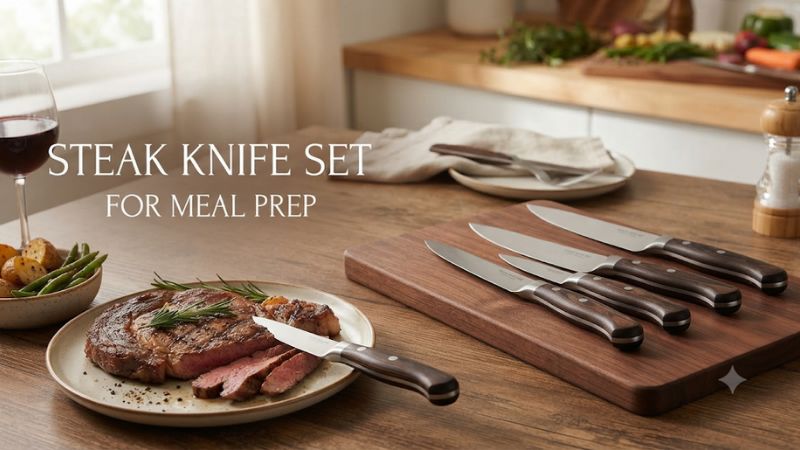
A steak knife set for meal prep can make serving cooked proteins easier, especially when preparing several portions for family dinners or weekly meals. However, steak knives are primarily dining and portioning tools, not replacements for a chef’s knife or dedicated raw-meat preparation equipment. This guide explains how to choose the right blade style, determine a practical set size, compare handle materials, and maintain safe, convenient storage.
- Quick Answer: What Steak Knife Set Works Best for Meal Prep?
- Understand the Role of Steak Knives in Meal Preparation
- Serrated Versus Straight-Edge Steak Knives
- Choose the Right Number of Steak Knives
- Handle Materials and Everyday Comfort
- Blade Steel and Construction: What Matters?
- Meal-Prep Workflow: Using Steak Knives Effectively
- Cleaning and Caring for Steak Knife Sets
- How to Store a Steak Knife Set Safely
- Common Buying Mistakes
- Frequently Asked Questions
- Conclusion
Quick Answer: What Steak Knife Set Works Best for Meal Prep?
For most households, a four- or six-piece steak knife set with comfortable handles, dependable stainless-steel blades, and suitable protective storage provides enough flexibility for regular meals. Serrated edges can be convenient for slicing cooked steak and other foods at the table, while straight-edge steak knives appeal to people who prefer a smoother cut and are willing to maintain the edges appropriately.
The correct purchase depends on what you mean by meal preparation.
Recommended choices:
- Best for family dinners: Six-piece set with consistent handles and comfortable blade lengths.
- Best for two-person households: Four-piece set.
- Best for frequent steak meals: Quality serrated or appropriately sharpened straight-edge steak knives.
- Best for easy maintenance: Stainless-steel blades with manufacturer-approved handle-care instructions.
- Best for storage: Individual blade protection or a dedicated compartmented case.
- Best for regular batch cooking: A separate chef’s knife for raw preparation and steak knives for cooked portions.
- Best for entertaining: Enough matching knives for the typical number of diners.
A steak knife should not be your primary tool for trimming raw chicken, deboning meat, or chopping vegetables. Its narrow design and table-oriented dimensions are usually better suited to cooked-food portioning and dining.
Understand the Role of Steak Knives in Meal Preparation
Meal preparation includes shopping, trimming, cooking, portioning, packaging, and eventually eating the prepared food. A steak knife can contribute to the later stages, especially when slicing cooked proteins or serving individual portions. But it does not replace the versatility of a chef’s knife, carving knife, or suitable boning knife during ingredient preparation.
What Steak Knives Are Designed to Do
Steak knives are generally intended to cut cooked meat at the table. Their narrow blades and pointed tips make them suitable for individual portions, while serrations or sharpened plain edges help separate bites without requiring the diner to rely on a butter knife.
Common uses include:
- Slicing cooked steak.
- Portioning roasted meat on a plate.
- Cutting cooked pork chops.
- Serving grilled chicken.
- Slicing firm cooked vegetables at the table.
- Preparing individual dinner portions.
- Serving family-style meals.
These uses become relevant during meal prep when food is cooked in advance and portioned for later consumption.
However, cutting raw meat into cubes for a freezer meal is a different task. A chef’s knife or appropriate specialist knife usually provides better control on a cutting board.
Where a Steak Knife Fits Into Weekly Meal Prep
A household may cook several chicken breasts, steaks, or roasted pork portions at once. After cooking and appropriate resting, the food can be divided into servings using a suitable sharp knife. Steak knives may be convenient when several people portion their own food, particularly during a family dinner.
For extensive batch slicing, a longer chef’s knife or carving knife is often more efficient.
Practical meal-prep workflow:
- Prepare raw ingredients with suitable kitchen knives.
- Cook food to safe temperatures.
- Rest meat when appropriate.
- Portion cooked food using an appropriate clean knife.
- Transfer portions into suitable containers.
- Refrigerate or freeze promptly.
- Reheat and serve safely.
The important distinction is that steak knives support portioning and eating rather than every stage of food preparation.
When a Steak Knife Set Is Unnecessary
A dedicated steak knife set may offer limited value when most weekly meals consist of soups, pasta, soft vegetables, or foods that are already bite-sized. If you rarely serve steak or other substantial cooked proteins, ordinary table knives and a well-maintained chef’s knife may cover your needs.
Consider skipping a set when:
- You rarely prepare steak or chops.
- Meals are usually pre-portioned.
- You already own suitable table knives.
- Drawer space is severely limited.
- You are trying to reduce duplicate kitchen equipment.
- You need a raw-meat preparation knife instead.
Avoid treating every meal-prep accessory as essential.
A carefully selected small knife collection is often more useful than a crowded drawer of overlapping tools.
Serrated Versus Straight-Edge Steak Knives
The cutting edge is one of the most important decisions when shopping for steak knives. Serrated models use small teeth to engage food surfaces, while plain-edge designs rely on a continuous sharpened edge. Both can cut cooked meat, but they differ in feel, maintenance, and suitability for certain foods.
Serrated Steak Knife Sets
Serrated steak knives have toothed cutting edges that are intended to slice cooked meat with a sawing motion. They are common in household dining sets and may remain usable between maintenance sessions, although individual edge geometry and quality vary widely.
Best For: Everyday steak dinners and households wanting familiar table-cutting action.
Key Features:
- Serrated blade.
- Pointed or rounded tip depending on model.
- Stainless-steel construction on many products.
- Four-, six-, or eight-piece configurations.
- Wooden, synthetic, or metal handles.
Pros:
- Familiar cutting motion.
- Useful on cooked steak.
- Often available in economical sets.
- Can handle several firm foods at the table.
Cons:
- May create a more textured cut.
- Specialized sharpening can be required.
- Aggressive sawing can damage delicate foods.
- Serrations can retain food particles.
Buy If: Your household regularly serves steak and prefers low-fuss everyday table knives.
Skip If: You want a very smooth cutting action and prefer maintaining plain edges.
Serrations are not proof that a knife will never require sharpening. They simply change the edge’s cutting mechanism and maintenance needs.
Straight-Edge Steak Knife Sets
Straight-edge steak knives have continuous sharpened edges that can make smooth cuts when maintained properly. They may appeal to cooks who value clean slicing and enjoy sharpening their knives with appropriate equipment.
Best For: Diners who prefer smooth cuts and are willing to maintain the edge.
Key Features:
- Continuous sharpened edge.
- Slim blade profile.
- Comfortable table-knife handle.
- Different steel constructions.
- Suitable protective storage.
Pros:
- Smooth cutting feel when sharp.
- Conventional sharpening methods may be suitable.
- Useful for a variety of cooked proteins.
- Familiar to people using premium kitchen cutlery.
Cons:
- Edge performance declines without maintenance.
- Hard ceramic plates can contact the edge.
- A dull blade may require excessive pressure.
- Often more expensive in premium sets.
Buy If: You value precise slicing and can maintain the knives appropriately.
Skip If: You want to avoid sharpening and maintenance altogether.
Straight-edge steak knives should not be treated as maintenance-free simply because they cost more or use harder steel.
Which Edge Works Better for Meal Prep?
For dining and individual cooked portions, either edge style can work. Serrated knives are often convenient for routine table use, while straight-edge models offer a different cutting feel. For preparing large quantities of sliced meat in advance, however, the larger distinction is between a steak knife and a proper carving or chef’s knife.
Choose according to the task:
- Individual cooked portions: Serrated or straight-edge steak knife.
- Large roast slicing: Carving knife.
- Raw meat trimming: Appropriate chef’s or boning knife.
- Vegetable chopping: Chef’s knife, Santoku, or suitable vegetable knife.
- Boneless cooked food in meal containers: Appropriate clean kitchen knife.
A steak knife set becomes valuable when several people need their own dining knives, not necessarily when one person is preparing twenty meal containers.
Choose the Right Number of Steak Knives
Steak knife sets commonly contain four, six, or eight pieces, although larger collections are available. The right number depends on household size, dining habits, and whether guests frequently join meals. Buying additional knives beyond realistic needs increases storage and cleaning without necessarily making meal preparation easier.
Four-Piece Steak Knife Sets
A four-piece set can serve couples, small households, and people who occasionally host a few guests. It provides enough knives for common everyday meals without occupying excessive drawer space.
Best For: One- to four-person households.
Advantages:
- Compact storage.
- Lower total purchase commitment.
- Fewer knives to clean.
- Practical for small dining groups.
- Easier to replace with a different design later.
Limitations:
- Insufficient for larger family gatherings.
- No extra knives when several are being washed.
- Limited flexibility for entertaining.
Buy If: Your typical dinner includes no more than four people.
Skip If: You routinely serve five or more diners.
Four quality knives that are used regularly can provide more value than a large mismatched collection.
Six-Piece Steak Knife Sets
Six-piece sets are a useful middle ground for families and households that entertain occasionally. They offer additional dining capacity without requiring the space associated with an extensive twelve-piece collection.
Best For: Families and moderate entertaining.
Advantages:
- Suitable for many dinner tables.
- Provides spare knives for smaller households.
- Balances capacity and storage.
- Available in multiple handle materials.
- Often convenient for matching place settings.
Limitations:
- More cleaning than a compact set.
- May be unnecessary for one-person households.
- Storage cases can be larger.
Buy If: You regularly serve several people or want a few extra knives for guests.
Skip If: Your kitchen is extremely small and most meals are eaten alone.
For many households, a six-piece set is a sensible long-term purchase.
Eight- and Twelve-Piece Sets
Larger sets make sense when the household regularly hosts group dinners or has a large family. They can also provide matching place settings for occasions when everyone receives a plated steak or chop.
Best For: Larger families and frequent entertaining.
Advantages:
- More matching knives.
- Better accommodation of guests.
- Fewer shortages at dinner.
- May coordinate with a large tableware collection.
Limitations:
- Additional storage.
- Higher cost.
- More cleaning.
- Greater risk of buying knives that remain unused.
Buy If: The household actually serves eight or more diners regularly.
Skip If: You are purchasing extra knives only because a large set appears cheaper per piece.
Compare expected use, not just unit cost.
Handle Materials and Everyday Comfort
A steak knife is used repeatedly at the dining table, so comfort matters. Handles vary from riveted wood to molded polymer and all-metal designs. The best choice should feel secure, fit the hand comfortably, and suit the household’s cleaning routine.
Wooden Handles
Wooden steak knife handles offer a traditional appearance and are common in rustic and premium cutlery sets. However, wood generally requires moisture-sensitive maintenance.
Advantages:
- Natural appearance.
- Available in many classic styles.
- Comfortable feel for some users.
- Can coordinate with wooden tableware.
Limitations:
- Often requires handwashing.
- Prolonged soaking can damage finishes.
- Dishwasher use may be prohibited.
- Handle joints need inspection.
Buy If: You prefer traditional styling and do not mind careful handwashing.
Skip If: Your household routinely uses the dishwasher for all cutlery.
Use the manufacturer’s actual care instructions.
Synthetic Handles
Polymer and composite handles are available in different shapes and textures. Some provide secure grip surfaces and straightforward cleaning requirements.
Advantages:
- Many ergonomic options.
- Often easy to wipe clean.
- Resistant to ordinary splashes on suitable models.
- Available across different price ranges.
Limitations:
- Cleaning instructions vary.
- Textured areas can retain debris.
- Thin handles may feel uncomfortable.
- Some polymers may discolor over time.
Buy If: You prioritize everyday practicality and consistent handle feel.
Skip If: You strongly prefer natural materials.
A synthetic handle does not automatically make a steak knife dishwasher-safe.
All-Metal Handles
Stainless-steel steak knives with integrated or metal handles can coordinate with modern flatware collections. Their surfaces may be straightforward to wipe, although smooth polished designs can feel different from textured grips.
Advantages:
- Consistent metal appearance.
- May coordinate with existing flatware.
- No exposed wooden panels.
- Different modern designs available.
Limitations:
- Polished surfaces can feel slippery.
- Handle weight varies.
- Some designs show fingerprints.
- Dishwasher compatibility must be confirmed.
Buy If: You want a coordinated contemporary table setting.
Skip If: The handle shape or grip feels uncomfortable.
Comfort should remain more important than visual matching.
Blade Steel and Construction: What Matters?
Steak knives are commonly made from stainless cutlery steel, but steel grade, heat treatment, blade thickness, and edge geometry vary. Some premium sets are forged, while many economical models use stamped construction. Neither term alone determines whether a knife is suitable for ordinary dining.
Stainless Steel for Everyday Dining
Stainless steel is popular because it offers practical corrosion resistance when cleaned and maintained correctly.
Useful characteristics:
- Appropriate corrosion resistance.
- Manageable edge maintenance.
- Several sharpening options.
- Compatibility with many handle designs.
- Wide availability.
Even stainless steel can stain or corrode under unsuitable conditions.
Clean food residue and dry knives according to the manufacturer’s instructions.
Forged Versus Stamped Steak Knives
Forged knives are shaped through a metalworking process, while stamped blades are cut from sheet stock before further manufacturing steps. Both can produce useful steak knives.
Forged construction may offer:
- Different bolster designs.
- Particular handle-to-blade transitions.
- More substantial feel in some products.
- Premium construction options.
Stamped construction may offer:
- Lower overall weight.
- Practical everyday designs.
- Lower purchase costs on some models.
- Straightforward blade profiles.
The quality of the steel, edge, heat treatment, and finishing still matters.
A stamped knife is not automatically inferior, and a forged knife is not automatically easier to clean.
Avoid Unsupported Edge-Retention Claims
Marketing descriptions sometimes promise extremely long-lasting sharpness. Actual edge performance depends on steel, sharpening, contact surfaces, and use.
Steak knives routinely contact plates, and some may experience more edge wear than kitchen knives used on suitable cutting boards.
Rather than relying on unsupported promises, choose an identifiable manufacturer and understand its sharpening guidance.
A properly maintained modest set can be more useful than an expensive collection neglected over time.
Meal-Prep Workflow: Using Steak Knives Effectively
A steak knife set can support portioned meals, but the full workflow should be planned around food safety and efficiency. Raw ingredients, cooked food, meal containers, and table settings require different handling. A good arrangement avoids unnecessary knife changes while keeping clean utensils separate from contaminated ones.
Prepare Raw Ingredients With Suitable Kitchen Knives
Begin with the correct tools for the raw ingredients.
A chef’s knife can handle many ordinary cutting tasks, while a boning knife may be useful for trimming meat near bones.
Preparation priorities:
- Stable cutting board.
- Clean sharp kitchen knife.
- Appropriate ingredient handling.
- Separation of raw and ready-to-eat foods.
- Safe hand positioning.
- Clean containers for prepared ingredients.
A steak knife is usually too short and specialized to replace a chef’s knife during substantial batch preparation.
Use the appropriate tool rather than forcing the dining knife into every task.
Portion Cooked Meat Appropriately
After cooking food to safe temperatures, let it rest when the recipe calls for resting. Portioning can then be performed using an appropriate clean knife.
Practical considerations:
- Use a clean cutting surface.
- Keep raw-meat utensils separate or clean and sanitize them appropriately.
- Slice with controlled movements.
- Avoid pressing too hard.
- Transfer portions promptly.
- Follow safe cooling and storage guidance.
A steak knife may be convenient for individual servings, but a carving knife is usually more efficient for slicing a large roast.
Prepare Meals for Refrigeration
Cooked food should not remain at room temperature for unnecessarily long periods.
General meal-prep habits:
- Use suitable food containers.
- Divide large batches into manageable portions.
- Refrigerate promptly.
- Keep the refrigerator at 40°F or below.
- Label prepared meals when useful.
- Follow safe storage and reheating guidance.
- Reheat to appropriate temperatures.
The USDA recommends refrigerating perishable leftovers within two hours, or within one hour when the surrounding temperature exceeds 90°F.
Clean steak knives after use and avoid placing contaminated utensils into prepared meal containers.
Cleaning and Caring for Steak Knife Sets
Steak knives may have serrated edges, narrow blade-to-handle transitions, and materials that require different care. A set is most convenient when the cleaning routine matches the household’s habits. Handwashing is commonly recommended for quality kitchen cutlery, but the exact manufacturer’s instructions should take priority.
Handwashing Steak Knives
Handwashing gives the user control over blade contact and handle exposure.
Recommended routine:
- Clean knives after use.
- Use appropriate mild detergent.
- Keep fingers clear of the cutting edge.
- Clean around handle joints.
- Rinse carefully.
- Dry promptly.
- Return knives to protective storage.
Do not leave sharp steak knives loose in a sink where another person may reach into cloudy water.
Use a safe grip when cleaning serrations.
Dishwasher Compatibility
Some manufacturers designate specific steak knives as dishwasher-safe, while others require handwashing.
Before using a dishwasher, verify:
- Blade-care instructions.
- Handle material restrictions.
- Temperature limitations.
- Recommended rack placement.
- Whether loose knife movement can occur.
- Drying instructions.
Do not assume all stainless-steel knives belong in a dishwasher.
Even when permitted, careful handwashing may help reduce unnecessary contact with other utensils.
Sharpening Serrated and Plain Edges
Plain-edge steak knives can often be sharpened using appropriate conventional methods. Serrated models may require a suitable tapered tool or professional service.
Maintenance priorities:
- Follow manufacturer guidance.
- Avoid inappropriate pull-through sharpeners.
- Do not grind away serration profiles.
- Inspect chipped or damaged edges.
- Replace unsafe knives.
- Maintain a consistent safe storage routine.
A steak knife that has become difficult to use may require maintenance rather than additional cutting pressure.
How to Store a Steak Knife Set Safely
Several sharp knives stored together can create hazards if their edges are exposed. Storage should keep the blades separated and prevent accidental contact when opening a drawer. The best arrangement depends on the set’s size, available space, and whether young children can access the storage location.
Individual Blade Protection
Protective guards can be useful when knives are stored in a drawer.
Features to check:
- Correct blade length.
- Complete edge coverage.
- Secure fit.
- Tip protection.
- Suitable materials.
- Easy controlled removal.
A loose guard that falls off in a drawer is not suitable.
Do not improvise storage with exposed edges.
Knife Blocks and Drawer Inserts
Some steak knife sets include wooden storage blocks or fitted cases.
A block may be convenient on a large countertop, while a drawer insert can preserve counter space.
Consider:
- Number of slots.
- Knife compatibility.
- Drawer dimensions.
- Cleaning access.
- Blade orientation.
- Stable placement.
- Child safety.
If the set arrives without storage, include a suitable organizer in the purchasing budget.
Keep Knives Out of Unsupervised Children’s Reach
A dining knife is still a sharp cutting tool.
Young children should not have unsupervised access to sharp steak knives.
Use appropriate storage and supervision arrangements based on the household.
A decorative display block is not automatically child-safe.
Common Buying Mistakes
Steak knife sets can be disappointing when buyers choose the largest collection, confuse dining knives with food-preparation knives, or overlook care requirements. The most useful purchase is one that matches household meals, table settings, and storage. Avoid paying for features that do not improve ordinary use.
Using Steak Knives for Heavy Meal Prep
Steak knives are not substitutes for boning knives, chef’s knives, or carving knives.
Use the correct tool for raw meat, vegetables, and large cooked portions.
A steak knife set primarily supports dining and individual portioning.
Buying Too Many Knives
An eight-piece set may be unnecessary in a two-person household.
Choose according to normal dining size and realistic entertaining frequency.
Extra knives create storage and cleaning responsibilities.
Ignoring Handle Care
Wooden, synthetic, and metal handles can have different cleaning restrictions.
Check the instructions before purchasing.
Choose a set the household can maintain consistently.
Choosing Appearance Over Comfort
Decorative finishes may appeal to buyers, but comfort and secure handling matter more.
A poorly fitting handle can become unpleasant during repeated dining use.
Prioritize the actual grip and cutting edge.
Frequently Asked Questions
Steak knife shopping for meal preparation often raises questions about whether dining knives are appropriate for batch cooking, how many pieces are necessary, and whether serrated or plain edges are easier to maintain. The correct answer depends on the household’s meals and the specific cutting task rather than the advertised size of the set.
Are Steak Knives Good for Meal Prep?
They are useful mainly for individual portioning and dining with cooked meat. For cutting raw ingredients, chopping vegetables, or preparing large batches of food, a chef’s knife or suitable specialist knife is usually more efficient. A steak knife set can complement a meal-prep kitchen, but it should not replace basic food-preparation cutlery.
How Many Steak Knives Does a Family Need?
Choose enough knives for the household’s typical dining group and occasional guests. Four pieces can suit smaller households, while six or eight may be practical for families and regular entertaining. There is no universal ideal number. Buying an unnecessarily large set increases storage needs without necessarily improving the meal-preparation process.
Are Serrated Steak Knives Better Than Straight-Edge Knives?
Neither is universally better. Serrated knives use a sawing action and are common for everyday steak dining. Straight-edge knives can provide smooth cuts when maintained properly. Serrated sharpening may require specialized tools, while plain edges typically use more conventional sharpening methods. Choose based on cutting preference and willingness to maintain the edge.
Can Steak Knives Cut Raw Chicken?
Although a sharp steak knife can cut some foods, it is not generally the best tool for raw poultry preparation. A chef’s knife or appropriate boning knife offers a more suitable working length and blade shape for many tasks. Raw poultry also requires careful handling to avoid cross-contamination. Use the correct knife and a stable food-preparation board.
Should Steak Knives Be Washed by Hand?
Follow the manufacturer’s care instructions. Many quality steak knives benefit from careful handwashing and prompt drying, especially those with wooden handles. Some sets are marked dishwasher-safe, but this designation should be verified for the exact product. Avoid loose knife movement or accidental contact with exposed edges during cleaning.
Is a Forged Steak Knife Set Worth Buying?
Forged construction may provide particular handle transitions, weight, or bolster designs, but it does not guarantee superior cutting results or easier care. Steel quality, blade geometry, handle comfort, and edge maintenance still determine practical usefulness. A well-designed stamped set may be sufficient for ordinary dining. Choose forged knives when their specific features justify the purchase.
Conclusion
A steak knife set for meal prep makes the most sense when your household regularly serves cooked proteins and wants comfortable, consistent knives for individual portions. Start with four or six pieces unless you frequently host larger meals, then choose serrated or straight edges according to cutting preference and maintenance habits. Prioritize comfortable handles, appropriate stainless steel, easy cleaning, and protective storage. For substantial raw-food preparation or slicing large roasts, invest in a suitable chef’s or carving knife rather than expecting steak knives to perform every kitchen task.







Write Your Review
No reviews yet. Be the first to share your experience!