
Choosing a paring knife for easy storage means finding a compact blade that handles peeling and trimming while fitting safely into a small kitchen. The knife itself may be only three or four inches long, but its exposed edge still needs protection. This guide explains how to compare knives with sheaths, drawer organizers, blocks, and other space-saving storage options.
- Quick Answer: What Is the Best Storage-Friendly Paring Knife?
- Why Storage Should Influence Your Knife Purchase
- How to Choose a Paring Knife That Is Easy to Store
- Comparison: Storage Options for Paring Knives
- Storage-Friendly Paring Knife Examples
- How to Organize a Small Kitchen Knife Drawer
- Safety Considerations for Families and Shared Kitchens
- Common Mistakes When Choosing Storage-Friendly Paring Knives
- Frequently Asked Questions
- Conclusion
Quick Answer: What Is the Best Storage-Friendly Paring Knife?
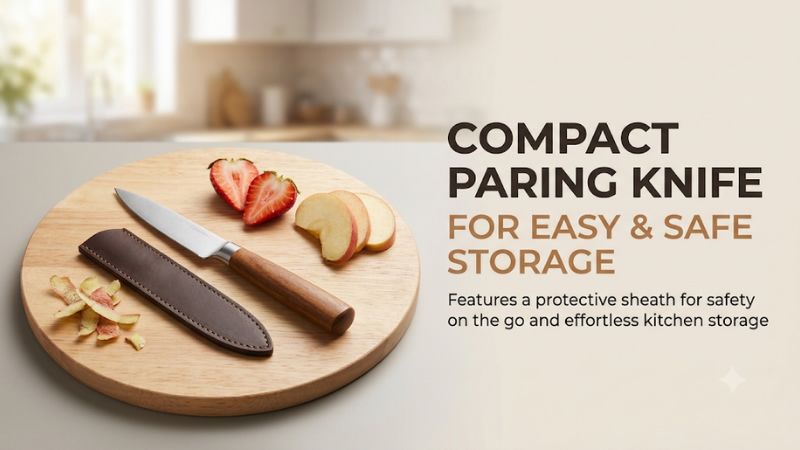
For a compact kitchen without a dedicated knife block, a short straight-edge paring knife with a correctly fitted protective sheath is often a practical choice. The sheath helps protect the blade and reduces accidental contact with the edge during ordinary storage. However, the knife should still be kept in a secure location rather than mixed carelessly with other utensils.
Useful buying priorities
- Blade length around three to four inches.
- Comfortable grip.
- Corrosion-resistant steel where practical.
- Manufacturer-compatible protective sheath.
- Compact overall dimensions.
- Easy handwashing and drying.
- Storage location away from children.
- Simple sharpening requirements.
- Durable handle and guard construction.
A knife supplied with a sheath may be especially convenient in an apartment or dorm-style kitchen with limited cabinetry.
However, a separate knife block or in-drawer tray can also work well when the user owns several knives.
The best solution depends on how many blades need storage and how accessible the knife should be during cooking.
A sheath should not be treated as permission to leave a sharp knife unattended on the counter or within easy reach of children.
Why Storage Should Influence Your Knife Purchase
Paring knives are frequently used for small food preparation tasks, but their compact size can create a false sense of safety. A short sharp blade can still cause serious injuries, particularly when stored loose inside a drawer where someone reaches for a spoon or measuring tool. Proper storage protects the user and also helps preserve the edge from contact with hard kitchen accessories.
Benefits of suitable storage
- Reduces exposed-edge contact.
- Protects the blade from other utensils.
- Makes the knife easier to locate.
- Helps maintain drawer organization.
- Reduces unnecessary edge damage.
- Keeps the cutting area uncluttered.
- Supports consistent washing and drying.
- Provides a predictable storage location.
Many kitchens have limited space for a large knife block.
In those situations, an individual sheath or compact drawer organizer may provide a more efficient solution.
However, not all protective guards fit every blade.
A guard intended for a long utility knife may be too loose for a short paring knife.
Before purchasing, consider the blade’s actual shape and the storage accessories available.
How to Choose a Paring Knife That Is Easy to Store
A storage-friendly knife should be evaluated as a complete system: blade, handle, protective cover, and final storage location. The smallest knife is not automatically the easiest to store, especially when the handle is bulky or the blade has an unusual curvature. The best purchase should support safe access while requiring minimal cabinet space and maintenance.
Choose a Short Blade Without Sacrificing Control
Paring knives typically have blades around three to four inches long. Shorter blades are convenient for fine peeling and trimming, while slightly longer models can serve small board-based cutting tasks. The chosen length should reflect the food you prepare most frequently rather than the goal of finding the smallest possible object.
Practical size guide
- About 2.5 inches: Very detailed work.
- 3 inches: Compact peeling and trimming.
- 3.5 inches: Versatile general-purpose paring.
- 4 inches: Additional reach for small slicing tasks.
- Longer blades: Often better classified as utility knives.
A three-inch knife may fit comfortably into a compact drawer organizer.
A four-inch version still requires relatively little space, particularly when supplied with a compatible sheath.
However, a short blade should not encourage users to cut large ingredients while holding them unsafely.
Use a stable board when appropriate.
Buying recommendation: Choose the blade length that suits normal preparation tasks, then select storage designed for that exact blade.
Look for a Manufacturer-Supplied Sheath
A matching sheath is one of the most convenient storage features for a compact knife. It helps cover the sharp edge and provides a predictable way to keep the blade protected in a drawer. Products such as the Kuhn Rikon COLORI+ Paring Knife are available with matching protective covers intended for this purpose.
Useful sheath features
- Correct blade length.
- Secure fit.
- Adequate edge coverage.
- Smooth interior.
- Simple removal.
- Easy cleaning.
- Suitable moisture handling.
- Durable construction.
A sheath should not require the user to force a blade into a tight opening.
Likewise, an excessively loose guard may slip off and leave the edge exposed.
Use only compatible accessories and follow the manufacturer’s instructions.
A protective cover must be kept clean, particularly when used after cutting moist fruit or other foods.
Buying recommendation: Prefer a properly fitted manufacturer-supplied sheath when drawer storage is the priority.
Consider an In-Drawer Knife Organizer
An in-drawer knife organizer provides dedicated spaces for multiple blades while keeping the cutting edges separated. This is useful for households that own a chef’s knife, bread knife, and paring knife but do not want a large countertop knife block. However, a drawer organizer must fit the cabinet and allow the drawer to close without striking the stored handles.
Advantages
- Keeps the countertop clear.
- Provides designated knife positions.
- Reduces loose blade contact.
- Makes several knives easier to identify.
- Can accommodate a small knife collection.
- Often requires no wall mounting.
Limitations
- Occupies drawer space.
- Requires accurate measurements.
- May not fit unusual handles.
- Must be cleaned periodically.
- Does not automatically provide child-resistant storage.
Measure interior width, depth, and loaded height.
A shallow drawer may not close when large knife handles protrude above the organizer.
Buying recommendation: Use a dedicated drawer tray when storing several knives in one cabinet.
Decide Whether a Compact Knife Block Makes Sense
A small knife block can keep selected knives organized on the countertop. For households with limited drawer space but adequate worktop clearance, it may offer convenient access during cooking. However, a block designed for a full knife set can consume unnecessary space, and the slots must match the knives being stored.
Features to consider
- Stable nonslip base.
- Appropriate slot size.
- Compact footprint.
- Easy access.
- No obstruction near the sink.
- Suitable cleaning method.
- Secure placement.
- Appropriate distance from children.
Do not force a paring knife into a slot that cannot support its handle safely.
A poorly sized slot may cause the blade to lean or contact the block interior unnecessarily.
Also consider where the block will sit.
Keeping sharp knives beside a crowded preparation area or near the counter edge can create avoidable risks.
Buying recommendation: Choose a compact block when you prefer countertop storage and have a secure location for it.
Evaluate Magnetic Knife Storage Carefully
A magnetic knife strip can free countertop and drawer space by storing blades vertically on an appropriate wall surface. However, installation and loading are important. The strip must be securely mounted, suitable for the knife’s weight, and positioned so users can remove a blade without contacting adjacent edges or other objects.
Important checks
- Manufacturer-approved mounting method.
- Wall material compatibility.
- Safe installation height.
- Weight capacity.
- Adequate space between knives.
- Easy removal without scraping.
- No contact with crowded work areas.
- Appropriate supervision and child-access precautions.
A strong magnet does not automatically make the system safe.
A knife may be damaged or become dislodged if handled carelessly.
Some knives also require attention to how the blade contacts the magnetic surface.
Buying recommendation: Use magnetic storage only when it can be installed securely and positioned appropriately for the household.
Compare Stainless Steel and Carbon Steel Maintenance
Paring knives may use stainless steel or more reactive carbon steels. For someone prioritizing easy storage and maintenance, stainless steel can reduce certain corrosion concerns, although it still requires cleaning and drying. Reactive carbon steel may develop a patina and needs particular care around moisture and acidic ingredients.
Stainless steel advantages
- Common in everyday kitchen knives.
- Generally more corrosion-resistant.
- Available with synthetic handles.
- Suitable for various storage formats.
Carbon steel considerations
- Can require prompt drying.
- May develop surface patina.
- Needs careful cleaning after acidic foods.
- Should not be stored damp.
- Requires appropriate protective storage.
No steel is completely maintenance-free.
A stainless knife can still corrode under unsuitable conditions.
Buying recommendation: Choose a blade material compatible with your willingness to clean and dry it consistently.
Think About Handle Size and Drawer Clearance
The blade may be only three inches long, but the complete knife includes a handle that can account for much of its storage length. Some forged paring knives have substantial grips, while lightweight synthetic models may be slimmer. Buyers should measure the overall product rather than assuming the blade length defines how much space the knife requires.
Measurements to record
- Overall knife length.
- Blade length.
- Handle thickness.
- Handle height.
- Sheath dimensions.
- Storage tray slot size.
- Drawer depth.
- Clear height beneath the cabinet frame.
A knife supplied with a protective sheath may require slightly more width than the bare blade.
That extra space is worthwhile when it provides proper protection.
Avoid buying a storage tray based only on marketing photographs.
Buying recommendation: Confirm overall dimensions, including the sheath or organizer, before purchasing.
Avoid Storing Wet Knives in Enclosed Covers
One of the most important storage habits is drying the knife before enclosing its blade in a sheath. Trapped moisture can affect the blade finish, handle materials, and cleanliness of the storage accessory. A sheath also needs occasional cleaning because residue can remain inside after contact with food.
Safe storage routine
- Wash the knife after use.
- Remove food residue.
- Dry the blade.
- Dry the handle.
- Inspect the sheath.
- Clean the sheath as instructed.
- Allow both components to dry.
- Reassemble without forcing.
- Place the knife in a secure location.
Do not put a wet blade into a narrow protective cover and leave it for several days.
Likewise, a knife block should not become a storage place for knives that have not been cleaned properly.
Buying recommendation: Choose a storage system that supports drying and easy maintenance, not only compactness.
Comparison: Storage Options for Paring Knives
Different storage systems offer different trade-offs in access, footprint, installation, and maintenance. A sheath may be ideal for one paring knife, while an in-drawer tray is more practical for several blades. Wall-mounted storage saves drawer space but requires secure installation. The table below connects these formats with common household needs.
| Storage Format | Best For | Main Advantage | Main Limitation |
|---|---|---|---|
| Matching blade sheath | One or two knives | Compact protected storage | Requires correct fit |
| In-drawer knife organizer | Multiple knives | Defined blade positions | Occupies drawer space |
| Small knife block | Accessible countertop storage | Easy retrieval | Uses worktop area |
| Magnetic knife strip | Wall organization | Saves counter and drawer space | Requires safe mounting |
| Knife roll | Transport or temporary storage | Protects multiple blades | Not always best for frequent access |
| Closed cabinet knife tray | Households prioritizing secure storage | Keeps knives in one protected area | Access depends on cabinet |
For many small kitchens, a sheath or compact in-drawer organizer offers the most straightforward solution.
However, a properly installed magnetic strip can also work well when it is appropriate for the household.
Storage-Friendly Paring Knife Examples
A buying guide should connect features with real products, but selecting the right knife is not simply a matter of buying whichever model includes a cover. Some quality paring knives are sold without sheaths and work well with compatible separate storage accessories. These examples illustrate different combinations of blade and storage approach.
Kuhn Rikon COLORI+ With Matching Sheath
The Kuhn Rikon COLORI+ Paring Knife is relevant to storage-conscious buyers because the brand offers matching protective sheaths for certain configurations. The knife combines a compact blade with a synthetic handle and coated finish. This arrangement can be convenient for a household that stores one or two knives in a small kitchen drawer.
Best For
- Compact kitchens.
- Individual blade protection.
- Simple drawer organization.
- Users who prefer matching accessories.
Practical considerations
- Verify the exact knife variant.
- Confirm the included sheath.
- Check whether it covers the edge securely.
- Clean and dry the blade before storage.
- Keep the protected knife in a secure drawer.
The sheath is useful, but it does not make the knife safe for children to handle without supervision.
Victorinox Swiss Classic With a Compatible Guard
The Victorinox Swiss Classic Straight-Edge Paring Knife is a lightweight everyday model that can work well in compact kitchens. Because different sets and variants may include different accessories, shoppers should check whether a suitable blade guard is included or needs to be purchased separately. Its small blade is useful for fruit and vegetable preparation without requiring a large storage space.
Best For
- Basic home kitchens.
- Lightweight everyday prep.
- Small storage drawers.
- Users prioritizing straightforward maintenance.
Practical considerations
- Match the guard to the exact blade.
- Consider handle width.
- Avoid loose drawer storage.
- Keep the knife dry.
- Check the chosen model’s cleaning instructions.
A separate compatible guard may provide a straightforward alternative to buying a new knife block.
WÜSTHOF Classic in an In-Drawer Knife Tray
The WÜSTHOF Classic 3.5-Inch Paring Knife is a forged model with a conventional handle and pointed blade. It can be stored in a suitable in-drawer knife tray alongside other appropriately sized kitchen knives. The main benefit comes from giving each blade a dedicated protected position rather than allowing the knives to contact one another.
Best For
- Coordinated cutlery collections.
- Home cooks with several knives.
- Traditional forged blade preferences.
- Dedicated kitchen drawers.
Practical considerations
- Check tray slot dimensions.
- Confirm the handle fits.
- Keep the edge separated from other tools.
- Clean and dry before storage.
- Avoid overcrowded drawers.
A premium knife does not require a premium storage system, but it does require appropriate edge protection.
How to Organize a Small Kitchen Knife Drawer
A small drawer can store several knives safely when the arrangement is carefully planned. The goal is to keep sharp edges protected, preserve access, and avoid mixing blades with loose utensils. A few suitable compartments often work better than a complicated system that fills every inch of drawer space.
Step-by-step setup
- Empty the drawer.
- Measure interior width, depth, and height.
- Sort kitchen knives by length.
- Remove damaged or unnecessary tools.
- Choose a compatible knife tray or sheaths.
- Position blades in dedicated spaces.
- Keep handles accessible.
- Avoid exposed blade overlap.
- Confirm the drawer closes smoothly.
- Store other utensils separately where practical.
Do not attempt to stack knives directly on top of one another.
If sharp tools cannot be stored safely in the available drawer, choose a different location.
Safety Considerations for Families and Shared Kitchens
Knife storage becomes especially important when several people use the same kitchen. A sharp paring knife may be overlooked because of its small size, but it can still cause serious injury. The storage system should protect the edge and reduce unintended access, particularly when children are present.
Important precautions
- Keep knives away from unsupervised children.
- Use secure storage appropriate to the household.
- Avoid exposed blades in ordinary cutlery drawers.
- Do not leave knives near counter edges.
- Check magnetic mounting security.
- Inspect sheaths for cracks or damage.
- Keep the storage area dry and clean.
- Teach appropriate knife handling to responsible users.
- Avoid hiding knives beneath towels.
- Never leave sharp tools submerged in sinks.
A locked cabinet or child-resistant storage arrangement may be appropriate for households with young children, depending on their circumstances.
The goal is preventing access and accidental contact rather than merely concealing the knife from view.
Common Mistakes When Choosing Storage-Friendly Paring Knives
A compact knife is not automatically easy to store safely. Common mistakes include choosing an incompatible sheath, purchasing a block with oversized slots, leaving a wet blade enclosed, or assuming that a magnetic strip will support every knife without proper installation. These errors can damage the equipment and create unnecessary injury risks.
Mistakes to avoid
- Buying a guard without checking blade dimensions.
- Assuming every paring knife includes a sheath.
- Storing exposed blades with silverware.
- Placing wet knives inside enclosed covers.
- Overcrowding knife blocks.
- Using unsuitable magnets or adhesives.
- Leaving knives within unsupervised child access.
- Ignoring overall knife length.
- Choosing a handle that does not fit the storage tray.
- Storing knives near excessive moisture.
- Neglecting guard cleaning.
- Forcing a blade into a tight sheath.
- Treating storage accessories as substitutes for safe handling.
A practical storage system should protect the edge without making the knife difficult to retrieve or clean.
Frequently Asked Questions
Buying a storage-friendly paring knife often raises questions about blade guards, compact knife blocks, magnetic strips, and whether short blades can safely remain in an ordinary kitchen drawer. The following answers explain which storage formats are appropriate and what to check before buying a knife or accessory.
What Is the Best Paring Knife for Easy Storage?
A compact straight-edge paring knife with a correctly fitting sheath is a practical option for small kitchens. The sheath helps protect the blade and reduces accidental edge contact in storage.
However, knives without included sheaths can also be stored safely in compatible organizers.
Choose according to your kitchen layout.
Can I Store a Paring Knife in a Drawer?
Yes, provided the sharp edge is appropriately protected and the storage arrangement is secure. A dedicated knife tray or compatible blade guard is preferable to leaving a knife loose among other utensils.
Keep the drawer clean and dry.
Consider access restrictions where children are present.
Are Knife Sheaths Safe?
A correctly fitted sheath can protect the edge during storage and reduce accidental contact. However, it is not childproof and should not be relied on to make a knife harmless.
Use manufacturer-compatible guards.
Dry the knife before enclosing it and store it securely.
Do Magnetic Knife Strips Work for Paring Knives?
A properly installed magnetic strip can hold suitable paring knives when the strip is designed for the blade and used according to manufacturer instructions. Installation strength, placement, and household access all matter.
Avoid weak or improvised mounting.
Check that the knife can be removed without contacting other blades.
Is a Folding Paring Knife Better for Small Kitchens?
A folding kitchen knife can be compact, but it introduces hinges, locking mechanisms, and cleaning requirements that differ from conventional paring knives. A small fixed-blade knife with a protective sheath may be simpler to maintain.
Evaluate the entire design rather than size alone.
Use the tool only for tasks supported by its construction.
Conclusion
The best paring knife for easy storage should combine controlled everyday cutting with a practical way to protect the edge. A compact straight-edge knife with a correctly fitted sheath is a sensible option for limited drawer space, while an in-drawer organizer works better for storing several knives together. Small knife blocks and properly mounted magnetic strips offer alternatives when the kitchen layout permits them. Choose a blade length and handle that fit your normal preparation tasks, dry the knife before storage, and keep all sharp tools securely positioned away from unintended contact.








Write Your Review
No reviews yet. Be the first to share your experience!