
Choosing a serrated bread knife for large families is about more than finding a sharp blade. When several people eat toast, sandwiches, bagels, or homemade bread every day, the knife needs to handle repeated slicing comfortably and safely. This guide explains which blade lengths, serrations, handles, and maintenance features matter for busy family kitchens.
- Quick Answer: What Should a Large Family Buy?
- Why Large Families Have Different Bread-Cutting Needs
- How to Choose a Serrated Bread Knife for a Large Family
- Comparison: Bread Knife Options for Family Kitchens
- Practical Bread-Cutting Setups for Family Meals
- How to Use a Serrated Knife Safely
- Common Buying Mistakes for Large Households
- Frequently Asked Questions
- Conclusion
Quick Answer: What Should a Large Family Buy?
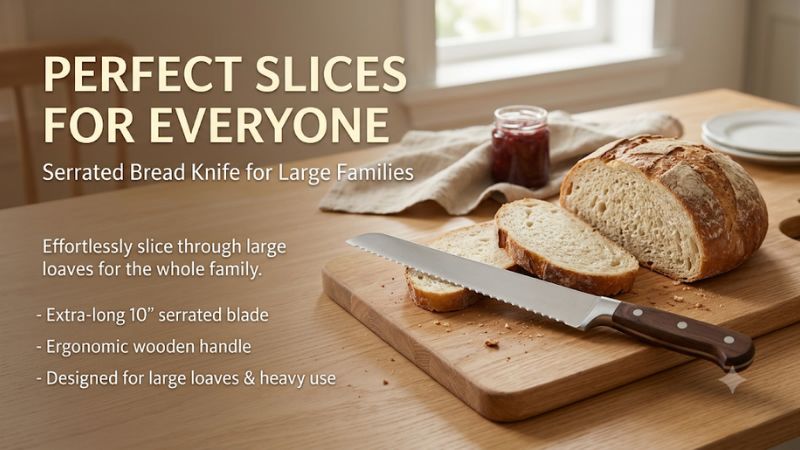
For many large households, a comfortable nine- or ten-inch serrated bread knife is a practical starting point. This length accommodates common sandwich loaves, baguettes, and substantial artisan bread while providing enough cutting reach for repetitive preparation. The right design should minimize the need for excessive pressure and remain easy to wash, dry, and store securely.
Top buying priorities
- Blade length: Around 9–10 inches for versatile family use.
- Serration design: Effective on both crusty and soft bread.
- Handle: Secure and comfortable during repeated slicing.
- Knuckle clearance: Enough space above the cutting board.
- Maintenance: Realistic cleaning and sharpening requirements.
- Durability: Appropriate construction and supported use.
- Storage: Protected blade in a dedicated safe location.
- Versatility: Suitable for bread, bagels, rolls, and selected baked goods.
A family that purchases soft sliced sandwich bread may not need a large premium serrated knife.
However, households baking sourdough or cutting several baguettes every week can benefit from greater blade length.
Do not select a knife solely because it is advertised as professional.
Commercial-style length may be useful, but the handle and overall dimensions must also fit the home’s cutting board and storage arrangement.
Why Large Families Have Different Bread-Cutting Needs
A household preparing breakfast and lunch for several people may slice bread far more frequently than someone who cooks alone. Multiple sandwich loaves, bagels, breakfast pastries, and homemade boules can pass through the kitchen every week. This increases the importance of comfortable handling, efficient cutting, and safe storage where different family members can find the tool without encountering an exposed edge.
Typical large-family bread tasks
- Cutting homemade sandwich loaves.
- Preparing several packed lunches.
- Slicing sourdough for breakfast.
- Halving bagels.
- Cutting baguettes for dinner.
- Portioning homemade rolls.
- Preparing French toast.
- Slicing brioche.
- Cutting certain layer cakes.
- Preparing bread for entertaining.
Different breads require different cutting pressures.
A soft brioche loaf can be crushed by heavy downward pressure, while a dense artisan crust needs enough serrated engagement to start the cut.
The most versatile family knife should manage both situations with an appropriate technique.
A sharp serrated blade helps, but it does not eliminate the need for a stable cutting surface.
How to Choose a Serrated Bread Knife for a Large Family
A family bread knife should support repeated use rather than only occasional slicing. That means considering blade length, handle comfort, serration design, maintenance, and how the knife fits into the household’s routine. A useful purchase should also account for which adults use the tool and whether children can access the storage location.
Choose a Blade Long Enough for Family-Size Loaves
Blade length is especially important when cutting large sourdough boules or wide homemade sandwich loaves. A blade that is too short may require awkward repositioning, increasing the chance of uneven slices. A longer knife offers more cutting reach, but it must also be manageable on the available board and inside the kitchen’s storage system.
Practical length ranges
- 7–8 inches: Smaller loaves, rolls, and compact cutting areas.
- 9 inches: Balanced general family use.
- 10 inches: Large sandwich loaves and artisan bread.
- 10.5 inches: Extra cutting reach for wide loaves.
- Longer specialty blades: Only when the bread and workstation justify them.
A nine-inch serrated knife is a reasonable option when the family eats a mix of bakery bread and homemade loaves.
A ten-inch blade may provide additional convenience when slicing large crusty boules.
However, a long knife can feel awkward when cutting small bagels or individual rolls.
Buying recommendation: Match the blade to the largest loaf you cut regularly, not the largest loaf you might buy once a year.
Match Serration Style to the Bread You Serve
Bread knives have different cutting patterns, including wide wavy teeth, pointed serrations, and double-serrated edges. These shapes affect how the blade engages a crust and moves through the soft interior. A family using a variety of breads may benefit from a general-purpose serration pattern rather than an unusually aggressive design intended for very hard crusts.
Serration types
- Wide wavy edge: Useful for general bread slicing.
- Pointed serrations: Help engage firmer crusts.
- Double serrations: Smaller teeth nested within larger serrations.
- Curved serrated blade: Offers a different cutting path.
- Offset serrated blade: May increase clearance between hand and board.
Do not assume that larger teeth always cut better.
An aggressive tooth pattern can catch soft baked goods when the user applies too much force.
Similarly, a fine serration pattern may require careful technique when starting a particularly hard crust.
The edge must be suited to the household’s typical bread.
Buying recommendation: Choose a versatile serration pattern and prioritize controlled cutting over claims of maximum aggressiveness.
Prioritize a Comfortable Handle for Repeated Slicing
Preparing sandwiches for several people can require many nearly identical cuts. During repeated sawing motions, the handle should remain secure without forcing the user to grip excessively hard. Handle material, shape, and grip texture can influence comfort, but the best choice depends on the individual who prepares most family meals.
Features to evaluate
- Handle circumference.
- Surface texture.
- Grip angle.
- Finger guard.
- Balance.
- Ease of cleaning.
- Knuckle clearance.
- Comfort over repeated strokes.
A textured synthetic handle may be a practical option for a household where the knife is used frequently.
A traditional riveted handle can also provide excellent control when it fits the user’s hand.
Decorative materials should not be prioritized over a reliable grip.
For a family with several adult users, consider whether the handle is reasonably comfortable for more than one person.
Buying recommendation: Choose secure handling before premium finishes.
Consider Offset Blades and Knuckle Clearance
Knuckle clearance is the space between the user’s gripping hand and the cutting board during a full cutting motion. Some bread knives place the handle directly in line with the blade, while offset designs raise the hand above the cutting edge. This can make a difference when slicing thick bread close to the board, particularly for users with larger hands.
Potential advantages of extra clearance
- Less chance of knuckles contacting the board.
- More comfortable hand position for certain users.
- Better access when cutting tall loaves.
- Easier completion of some full-depth cuts.
Possible disadvantages
- Unfamiliar blade-to-handle angle.
- Different balance.
- More space required in storage.
- Not necessary for every technique.
A conventional long bread knife may already provide comfortable clearance for your grip.
Offset construction should therefore be treated as a useful option, not a required upgrade.
Buying recommendation: Consider an offset or curved design if hand clearance is a recurring problem with your current knife.
Think About Batch Slicing for School Lunches
A family making several sandwiches every morning benefits from a repeatable slicing routine. The knife should cut bread consistently without flattening the loaf or requiring several awkward passes. However, even a premium serrated blade cannot guarantee equal slice thickness without careful positioning and controlled movement.
Batch-slicing tips
- Use one stable board.
- Allow freshly baked bread to cool appropriately.
- Decide on a consistent slice thickness.
- Make the first cut gently.
- Use a controlled sawing motion.
- Avoid excessive downward pressure.
- Move slices away from the cutting path.
- Store cut bread appropriately.
For a large batch of lunch sandwiches, the cutting board should provide enough space for both the loaf and the finished slices.
A small board can create clutter and increase the likelihood of accidental contact with the blade.
Avoid rushing just because the household is preparing multiple lunches.
Buying recommendation: Choose a blade that allows comfortable, steady strokes and maintain a clear preparation area.
Know When a Bread Slicer Is Not the Right Tool
Large-family kitchens may also prepare roasts, vegetables, cheese, fruit, and frozen foods. A long serrated bread knife can sometimes cut selected foods beyond bread, but it should not automatically become the household’s universal slicing tool. The correct tool depends on texture and the amount of force required.
Appropriate uses may include
- Crusty bread.
- Sandwich loaves.
- Bagels.
- Baguettes.
- Brioche.
- Certain cakes.
- Some foods with firm outer skins.
Tasks better handled separately
- Dicing vegetables: Chef’s knife.
- Peeling fruit: Paring knife.
- Carving tender boneless roasts: Suitable slicing knife.
- Cutting bones: Appropriate meat-processing equipment.
- Cutting frozen foods: Manufacturer-approved tools and methods.
- Opening packaging: Appropriate utility tools.
Using one knife for incompatible tasks can damage its edge and create unnecessary injury risks.
Buying recommendation: Build a small functional cutlery collection instead of expecting the bread knife to replace every blade.
Compare Stamped and Forged Construction Realistically
Bread knives can be made using stamped or forged manufacturing processes. Forged designs may feature substantial handles and traditional construction, while stamped models can offer lighter profiles and practical value. Neither process guarantees better performance because edge design, heat treatment, handle comfort, and maintenance also influence cutting.
Considerations
- Blade straightness.
- Handle attachment.
- Serration consistency.
- Comfortable balance.
- Manufacturer care instructions.
- Warranty coverage.
- Suitable edge sharpening.
- Replacement value.
A family does not necessarily need a premium forged bread knife to slice sandwiches effectively.
A well-designed stamped knife may be entirely sufficient.
However, premium construction can appeal to buyers seeking specific handle materials, balance, or a coordinated knife collection.
Buying recommendation: Choose based on the entire knife, not just the word forged.
Plan Sharpening and Long-Term Maintenance
Serrated knives eventually become worn even though their teeth may remain functional for a long time. Sharpening is more specialized than maintaining a straight-edge chef’s knife because the tooth shapes must be preserved. Some designs are easier for qualified sharpeners to service than others, and replacement can be more practical for certain inexpensive models.
Maintenance questions
- Does the manufacturer provide sharpening guidance?
- Can the edge be professionally sharpened?
- Is the serration pattern conventional or unusual?
- Does the handle require moisture care?
- Are suitable storage accessories available?
- Is a replacement blade affordable?
- Does the product include warranty support?
Do not attempt to grind away serrations with an ordinary sharpener that is not designed for them.
Double-serrated knives may require particularly careful maintenance.
A bread knife should be washed and dried promptly after use.
Buying recommendation: Consider the full ownership experience, including eventual sharpening, before paying a premium.
Make Safe Storage a Family Priority
A large household may have children, teenagers, visiting relatives, or multiple adults sharing the same kitchen. A long exposed serrated blade should not be placed loose in a drawer or left beneath towels near the sink. A dedicated storage arrangement protects both the edge and anyone reaching for nearby utensils.
Safer storage choices
- Appropriate knife block.
- Secure in-drawer knife tray.
- Manufacturer-compatible blade guard.
- Properly installed magnetic knife strip.
- Closed cabinet with protected blades.
- Knife roll for approved transport or temporary storage.
A knife block should be stable and positioned away from easy child access where necessary.
A magnetic strip must be installed securely and used according to its load and placement instructions.
Do not assume that a blade guard makes a knife safe for unsupervised children.
Buying recommendation: Include protective storage in the purchase plan, especially when the knife will be used by several household members.
Comparison: Bread Knife Options for Family Kitchens
Different knife designs suit different bread habits. The following comparison helps connect family size, loaf type, and storage constraints to useful features rather than relying on a universal ranking. A family that bakes crusty artisan bread every weekend may have different priorities from one that prepares mostly soft sandwiches and bagels during the school week.
| Family Situation | Practical Knife Format | Main Benefit | Potential Limitation |
|---|---|---|---|
| Daily sandwich preparation | 9-inch serrated | Manageable length | Large boules may need longer reach |
| Regular sourdough baking | 10-inch wavy edge | Broad cutting path | More storage space |
| Premium family baking | 9-inch double-serrated | Distinct serration design | Specialized maintenance |
| Mixed bread and roast serving | Long bread/roast slicer | Versatile reach | Not ideal for all cooked foods |
| Compact family kitchen | 8–9-inch blade | Easier handling | Limited reach for very wide loaves |
| Large cutting board and frequent bread use | 10–10.5-inch blade | Extended cutting reach | Can feel excessive for small rolls |
The table provides a starting point, but the exact knife must still fit the user’s hand and cutting surface.
A household can benefit from a long blade even when it has only a few people, and a large family may be happy with a nine-inch knife if most bread is already sliced.
Practical Bread-Cutting Setups for Family Meals
The most useful knife is part of a complete preparation process. A suitable cutting board, clean workspace, and predictable bread-storage routine can make as much difference as blade selection. These scenarios show how families can use serrated knives efficiently while avoiding unnecessary clutter or unsafe movements.
Breakfast for a Household of Five or More
A busy breakfast may involve toast, bagels, rolls, and fruit prepared at the same time. Bread cutting should take place on a stable surface separate from appliances and hot cookware. A long serrated knife can handle larger loaves, but the user should avoid reaching across other people or allowing loose crumbs to collect beneath the cutting board.
Suggested routine
- Place bread on a stable board.
- Slice enough pieces for the meal.
- Keep fingers outside the cutting path.
- Use gentle sawing motions.
- Move slices to a serving plate.
- Keep the knife off crowded counters.
- Clean and store it after use.
The goal is controlled preparation, not maximum speed.
Weekly Homemade Sourdough Baking
Households baking several loaves at once may need to portion bread for meals, lunches, or freezer storage. A 10-inch serrated knife offers useful reach for many large boules. However, slicing should begin only after the loaf has cooled sufficiently for the intended texture, because cutting very hot bread can compress or damage the crumb.
Suggested routine
- Allow bread to cool appropriately.
- Use a large stable board.
- Set a consistent slice thickness.
- Start the crust with short gentle strokes.
- Continue with long controlled movements.
- Package portions for appropriate storage.
- Clean the blade between tasks.
A bread-slicing guide can help with consistency, but it must be compatible with the blade and used safely.
Family Gathering or Holiday Meal
A gathering may involve baguettes, dinner rolls, sandwich platters, and several baked dishes. One versatile bread knife can serve many of these tasks, provided the blade is clean between foods and used appropriately. For carved meat or delicate desserts, another specialized tool may be preferable.
Suggested setup
- Main bread knife for loaves and rolls.
- Separate chef’s knife for vegetables.
- Appropriate carving knife for roasts.
- Clean board for ready-to-eat food.
- Protected storage away from guests.
- Clear serving area.
Avoid allowing children or inexperienced users to handle a large serrated knife without suitable supervision.
How to Use a Serrated Knife Safely
A bread knife should cut through crusts using repeated controlled strokes rather than brute force. Improper hand positioning, unstable cutting boards, and careless handling can cause serious cuts even when the blade is intended for soft foods. These precautions are particularly important in households where cooking happens while several people are moving through the kitchen.
Recommended cutting method
- Select a board large enough for the loaf.
- Position the board on a stable counter.
- Place bread on a flat supported side.
- Keep the supporting hand clear of the edge.
- Make a small initial cut through the crust.
- Continue with a gentle sawing action.
- Avoid downward pressure that compresses the bread.
- Finish the slice without striking the board forcefully.
- Set the knife down with the edge visible and away from traffic.
- Wash, dry, and protect the knife after use.
For bagels, never cut toward the palm while holding the bagel in the hand.
A stable board and appropriate holding method are essential.
Common Buying Mistakes for Large Households
Large families sometimes purchase bread knives based on maximum length, low price, or a promise of effortless cutting. These factors can distract from handle comfort, safe storage, and whether the knife works well with the actual bread served. Avoiding the mistakes below can make a modestly priced knife more useful than an inappropriate premium model.
Mistakes to avoid
- Selecting the longest blade without considering storage.
- Ignoring the main bread types.
- Assuming any serrated knife works equally well.
- Choosing an uncomfortable handle.
- Cutting on unstable boards.
- Buying decorative steel without evaluating functionality.
- Expecting permanently sharp serrations.
- Trying to sharpen unusual teeth with inappropriate equipment.
- Storing the knife loose.
- Using the blade to cut bones.
- Cutting frozen bread without an approved method.
- Rushing through repetitive slicing.
- Allowing different food categories to contaminate the cutting area.
- Forgetting to inspect damaged handles.
A sensible purchase should support years of ordinary use when maintained correctly, without making promises that cannot be verified from specifications.
Frequently Asked Questions
Families comparing bread knives often want a clear recommendation on blade length, whether premium serrations are worth paying for, and how to keep the knife safe around children. The following questions focus on practical household use rather than assumptions that every family needs professional equipment.
What Is the Best Serrated Bread Knife for a Large Family?
A comfortable nine- or ten-inch serrated knife is a useful starting point for families that regularly slice sandwich loaves, sourdough, and baguettes. A wider wavy edge can be practical for mixed bread types, while a premium double-serrated design offers another option.
Choose the knife according to bread size and handle comfort.
A long blade is not automatically the best fit for every kitchen.
Is a Ten-Inch Bread Knife Too Long for Everyday Use?
Not necessarily. A ten-inch blade can be convenient for large loaves, but it requires sufficient cutting-board and storage space. People who mostly slice bagels and small rolls may find a shorter knife easier to control.
Consider both the food and the workstation.
Comfort matters more than maximum length.
How Often Does a Serrated Bread Knife Need Sharpening?
Sharpening frequency depends on usage, edge design, cutting surfaces, and the condition of the blade. A family using the knife daily may eventually notice more tearing or the need for additional pressure.
Follow the manufacturer’s recommendations.
Seek appropriate specialist sharpening when needed.
Are Serrated Bread Knives Safe Around Children?
Serrated bread knives are sharp cutting tools and can cause serious injuries. They should be stored securely, and children should not have unsupervised access when they are not ready to handle knives safely.
Age-appropriate kitchen instruction should involve direct supervision and safe equipment.
A blunt-looking serrated edge is not harmless.
Can One Bread Knife Handle Bagels, Sourdough, and Cakes?
A suitable serrated knife can serve many of these tasks, but the required pressure and technique differ. Dense bagels should be placed securely on a board, sourdough requires controlled crust engagement, and delicate cakes benefit from gentle sawing.
Use a separate appropriate tool when the product demands it.
Clean the blade between foods.
Conclusion
The right serrated bread knife for large families should provide enough blade length for common loaves, comfortable handling for repeated use, and safe storage in a busy kitchen. A nine- or ten-inch design is a practical choice for many households, with longer blades worth considering for frequent sourdough baking. Choose serrations suited to the bread you serve, maintain the edge properly, and use a stable cutting board with gentle sawing motions. A dependable family bread knife should make breakfasts, lunches, and gatherings easier without requiring unnecessary specialty equipment.










Write Your Review
No reviews yet. Be the first to share your experience!