
A utility kitchen knife for apartments can make food preparation easier when counter space, cutting boards, and knife storage are limited. A compact four- to six-inch blade handles many everyday tasks without the reach of a full-size chef’s knife. This guide explains how to choose the right edge, handle, storage system, and price category for a practical apartment kitchen.
- Quick Answer: What Utility Knife Works Best in an Apartment?
- Why Apartment Kitchens Benefit From Compact Cutlery
- How to Choose a Utility Kitchen Knife for Apartments
- Utility Knife Options for Different Apartment Kitchens
- Step-by-Step Apartment Knife Selection
- Common Apartment Utility Knife Mistakes
- Frequently Asked Questions
- Conclusion
Quick Answer: What Utility Knife Works Best in an Apartment?
For most apartment kitchens, a five-inch straight-edge utility knife is a versatile starting point. It provides enough length to slice many fruits, vegetables, and boneless ingredients while remaining manageable on a small cutting board. A compact serrated alternative may be a better choice when the household primarily prepares sandwiches, tomatoes, and small bread products.
Apartment-friendly priorities
- Blade length around four to six inches.
- Comfortable and secure handle.
- Edge style matched to common foods.
- Compact overall length.
- Appropriate blade guard or secure storage.
- Straightforward cleaning.
- Realistic sharpening requirements.
- Useful function without unnecessary duplication.
- Compatibility with small cutting boards.
- Affordable ownership cost.
An apartment kitchen does not necessarily need a complete knife block containing eight or ten blades.
One suitable chef’s knife, a compact utility or paring knife, and a bread knife may cover many everyday meals.
However, the correct collection depends on cooking habits.
Someone who regularly prepares large vegetables or substantial meat portions may still need a larger blade.
The goal is to choose a compact knife that makes ordinary tasks easier without sacrificing safe control.
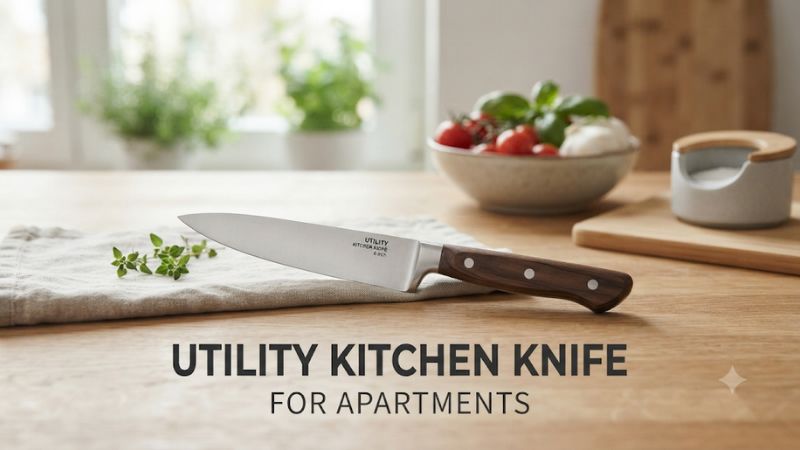
Why Apartment Kitchens Benefit From Compact Cutlery
Small kitchens often have limited preparation surfaces, shallow drawers, few cabinets, and crowded countertops. A knife that requires a large board or bulky storage block may be inconvenient even when it performs well. A compact utility blade can reduce unnecessary handling space, especially for single servings, snacks, sandwiches, and modest vegetable preparation.
Common apartment challenges
- Limited counter depth.
- Small cutting boards.
- Narrow kitchen drawers.
- Few safe knife-storage locations.
- Shared kitchen equipment.
- Restricted dishwasher or sink space.
- Multiple appliances on the countertop.
- Little room for specialized cutlery.
- Limited budgets for new kitchen equipment.
A useful kitchen system should start with the meals actually prepared.
If breakfast usually involves fruit and toast, a compact utility knife may be sufficient for many tasks.
If dinner regularly requires chopping several pounds of vegetables, a full-size chef’s knife remains helpful.
Apartment-friendly does not mean buying the smallest possible blade.
It means selecting tools that fit the available workspace and provide controlled cutting.
How to Choose a Utility Kitchen Knife for Apartments
The right apartment utility knife combines suitable blade length, practical edge geometry, and convenient storage. Buyers should also evaluate whether the knife duplicates a tool they already own. The following factors help identify a useful purchase without turning limited kitchen storage into an overcrowded collection of unnecessary accessories.
Measure Your Cutting Board Before Choosing the Blade
A knife must have enough workspace for the ingredient, the cutting motion, and safe hand positioning. In a compact kitchen, the available cutting board may be smaller than a standard restaurant preparation surface. A long knife can be awkward on a narrow board, but an excessively short blade may require repeated cuts through larger foods.
Measurements to consider
- Cutting board width.
- Cutting board depth.
- Clear counter space.
- Distance from the board to the counter edge.
- Room for a scrap bowl.
- Space for ingredients after cutting.
- Distance from other appliances.
- Safe movement of the blade.
A five-inch utility knife can feel comfortable when preparing tomatoes, small fruit, or sandwiches on a medium-size board.
However, a six-inch blade might be more appropriate for larger vegetables.
Keep the cutting surface stable and avoid placing it partly over the sink or counter edge unless using a properly designed and securely supported system.
Buying recommendation: Choose blade length around the actual food and board rather than apartment size alone.
Choose Between Four-, Five-, and Six-Inch Blades
Utility knives are available in several lengths, with different manufacturers using the category for slightly different blade shapes. A four-inch utility model can overlap with a paring knife, while a six-inch blade approaches compact chef’s knife territory. Five inches is often a convenient compromise when cooking modest meals.
Length comparison
| Blade Length | Main Advantage | Common Tasks | Limitation |
|---|---|---|---|
| 4 inches | Very compact | Small fruit and trimming | Limited reach |
| 4.5 inches | Easy handling | Tomatoes, snacks, vegetables | Less suitable for large foods |
| 5 inches | Versatile middle ground | Sandwiches and everyday preparation | Not ideal for extensive chopping |
| 6 inches | Additional slicing reach | Medium vegetables and boneless food | Requires more board space |
A smaller blade is not inherently safer.
Safe cutting depends on controlling the edge and stabilizing the ingredient.
Buying recommendation: Select a five-inch knife for general use, adjusting shorter or longer according to your typical meals.
Decide Whether a Straight or Serrated Edge Is More Useful
The edge style should reflect the foods you prepare. A straight-edge utility knife can provide precise cuts through vegetables and boneless ingredients, while a serrated knife can help engage certain skins and bread crusts. Apartment residents who make frequent sandwiches may value serrations more than someone who cooks vegetable-heavy meals.
Choose a straight edge for:
- Cucumber slices.
- Apple wedges.
- Shallots.
- Small pepper preparation.
- Boneless protein portions.
- General trimming.
Choose a serrated edge for:
- Tomatoes.
- Small sandwich rolls.
- Certain citrus fruits.
- Soft bread.
- Selected foods with firm skins.
A sharp straight-edge knife can also slice tomatoes well.
The difference becomes more noticeable when the user prefers a gentle sawing motion or the plain edge is not maintained properly.
However, maintaining a dull blade is not a good reason to avoid sharpening.
Buying recommendation: Buy one versatile edge type first rather than two similar knives without a clear need.
Consider a Compact Chef’s Knife Instead of a Utility Knife
A utility knife is not always the most versatile solution for an apartment. A compact five- or six-inch chef’s knife may provide a broader blade and more suitable knuckle clearance for chopping vegetables. The right choice depends on whether the main tasks involve slicing small foods or preparing complete meals.
Utility knife strengths
- Small and medium slicing.
- Fruit preparation.
- Sandwich ingredients.
- Compact drawer storage.
- Short controlled cuts.
Compact chef’s knife strengths
- Chopping vegetables.
- Mincing herbs.
- Dicing onions.
- More substantial board-based work.
- Broader all-purpose preparation.
If an apartment has room for only one main knife, a compact chef’s knife may provide better overall versatility.
A utility knife becomes more useful when it complements an existing chef’s knife.
Buying recommendation: Choose the blade category that handles your most frequent cutting motions.
Compare Handle Materials for Everyday Apartment Use
A knife used daily should provide a secure grip and be easy to clean. Handle materials include synthetic plastic, composite wood, natural wood, and stainless steel. Each has advantages, but appearance alone should not determine the purchase.
Synthetic handles
- Often straightforward to maintain.
- Available in lightweight designs.
- Can provide textured gripping surfaces.
- May be suitable for practical everyday cutlery.
Wood and composite handles
- Offer different tactile characteristics.
- May require additional moisture care.
- Can provide a traditional appearance.
- Should not be soaked.
Stainless steel handles
- Create a streamlined design.
- May feel comfortable to some users.
- Require secure gripping.
- Can feel different from textured synthetic materials.
A comfortable handle is especially important when the user has limited space to reposition the cutting board.
Buying recommendation: Prioritize grip security and easy cleaning over matching the kitchen’s decor.
Look for a Simple Sharpening Routine
Small apartment kitchens may have limited space for sharpening equipment. A utility knife that requires highly specialized maintenance can create unnecessary inconvenience for an owner who only prepares simple meals. Straight-edge stainless knives can often be maintained with suitable conventional methods, while serrated blades require different equipment or professional service.
Maintenance considerations
- Manufacturer sharpening guidance.
- Straight or serrated edge.
- Access to a suitable sharpener.
- Blade steel and geometry.
- Frequency of use.
- Safe storage of sharpening tools.
- Availability of professional services.
Do not assume that one inexpensive pull-through sharpener is compatible with every knife.
Some fine Japanese edges require particular sharpening techniques.
A small sharpening stone or professional service may be more appropriate than an unsuitable gadget.
Buying recommendation: Choose a knife whose maintenance you can perform correctly and consistently.
Plan Safe Storage in a Small Drawer
Storage is often the main challenge in an apartment kitchen. A utility knife may be short enough to fit in a drawer, but it should not be left with its exposed edge among forks or cooking utensils. A correctly fitted sheath or in-drawer organizer provides a more practical arrangement.
Useful storage options
- Manufacturer-compatible blade guard.
- Compact in-drawer knife tray.
- Small knife block.
- Properly installed magnetic strip.
- Secure closed cabinet.
Measure the overall knife length, not only the blade.
The handle may account for more than half the stored dimensions.
If using a sheath, clean and dry the knife before enclosing it.
Buying recommendation: Include suitable edge protection in the total purchase budget.
Think About Shared Kitchens and Household Safety
Apartment kitchens are sometimes shared with roommates, partners, children, or guests. A knife should have a predictable storage location and should not be left exposed during ordinary activities. In a small kitchen, several people may move close to the preparation area, making safe placement especially important.
Safety practices
- Keep blades away from counter edges.
- Use stable cutting boards.
- Return knives to designated storage.
- Avoid leaving blades in sinks.
- Do not hide knives beneath towels.
- Keep sharp equipment away from unsupervised children.
- Clean after raw animal foods.
- Use safe carrying practices.
A knife guard is not childproof.
Households with young children may need locked or otherwise secured storage.
Buying recommendation: Choose equipment that can be stored predictably and securely.
Evaluate Budget and Long-Term Value
A compact utility knife does not need to be expensive to be useful. Some practical synthetic-handled models provide the essential function without decorative materials, while premium forged or Japanese-made knives may offer specific handling preferences. The best value depends on how often the knife is used and whether the extra features improve everyday cooking.
Budget categories
- Basic utility knife: Simple steel blade and synthetic handle.
- Midrange utility knife: More refined handle or construction.
- Premium forged knife: Traditional manufacturing and established finish.
- Premium Japanese utility knife: Specialized steel, geometry, or handle materials.
These are relative buying categories, not fixed price quotations.
Current retailer prices and promotions can vary substantially.
A lower-cost knife that fits properly and is maintained well may be a better investment than an expensive blade used only occasionally.
Buying recommendation: Spend first on appropriate function, edge maintenance, and safe storage.
Utility Knife Options for Different Apartment Kitchens
Different apartment layouts require different approaches to cutlery. A studio kitchenette may have one cutting board and a narrow drawer, while a larger apartment can accommodate a conventional knife block and several specialized tools. The right format should solve the available kitchen’s problems rather than follow a universal checklist.
Studio Apartment With a Minimal Kitchenette
A studio apartment may have a short countertop, a small sink, and one main drawer. A compact straight-edge utility knife can serve everyday fruit and vegetable preparation without occupying much storage space. However, the cutting board must still provide adequate support for the ingredients being prepared.
Suggested setup
- One compact utility or chef’s knife.
- One suitable cutting board.
- One compatible blade guard.
- A small cleaning area.
- Separate safe food storage.
- No unnecessary duplicate cutlery.
A four- or five-inch blade may be especially convenient.
Apartment With Frequent Sandwich Preparation
A household that prepares sandwiches, bagels, and quick lunches may benefit from a five-inch serrated utility knife. It can cut tomatoes and small rolls without requiring a long bread knife for every task. However, a dedicated bread knife remains useful for large crusty loaves.
Suggested setup
- Serrated utility knife.
- Stable cutting board.
- Clean sandwich preparation area.
- Separate knife for raw protein preparation when appropriate.
- Secure blade storage.
The main advantage is efficient access to an appropriately sized slicer.
Apartment With Regular Home Cooking
A resident who cooks several dinners per week may be better served by a compact chef’s knife and a small straight-edge utility knife. The larger knife handles substantial vegetable preparation, while the utility blade supports quick slicing and detail work.
Suggested setup
- Compact chef’s knife.
- Straight-edge utility knife.
- Paring knife if detailed trimming is frequent.
- Serrated bread knife when needed.
- Suitable storage.
Do not purchase every knife at once.
Start with the tasks that the existing collection cannot handle comfortably.
Step-by-Step Apartment Knife Selection
A good buying process prevents purchasing knives that look attractive but create storage problems. Begin with the foods you prepare, measure the work area, and choose one blade that addresses a recurring need. Then plan cleaning, sharpening, and storage before completing the purchase.
Step One: Review Your Current Cooking Tasks
List the cutting jobs you perform most often. Distinguish small slicing tasks from extensive chopping or specialized bread preparation. This makes it easier to choose a utility knife only when it adds meaningful functionality.
Checklist
- Fruit.
- Small vegetables.
- Sandwiches.
- Boneless proteins.
- Bread rolls.
- Herbs.
- General meal preparation.
- Occasional specialty ingredients.
Choose the category that creates the most inconvenience with your current knives.
Step Two: Measure the Workstation
Check the cutting board, countertop, and storage drawer. A knife should be controllable within the available space and fit a secure storage solution.
Measurements
- Board width.
- Board depth.
- Clear counter area.
- Drawer depth.
- Drawer height.
- Overall knife length.
- Sheath dimensions.
Avoid purchasing a blade that requires awkward board positioning.
Step Three: Compare the Edge and Handle
Decide between a straight and serrated blade before comparing premium materials. Select a handle that offers a secure grip and suitable cleaning requirements.
Questions
- Do you cut more vegetables or bread?
- Do you prefer a textured grip?
- Is handwashing convenient?
- Can you sharpen the edge?
- Does the knife fit your hand?
- Do you have safe storage?
A simple practical choice can be more effective than a highly specialized purchase.
Step Four: Test the Storage Plan
Before ordering, ensure that the knife can be stored without leaving the blade exposed. A compatible sheath or in-drawer tray may be necessary.
Final checks
- Blade fits the guard.
- Drawer closes properly.
- Storage is dry.
- No exposed edge contacts other utensils.
- The knife can be retrieved safely.
- Children cannot access it unsupervised.
Storage should be part of the purchase, not an afterthought.
Common Apartment Utility Knife Mistakes
Compact kitchens encourage shoppers to choose small tools, but size alone does not guarantee usefulness. A blade that is too short for normal foods, a handle that feels slippery, or a sheath that does not fit can create unnecessary problems. Avoiding these mistakes helps keep the kitchen functional without adding clutter.
Mistakes to avoid
- Buying the smallest knife regardless of task.
- Purchasing duplicate blades.
- Ignoring cutting-board size.
- Using a utility knife for bone cutting.
- Choosing serrations for fine trimming.
- Forgetting sharpening requirements.
- Storing the blade loosely.
- Selecting a guard without measuring.
- Using unsuitable hard cutting surfaces.
- Putting a knife in the dishwasher against care instructions.
- Leaving a wet blade in a sheath.
- Keeping knives near crowded counter edges.
- Buying a large knife block for a tiny kitchen.
- Choosing appearance over grip.
The best apartment kitchen usually contains a small collection of useful tools rather than many specialized knives.
Frequently Asked Questions
Apartment residents often want a knife that is compact, versatile, affordable, and easy to store. However, different blade styles suit different cooking tasks, and a shorter knife is not always the safest or most efficient option. The answers below clarify common decisions for smaller home kitchens.
What Is the Best Utility Kitchen Knife for Apartments?
A five-inch straight-edge utility knife is a practical choice for many apartment kitchens because it balances compact handling with useful cutting reach. A serrated version may be more suitable for frequent sandwiches and tomatoes.
Choose according to typical meals and available cutting-board space.
Can a Utility Knife Replace a Chef’s Knife in a Small Kitchen?
It can handle many smaller tasks but is usually less convenient for extensive chopping. A compact chef’s knife may offer better overall versatility when preparing complete meals regularly.
Consider which cutting motions you use most frequently.
What Blade Length Is Best for a Studio Kitchen?
Around four to five inches can be practical for a compact preparation area, but the right size depends on ingredients and comfort. A six-inch blade may still work well when the board provides sufficient room.
Do not choose the shortest blade automatically.
Should I Choose a Serrated Utility Knife?
A serrated blade is useful for tomatoes, small rolls, and certain foods with firmer skins. A straight edge offers more flexibility for controlled vegetable preparation and trimming.
Buy the edge type that matches your most frequent tasks.
How Can I Store a Utility Knife Without a Knife Block?
Use a properly fitted blade guard or a secure in-drawer knife organizer. A correctly installed magnetic strip may also work in suitable kitchens.
Avoid placing the exposed blade loose among other utensils.
Are Expensive Utility Knives Worth It?
Premium knives can offer distinct construction, handles, and steel choices, but price does not guarantee better comfort or results for every cook. A practical lower-cost knife can perform everyday tasks well when used and maintained correctly.
Start with function, fit, and safe storage.
Conclusion
The best utility kitchen knife for apartments should provide enough cutting reach for daily meals without overcrowding the preparation area or storage drawers. A five-inch straight-edge knife is a versatile starting point, while a serrated version may better suit tomatoes and small bread products. Compare handle comfort, sharpening requirements, and overall dimensions before buying. Choose a compact knife that complements the tools you already own, use a stable cutting board, and protect the blade in storage. A few reliable knives are usually more useful than a crowded apartment kitchen filled with unnecessary cutlery.










Write Your Review
No reviews yet. Be the first to share your experience!