
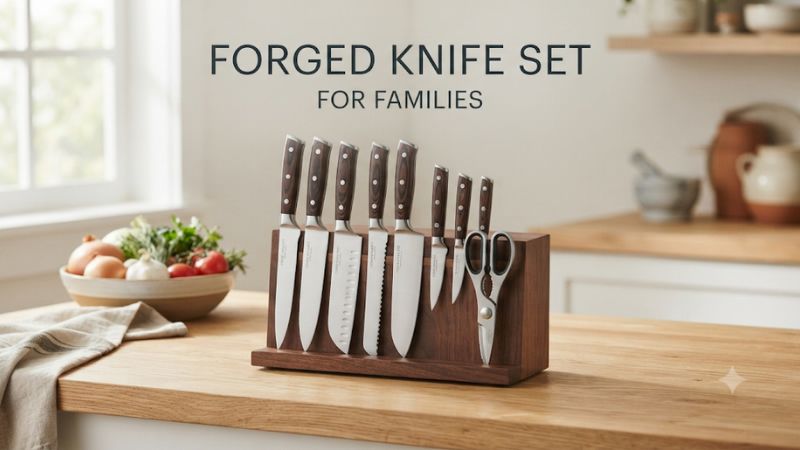
A forged knife set for families should support daily meal preparation, comfortable handling, and safe storage without adding unnecessary blades to a busy kitchen. Larger households may benefit from a chef’s knife, bread knife, paring knife, utility knife, and matching steak knives, but piece count alone does not determine value. This guide explains forged construction, family-friendly set sizes, handle comfort, maintenance, and practical long-term buying decisions.
- Quick Answer: What Forged Knife Set Works Best for Families?
- Why Family Kitchens Have Different Knife Needs
- What Forged Construction Means for Families
- Essential Knives Every Family Set Should Include
- Optional Knives for Larger Families
- How Many Pieces Should a Family Buy?
- How to Compare Forged Knife Set Brands and Collections
- Handle Comfort for Multiple Family Cooks
- Safe Knife Storage for Households With Children
- Cleaning and Maintenance for Busy Families
- Budget and Long-Term Value
- Common Mistakes Families Should Avoid
- Frequently Asked Questions
- Conclusion
Quick Answer: What Forged Knife Set Works Best for Families?
For many families, a forged knife collection with four essential preparation blades and suitable protective storage is a practical starting point. A larger set becomes worthwhile when the household also needs steak knives, carving equipment, or other frequently used tools. The best choice should fit the family’s cooking habits and provide safe access for adults while keeping sharp blades away from unsupervised children.
Recommended configurations:
- Best for a small family: Five- to seven-piece set containing core preparation knives.
- Best for frequent family dinners: Larger collection with appropriate steak knives.
- Best for everyday meal prep: Chef’s, paring, bread, and utility knives.
- Best for cooking large roasts: Set with a suitable carving knife.
- Best for easy maintenance: Stainless cutlery steel and manageable handle materials.
- Best for family safety: Protected storage in a controlled-access location.
- Best for long-term value: A compact set of useful knives rather than the largest available block.
Families should not choose a forged set solely because it appears premium. Handle comfort, appropriate cutting tools, safe storage, and realistic maintenance habits matter more than decorative finishing.
Why Family Kitchens Have Different Knife Needs
A family kitchen often supports more frequent cooking, greater food quantities, and several users with different experience levels. Meals may include school lunches, weekday dinners, weekend baking, and occasional entertaining. Knife selection should reflect these activities without assuming that everyone in the household needs access to the same sharp tools.
Daily Family Meals Require Versatility
Preparing several portions can involve chopping vegetables, slicing fruit, trimming ingredients, cutting bread, and portioning cooked proteins. A chef’s knife handles many general tasks, while a paring knife and bread knife support more specialized cutting.
Common family preparation tasks:
- Chopping vegetables for dinner.
- Slicing fruit for snacks.
- Preparing sandwich ingredients.
- Cutting bread.
- Portioning boneless meat.
- Trimming suitable ingredients.
- Preparing larger weekend meals.
- Serving cooked food.
A useful knife set provides appropriate blade sizes for these activities.
However, it should not encourage using the wrong knife for a task merely because that blade is available.
Different Household Members May Prefer Different Handles
A comfortable knife for one adult may feel too large, heavy, or awkward for another. Forged knives vary in balance, bolster shape, and handle construction, so family buyers should not assume that one premium design suits every user equally.
Comfort considerations:
- Handle thickness.
- Handle length.
- Grip texture.
- Blade weight.
- Balance.
- Pinch-grip clearance.
- Wrist comfort.
- Cutting-board height.
The primary cook should be able to control the chef’s knife comfortably during extended preparation.
If several adults cook regularly, involve them in selecting the knife when possible.
Family Safety Matters as Much as Convenience
Sharp kitchen knives can create significant risks when stored within easy reach of children. A countertop block or magnetic display may be attractive, but it is not automatically suitable for every household.
Safety priorities:
- Keep sharp knives out of unsupervised children’s reach.
- Use appropriate access restrictions when needed.
- Store cutting edges protected.
- Do not leave knives loose in drawers.
- Keep knives away from counter edges.
- Teach age-appropriate kitchen safety.
- Supervise any permitted knife use.
- Maintain predictable storage positions.
A good family knife set should support a safe routine rather than simply make knives visible and accessible.
What Forged Construction Means for Families
Forged knives are produced using a metal-shaping process that can influence blade, tang, and bolster construction. Some products are described as forged from one steel piece, while others emphasize forged-bolster construction. These differences may affect handle feel and manufacturing design, but they do not guarantee that every forged knife is more durable or sharper than every stamped alternative.
Understand Fully Forged Knives
Manufacturers may describe fully forged knives as being shaped from a single piece of steel through a forging process. This often produces a defined blade-to-handle transition and can support different bolster designs.
Potential characteristics:
- Shaped bolster.
- Defined tang construction.
- Substantial feel.
- Traditional styling.
- Different balance characteristics.
- Premium manufacturing options.
Benefits for families:
- Coordinated handle designs.
- Familiar cutting formats.
- Multiple essential blade styles.
- Long-term ownership potential when maintained.
Limitations:
- May cost more.
- Some models feel heavy.
- Premium knives still require sharpening.
- Not every bolster suits every grip.
Choose according to the complete knife rather than the manufacturing term alone.
Understand Forged-Bolster Construction
Some kitchen knives have a forged bolster combined with a blade manufactured using other processes. Manufacturers may market such collections under forged product names.
Important questions:
- Is the entire blade forged?
- Is the bolster specifically forged?
- What steel is used?
- How is the tang constructed?
- Are handle scales riveted?
- What care requirements apply?
- Which blades are included?
A forged bolster can be part of a useful knife, but it does not make the manufacturing method identical to a fully forged single-piece construction.
Understanding this distinction helps families compare products accurately.
Forged Versus Stamped for Family Cooking
Stamped knives are produced from steel stock and finished through subsequent manufacturing steps. They may offer lighter weight and lower prices in some collections.
Forged-set advantages to consider:
- Different bolster profiles.
- Particular balance and handle designs.
- Premium construction options.
- Coordinated knife families.
Stamped-set advantages to consider:
- Often lighter.
- Available across wide price ranges.
- Can be practical for frequent preparation.
- Some households prefer their feel.
Neither category automatically guarantees better cutting results.
A well-designed stamped knife may be more comfortable for certain family cooks than a heavy forged alternative.
Essential Knives Every Family Set Should Include
A useful family knife collection should begin with common food-preparation tasks. The four most practical categories for many households are a chef’s knife, paring knife, bread knife, and medium-size utility knife. Additional knives can be worthwhile when the family’s actual meals justify them.
Chef’s Knife for Everyday Meal Preparation
The chef’s knife is the centerpiece of many kitchen sets because it handles broad chopping, slicing, and dicing tasks.
Best For: General family cooking.
Common uses:
- Chopping vegetables.
- Dicing onions.
- Slicing suitable boneless foods.
- Preparing fruit.
- Cutting herbs.
- Portioning ingredients.
Features to evaluate:
- Comfortable handle.
- Appropriate blade length.
- Manageable weight.
- Suitable steel.
- Stable balance.
- Clear sharpening guidance.
For many adults, an eight-inch chef’s knife is a familiar choice, but smaller or larger designs may be more comfortable depending on the user.
Do not select a larger blade solely because more food is prepared.
Control remains more important than size.
Paring Knife for Small Ingredients
A paring knife provides more control for detailed work on smaller fruits and vegetables. It is useful when an eight-inch chef’s knife feels cumbersome.
Best For: Small preparation tasks.
Typical uses:
- Trimming fruit.
- Preparing strawberries.
- Cutting small vegetables.
- Peeling appropriate ingredients.
- Detailed trimming on a cutting board.
Advantages:
- Short blade.
- Compact storage.
- Convenient small-task handling.
- Useful alongside a chef’s knife.
Limitations:
- Not intended for heavy chopping.
- Less cutting length.
- Requires careful handling near fingers.
A three- to four-inch paring knife is common in household sets.
For family cooking, one appropriate paring knife may be sufficient unless several adults routinely prepare food at the same time.
Bread Knife for Breakfast and Lunch Preparation
A serrated bread knife can be particularly useful for families preparing sandwiches, toast, bagels, and baked goods. Its serrated edge is designed to engage crusty surfaces without relying entirely on downward force.
Best For: Bread and suitable pastries.
Useful tasks:
- Slicing sourdough.
- Cutting sandwich loaves.
- Portioning bagels safely.
- Slicing dinner rolls.
- Cutting certain cakes.
Features to evaluate:
- Blade length.
- Serration design.
- Comfortable handle.
- Safe storage.
- Manufacturer sharpening guidance.
A bread knife is an important inclusion for households that regularly buy unsliced loaves.
If the set omits one, consider whether purchasing a separate serrated knife would be necessary.
Utility Knife for Medium-Size Tasks
A utility knife falls between a chef’s knife and paring knife in size and can be convenient for many everyday foods.
Best For: Medium-size slicing and trimming.
Potential uses:
- Slicing tomatoes.
- Cutting sandwich ingredients.
- Portioning small fruit.
- Trimming suitable boneless foods.
- Preparing snack portions.
Advantages:
- Manageable blade length.
- Versatile for selected tasks.
- Useful in smaller work areas.
- Complementary to larger knives.
Limitations:
- Can overlap with chef’s and paring knives.
- Not essential for every household.
- Serrated and plain-edge models serve different purposes.
A utility knife is worthwhile when its tasks occur regularly.
Otherwise, a simpler three-knife set may be enough.
Optional Knives for Larger Families
Larger families sometimes benefit from specialty knives for dining, carving, or repeated meal preparation. However, buying every available knife category can create an expensive collection that is difficult to store and clean. Optional pieces should be chosen only when the household performs their intended tasks frequently.
Steak Knives for Family Dinners
A matching set of steak knives can be useful when several people regularly eat cooked steak, chops, or other foods that require table cutting.
Best For: Family dining and entertaining.
Considerations:
- Number of diners.
- Serrated or straight edge.
- Handle comfort.
- Storage.
- Cleaning requirements.
- Whether existing table knives are sufficient.
Buy If: The household regularly serves meals requiring sharp dining knives.
Skip If: Most meals are already bite-sized or the family owns suitable steak knives.
A fourteen-piece knife set may contain six steak knives, meaning the number of unique food-preparation blades is much smaller than the package total suggests.
Carving Knife for Larger Roasts
A carving knife can provide additional cutting length for slicing appropriately cooked meat during family gatherings.
Best For: Roasts, turkey, and similar cooked foods.
Useful features:
- Long narrow blade.
- Comfortable grip.
- Suitable edge.
- Compatible carving fork when needed.
- Protected storage.
Advantages:
- Useful for large portions.
- Can support consistent slices.
- Appropriate for holiday meals.
Limitations:
- Not necessary for daily chopping.
- Requires storage.
- May be used infrequently.
If the family prepares large roasts only once or twice a year, a separate carving knife may be a lower priority than a comfortable everyday chef’s knife.
Santoku Knife for Vegetable-Focused Cooking
A Santoku provides a broad blade with a different profile from many Western chef’s knives. It can be useful for preparing vegetables and suitable boneless ingredients.
Best For: Frequent chopping and slicing.
Advantages:
- Practical vegetable-cutting profile.
- Several common blade lengths.
- Different handle and weight options.
- Useful as an alternative to a chef’s knife.
Limitations:
- Some tasks overlap with the chef’s knife.
- Not a bone cleaver.
- Requires suitable technique and maintenance.
A family does not automatically need both an eight-inch chef’s knife and a Santoku.
Choose the combination that its regular cooks actually prefer.
Boning Knife for Frequent Meat Preparation
A boning knife is a specialist tool intended for trimming meat and working around bones and connective tissue.
Best For: Households regularly purchasing bone-in meat.
Useful features:
- Narrow blade.
- Appropriate flexibility.
- Comfortable handle.
- Protected storage.
- Suitable sharpening method.
Limitations:
- Specialized task.
- Not a bone-chopping tool.
- Requires controlled technique.
- May remain unused in households buying boneless meat.
Consider buying the knife separately if it is not a regular part of family cooking.
How Many Pieces Should a Family Buy?
The advertised number of pieces is not the same as the number of distinct cutting functions. Families should compare packages based on how many kitchen knives, dining knives, and accessories they actually need. This prevents overpaying for duplicate tools and helps choose a storage arrangement that fits the household.
Five- to Seven-Piece Sets for Smaller Families
A compact set can provide the essentials for families that cook regularly but do not need many specialized knives.
Typical contents:
- Chef’s knife.
- Paring knife.
- Bread knife.
- Utility knife.
- Kitchen shears.
- Honing steel.
- Storage block.
A seven-piece set may contain only four cutting knives.
That is not a disadvantage when the remaining components are useful.
Buy If: You want a manageable starter collection.
Skip If: You need matching steak knives or specialist carving equipment included.
The best smaller collection is one that supports almost every normal meal without accumulating duplicates.
Eight- to Eleven-Piece Sets for Varied Cooking
These collections can include extra preparation knives, specialty blades, or serving equipment.
Useful for families that:
- Cook several cuisines.
- Prepare meat frequently.
- Bake and slice bread.
- Entertain regularly.
- Have more than one adult cook.
- Want coordinated storage.
However, more knives create additional maintenance and storage needs.
Check whether the household would actually use the added Santoku, boning, or carving knife.
Twelve- to Fifteen-Piece Sets for Family Dining
Large sets often include six steak knives alongside the preparation collection.
Advantages:
- Matching dining knives.
- Coordinated appearance.
- Broad kitchen coverage.
- Fewer separate purchases.
Trade-offs:
- Larger storage block.
- Higher purchase cost.
- More washing.
- More blades needing maintenance.
- Possible overlap between preparation knives.
A family should count the number of truly distinct preparation knives and compare that with an existing collection.
The best value is not automatically the package with the most pieces.
How to Compare Forged Knife Set Brands and Collections
Several established manufacturers offer forged or forged-bolster kitchen collections. The right brand is not necessarily the one with the highest price or most elaborate marketing claims. Compare the actual blade design, handle, warranty terms, and included tools.
Traditional Forged Collections
WÜSTHOF Classic and ZWILLING Pro are examples of recognizable fully forged kitchen ranges.
Characteristics worth comparing:
- Chef’s knife handle profile.
- Bolster shape.
- Blade length.
- Steel and heat treatment.
- Set composition.
- Storage block.
- Manufacturer care instructions.
These collections can suit households looking for a long-term coordinated knife system.
However, the correct choice depends on the feel of the actual knives.
Family-Focused Forged-Bolster Collections
HENCKELS Forged Premio is an example of a collection that emphasizes forged-bolster construction and offers larger sets with steak knives.
Potential advantages:
- Matching dining cutlery.
- Several preparation categories.
- Familiar riveted handles.
- Coordinated block storage.
Considerations:
- Exact manufacturing description.
- Number of actual kitchen knives.
- Bread-knife inclusion.
- Dishwasher instructions.
- Block footprint.
A large family set can be practical when its extra pieces are genuinely needed.
Preparation-Focused Forged Sets
Mercer Genesis provides an example of a precision-forged collection emphasizing practical working knives, including a boning knife in certain configurations.
Useful when:
- Meat preparation is common.
- Several distinct blade types are needed.
- Synthetic handles are preferred.
- A functional working collection matters more than matching steak knives.
However, a specialized boning knife has limited value when the family primarily buys prepared boneless meat.
Choose according to real use.
Handle Comfort for Multiple Family Cooks
A family knife set may be used by more than one adult, so a handle comfortable to the primary purchaser may not suit everyone. Grip shape, blade weight, and balance are especially important during repeated chopping. A practical collection should accommodate the people who use the knives most frequently.
Consider Different Hand Sizes
A large chef’s knife handle may feel comfortable for one cook and awkward for another.
Important features:
- Handle circumference.
- Handle length.
- Grip texture.
- Bolster position.
- Balance.
- Weight.
- Knuckle clearance.
If several family members regularly prepare meals, try to evaluate the knife’s grip before buying.
Comfort should outweigh decorative appearance.
Choose a Manageable Chef’s Knife Weight
Forged knives can vary substantially in weight.
A heavier knife is not automatically easier to control.
For repeated vegetable chopping, some cooks prefer lighter blades, while others appreciate a more substantial feel.
Choose according to actual technique and wrist comfort.
A manageable knife is generally a better long-term tool than one that creates unnecessary fatigue.
Do Not Assume Premium Handles Are Better for Everyone
Premium collections may include natural wood, polished composite, or specially contoured handles.
These can be attractive, but no single material suits every user.
Consider:
- Cleaning requirements.
- Surface texture.
- Handle shape.
- Moisture sensitivity.
- Long-term care.
- Comfortable grip.
A simple synthetic handle may be more practical for a busy family than a premium natural material requiring additional attention.
Safe Knife Storage for Households With Children
Storage deserves particular attention in family kitchens. A sharp knife set is not simply an attractive countertop accessory. The location should reduce accidental contact, prevent knives from shifting, and limit unsupervised access by children.
Traditional Countertop Knife Blocks
A wooden block provides organized storage and keeps individual blades separated.
Advantages:
- Defined slots.
- Convenient adult access.
- Familiar appearance.
- Easy identification of handles.
Potential concerns:
- Countertop accessibility.
- Moisture inside slots.
- Large footprint.
- Unsupervised child access.
Place the block in an appropriate secure location.
Do not assume that a knife block is childproof.
In-Drawer Knife Organizers
Drawer organizers can preserve counter space and keep blades in defined positions.
Useful features:
- Properly sized channels.
- Complete edge protection.
- Stable placement.
- Appropriate drawer clearance.
- Removable cleaning access.
Safety considerations:
- Accessible drawer locks where appropriate.
- No loose exposed knives.
- Safe handle orientation.
- Correct fit for all blades.
A drawer organizer is useful only when the complete system can be secured and maintained.
Magnetic Knife Storage
Magnetic racks can keep knives visible and separated, but their suitability depends on secure mounting and safe access.
Important checks:
- Manufacturer installation requirements.
- Magnetic holding capacity.
- Placement away from children.
- Stable mounting surface.
- Safe blade retrieval.
- Appropriate cleaning.
Magnetic display storage may be more suitable for kitchens where access can be controlled.
Avoid mounting knives where someone could accidentally brush against them.
Teach Consistent Knife Safety Routines
Everyone using the kitchen should understand where knives belong.
Family safety habits:
- Return knives to storage promptly.
- Never hide blades beneath towels.
- Avoid leaving knives in sinks.
- Clean and dry before storing.
- Keep sharp tools away from children.
- Supervise age-appropriate cooking instruction.
- Do not use damaged knives.
Safe storage and predictable routines are more important than buying the largest premium block.
Cleaning and Maintenance for Busy Families
Family kitchens can generate more dishes and utensils than small households, making cleaning convenience important. A forged knife set should be chosen with realistic maintenance expectations. Some manufacturers permit certain dishwasher use while recommending handwashing, whereas other knives and wooden handles require handwashing.
Establish a Simple Handwashing Routine
A consistent cleaning method can help protect blades and handles.
Recommended steps:
- Clean the knife after use.
- Use suitable mild detergent.
- Keep fingers clear of the edge.
- Clean handle joints.
- Rinse carefully.
- Dry promptly.
- Return to protective storage.
Do not leave sharp knives loose in a sink filled with water.
A family member may not see the blade while washing other dishes.
Prevent Cross-Contamination During Meal Prep
Families may prepare raw meat, vegetables, fruit, and ready-to-eat foods during the same meal.
Food-safety priorities:
- Keep raw animal foods separate.
- Clean knives between incompatible tasks.
- Use suitable cutting boards.
- Wash hands after handling raw proteins.
- Prevent raw juices from contacting ready-to-eat food.
- Refrigerate perishable ingredients promptly.
- Use food thermometers when appropriate.
A matching knife set does not replace safe food handling.
The knife and cutting board must be cleaned correctly between tasks.
Maintain Knife Edges Appropriately
A forged knife still becomes dull through use.
Different steels and blade geometries may require different maintenance.
Options include:
- Manufacturer-compatible honing.
- Appropriate sharpening stones.
- Suitable manual sharpeners.
- Professional sharpening services.
Do not assume that a honing steel restores every dull edge.
Follow the specific manufacturer’s guidance.
Keep Blocks and Storage Clean
Knife blocks can collect crumbs and moisture, particularly in narrow slots.
Routine care:
- Insert only clean, dry knives.
- Wipe storage exteriors.
- Clean accessible surfaces.
- Follow manufacturer block-care instructions.
- Avoid standing water.
- Inspect for damage.
- Keep the block stable.
A large family knife collection needs regular attention to remain convenient.
Budget and Long-Term Value
Forged knife sets can represent a substantial purchase, but higher prices do not automatically provide better value. The most useful long-term investment is a set that contains the right blades, feels comfortable, and can be maintained properly. Families should compare the cost of a complete block with purchasing individual knives.
Compare Package Value With Individual Knives
Buying a coordinated set may be convenient, but the package can include tools the family does not need.
Evaluate:
- Price of essential knives individually.
- Whether the set includes steak knives.
- Storage block value.
- Additional accessories.
- Warranty conditions.
- Replacement availability.
- Expected use of every component.
A smaller collection may deliver better value when most of its pieces are used weekly.
Avoid Paying for Unnecessary Specialty Blades
A carving knife is useful when preparing large roasts, while a boning knife is relevant to particular meat-preparation tasks.
Neither is essential for every family.
Ask before purchasing:
- How often is the specialty knife needed?
- Can an existing knife perform the task appropriately?
- Is safe storage available?
- Will another family member use it?
- Does it require different sharpening equipment?
A premium set is not good value when half the knives remain unused.
Consider Replacement and Warranty Support
Manufacturer warranties can be useful, but they differ in coverage and exclusions.
Review the exact terms.
Important questions:
- What defects are covered?
- Is accidental damage excluded?
- Are handles included?
- Is normal edge wear covered?
- How is service requested?
- Are individual replacements available?
Do not assume that a lifetime warranty means free sharpening or replacement for every type of damage.
Plan for Future Kitchen Changes
A family may move, renovate, or change cooking habits.
A compact set can be easier to relocate and store.
Consider whether the block can accommodate additional knives or whether a separate drawer organizer might become necessary.
Do not buy excessive capacity based on hypothetical future needs.
Common Mistakes Families Should Avoid
Family knife purchases often go wrong when buyers choose the largest set, overlook handle comfort, or fail to consider child-safe storage. Other problems arise when a forged construction label is treated as proof of superior cutting performance. The best buying decisions begin with actual household needs.
Buying Based Only on Piece Count
A fifteen-piece set may include six steak knives, a block, honing steel, and shears.
Count the actual preparation knives.
Choose based on functions used regularly.
Assuming Forged Means Maintenance-Free
Forged knives still require cleaning, drying, and sharpening.
Premium steel can still be damaged by hard surfaces or inappropriate use.
Follow manufacturer care instructions.
Ignoring Child Access
A countertop block may be convenient for adults but unsuitable in an accessible location for young children.
Plan safe storage before purchasing.
Consider appropriate locks or controlled-access cabinets.
Choosing Heavy Knives for Every Cook
A substantial forged chef’s knife may feel comfortable to one person but tiring to another.
Evaluate handle comfort and weight.
A good family set should be practical for the people actually using it.
Paying for Knives the Family Does Not Need
Specialty blades can be useful, but they add cost and maintenance.
Identify the everyday essentials first.
Add specialist tools only when real cooking needs justify them.
Frequently Asked Questions
Families shopping for forged knife sets often want to know how many knives are necessary, whether forged construction is worth the extra money, and which features are safest and easiest to maintain. The most practical answers depend on household size, cooking habits, available storage, and the people using the knives.
How Many Knives Does a Family of Four Need?
A chef’s knife, paring knife, bread knife, and optional utility knife can cover many everyday tasks. Additional steak knives may be useful for family dining, while carving or boning knives depend on specific cooking habits. A family of four does not automatically need fifteen pieces. Choose according to actual meal preparation and safe storage capacity.
Are Forged Knife Sets Better for Families?
They can be a good choice when the handle design, balance, construction, and included blades suit the household. However, forging alone does not guarantee better cutting performance or easier maintenance. Quality stamped knives may also serve families well. Evaluate comfort, blade geometry, storage, and long-term care rather than relying solely on the manufacturing label.
Should a Family Knife Set Include Steak Knives?
They are useful when the household regularly serves cooked steak, chops, or other foods requiring table cutting. A family may prefer four, six, or eight matching steak knives according to dining size and entertaining habits. If suitable steak knives are already available, a preparation-focused forged set may be better value.
Are Forged Knives Safe Around Children?
Forged knives are sharp kitchen tools and require the same access precautions as other knives. A knife block or drawer organizer does not automatically make them child-safe. Store knives out of unsupervised reach, use appropriate access controls when needed, and supervise age-appropriate cooking instruction. Safe handling matters more than the knife’s manufacturing method.
What Is the Best Handle Material for a Family Knife Set?
There is no universally best material. Synthetic handles may offer convenient maintenance, while wooden or composite handles provide different appearances and grip characteristics. The main priorities are comfortable control, secure construction, and cleaning requirements the household can follow. If several adults cook, assess handle comfort for the primary users.
Do Families Need a Professional Knife Set?
Not necessarily. Professional-style knives can be useful, but many families prepare ordinary meals with a modest selection of appropriately designed kitchen knives. A comfortable chef’s knife, paring knife, and bread knife often provide more practical value than an extensive collection of specialized blades. Choose according to real cooking tasks rather than professional branding.
How Long Should a Forged Knife Set Last?
There is no universal lifespan. Longevity depends on steel, manufacturing quality, cutting-board materials, cleaning, sharpening, storage, and frequency of use. Properly maintained quality knives may remain useful for many years, but damaged handles or blades require assessment. Forged construction does not make a knife indestructible or eliminate normal edge wear.
Should Families Choose a Knife Block or Drawer Storage?
Both can work when selected and installed appropriately. Blocks provide convenient adult access but occupy counter space, while drawer organizers conceal blades and preserve counters. The better choice depends on kitchen layout, knife dimensions, cleaning access, and child-safety needs. Prioritize stable protective storage rather than decorative appearance.
Conclusion
A forged knife set for families should provide practical preparation tools, comfortable handles, and safe storage without relying on an unnecessarily large piece count. Start with a chef’s knife, paring knife, bread knife, and optional utility knife, then add steak, carving, or specialty knives only when family meals justify them. Compare fully forged and forged-bolster descriptions carefully, evaluate cleaning requirements, and plan appropriate storage where children cannot access sharp blades unsupervised. A well-chosen manageable collection is usually a better long-term investment than an oversized set of rarely used knives.


Write Your Review
No reviews yet. Be the first to share your experience!