
A knife drawer organizer for everyday use should keep sharp blades protected while making familiar kitchen knives easy to identify and retrieve. The best design is not necessarily the one holding the most knives; it is the one that fits your drawer and cooking habits safely. This guide covers storage styles, blade compatibility, daily workflow, materials, maintenance, and common purchasing mistakes.
- Quick Answer: Choose a Simple Organizer for Your Core Knives
- Why Everyday Knife Storage Needs Special Attention
- Types of Knife Drawer Organizers for Daily Cooking
- How to Measure the Drawer and Your Knives
- Safety Features That Matter Every Day
- Organizing Knives Around Cooking Frequency
- Cleaning, Materials, and Maintenance
- Common Buying Mistakes to Avoid
- Frequently Asked Questions
- Conclusion
Quick Answer: Choose a Simple Organizer for Your Core Knives
For ordinary home cooking, a stable in-drawer knife tray with clearly separated blade positions is a practical choice. Compact two-tier organizers can save space, while traditional wooden trays offer straightforward individual slots. The ideal setup provides safe access to the chef’s knife, paring knife, bread knife, and other tools you actually use without exposing loose cutting edges.
Best configurations for everyday use:
- Compact kitchens: Two-tier molded knife organizer.
- Traditional kitchen drawers: Wooden fixed-slot knife tray.
- Small knife collections: Narrow organizer with four to eight positions.
- Larger everyday collections: Appropriately sized ten- to twelve-position tray.
- Mixed blade shapes: Compatible flexible-support organizer.
- Shared household kitchens: Clearly organized knife positions with appropriate access controls.
Do not purchase a large tray simply because it accommodates more knives. A household using four knives regularly may be better served by a narrow organizer that leaves drawer space available for other suitable utensils.
Why Everyday Knife Storage Needs Special Attention
Knives differ from most kitchen utensils because their cutting edges can injure users when stored or retrieved carelessly. Loose drawer storage also allows blades to contact other objects and may damage edges or handles over time. A dedicated organizer makes the storage position predictable, but it remains essential to handle knives carefully and protect access where children may be present.
Prevent Loose Blade Contact
A chef’s knife placed loose beside a peeler, whisk, or measuring spoon may shift whenever the drawer moves. Someone reaching for an unrelated tool can encounter the exposed edge unexpectedly. A knife organizer reduces that problem by assigning protected positions to the blades and keeping the handles accessible.
Important safety benefits:
- Separates sharp blades.
- Reduces unintended contact with other utensils.
- Creates predictable knife positions.
- Limits shifting during drawer movement.
- Helps keep handles visible.
- Supports safer retrieval when used properly.
However, an organizer cannot prevent every injury. Poor placement, overloading, incompatible knives, or unsupervised access can still create hazards.
The product must be used according to its intended design.
Improve Access During Normal Cooking
Many home cooks reach for the same few knives repeatedly. A chef’s knife handles much of the chopping and slicing, while a paring knife is useful for smaller preparation tasks. A bread knife or serrated utility knife may be used less frequently but still needs accessible storage.
A clear arrangement reduces searching and unnecessary handling.
Suggested knife categories:
- Chef’s knife.
- Paring knife.
- Utility knife.
- Bread knife.
- Santoku when used.
- Carving knife.
- Specialized knives used regularly.
Position frequently used knives where their handles can be grasped naturally.
Avoid placing the most-used knife beneath another blade or in a slot requiring awkward wrist movement.
Keep Countertops Clear Without Losing Convenience
Countertop knife blocks can be useful, but they occupy space that may be valuable in small kitchens. In-drawer organizers move knives into enclosed storage while keeping them accessible near the preparation area.
This is especially relevant when the counter must also accommodate a cutting board, small appliances, and food ingredients.
Potential advantages:
- More usable counter space.
- Less visible clutter.
- Dedicated knife positions.
- Reduced contact with unrelated countertop objects.
- A cleaner visual kitchen layout.
The trade-off is drawer space.
A knife organizer should not consume an essential utensil drawer without improving the overall kitchen workflow.
Choose its location carefully.
Types of Knife Drawer Organizers for Daily Cooking
There are several ways to organize knives inside a drawer, ranging from fixed slotted wood trays to compact overlapping polymer designs. Some products use flexible inserts to accommodate unusual blade shapes. The best format depends on knife dimensions, drawer clearance, maintenance preferences, and whether the household expects the collection to change.
Two-Tier Compact Knife Organizers
Two-tier designs use overlapping blade positions to reduce horizontal space requirements. Smaller knives typically occupy one level while larger knives use another. This arrangement can be efficient when the drawer is deep enough to accommodate the organizer and knife handles, but too narrow for a broad conventional tray.
Best For: Small kitchens with several everyday knives.
Key Features:
- Two storage levels.
- Separate positions for small and large knives.
- Compact footprint.
- Protected blade channels.
- Freestanding construction.
Pros:
- Efficient use of width.
- Clear grouping by blade size.
- No permanent installation.
- Suitable for mixed collections.
Cons:
- Requires adequate drawer height.
- Some handles may overlap.
- Very wide blades may not fit.
- Channels need cleaning.
Buy If: You want an organized knife collection without dedicating a wide drawer to storage.
Skip If: The drawer has very limited height or contains unusual broad blades.
Before buying, compare the height of the loaded organizer with the actual drawer clearance. The tray’s listed height alone may not represent the space needed for knife handles.
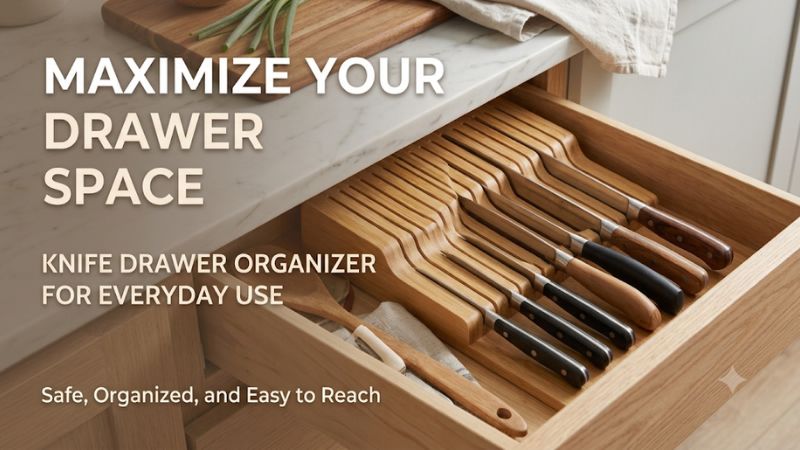
Traditional Wooden Knife Trays
Wooden knife trays use defined grooves or channels to support blades in predictable positions. Beech, acacia, and bamboo are common construction materials. These designs suit households with conventional knife profiles and a preference for a natural appearance, provided there is enough space and the owner follows appropriate moisture-care instructions.
Best For: Standard knife collections and traditional kitchen layouts.
Key Features:
- Fixed blade slots.
- Wooden or bamboo construction.
- Low-profile form on selected models.
- Individual knife positions.
- Removable placement.
Pros:
- Simple design.
- Predictable arrangement.
- No moving components.
- Natural appearance.
Cons:
- Slot sizes are fixed.
- Moisture care is important.
- Some broad or unusual knives may not fit.
- Wooden surfaces can become damaged if neglected.
Buy If: Your knives match the supported slot dimensions and you prefer a straightforward layout.
Skip If: You frequently change knives or need universal blade accommodation.
Wooden trays should remain clean and appropriately dry. Do not store damp knives against moisture-sensitive wooden surfaces.
Flexible Bristle-Style Knife Organizers
Bristle-style organizers use numerous flexible supports that hold knife blades without relying on traditional individual grooves. They can offer flexibility for mixed knife shapes and sizes, although practical capacity depends on the relationship between neighboring handles and blades.
Best For: Mixed collections that do not fit conventional slots.
Key Features:
- Flexible internal support.
- Defined outer frame.
- Removable insert on selected products.
- Variable blade placement.
- Compact cabinet storage.
Pros:
- Accommodates different blade shapes.
- Less dependence on fixed slot widths.
- May support evolving knife collections.
- Some inserts are removable for cleaning.
Cons:
- Practical capacity is less predictable.
- Bristles require inspection.
- Cleaning can involve multiple components.
- Incorrect insertion remains hazardous.
Buy If: You own knives with different profiles that are difficult to fit into standard trays.
Skip If: You prefer clearly defined individual positions.
Careful insertion is essential. Do not force a knife into a crowded bristle section or allow its cutting edge to contact neighboring handles.
Individual Blade Guards as an Alternative
Individual blade guards are protective covers fitted to compatible knife blades. They can be useful when a dedicated drawer organizer will not accommodate a specialized knife or when the household owns only a small number of knives. However, covered knives can still move freely in a drawer unless they are organized separately.
Best For: Specialized blades and limited storage situations.
Key Features:
- Blade-specific protective cover.
- Portable format.
- No large tray required.
- Compatibility determined by blade dimensions.
- Useful for selected unusual knife shapes.
Pros:
- Protects individual cutting edges.
- Requires little space.
- Useful for knives that do not fit standard channels.
- Can supplement a drawer organizer.
Cons:
- Guards must fit correctly.
- Loose protected knives may still shift.
- Covers require cleaning.
- Not every guard is suitable for every blade.
Buy If: You need supplementary protection for a few knives.
Skip If: You want a complete organized drawer layout without loose objects.
A sheath should be appropriately sized and used according to its instructions. Avoid storing an exposed blade loosely in the same drawer merely because a guard is available for another knife.
How to Measure the Drawer and Your Knives
A knife organizer must fit two things simultaneously: the available drawer space and the knife collection itself. Measuring only the drawer can lead to a tray whose channels are too short. Measuring only the knives can lead to a bulky organizer that prevents the drawer from closing. Both sets of dimensions are necessary.
Measure the Usable Drawer Interior
Open the drawer completely and measure the interior width, depth, and height. Account for any narrowing near the back, internal braces, or cabinet framing above the drawer.
Measurements to record:
- Usable interior width.
- Front-to-back depth.
- Closed vertical clearance.
- Drawer opening width.
- Position of drawer hardware.
- Space around neighboring organizers.
- Clearance for knife handles.
A tray should fit without forcing or scraping.
If the organizer must share the drawer with flatware, calculate the combined footprint rather than measuring each tray separately.
A small gap around the organizer can make removal and cleaning easier.
Measure Blade Length and Handle Width
Knife labels do not always describe complete dimensions. An eight-inch chef’s knife refers to blade length, but the overall knife includes the handle and sometimes a prominent bolster. A storage tray must accommodate the full arrangement.
Check each knife for:
- Blade length.
- Blade height.
- Handle length.
- Handle width.
- Bolster thickness.
- Blade curvature.
- Tip shape.
- Additional protective guards.
The longest knife should fit comfortably without its tip pressing against the organizer.
Likewise, a broad knife should not be forced into a narrow channel.
Check the Loaded Height
A common mistake is assuming that a low-profile tray automatically fits a shallow drawer.
Some knives sit with their handles raised above the organizer.
The total height may therefore exceed the empty tray’s specification.
Place the intended organizer dimensions on a cardboard template and estimate where the handles will rest.
Check the closing path slowly.
If a handle contacts the cabinet frame, do not force the drawer shut.
Choose a lower-profile design or another storage location.
Safety Features That Matter Every Day
A knife organizer is a practical safety accessory only when its design keeps cutting edges appropriately contained and permits predictable retrieval. Advertised capacity and appearance are less important than whether every stored knife can be removed without contacting another sharp blade. Evaluate the whole drawer, not just the individual product.
Protected Blade Channels
A protected channel should keep the cutting edge from unnecessary contact with fingers and loose kitchen utensils.
Features to inspect:
- Adequate slot depth.
- Smooth contact surfaces.
- Proper blade-length compatibility.
- Suitable support near the tip.
- No exposed sharp edges outside the tray.
- Safe handle access.
Do not assume that all in-drawer organizers prevent every kind of blade damage.
Correct fit and gentle handling remain necessary.
Stable Placement During Drawer Movement
An organizer that shifts whenever the drawer opens can create a new problem. Some trays include non-slip feet, but their stability still depends on the drawer surface and loading.
Stability checklist:
- Flat supporting surface.
- Appropriate non-slip features.
- Secure blade positions.
- Balanced distribution.
- No loose accessories pressing against the tray.
- Smooth opening and closing.
If the organizer moves excessively, investigate the fit rather than wedging sharp tools around it.
A slightly different tray or an approved non-slip base may be more appropriate.
Safe Access in Family Kitchens
Children should not have unsupervised access to sharp kitchen knives.
A drawer organizer may conceal knives from view, but it does not automatically make the drawer child-safe.
Household safety measures:
- Use appropriate access restrictions where needed.
- Keep knives in designated positions.
- Teach safe handling to appropriate household members.
- Avoid leaving drawers open.
- Do not store blades loosely near ordinary utensils.
- Never allow children to play with knife-storage accessories.
The kitchen’s actual users and daily routines should determine the appropriate storage location.
Organizing Knives Around Cooking Frequency
A dedicated knife drawer works best when it reflects normal meal preparation. Most households have a small core collection used repeatedly, along with specialty knives that are reached for less often. The organizer should make that difference clear without burying rarely used knives beneath commonly used ones.
Give Everyday Knives Convenient Positions
Start by identifying the knives used during a normal week.
Typical everyday collection:
- Chef’s knife for general preparation.
- Paring knife for small cutting tasks.
- Serrated knife for bread or suitable foods.
- Utility knife.
- Santoku or other preferred multipurpose knife.
Position the most-used handles where they can be reached comfortably.
Avoid assigning a common knife to the deepest or most awkward slot simply because the organizer’s layout appears symmetrical.
Function matters more than appearance.
Separate Specialized Knives
Long slicing knives, carving knives, cleavers, and specialty blades may not fit conventional trays.
Do not force them into remaining spaces.
Use compatible protective storage and consider whether they belong in a separate suitable drawer or cabinet.
A smaller organizer holding the everyday collection correctly is better than an overcrowded tray containing incompatible blades.
Maintain a Consistent Return Routine
After washing, knives should be cleaned and dried according to their manufacturer instructions before being stored.
Return each knife to its usual position.
Practical routine:
- Clean the knife appropriately.
- Dry it thoroughly.
- Check the intended storage channel.
- Insert carefully.
- Keep the handle accessible.
- Close the drawer gently.
Do not leave a knife loose on the counter while the drawer is being reorganized.
A predictable routine reduces unnecessary handling.
Cleaning, Materials, and Maintenance
Knife organizers can collect debris inside narrow blade channels, making regular cleaning important. Wood, bamboo, polymer, and removable bristle inserts have different care requirements. The best product for everyday use is one that can be maintained consistently without damaging its materials or creating a difficult cleaning process.
Cleaning Wooden Knife Trays
Wooden trays should generally be cleaned according to the manufacturer’s moisture guidance.
Useful steps:
- Remove all knives.
- Brush out crumbs or debris.
- Wipe with an appropriate lightly damp cloth.
- Avoid unnecessary soaking.
- Dry thoroughly.
- Inspect for cracks or splinters.
- Return only dry knives.
Some manufacturers recommend occasional maintenance with a suitable food-safe oil.
Follow the exact product’s guidance rather than applying treatment indiscriminately.
Cleaning Polymer and Bristle Organizers
Polymer organizers may be straightforward to wipe or wash, but dishwasher suitability varies.
For bristle systems, removable inserts can simplify cleaning.
Maintenance considerations:
- Follow washing instructions.
- Remove debris from deep channels.
- Inspect flexible supports.
- Dry all components completely.
- Check for deformation or cracks.
- Avoid using damaged storage products.
A clean organizer supports orderly knife storage but does not substitute for proper cleaning of the knives themselves.
Recognize When the Organizer Needs Replacement
An organizer may need replacement when slots crack, wooden dividers split, bristle supports wear, or the tray no longer holds knives securely.
Do not continue using a damaged product simply because it still fits the drawer.
Likewise, a growing knife collection may require a different configuration.
A new tray should be chosen according to current knife dimensions rather than the original purchase.
Common Buying Mistakes to Avoid
The most common knife-storage mistakes are preventable. Buyers may choose a tray based on advertised capacity, overlook drawer height, or assume a wooden organizer can accept any blade. These issues can make storage less convenient and potentially unsafe. Careful measurement and realistic assessment are better than selecting the most decorative product.
Choosing Maximum Capacity Over Fit
A twelve-slot tray is not automatically better than an eight-slot organizer.
If the household owns five frequently used knives, a smaller tray may leave valuable room for other tools.
The best capacity allows comfortable handle access.
Avoid filling every position tightly simply to achieve the advertised maximum.
Ignoring Wide Blades and Thick Handles
Knife collections are not uniform.
A broad santoku, thick-handled chef’s knife, or cleaver may require more space than an ordinary narrow blade.
Check product compatibility before purchasing.
A fixed-slot tray is suitable only when its channels match the intended knives.
Storing Wet Knives
Storing damp blades can create maintenance problems for both the knives and the organizer.
Clean and dry utensils according to their instructions.
Do not place wet knives into wooden slots or enclosed storage.
If moisture becomes trapped inside a tray, remove the knives and clean and dry the organizer.
Frequently Asked Questions
Everyday knife drawer storage involves decisions about safety, convenience, material, and accessibility. A dedicated organizer can improve a kitchen drawer, but it needs to match the knives and the people using them. These questions focus on the practical details most likely to affect daily use rather than unsupported claims about blade longevity.
Is an In-Drawer Knife Organizer Better Than a Countertop Block?
Neither is universally better. An in-drawer tray frees counter space and keeps knives in enclosed storage, while a countertop block may provide faster access without opening a drawer. Both require appropriate blade protection and cleaning. The best choice depends on available space, household safety needs, and how frequently knives are used.
Can I Store Knives in a Drawer Without an Organizer?
Sharp knives should not be stored loosely where exposed edges can contact hands or other utensils. Appropriate individual blade guards can provide an alternative when a dedicated tray is unavailable, but the knives should still be organized safely. A well-fitted drawer organizer provides predictable positions and reduces uncontrolled movement.
How Many Knives Should a Drawer Organizer Hold?
Choose capacity according to the actual collection. Many households use four to six knives regularly, while others have more specialized tools. Leave enough room for safe removal rather than choosing the highest advertised capacity. A tray should comfortably accommodate the longest and widest knives you intend to store.
Are Wooden Knife Organizers Hard to Clean?
They require different care from some polymer models but are not necessarily difficult to maintain. Remove knives, clean debris, wipe according to manufacturer instructions, and dry thoroughly. Avoid soaking unless permitted. A simple wooden tray with accessible channels can be practical for daily use when the household keeps it dry and clean.
Can Knife Organizers Fit Shallow Drawers?
Some low-profile trays are designed for relatively shallow drawers, but the combined height of the organizer and knife handles determines fit. Measure the drawer’s actual closed clearance rather than relying on its outside appearance. Test carefully before loading all knives and avoid forcing the drawer closed.
Should Children Be Able to Open a Knife Drawer?
Sharp knives should be kept out of unsupervised reach of young children. A drawer organizer does not replace access controls or responsible supervision. Depending on the household, an appropriate lock or a different storage location may be needed. Safety decisions should reflect the children’s ages, abilities, and access to the kitchen.
Conclusion
A knife drawer organizer for everyday use should protect blades, keep handles easy to reach, and fit comfortably inside the closed drawer. Compact two-tier trays work for limited spaces, wooden slotted models suit conventional collections, and flexible-support designs may accommodate varied knife shapes. Measure both the drawer and every knife before purchasing. Maintain clean, dry storage, avoid loose sharp blades, and prioritize predictable retrieval over maximum capacity. The simplest safe arrangement is often the most convenient for daily cooking.









Write Your Review
No reviews yet. Be the first to share your experience!