
A knife drawer organizer keeps kitchen knives separated, protects cutting edges from unnecessary contact, and clears counter space occupied by traditional knife blocks. The best options vary in slot capacity, drawer clearance, wood construction, and blade compatibility. Compare six identifiable organizers and learn how to choose a practical storage system that fits both your knives and your kitchen.
- Quick Verdict: Which Knife Drawer Organizer Should You Choose?
- Quick Comparison Table
- How We Selected These Six Organizers
- Six Knife Drawer Organizers Reviewed in Detail
- Buying Guide: How to Choose the Right Knife Drawer Organizer
- Installation, Cleaning, and Long-Term Care
- Frequently Asked Questions
- Conclusion
Quick Verdict: Which Knife Drawer Organizer Should You Choose?
For a small collection, a compact two-tier knife tray can save drawer width while keeping larger and smaller blades separated. A wooden slotted organizer provides a more traditional arrangement, while a universal bristle-style caddy may accommodate varied blade shapes. The strongest purchase depends on actual knife dimensions and safe access rather than the highest advertised slot count.
Six recommended configurations:
- Best compact polymer design: Joseph Joseph DrawerStore 2-Tier Compact Knife Organizer.
- Best for a larger matching collection: Joseph Joseph DrawerStore Bamboo Large 2-Tier Knife Organizer.
- Best narrow wooden organizer: ZWILLING Storage Acacia 8-Knife In-Drawer Organizer.
- Best traditional wooden tray: WÜSTHOF 7-Slot In-Drawer Beech Knife Tray.
- Best flexible bristle-style storage: Totally Bamboo Universal In-Drawer Knife Caddy.
- Best integrated cutlery-drawer system: Kuhn Rikon WAVE Drawer Organizer Set with Safe Store Knife Organizer.
These recommendations compare documented designs, not measured cutting-edge retention or independent durability tests.
The principal goal is to keep sharp blades from contacting fingers, other utensils, and hard surfaces when the drawer is opened and used.
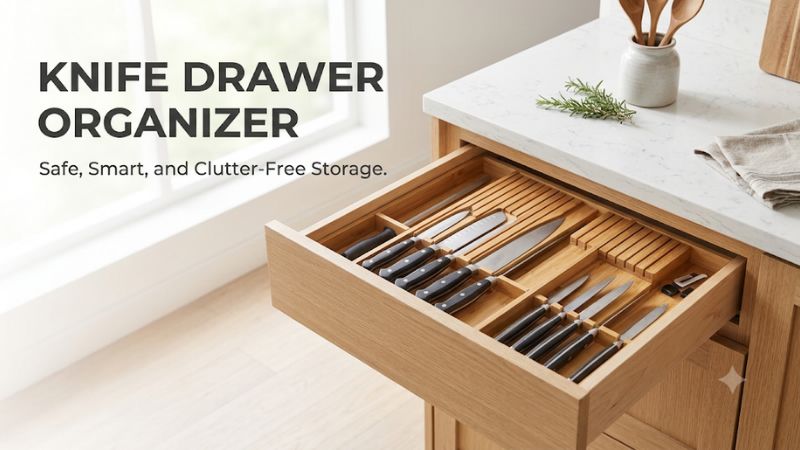
Quick Comparison Table
A knife organizer should be evaluated by the knives it actually accepts, not simply by its number of slots. A tray rated for twelve small and medium knives may be unsuitable for a wide cleaver or unusually long slicing knife. The products below use different approaches, including overlapping tiers, shaped wooden slots, flexible bristles, and an integrated modular drawer kit.
| Product | Best For | Main Design | Key Advantage | Main Limitation |
|---|---|---|---|---|
| Joseph Joseph DrawerStore 2-Tier Compact | Small modern kitchens | Compact molded two-tier tray; up to 11 knives | Efficient use of drawer width | Requires appropriate drawer height |
| Joseph Joseph DrawerStore Bamboo Large | Larger knife collections | Two-tier bamboo design; up to 12 knives | Higher capacity and clear blade grouping | Broad footprint and wood care |
| ZWILLING Storage Acacia 8-Knife | Narrow wooden storage | Acacia wood with 8 individual knife positions | Relatively narrow footprint | Fixed blade-size categories |
| WÜSTHOF 7-Slot Beech Tray | Traditional knife collections | Wooden tray with 7 slots | Simple individual storage | Limited capacity |
| Totally Bamboo Universal Knife Caddy | Mixed blade shapes | Bamboo holder with removable bristle insert | Less dependence on fixed slots | Bristles require inspection and cleaning |
| Kuhn Rikon WAVE Drawer Organizer Set | Full drawer reorganization | Six-piece modular set including knife holder | Organizes knives and other utensils together | More components and overall drawer space |
The capacity labels describe manufacturer-advertised configurations. They should not be interpreted as guarantees that every knife fits comfortably.
Broad chef’s knife handles, long blades, bolsters, and unusual blade profiles can limit usable positions even when the number of knives is below the stated capacity.
How We Selected These Six Organizers
The six selections represent identifiable products with different materials and storage approaches. We considered how knives enter and leave each organizer, whether blade contact is controlled, the amount of drawer space required, and the maintenance associated with the design. Safety, accessibility, and compatibility are more important than decorative appearance.
Selection criteria:
- Blade protection: Individual channels or another intended method of containing sharp edges.
- Drawer compatibility: Width, depth, and closed-height requirements.
- Capacity: Number and sizes of knives the product is designed to hold.
- Material: Molded polymer, wood, bamboo, or bristle inserts.
- Retrieval: Visibility and safe access to handles.
- Cleaning: Ability to remove debris and dry components.
- Stability: Appropriate support during drawer movement.
- Purchase relevance: A clear distinction from the other options.
No original blade-dulling, edge-contact, drop, or endurance testing was performed.
Manufacturer specifications were used for product identification, but the exact current model and fit should be checked before purchase.
Six Knife Drawer Organizers Reviewed in Detail
Each organizer below is intended to address a different knife-storage problem. A two-tier molded tray may suit a small apartment, while a larger bamboo design is more appropriate for an extensive cooking collection. A fixed-slot wooden tray is easy to understand, whereas a bristle system offers a different way to accommodate varied shapes. The reviews focus on real design trade-offs rather than unsupported claims of superior safety performance.
Joseph Joseph DrawerStore 2-Tier Compact Knife Organizer
The Joseph Joseph DrawerStore 2-Tier Compact Knife Organizer is a molded two-level tray designed to store up to eleven kitchen knives. The current manufacturer description identifies deep blade slots and a construction containing at least fifty percent post-consumer recycled plastic. Its overlapping layout distinguishes it from wider conventional knife blocks by separating short and long knives across different levels.
Best For: Small kitchens where drawer width is limited.
Why We Picked It: The compact tiered arrangement is specifically designed to store multiple knife sizes in a narrower footprint.
Key Specifications:
- Brand: Joseph Joseph.
- Product: DrawerStore 2-Tier Compact Knife Organizer.
- Advertised capacity: Up to 11 knives.
- Design: Two tiers with deep blade slots.
- Material: Polymer containing recycled material.
- Care: Hand wash and dry.
- Drawer fit: Verify minimum internal height for the exact version.
Features & Benefits:
- Separates shorter and longer knives.
- Keeps cutting edges within dedicated channels.
- Uses a compact overlapping layout.
- Removes the need for a countertop knife block.
- Can be lifted out for drawer cleaning.
Pros:
- High advertised capacity for a compact format.
- Easy-to-understand two-tier design.
- No mounting required.
- Appropriate for many mixed household knife collections.
Cons:
- Requires sufficient drawer height.
- Some unusually shaped knives may not fit.
- Molded channels need cleaning.
- Overcrowded handles can reduce practical capacity.
Buy If: You want an efficient compact tray for several everyday kitchen knives.
Skip If: The drawer is shallow or your collection includes very wide blades that do not fit the channels.
Performance & Practical Use
The two-tier design can help organize paring knives separately from larger chef’s knives. This makes the collection easier to identify and reduces the need to reach through a pile of loose sharp tools.
However, a knife stored at the wrong angle or forced into an unsuitable slot can still create a hazard.
Test each knife carefully before fully loading the organizer.
What Makes It Different
The current DrawerStore configuration emphasizes compact storage and recycled polymer content.
Unlike a traditional wooden tray, its overlapping layout is intended to conserve drawer width.
The main buying consideration is vertical clearance, particularly when knife handles rise above the organizer.
Joseph Joseph DrawerStore Bamboo Large 2-Tier Knife Organizer
The Joseph Joseph DrawerStore Bamboo Large 2-Tier Knife Organizer is a higher-capacity wooden alternative intended for up to twelve knives. The manufacturer describes an upper level for smaller knives and a lower level for larger knives, with support for blade lengths up to approximately nine inches. Its bamboo construction and substantial footprint make it relevant for cooks who want matching natural materials inside a dedicated knife drawer.
Best For: Households storing a larger collection of standard kitchen knives.
Why We Picked It: It combines a documented twelve-knife capacity with a spacious two-tier bamboo arrangement.
Key Specifications:
- Advertised capacity: Up to 12 knives.
- Maximum described blade length: 9 inches.
- Approximate dimensions: 15.5 inches deep, 7 inches wide, and 3 inches high.
- Material: Bamboo.
- Features: Non-slip feet.
- Drawer requirement: Manufacturer specifies suitable minimum internal height.
- Care: Wipe with a damp cloth, dry by hand, and maintain as directed.
Features & Benefits:
- Separate positions for different knife sizes.
- Natural bamboo appearance.
- Two-tier arrangement.
- Non-slip feet help position the tray.
- Dedicated channels support orderly storage.
Pros:
- Twelve-knife advertised capacity.
- Larger format suits established collections.
- Clear separation of blades.
- Attractive natural construction.
Cons:
- Uses more drawer width than a compact tray.
- Wood requires moisture care.
- Oversized knives may exceed the intended dimensions.
- High advertised capacity may not translate to comfortable spacing for every handle.
Buy If: You have a spacious drawer and regularly use a varied knife collection.
Skip If: You own only three or four knives or want a dishwasher-cleanable organizer.
Performance & Practical Use
The large bamboo tray can provide a predictable position for knives used in everyday meal preparation.
A family using a chef’s knife, bread knife, several utility knives, and paring knives may benefit from a single designated storage system.
However, the tray should not become a place for damaged or loosely fitting blades simply to use every slot.
What Makes It Different
Compared with the compact polymer DrawerStore, the large bamboo model prioritizes capacity and a natural material.
It is a practical choice when drawer space is available, but its care requirements are more demanding.
The manufacturer advises moisture-sensitive maintenance, so knives should be clean and dry before storage.
ZWILLING Storage Acacia 8-Knife In-Drawer Organizer
The ZWILLING Storage Acacia In-Drawer Organizer is a wooden knife tray designed for eight knives, divided into four smaller and four larger positions. The manufacturer identifies acacia construction and a narrow footprint measuring approximately 15.75 inches long, 4.25 inches wide, and 1.97 inches high. This makes the organizer relevant for kitchens where a slender dedicated knife tray is preferable to a broad overlapping system.
Best For: Narrow drawers or drawer layouts shared with other organizers.
Why We Picked It: Its documented dimensions and eight-position arrangement provide a compact natural-wood alternative.
Key Specifications:
- Brand: ZWILLING.
- Material: Acacia wood.
- Capacity: 8 knives.
- Positions: 4 small and 4 large.
- Small-blade compatibility: Up to approximately 5 inches.
- Large-blade compatibility: Up to approximately 10 inches.
- Dimensions: 15.75 x 4.25 x 1.97 inches.
- Product identifier: 1033770.
Features & Benefits:
- Individual channels hold knives in defined positions.
- Narrow width can leave drawer space for other tools.
- Contoured design assists handle access.
- Wooden construction offers a traditional appearance.
- Separates smaller and larger blade categories.
Pros:
- Narrow footprint.
- Low organizer height.
- Clear size grouping.
- Identifiable manufacturer specifications.
Cons:
- Limited eight-knife capacity.
- Fixed slots reduce flexibility.
- Acacia requires appropriate care.
- Broad handles may still crowd neighboring positions.
Buy If: You want a narrow wooden tray for a modest collection of standard knives.
Skip If: Your knives have unusual blade shapes or you need more than eight positions.
Performance & Practical Use
The narrow footprint is especially useful when the household wants a dedicated knife area beside a separate silverware organizer.
However, check the combined widths carefully. Two organizers that fit individually may not fit side by side.
The low tray height is helpful, but the total clearance still depends on the knife handles resting above it.
What Makes It Different
ZWILLING’s acacia version offers a different material and narrower arrangement from larger bamboo tiered organizers.
It favors a relatively compact collection rather than maximum capacity.
For someone with a few frequently used knives, this may be more appropriate than purchasing a twelve-slot tray that occupies unnecessary width.
WÜSTHOF 7-Slot In-Drawer Beech Knife Tray
The WÜSTHOF 7-Slot In-Drawer Beech Knife Tray is a traditional wooden storage solution intended for seven knives. The manufacturer identifies natural wood construction and compatibility with blades up to approximately nine inches. It is designed to protect knife edges from the damage associated with loose drawer storage while providing a straightforward arrangement that does not depend on moving components.
Best For: Small-to-medium collections of conventional kitchen knives.
Why We Picked It: The seven-slot format offers a simple branded wooden design for cooks who prioritize individual knife positions.
Key Specifications:
- Brand: WÜSTHOF.
- Product: 7-Slot In-Drawer Beech Knife Tray.
- Capacity: 7 knives.
- Material: Beechwood.
- Maximum listed blade length: Approximately 9 inches.
- Design: Fixed individual knife positions.
- Installation: Freestanding drawer placement.
Features & Benefits:
- Keeps knives separated.
- Reduces unnecessary blade contact.
- Provides designated positions.
- Fits suitable cutlery drawers.
- Traditional wooden appearance.
Pros:
- Simple individual-slot design.
- No mounting or assembly required.
- Suitable for a focused knife collection.
- Clear manufacturer identity.
Cons:
- Seven-position capacity.
- Fixed slot arrangement.
- Requires appropriate drawer dimensions.
- Wood must be kept suitably dry.
Buy If: You want a straightforward wooden organizer for several standard kitchen knives.
Skip If: You have an extensive collection or need highly adjustable blade positions.
Performance & Practical Use
A fixed wooden tray can make everyday knife storage intuitive.
Each knife has a predictable location, reducing the temptation to put it loose among peelers, spatulas, and other kitchen tools.
The limitation is that the number and dimensions of slots are predetermined.
A very wide cleaver or unusually thick handle may not fit, even when an empty slot remains.
What Makes It Different
The WÜSTHOF tray provides a traditional low-complexity format.
Unlike bristle systems, it relies on shaped positions intended for common knife forms.
It suits buyers who prefer consistency and do not frequently change the types of knives they own.
Totally Bamboo Universal In-Drawer Knife Caddy
The Totally Bamboo Universal In-Drawer Knife Caddy uses a bamboo frame and removable bristle-style insert rather than a series of fixed wooden knife slots. The manufacturer describes a design intended to accommodate different knife shapes while leaving part of the blade visible for identification. This offers an alternative when a household’s collection does not match the narrow categories used by conventional slotted trays.
Best For: Mixed knife collections with varied shapes and handle sizes.
Why We Picked It: The removable bristle construction provides a distinct approach to supporting blades inside a drawer.
Key Specifications:
- Brand: Totally Bamboo.
- Product: Universal In-Drawer Knife Caddy.
- Main structure: Bamboo.
- Blade support: Removable bristle insert.
- Configuration: Universal rather than fixed individual slots.
- Cleaning: Manufacturer describes removable bristles suitable for dishwasher cleaning.
- Bamboo care: Hand cleaning and drying.
Features & Benefits:
- Bristles adapt to various inserted blade profiles.
- Bamboo frame creates a defined storage position.
- Removable insert assists cleaning.
- Partial blade visibility can help identification.
- No fixed slot count limits the design in the same way as a traditional tray.
Pros:
- Flexible blade positioning.
- Distinctive universal design.
- Removable cleaning component.
- Natural bamboo outer construction.
Cons:
- Practical capacity depends on knife sizes and spacing.
- Bristles need regular inspection.
- Bamboo and insert have different cleaning requirements.
- Improper insertion can still damage blades or create risk.
Buy If: You own mixed knife styles and want a holder less dependent on fixed slots.
Skip If: You prefer individually defined blade channels or want a single-piece organizer with no removable insert.
Performance & Practical Use
The bristle insert can be useful when the household owns knives that differ substantially in width and shape.
However, users must insert blades carefully and ensure that neighboring handles remain accessible.
Do not force a broad blade into a crowded section or allow the knife edge to contact another object outside the intended support.
What Makes It Different
Unlike fixed-slot trays, this caddy uses a flexible internal support.
That distinction makes it worth considering for changing knife collections.
The trade-off is maintenance: the removable bristles and bamboo frame require different cleaning procedures and should be allowed to dry appropriately.
Kuhn Rikon WAVE Drawer Organizer Set With Safe Store Knife Organizer
The Kuhn Rikon WAVE Drawer Organizer Set is a six-piece modular system that includes a WAVE Safe Store Knife Organizer alongside other drawer organizers. It is intended to organize a broader collection of kitchen utensils rather than knives alone. The manufacturer describes a wavy base that helps users grip smaller items and components that can be combined or stacked within suitable drawer dimensions.
Best For: Households reorganizing knives and multiple utensil categories at the same time.
Why We Picked It: The included dedicated knife organizer makes this a distinct integrated drawer-storage option.
Key Specifications:
- Brand: Kuhn Rikon.
- Product: WAVE Drawer Organizer Set, 6 Pieces.
- Included: 1 Safe Store Knife Organizer.
- Additional components: 2 large, 1 medium, and 2 small WAVE drawer organizers.
- Design: Modular arrangement.
- Drawer fit: Manufacturer identifies a minimum drawer height of approximately 2.5 inches for the set.
- Use: Mixed kitchen drawer organization.
Features & Benefits:
- Dedicated knife storage within a modular system.
- Additional compartments for utensils.
- Wavy interior surfaces facilitate small-item retrieval.
- Components can be arranged according to available space.
- Suitable for a coordinated drawer reset.
Pros:
- Organizes several categories.
- Includes a dedicated knife-storage component.
- Modular layout.
- Useful for broad kitchen-drawer reorganization.
Cons:
- More components than a knife-only tray.
- Total drawer footprint may be substantial.
- Specific blade capacity must be confirmed.
- May be unnecessary when the household already has a silverware organizer.
Buy If: You want to reorganize the entire utensil drawer rather than purchase only a knife tray.
Skip If: You have limited space or need storage exclusively for a knife collection.
Performance & Practical Use
The value of this set comes from coordinating several utensil categories within one drawer.
A household can create separate positions for knives, peelers, serving tools, and other frequently used accessories.
However, the complete layout needs enough space to keep the knife component isolated from ordinary utensils.
What Makes It Different
The WAVE system is not simply a stand-alone knife block.
It is a broader drawer-organization package that includes protective knife storage.
That makes it more appropriate for a complete drawer project than for buyers seeking the smallest possible solution.
Buying Guide: How to Choose the Right Knife Drawer Organizer
The most important factor is whether each knife can be stored with its sharp edge protected and its handle accessible. A tray that fits the drawer but cannot accommodate the longest blade is not a successful purchase. Measure both the knives and the storage area, consider who uses the kitchen, and choose a design that prevents loose blade movement.
Measure Drawer Width, Depth, and Closed Height
Measure the clear interior dimensions rather than the decorative drawer front. Pay particular attention to vertical clearance, because many tiered organizers raise knife handles above the tray.
Measurement checklist:
- Usable drawer width.
- Front-to-back depth.
- Closed internal height.
- Drawer opening clearance.
- Space around the organizer.
- Tallest knife handle height.
- Room to lift knives safely.
Do not assume that an organizer under two inches high will fit in a two-inch drawer once knives are loaded.
The handles may require additional clearance.
A cardboard outline and an empty-drawer test can prevent an unsuitable purchase.
Inventory Blade Lengths and Shapes
Knife collections vary significantly. A short paring knife may fit almost any designated slot, while a long bread knife or wide cleaver may be incompatible with an ordinary tray.
Check each knife for:
- Blade length.
- Blade height.
- Handle width.
- Bolster shape.
- Tip profile.
- Protective sheath compatibility.
- Safe insertion direction.
If you own a cleaver, carving knife, or other unusually shaped blade, verify compatibility before ordering.
Do not force a knife into an undersized slot.
Choose Wood, Bamboo, Polymer, or Bristles
Different materials provide different handling and cleaning experiences.
Wood and bamboo:
- Traditional appearance.
- Fixed channels on many designs.
- Usually require careful moisture management.
- May be heavier than polymer trays.
Polymer:
- Often lightweight.
- Available in compact molded forms.
- May provide easy cleaning.
- Care instructions vary.
Bristle inserts:
- Can accommodate mixed blade shapes.
- Require inspection for wear.
- Cleaning may involve removing the insert.
- Capacity depends on the actual knife collection.
No material automatically guarantees better blade protection.
A correctly fitted organizer matters more than the finish alone.
Prioritize Safe Knife Retrieval
Knives should be stored so users can grasp the handles without reaching across exposed edges. The organizer should remain stable during drawer movement, and blades should not contact surrounding loose tools.
Safety checklist:
- Handles remain accessible.
- Sharp edges are contained.
- Knives do not collide with one another.
- Organizer stays positioned.
- Drawer closes without contacting handles.
- Children cannot access sharp knives unsupervised.
- Clean, dry knives are stored appropriately.
A drawer lock or suitable child-resistant storage arrangement may be important in households with young children.
Never treat an organizer as a substitute for responsible knife handling.
Installation, Cleaning, and Long-Term Care
Most in-drawer knife organizers are freestanding, so setup is straightforward. Nevertheless, the drawer should be clean, dry, structurally sound, and large enough for the organizer and knives. Maintenance matters because dust, crumbs, moisture, and food residue can accumulate in blade channels where they are difficult to see.
Set Up the Drawer Correctly
Begin by removing all knives and unrelated utensils. Clean the drawer, confirm the fit, and position the organizer where knife handles are easy to reach.
Setup steps:
- Empty the drawer.
- Clean and dry the interior.
- Place the organizer in the intended position.
- Confirm clearance.
- Insert one knife carefully.
- Test handle accessibility.
- Add remaining knives.
- Open and close the drawer gently.
- Remove any incompatible knife.
Do not place knives loosely beside the organizer if they cannot fit safely.
Instead, use an appropriate blade guard or another dedicated storage method.
Clean the Organizer Without Damaging It
Always remove knives before cleaning the organizer.
Care considerations:
- Follow the manufacturer’s washing directions.
- Avoid soaking wooden trays unless specifically permitted.
- Remove debris from channels.
- Clean removable bristle inserts as instructed.
- Dry all components thoroughly.
- Inspect for cracks, splinters, or worn supports.
A knife tray should not trap moisture around stored blades.
Keep knives clean and dry before returning them.
Know When to Replace or Reconfigure Storage
A knife organizer may become unsuitable when the household purchases a longer blade, changes handle styles, or adds more knives.
Reevaluate the layout rather than overcrowding the existing slots.
Replace the organizer if its structure becomes damaged or its blade supports no longer function as intended.
For a growing knife collection, a larger dedicated tray or separate protected storage may be more practical than forcing additional blades into limited spaces.
Frequently Asked Questions
Knife drawer organization raises important questions about safety, blade protection, drawer size, and material selection. Buyers should distinguish the organizer’s intended storage capacity from its real compatibility with their knives. An appropriately fitted tray can improve everyday storage, but safe handling and regular cleaning remain essential.
Are In-Drawer Knife Organizers Safe?
They can provide a more controlled storage arrangement than leaving sharp knives loose in a drawer, provided the blades fit properly and the organizer is used as intended. Handles should remain easy to access without touching exposed edges. The organizer must stay stable, and drawer closure should not contact the knives. Households with children may need additional access controls.
Do Knife Drawer Organizers Damage Blades?
Properly designed organizers are intended to reduce unnecessary contact between blades and other objects, but they are not automatically scratchproof or damage-proof. A knife that is forced into an undersized channel may still be damaged. Choose suitable slot dimensions, insert and remove knives carefully, and keep the organizer clean.
What Size Knife Organizer Fits a Standard Drawer?
There is no universal standard because kitchen drawers vary in width, depth, and usable height. Measure the actual interior and compare it with the manufacturer’s dimensions. Tiered organizers may require additional clearance for handles. The drawer must close freely when fully loaded. Never rely solely on the organizer’s empty height.
Is Bamboo Better Than Plastic for Knife Storage?
Neither material is universally better. Bamboo offers a natural appearance and shaped storage, while polymer trays can be lightweight and easier to maintain in some designs. The important factors are blade compatibility, stable support, safe retrieval, and cleaning. Follow the exact product’s care instructions, particularly for moisture-sensitive wooden materials.
Can I Put a Cleaver in a Knife Drawer Organizer?
Only if the organizer explicitly accommodates the cleaver’s size and shape. Wide blades and heavy handles may not fit standard knife channels. Forcing a cleaver into an unsuitable slot can create a hazard or damage the organizer. Consider a compatible protective sheath or specialized storage when ordinary drawer trays do not support the knife.
Should Kitchen Knives Be Stored With Silverware?
Sharp kitchen knives should not be left loose among forks, spoons, and other utensils. Dedicated protective storage reduces unintended contact with cutting edges and helps keep blades separated. Ordinary table knives are different from sharp preparation knives. Choose storage appropriate to each utensil type and keep access controlled where children are present.
Conclusion
The best knife drawer organizer fits both the drawer and the knives used in everyday cooking. Joseph Joseph offers compact and large two-tier formats, ZWILLING and WÜSTHOF provide traditional wooden trays, Totally Bamboo offers flexible bristle storage, and Kuhn Rikon includes a knife organizer within a broader modular drawer system. Measure blade lengths, handle clearance, and drawer dimensions before buying. Prioritize protected edges, stable positioning, safe retrieval, and straightforward cleaning rather than maximum advertised capacity.










Write Your Review
No reviews yet. Be the first to share your experience!