
Choosing a chef knife for entertaining can simplify the preparation behind dinner parties, holiday meals, and casual gatherings. From chopping vegetables for appetizers to slicing ingredients for a charcuterie board, a comfortable all-purpose blade helps keep food prep organized. This guide explains which features matter when cooking for guests and when a specialty knife is the better tool.
- Quick Answer: What Knife Works Best When Hosting Guests?
- Why Entertaining Changes Your Knife Requirements
- How to Choose a Chef Knife for Entertaining
- Recommended Knife Styles for Different Entertaining Menus
- Practical Hosting Scenarios
- How to Prepare a Safe and Efficient Cutting Station
- Common Mistakes When Buying a Knife for Hosting
- Frequently Asked Questions
- Conclusion
Quick Answer: What Knife Works Best When Hosting Guests?
For most home hosts, a comfortable eight-inch chef’s knife is the most versatile starting point. It provides useful blade length for chopping vegetables, slicing boneless proteins, and preparing ingredients for multiple dishes without requiring professional-sized equipment. The correct choice should remain comfortable during extended preparation and be straightforward to clean between ingredients.
Important buying priorities
- Eight-inch blade for general-purpose preparation.
- Secure, comfortable handle.
- Cutting profile suited to your technique.
- Sufficient knuckle clearance.
- Edge that can be maintained reliably.
- Appropriate balance for repeated chopping.
- Corrosion-resistant construction when desired.
- Safe storage away from guests and children.
A chef’s knife is primarily a preparation tool. If the event includes carving a large roast or slicing crusty baguettes, a carving knife or serrated bread knife may produce better results for those specific tasks.
Similarly, delicate cheese preparation may benefit from a cheese knife rather than using the same blade that just handled raw ingredients.
The best hosting setup does not require an enormous knife collection. One capable chef’s knife, a suitable cutting board, and one or two task-specific tools can cover many entertaining menus.
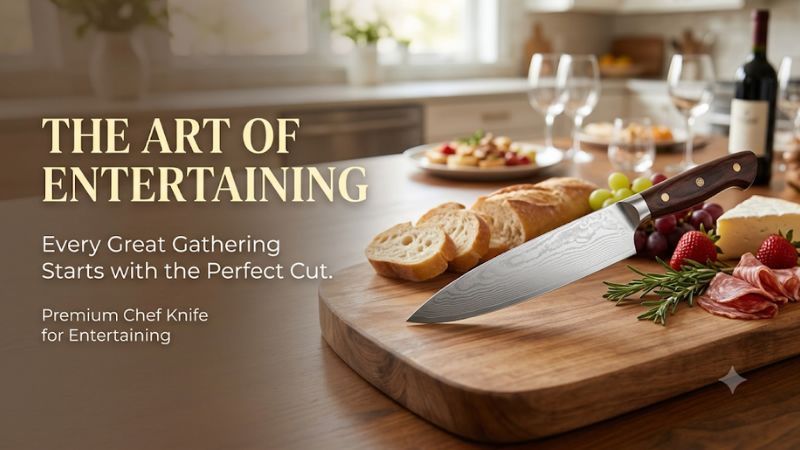
Why Entertaining Changes Your Knife Requirements
Cooking for guests differs from preparing a simple weeknight dinner because several ingredients and dishes may need attention during the same preparation period. You might chop vegetables for appetizers, slice fruit for drinks, prepare a salad, cut herbs for a garnish, and portion cooked food for serving. A knife that is comfortable for five minutes can feel less suitable after an extended series of repetitive tasks.
Common entertaining preparation tasks
- Chopping onions and aromatics.
- Dicing vegetables for appetizers.
- Slicing tomatoes and cucumbers.
- Preparing fruit platters.
- Mincing herbs.
- Portioning boneless poultry or fish before cooking.
- Slicing cheeses that suit a chef’s knife.
- Preparing vegetable garnishes.
- Cutting ingredients for sauces and dips.
- Organizing advance meal preparation.
A useful chef’s knife should handle these jobs without requiring the cook to change tools constantly.
However, convenience should not override food safety.
If the blade has been used on raw meat, poultry, seafood, or eggs, it must be washed appropriately before cutting ready-to-eat foods.
When hosting, a clean second knife or separate preparation schedule can help maintain appropriate separation.
How to Choose a Chef Knife for Entertaining
The right blade depends on your menu, preparation space, hand comfort, and the amount of advance work you plan to complete. Someone hosting casual appetizer nights may favor a light knife for vegetables and herbs, while a home cook preparing a substantial holiday meal might prefer a more substantial multipurpose design. The following factors help match a knife to real hosting needs.
Choose Blade Length Based on Your Menu
Blade length affects how much food can be cut in one controlled movement and how comfortable the knife feels on the available cutting board. Eight inches is a practical all-purpose starting point, but a smaller six-inch blade can be easier to manage in compact kitchens. A longer blade may help with large vegetables, though it requires more workspace and controlled handling.
Common sizes
- 6 inches: Compact apartments and smaller ingredients.
- 7 inches: A middle ground for shorter cutting boards.
- 8 inches: Versatile everyday preparation and gatherings.
- 9–10 inches: Large ingredient quantities and spacious workstations.
For a dinner party involving a large salad, roasted vegetables, and several appetizer components, an eight-inch knife usually offers a useful balance of reach and maneuverability.
A ten-inch blade may not provide a meaningful advantage if the board is too small.
Also consider hand size and confidence.
A blade that feels overly long can reduce control during fine cuts.
Buying recommendation: Start with an eight-inch knife unless your cutting board, hands, or preferred technique strongly favor a different length.
Prioritize Comfort for Extended Preparation
Hosting often involves repetitive chopping, particularly when preparing vegetable platters, soups, sauces, or multiple courses. Handle comfort therefore matters as much as blade appearance. A knife should support a secure grip without creating awkward wrist angles or requiring excessive squeezing during normal use.
Handle considerations
- Size and shape.
- Texture.
- Material.
- Balance point.
- Bolster design.
- Pinch-grip clearance.
- Knuckle space.
- Ease of cleaning.
A textured synthetic handle can be practical when switching between preparation tasks.
A smooth wooden or composite handle may appeal to cooks who prefer its feel.
An all-metal design offers another option, but not every user finds the same surface equally comfortable.
If possible, evaluate the handle safely before purchasing.
Buying recommendation: Favor a secure, natural grip over premium decorative materials.
Decide Between German and Japanese-Inspired Blade Profiles
Many traditional German-style chef’s knives feature a curved belly suitable for rocking cuts, while Japanese gyuto designs often emphasize a somewhat different slicing feel. Both can handle entertaining preparation, but the preferred technique matters. A cook accustomed to rocking through piles of herbs may prefer a different blade from someone who makes controlled forward slices through vegetables.
German-style strengths
- Familiar rocking profile.
- General-purpose chopping.
- Often substantial handling.
- Wide availability of established brands.
Japanese-influenced strengths
- Often refined cutting geometry.
- Controlled slicing.
- Vegetable and garnish preparation.
- Alternative handle and balance options.
These are general tendencies rather than guarantees.
A particular blade’s steel, geometry, and weight determine its actual behavior.
Do not assume that every Japanese knife is lighter or every German knife is more durable.
Buying recommendation: Match the cutting profile to the motion you already use comfortably.
Consider Ingredient Variety During a Party
An entertaining menu may include vegetables, fruit, boneless meats, cheeses, baked goods, and garnishes. A versatile chef’s knife handles many of these ingredients, but some textures require specialized tools. The buyer should consider what the knife will actually cut instead of relying on broad claims of universal performance.
Good chef’s knife tasks
- Chopping vegetables.
- Slicing boneless proteins.
- Dicing onions.
- Mincing parsley.
- Preparing fruit.
- Cutting suitable firm cheeses.
- Slicing peppers and cucumbers.
Better handled with another tool
- Crusty bread: Serrated bread knife.
- Large roast carving: Appropriate carving or slicing knife.
- Hard cheese requiring force: Suitable cheese tool.
- Small decorative trimming: Paring knife.
- Frozen food or bones: Task-appropriate equipment.
The distinction matters because using a chef’s knife for inappropriate tasks can damage the edge or increase injury risk.
A well-planned party prep station includes the right tool for each major job.
Buying recommendation: Choose a chef’s knife for most preparation, not as a replacement for every serving tool.
Understand Blade Steel and Maintenance
Steel composition influences wear resistance, corrosion behavior, and sharpening characteristics, but no single specification determines a knife’s quality. Heat treatment, blade geometry, manufacturing consistency, and user technique also matter. For entertaining, the most useful blade is one that remains properly maintained and can be cleaned easily between ingredients.
Features to evaluate
- Manufacturer-described blade steel.
- Corrosion resistance.
- Recommended sharpening method.
- Edge geometry.
- Appropriate honing guidance.
- Handle cleaning requirements.
- Safe storage instructions.
- Availability of professional sharpening services.
A very hard steel may hold certain edges well but require more careful handling.
A more conventional stainless steel may be easier for some home users to maintain.
Neither approach automatically guarantees better cooking results.
Buying recommendation: Select a steel and edge design that fit your maintenance skills rather than choosing the highest advertised hardness.
Look for Balance and Knuckle Clearance
Balance affects how naturally the knife moves during repeated chopping, while blade height influences how much room remains between the handle and cutting board. Adequate knuckle clearance can help users maintain a comfortable grip, especially when chopping vegetables for large groups. However, blade dimensions should be considered in relation to the cook’s technique and hands.
Practical handling checks
- Can you maintain a pinch grip comfortably?
- Does the handle crowd your fingers?
- Can the blade contact the board without awkward wrist movement?
- Is the weight comfortable?
- Can you control the tip during detailed cuts?
- Does the handle feel secure?
- Can you safely guide the blade through an ingredient?
A knife that feels too heavy may be tiring during prolonged prep.
An extremely light knife may feel unfamiliar to someone who prefers a more substantial tool.
Neither preference is inherently wrong.
Buying recommendation: Prioritize controlled movement and comfort over a particular advertised weight.
Plan Cleaning Between Courses and Ingredients
Entertaining menus can involve several foods with different contamination risks. A knife used to prepare raw chicken should never move directly to slicing tomatoes for a ready-to-eat salad without proper washing. The same applies to cutting boards, countertops, and other utensils that have contacted raw animal foods.
Safe preparation practices
- Prepare ready-to-eat ingredients separately when practical.
- Use clean tools for different food categories.
- Wash knives with appropriate soap and water.
- Clean cutting boards after raw animal foods.
- Dry the knife before returning it to storage.
- Avoid leaving blades hidden in sinks.
- Keep sharp tools away from guests and children.
Some hosts find it helpful to prepare vegetables before working with raw meat.
Others use separate boards and knives to support safe workflow.
Both approaches require proper hygiene.
Buying recommendation: Choose a knife that is easy to handwash and maintain during an active cooking session.
Consider Safe Storage During Gatherings
An exposed knife on a crowded countertop creates unnecessary risk when guests, children, or household members move through the kitchen. During entertaining, the preparation station may be accessed by several people who do not know where sharp tools have been placed. Safe storage should therefore be part of the knife purchase decision.
Storage options
- In-drawer knife organizer.
- Suitable knife block.
- Protective blade sheath.
- Secure magnetic storage installed correctly.
- Closed cabinet with dedicated protection.
Avoid loose storage in a utensil drawer where fingers can contact an exposed edge.
Do not leave a knife beneath towels or dirty dishes.
A knife roll can be useful for transportation between kitchens, but the blade should be protected and the roll secured appropriately.
Buying recommendation: Include suitable edge protection in the overall purchase budget.
Recommended Knife Styles for Different Entertaining Menus
Different gatherings place different demands on the cook. A casual appetizer party may require mainly vegetable chopping and garnish preparation, while a holiday dinner may involve extensive ingredient preparation and separate carving at the table. A single knife can manage much of the preparation, but selecting the right style makes the work more comfortable.
| Entertaining Menu | Useful Chef’s Knife Style | Main Tasks | Additional Tool |
|---|---|---|---|
| Appetizer party | Nimble 7–8-inch blade | Vegetables, dips, garnishes | Paring knife |
| Holiday dinner | Comfortable 8-inch general-purpose knife | Aromatics, vegetables, boneless prep | Carving knife |
| Charcuterie gathering | Precise all-purpose blade | Fruit, vegetables, suitable cheeses | Specialty cheese knives |
| Summer cookout | Practical corrosion-resistant knife | Tomatoes, peppers, onions | Serrated knife |
| Dinner party with multiple courses | Comfortable all-purpose chef’s knife | Repeated vegetable and protein prep | Bread knife |
| Brunch | Compact or standard chef’s knife | Fruit, herbs, vegetables | Serrated bread knife |
The menu should determine the additional tools.
Do not purchase a specialized knife merely because it is described as essential for entertaining.
Practical Hosting Scenarios
A chef’s knife becomes especially useful when it supports an organized preparation schedule. Rather than making every cut immediately before guests arrive, many hosts prepare ingredients in advance and reserve final assembly for serving time. The following scenarios show how knife choice and workstation setup work together.
Casual Appetizer Night
A casual appetizer evening may involve sliced vegetables, fruit, herbs, spreads, and a simple charcuterie presentation. The chef’s knife should handle routine preparation efficiently without requiring a large cutting area. A controlled eight-inch blade is usually suitable for these ingredients, while smaller decorative cuts may benefit from a paring knife.
Suggested workflow
- Wash produce.
- Prepare stable cutting surfaces.
- Chop vegetables by category.
- Slice fruit shortly before serving when appropriate.
- Clean the blade between food categories.
- Store ingredients safely.
- Keep the knife away from guest traffic.
If the menu includes hard cheese or crusty bread, switch to appropriate specialized tools.
Holiday Dinner for a Larger Group
Holiday meals often require substantial vegetable preparation along with proteins, sauces, and side dishes. The main advantage of a comfortable chef’s knife is its ability to handle repeated chopping without constantly changing tools. However, serving a large roast still benefits from a dedicated carving setup.
Suggested workflow
- Prepare aromatics first.
- Chop vegetables for side dishes.
- Wash and dry the knife.
- Handle raw proteins using appropriate separate surfaces.
- Clean all contaminated equipment.
- Set up a dedicated carving station later.
- Use appropriate serving utensils.
A good chef’s knife reduces preparation complexity, but it should not be forced into cutting through bones or large frozen items.
Brunch With Fruit and Baked Goods
Brunch preparation frequently involves fresh fruit, herbs, vegetables, pastries, and sandwiches. An all-purpose knife can handle fruit and vegetable cutting, but a serrated knife is usually better for slicing crusty loaves, bagels, and many baked goods without crushing them.
Suggested workflow
- Cut melons on a stable board.
- Portion berries when appropriate.
- Slice vegetables for sandwiches.
- Prepare garnishes.
- Use a serrated knife for crusty breads.
- Keep ready-to-eat foods separate from raw ingredients.
- Clean and store blades safely.
This combination is often more useful than buying several chef’s knives of similar size.
How to Prepare a Safe and Efficient Cutting Station
A knife can only perform well when the cutting station is suitable. Unstable boards, cluttered counters, and poor lighting can make precise cutting difficult regardless of blade quality. During entertaining, the work area should remain organized so ingredients can move safely from preparation to cooking and serving.
Preparation checklist
- Choose a stable cutting board.
- Keep the board away from the edge of the counter.
- Use a safe grip and finger position.
- Place a bowl nearby for trimmings.
- Keep clean ingredients separate from raw proteins.
- Remove unnecessary equipment from the work area.
- Maintain enough space for the blade.
- Wash and dry tools between tasks.
- Store sharp blades after preparation.
- Keep guests clear of the active cutting area.
Avoid glass and stone cutting surfaces that can damage knife edges.
Use materials recommended for kitchen cutting.
Common Mistakes When Buying a Knife for Hosting
Entertaining can encourage shoppers to prioritize impressive-looking equipment rather than practical kitchen needs. A decorative knife may look attractive on a counter but feel uncomfortable during an hour of chopping. Similarly, buying the longest available blade can create problems in a small preparation area. Avoiding these mistakes helps keep the purchase focused on control and versatility.
Mistakes to avoid
- Selecting a knife solely for appearance.
- Buying a blade too long for the cutting board.
- Ignoring handle comfort.
- Choosing extreme hardness without considering maintenance.
- Expecting one knife to carve every roast.
- Using a chef’s knife on bones or frozen food.
- Ignoring cross-contamination.
- Storing the blade loosely around guests.
- Treating hollow-edge dimples as guaranteed nonstick performance.
- Purchasing a knife without a maintenance plan.
- Assuming all premium steel is dishwasher-safe.
- Choosing a heavy knife without considering fatigue.
The best knife supports the food-preparation process without drawing unnecessary attention to itself.
Frequently Asked Questions
When choosing cutlery for dinner parties and gatherings, home cooks often wonder whether one premium knife is sufficient, which blade length works best, and how to handle serving tasks separately. These answers clarify the role of the chef’s knife in entertaining and explain where additional tools or better preparation habits may matter more than price.
What Is the Best Chef Knife for Entertaining?
A comfortable eight-inch chef’s knife is a versatile starting point because it can chop vegetables, prepare herbs, and slice boneless proteins for many different menus. The best specific model depends on grip preference, cutting technique, and maintenance expectations.
Look for dependable construction and a handle that feels secure.
Do not choose solely by brand prestige.
Do I Need a Separate Carving Knife for Dinner Parties?
A chef’s knife can slice some boneless cooked proteins, but a dedicated carving or slicing knife is often more convenient for large roasts and presentation cuts. A longer, narrower blade may help create even slices without repeated sawing motions.
Choose the tool according to the food being served.
A chef’s knife remains the main preparation blade.
Is an Eight-Inch Chef’s Knife Too Large for Small Kitchens?
Not necessarily, but the cutting board and available counter space matter. An eight-inch blade is versatile, yet a six- or seven-inch option may feel easier to control in a very compact workstation.
Measure the usable preparation area.
Choose the length that allows safe, comfortable movement.
Should I Buy a Japanese or German Knife for Hosting?
Both can work well. A German-style profile may appeal to cooks who use rocking motions, while Japanese gyuto designs often appeal to those who prioritize fine slicing and controlled cuts.
Handle comfort and maintenance matter more than the regional label alone.
Try to choose around your existing technique.
How Do I Keep My Knife Sharp Before a Party?
Maintain the edge regularly using manufacturer-approved sharpening and honing methods. Inspect the blade before preparation and avoid using it on hard cutting surfaces. If the knife needs substantial sharpening, address that before beginning a large cooking session.
Do not rush sharpening while guests are arriving.
A properly maintained edge supports more controlled cutting.
Conclusion
A chef knife for entertaining should make the preparation of appetizers, vegetables, garnishes, and boneless proteins more comfortable without becoming difficult to maintain. For many hosts, a well-balanced eight-inch blade is the most versatile choice. Compare handle comfort, cutting profile, steel care, and the size of your preparation area before buying. Keep a serrated knife or carving knife available for specialized serving tasks, and maintain proper cleaning and separation between raw and ready-to-eat ingredients. The best hosting knife supports an organized kitchen, not an unnecessarily complicated collection.








Write Your Review
No reviews yet. Be the first to share your experience!