
A cold brew coffee maker for small spaces can prepare smooth, concentrated coffee without a bulky electric appliance. But even compact systems require room for brewing, filtering, and refrigeration. The right choice depends on container shape, usable capacity, filter design, and how frequently you prepare coffee. This guide explains how to build a practical cold-brew routine in an apartment, dorm-approved kitchen, or other small space.
- Quick Verdict: What Cold Brew Coffee Maker Is Best for Small Kitchens?
- Understanding Cold Brew Coffee
- Cold Brew Maker Types for Small Spaces
- Measuring Refrigerator Space
- Choosing the Right Capacity
- Filter Design: One of the Most Important Features
- Coffee-to-Water Ratios
- Grind Size and Extraction
- Brewing Time and Temperature
- A Practical Small-Kitchen Cold Brew Routine
- Cold Brew Food Safety
- Choosing by Lifestyle
- Common Buying Mistakes
- Frequently Asked Questions
- Conclusion
Quick Verdict: What Cold Brew Coffee Maker Is Best for Small Kitchens?
For most households with limited space, a compact pitcher or jar-based cold brew system with a removable filter is the most practical starting point.
These systems generally require no electricity during extraction and can be stored in a refrigerator while brewing.
However, refrigerator fit and cleaning access are more important than exterior appearance.
| Brewer Type | Main Advantage | Main Limitation |
|---|---|---|
| Mason-jar-style infuser | Simple construction and compact storage | Filter removal and pouring vary |
| Slim refrigerator pitcher | Fits some narrow refrigerator spaces | May be tall or difficult to clean |
| Immersion brewer with separate filtering | Flexible capacity and recipes | Requires additional filtering equipment |
| Cold brew concentrate maker | Produces stronger coffee for later dilution | Concentrate ratios and storage need attention |
| Countertop rapid cold brew machine | Shorter preparation time | Needs electricity and additional space |
| French press used for cold brewing | Multipurpose equipment | May allow fine sediment and requires careful cleaning |
A small manual immersion brewer is usually more space-efficient than an electric cold-brew machine, particularly when you already have a refrigerator and do not need coffee prepared within minutes.
Understanding Cold Brew Coffee
What Makes Cold Brew Different?
Cold brew is made by extracting coffee with cool or cold water over an extended period.
Traditional immersion methods often steep coarsely ground coffee for many hours.
This differs from conventional hot brewing, which uses heated water to extract coffee relatively quickly.
The resulting flavor profile can be different.
Cold brew is often perceived as smoother or less sharply acidic, but the exact taste depends on coffee beans, roast, grind, water, extraction time, and dilution.
Do not assume every cold brew is low in acidity or suitable for people with particular digestive conditions.
Cold Brew vs. Iced Coffee
Iced coffee is typically prepared by brewing coffee with hot water and then cooling it.
Cold brew uses a lower-temperature extraction process.
Both can be served over ice.
However, the preparation methods produce different flavor and concentration characteristics.
If you want iced coffee quickly, hot brewing over ice may be more practical.
If you prefer preparing coffee ahead of time, a manual cold-brew system can be convenient.
Cold Brew vs. Cold Brew Concentrate
Cold brew concentrate uses a relatively high amount of coffee compared with water.
It is intended to be diluted before drinking, according to the recipe and desired strength.
Ready-to-drink cold brew uses a lower coffee concentration or is diluted during preparation.
A concentrate is not automatically stronger in caffeine per finished serving.
Caffeine content depends on coffee dose, extraction, dilution, and serving size.
Does Cold Brew Require Special Coffee Beans?
No.
Cold brew can be prepared using suitable roasted coffee beans.
However, different roasts and origins produce different flavor profiles.
A medium or dark roast may create a flavor some people prefer in milk-based cold brew drinks, while other drinkers enjoy lighter roasts.
There is no single universally correct bean.
Choose based on your preferred taste rather than packaging labeled specifically for cold brewing.
Cold Brew Maker Types for Small Spaces
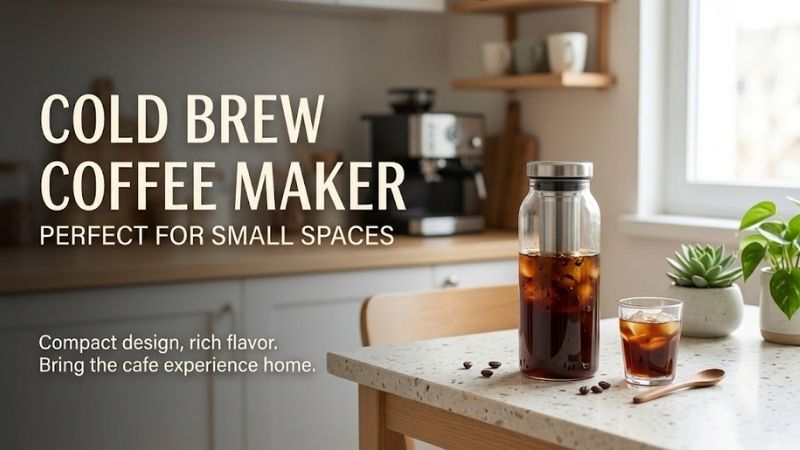
Compact Infuser Jars
An infuser jar typically contains a removable filter basket inside a glass or plastic vessel.
Ground coffee is placed in the filter, water is added, and the mixture steeps.
After extraction, the filter is removed.
The main advantage is that brewing and storage can occur in the same vessel.
However, the filter can occupy substantial interior volume.
Check the finished beverage capacity rather than assuming the nominal jar volume equals the amount of drinkable cold brew.
Slim Cold Brew Pitchers
Slim pitchers are often designed to fit refrigerator shelves or door compartments.
Their elongated shape may help with storage.
However, refrigerator-door fit varies.
A tall pitcher may also be difficult to wash by hand.
If it uses a narrow filter column, loading and removing wet grounds may be inconvenient.
Choose based on actual refrigerator dimensions and cleaning access.
Large Immersion Containers
A separate brewing container can provide flexibility.
You can steep coffee in a suitable food-safe vessel and filter it afterward.
This avoids buying a specialized cold-brew appliance.
However, filtering may require a separate strainer, paper filter, or other suitable equipment.
For minimalist kitchens, a single jar with an integrated filter may be more convenient.
Rapid Cold Brew Machines
Some electrical appliances advertise cold brew prepared in a much shorter time.
They may use agitation, circulation, or other extraction methods.
However, rapid brewing may produce a different flavor profile from traditional long-steep cold brew.
These machines also require electrical access and counter space.
If small-space storage is the main concern, an electric rapid brewer is not necessarily the best value.
Measuring Refrigerator Space
Why Refrigerator Dimensions Matter
Cold brew is often prepared in advance and stored cold.
A container that fits on your counter may not fit conveniently in your refrigerator.
Measure shelf height, depth, and usable width.
Also consider the space occupied by other food.
A compact apartment refrigerator may have limited shelf adjustment.
Choose a brewer that fits without forcing it into an unstable position.
Tall vs. Wide Containers
Tall pitchers use less shelf area but require sufficient height.
Wide jars may fit low shelves but occupy more horizontal space.
Neither design is inherently better.
The most useful shape depends on the refrigerator.
If a pitcher must be tilted to fit, consider another container.
Refrigerator Door Storage
Some narrow cold-brew pitchers fit in refrigerator doors.
However, door shelves vary in depth and strength.
Do not assume that every tall pitcher is designed for door storage.
A full pitcher can be heavy.
Ensure that the shelf supports it securely.
Storage When Empty
A cold brew maker also needs cabinet space between uses.
Some infuser jars can serve as ordinary beverage containers after removing the filter.
This can reduce the need for additional storage.
However, use only approved configurations and avoid misplacing small filter components.
Choosing the Right Capacity
Capacity for One Coffee Drinker
A small brewer may be sufficient for someone who drinks one glass of cold brew daily.
However, the amount of coffee consumed depends on dilution.
A jar holding 32 fluid ounces of concentrate may provide several servings when diluted appropriately.
The same volume of ready-to-drink cold brew provides fewer total ounces after preparation.
Compare the intended recipe.
Capacity for Couples
Two daily cold-brew drinkers may benefit from a larger pitcher or more frequent brewing sessions.
However, a larger batch increases refrigerator space requirements.
Before choosing a large vessel, consider whether you can consume the coffee within an appropriate storage period.
Capacity for Families
If several adults drink cold brew regularly, one compact pitcher may require frequent refilling.
A larger container can reduce brewing sessions, but it may be difficult to fit in a small refrigerator.
Two smaller containers may offer more flexibility, although they create additional cleaning work.
Usable Capacity vs. Advertised Capacity
A brewer’s nominal capacity may describe the container filled to its maximum level.
However, an internal filter occupies space.
Ground coffee also absorbs water.
As a result, finished beverage yield can be lower than the initial water volume.
Look for recipes that describe both starting ingredients and approximate finished volume.
Filter Design: One of the Most Important Features
Stainless Steel Mesh Filters
Metal mesh filters are reusable and common in cold brew pitchers.
They can simplify the process by holding coffee grounds within the brewing vessel.
However, fine particles may still pass through.
Mesh quality, opening size, and cleaning access vary.
A fine mesh may reduce sediment but become more difficult to wash.
Nylon and Other Reusable Filters
Some cold brew systems use synthetic mesh filters.
These may be flexible and relatively lightweight.
However, material and cleaning restrictions vary.
Check the manufacturer’s food-contact and dishwasher instructions.
Do not assume every filter can tolerate hot water or abrasive brushing.
Paper Filters
Paper filtration can remove fine coffee particles and certain oils.
This may produce a clearer finished beverage.
However, paper filters are consumable.
Filtering a large batch of cold brew through paper can also be slow, especially when fine sediment accumulates.
If clarity is important, a two-stage filtering process may be useful.
Filter-Basket Size
A narrow filter basket limits the amount of ground coffee that can be used.
This may restrict concentrate recipes.
A large coffee dose needs enough room for water to contact the grounds.
Overfilling the filter can produce uneven extraction.
Choose a brewer whose recommended recipe matches the desired beverage strength.
Cleaning Wet Grounds
After steeping, coffee grounds are saturated with water.
A filter that is easy to remove and empty can save time.
Look for a wide opening and practical handle.
Avoid filters with inaccessible seams where coffee residue accumulates.
Coffee-to-Water Ratios
Understanding Brew Ratio
Coffee-to-water ratio describes how much coffee is used relative to water.
For example, a 1:8 ratio by weight means one gram of coffee for every eight grams of water.
A recipe using 75 grams of coffee and 600 grams of water follows a 1:8 ratio.
However, that does not guarantee a particular final beverage concentration.
Grind, extraction time, filter design, and coffee absorption also matter.
Ready-to-Drink Cold Brew
A relatively lower coffee dose can produce a beverage intended for direct consumption.
Some home recipes use ratios in the broad neighborhood of 1:12 to 1:16, but recipes vary.
These figures should be treated as starting points rather than universal brewing standards.
Adjust according to the coffee and desired flavor.
Cold Brew Concentrate
Concentrate recipes typically use more coffee relative to water.
A ratio such as 1:6 or 1:8 may be used in certain preparations.
However, the ideal dilution depends on the finished concentration.
Do not assume that every 1:8 batch must be diluted by the same amount.
Taste after filtering and adjust according to the recipe.
Measuring by Weight
A kitchen scale can improve repeatability.
Coffee grounds vary in density, so measuring by scoops can produce inconsistent quantities.
For small kitchens, a compact scale may be a useful accessory.
However, it is not essential for someone who is satisfied with a consistent measured recipe.
Grind Size and Extraction
Why Coarse Grinding Is Common
Coarse coffee grounds are commonly recommended for immersion cold brewing.
They are easier to separate from the finished beverage and may reduce fine sediment.
However, the ideal grind depends on the brew method and filtration system.
An extremely coarse grind may require adjustments in extraction time or coffee dose.
What Happens With Fine Grounds?
Fine coffee can create more sediment.
It may also clog certain filters.
However, fine grinding does not automatically make cold brew bitter.
Flavor depends on the overall extraction conditions.
For an infuser-style pitcher, start with the manufacturer’s recommended grind.
Burr Grinder vs. Pre-Ground Coffee
A suitable burr grinder can provide more consistent particle-size control than some blade grinders.
However, owning a grinder adds cost and storage requirements.
For a small-space setup, appropriately ground coffee purchased from a reliable source may be sufficient.
Consistency Across Batches
Use the same coffee dose, water quantity, grind, and extraction conditions when evaluating a recipe.
Changing several variables at once makes it difficult to identify what improved or worsened the result.
A simple written recipe can make the process more repeatable.
Brewing Time and Temperature
How Long Does Cold Brew Take?
Traditional immersion cold brew often takes approximately 12–24 hours, depending on the recipe and brewing conditions.
However, there is no universal time suitable for every coffee and brewer.
A shorter steep may produce a lighter extraction.
A longer steep can change flavor and concentration, but does not always improve quality.
Follow an appropriate recipe and adjust carefully.
Refrigerator vs. Room-Temperature Brewing
Some recipes use room-temperature extraction, while others brew in the refrigerator.
For home preparation, refrigerator brewing is a conservative approach because it keeps the mixture cold during the long steep.
This can be particularly useful when you intend to store the finished beverage rather than drink it immediately.
Room-temperature extraction and storage require careful food-safety consideration.
Do not assume that coffee’s acidity or caffeine content makes it sterile.
Is Longer Always Better?
No.
Extended steeping can change flavor, but it does not guarantee superior extraction.
Very long preparation may also complicate scheduling and storage.
Choose a method that produces a flavor you enjoy within a manageable routine.
Managing Extraction Consistency
Water temperature, grind, coffee amount, agitation, and steep duration all influence the result.
For a small kitchen, a repeatable refrigerator routine may be more useful than elaborate temperature control.
A Practical Small-Kitchen Cold Brew Routine
Step 1: Choose Your Batch Size
Decide how much coffee you will consume before the next brewing session.
Do not automatically fill the largest container.
A smaller batch can be easier to store and use promptly.
Step 2: Measure Coffee and Water
Follow the brewer’s recommended starting recipe.
Use clean, potable water.
Measure ingredients consistently.
Step 3: Assemble the Filter
Place ground coffee in the approved filter basket.
Do not exceed its fill limit.
Ensure that the filter is secured properly.
Step 4: Add Water
Add the required amount of water.
Follow the recipe’s instructions for wetting and mixing the coffee.
Avoid filling beyond the container’s maximum level.
Step 5: Cover and Refrigerate
Use the lid or cover according to the manufacturer’s instructions.
Place the brewer securely in the refrigerator.
Keep the refrigerator at 40°F or below.
Step 6: Steep for the Recommended Time
Use an appropriate time for the recipe.
Avoid repeatedly opening the container unnecessarily.
Step 7: Remove Grounds
Remove the filter or separate the grounds using the approved method.
Do not squeeze or force components if the manufacturer warns against it.
Step 8: Adjust the Drink
If the finished coffee is a concentrate, dilute it according to the recipe and taste.
Add milk or other ingredients shortly before serving when practical.
Step 9: Store Properly
Keep the finished coffee refrigerated in a clean, covered container.
Label the preparation date if useful.
Use a conservative storage period based on the recipe and handling conditions.
Step 10: Clean the Equipment
Remove grounds and wash the filter, lid, and vessel according to their instructions.
Dry components thoroughly before storage.
Cold Brew Food Safety
Cold Brewing Does Not Sterilize Coffee
Cold extraction does not involve the same high water temperatures used in hot brewing.
It therefore should not be treated as a sterilization process.
Coffee grounds, containers, utensils, and water can introduce microorganisms.
Use clean equipment and appropriate cold storage.
Refrigeration
For home preparation, keep cold brew refrigerated at 40°F or below, particularly during storage after extraction.
Do not assume that a sealed pitcher allows indefinite storage.
Shelf Life Claims
Some commercial cold brew products have validated processing and storage systems.
Those shelf-life claims should not be applied to homemade cold brew.
The safe storage period depends on sanitation, ingredients, processing, and temperature.
Avoid assuming that homemade cold brew remains safe for several weeks merely because it tastes acceptable.
Milk and Cream Additions
Adding dairy milk or refrigerated plant-based beverages changes the storage requirements.
Prepare mixed beverages close to serving time when practical.
Keep perishable drinks refrigerated.
Cleaning Reusable Containers
Wash containers and filters thoroughly.
Coffee residue can collect in lid seals and narrow mesh openings.
A clean-looking pitcher is not proof that every internal surface is free from residue.
Choosing by Lifestyle
Studio Apartment
A slim pitcher may be convenient when refrigerator space is adequate.
Dormitory
A non-electric manual cold brew system may be easier to accommodate than a powered appliance, but check housing rules and access to refrigeration.
One-Person Household
A small infuser jar can provide manageable portions without occupying an entire refrigerator shelf.
Couples
A larger pitcher may reduce brewing frequency.
Frequent Iced Coffee Drinkers
A concentrate system can be practical when you routinely dilute coffee with water or milk.
Occasional Cold Brew Drinkers
A French press or simple jar-and-filter arrangement may be more economical than a specialized appliance.
Common Buying Mistakes
Measuring Only Countertop Space
Cold brew makers often spend more time in the refrigerator than on the counter.
Confusing Container Size With Finished Yield
Filters and coffee absorption reduce usable beverage volume.
Assuming All Cold Brew Is Concentrate
Some recipes produce ready-to-drink coffee.
Buying a Filter That Is Difficult to Clean
Fine mesh and narrow openings can trap sediment.
Assuming Cold Brew Has No Acidity
Flavor perception and measured acidity are not the same.
Treating Homemade Cold Brew as Shelf Stable
Cold brew requires safe preparation and appropriate storage.
Frequently Asked Questions
What Is the Best Cold Brew Coffee Maker for Small Spaces?
A compact infuser jar or slim refrigerator pitcher is a practical starting point. Choose based on refrigerator fit, usable capacity, and filter cleaning.
Can I Make Cold Brew Without a Special Coffee Maker?
Yes. A suitable food-safe container and an appropriate filtering method can work, provided you follow a safe preparation and storage procedure.
Does Cold Brew Need to Be Refrigerated?
Refrigerated preparation and storage are a conservative approach for homemade cold brew. Keep the finished beverage cold and follow appropriate food-safety guidance.
How Much Coffee Should I Use?
The ratio depends on whether you want concentrate or ready-to-drink coffee. Start with a suitable recipe and adjust by taste.
Is Cold Brew Stronger Than Regular Coffee?
It can be more concentrated, especially when brewed as a concentrate, but caffeine per serving depends on coffee quantity, extraction, dilution, and serving size.
Are Cold Brew Coffee Makers Easy to Clean?
Simple jars can be easy to wash, but narrow filters, mesh seams, and lid gaskets may require additional attention.
Conclusion
The best cold brew coffee maker for small spaces combines a refrigerator-friendly shape, manageable batch size, accessible filtration, and easy cleaning. A compact infuser jar is often sufficient for one person, while a larger pitcher may suit couples or frequent iced-coffee drinkers. Choose based on usable capacity rather than advertised volume, and treat refrigerated storage and cleaning as essential parts of the brewing routine.



Write Your Review
No reviews yet. Be the first to share your experience!