
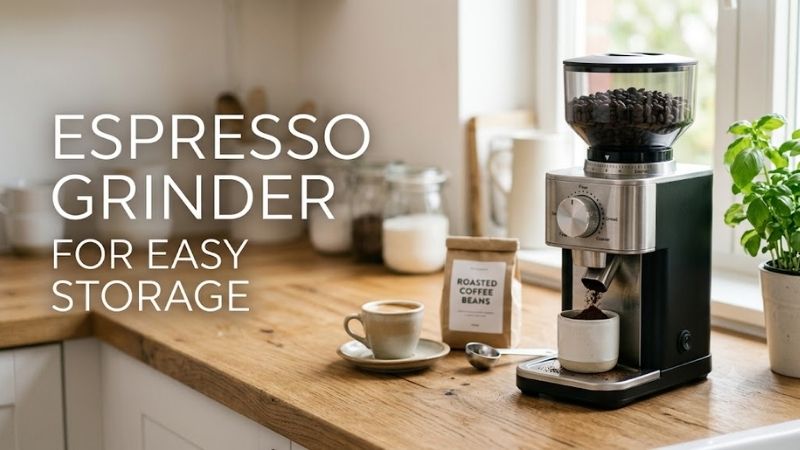
An espresso grinder for easy storage should fit comfortably into a small kitchen without compromising the grind control needed for good espresso. But choosing a compact grinder involves more than checking its dimensions. Burr adjustment, dosing, coffee retention, noise, and maintenance all influence whether it is convenient to use every day. This guide explains how to choose a storage-friendly espresso grinder without sacrificing the features that matter most.
- Quick Verdict: What Is the Best Espresso Grinder for Easy Storage?
- Understanding Why Espresso Needs a Specialized Grinder
- Compact Grinder Types Explained
- Measuring the Complete Grinder
- Vertical Storage vs. Permanent Countertop Placement
- Conical vs. Flat Burrs for Small Kitchens
- Espresso Adjustment Systems
- Understanding Grinder Retention
- Dosing Methods for Compact Grinders
- Noise and Vibration
- Burr Size, Motor Power, and Grinding Speed
- Cleaning a Small Espresso Grinder
- Storage After Cleaning
- Choosing by Coffee Routine
- Budget and Ownership Value
- Common Buying Mistakes
- Frequently Asked Questions
- Conclusion
Quick Verdict: What Is the Best Espresso Grinder for Easy Storage?
For most home baristas with limited counter space, a compact electric burr grinder designed specifically for espresso is the strongest starting choice.
A low-profile or single-dose design may be particularly convenient because it can eliminate the need for a large bean hopper.
However, a smaller grinder is not necessarily easier to maintain or better at producing consistent espresso.
If you have very limited storage space and prepare only one or two shots daily, a high-quality manual espresso grinder may be worth considering. It usually takes up less room and requires no electrical outlet, but fine grinding involves physical effort.
| Grinder Type | Best For | Main Advantage | Main Trade-Off |
|---|---|---|---|
| Compact electric espresso grinder | Regular home espresso | Convenient motorized grinding | Requires outlet and storage space |
| Single-dose electric grinder | Small coffee stations and changing beans | Reduced hopper bulk and flexible dosing | May need separate dosing accessories |
| Compact hopper grinder | Repeated shots using one coffee | Convenient bean storage | Hopper adds height |
| Manual espresso grinder | Minimal storage and occasional use | Portable, no power needed | More time and physical effort |
| All-purpose burr grinder | Espresso plus filter coffee | Supports multiple brew methods | Some compromise in espresso adjustment |
| Integrated espresso machine grinder | Keeping major functions in one housing | Fewer separate appliances | Limited independent upgrade options |
The most practical choice is a grinder that fits your storage location, provides fine espresso adjustment, and can be set up and cleaned without unnecessary work.
Understanding Why Espresso Needs a Specialized Grinder
Espresso Grind Size Is More Demanding
Traditional espresso involves pushing heated water through a compacted bed of finely ground coffee.
The ground coffee creates resistance to water flow.
Small differences in particle size can significantly change extraction time and beverage yield.
If the grind is too coarse, water may move through the puck too quickly. If it is too fine, flow may become excessively restricted.
This means a grinder needs sufficiently fine and repeatable adjustment.
A compact grinder advertised for coffee is not necessarily suitable for espresso.
For a machine using a nonpressurized filter basket, espresso-specific grinding capability should be a core requirement.
Why Burr Grinders Are Usually Preferred
A burr grinder passes beans between shaped grinding surfaces.
Adjusting the distance between those surfaces provides control over particle size.
A blade grinder, by contrast, chops beans through repeated blade contact.
That usually makes precise espresso adjustment more difficult.
A basic blade grinder may be adequate for certain casual brewing situations, but it is not a strong choice for developing a repeatable espresso recipe.
When comparing compact appliances, prioritize genuine burr grinding rather than simply selecting a product labeled electric coffee grinder.
Pressurized vs. Nonpressurized Espresso Baskets
Some beginner espresso machines use pressurized filter baskets.
These add resistance through the basket design and may tolerate a wider range of coffee grinds.
Nonpressurized baskets depend more directly on the grind and coffee puck.
A grinder unsuitable for nonpressurized espresso may still be usable with some pressurized baskets.
However, buying a properly adjustable grinder gives you more flexibility if you later change baskets or upgrade your machine.
Before purchasing, identify which basket system you use.
Compact Grinder Types Explained
Small Electric Burr Grinders
Compact electric grinders offer convenient daily operation.
Their motors eliminate the need to turn a hand crank.
However, the complete dimensions include the hopper, grounds outlet, adjustment dial, and power cord.
A narrow grinder may still be too tall for a low cabinet.
Likewise, a short grinder may occupy considerable counter depth.
The best compact design depends on the shape of your available storage space.
Single-Dose Espresso Grinders
Single dosing involves measuring a particular quantity of whole beans and grinding that portion.
For example, you might weigh 18 grams of coffee for an espresso recipe, place those beans into the grinder, and collect the output.
This approach can reduce dependence on a large bean hopper.
It may also simplify switching between different coffees.
However, single-dose grinders vary in retention, static, and dosing consistency.
A machine marketed as zero retention may still retain some coffee.
Look for credible measurements rather than taking the label literally.
Hopper-Based Espresso Grinders
A hopper grinder stores beans above the burr assembly.
This can be convenient for households using the same coffee repeatedly.
However, the hopper adds height and may make storage beneath cabinets difficult.
Some hoppers can be removed.
Others require beans to be emptied first.
If easy storage is your priority, confirm how the grinder is safely prepared for moving or storing.
Manual Espresso Grinders
A manual espresso grinder can provide fine adjustment in a compact package.
Many fit inside a drawer.
However, grinding espresso-fine coffee by hand can require significant effort.
A grinder that works comfortably for one shot may become inconvenient for four consecutive shots.
Choose manual grinding when its storage benefits outweigh the physical workload.
Measuring the Complete Grinder
Height With the Hopper Installed
Published dimensions often describe the assembled appliance.
Check whether the hopper is included in the stated height.
Also verify how much room is required to open its lid.
A grinder may fit beneath a shelf but still be impossible to refill there.
Width and Depth
Countertop depth matters as much as width.
Some grinders have a narrow body but a projecting dosing platform or portafilter holder.
Others use wide adjustment collars.
Measure the complete footprint, including protruding components.
Dosing Cup Clearance
If the grinder dispenses into a removable cup, ensure you can remove that cup comfortably.
A cramped shelf can make grounds transfer difficult.
For espresso grinders that dispense directly into a portafilter, measure the space required for the portafilter handle.
Power Cord and Outlet Location
A compact grinder still needs safe electrical access.
Check whether the cord exits from the rear, side, or bottom.
Avoid bending or trapping it beneath the appliance.
Do not operate the grinder where water from an espresso machine or sink can reach electrical connections.
Weight and Daily Handling
If you intend to move the grinder into a cabinet after every use, weight becomes important.
A heavier machine may remain stable during grinding but be awkward to lift repeatedly.
Choose a storage arrangement that does not require carrying a heavy appliance above shoulder height.
Vertical Storage vs. Permanent Countertop Placement
When Cabinet Storage Makes Sense
Cabinet storage can free valuable preparation space.
It may be practical when you make espresso only a few times per week.
However, daily setup and cleaning add effort.
If retrieving the grinder requires moving several other appliances, the storage plan may not be realistic.
Drawer Storage
Manual grinders and certain small accessories may fit inside drawers.
Most conventional electric grinders are not designed for drawer storage, especially when the hopper remains attached.
Check the manufacturer’s approved storage orientation.
Do not place heavy objects on delicate adjustment components.
Upright Storage
Some grinders are designed to remain upright.
Do not assume they can be stored on their sides.
Loose beans or grounds may move into unintended areas.
Follow the manual when moving or storing the appliance.
Coffee Station Organization
Consider positioning the grinder next to the espresso machine when space allows.
This reduces the distance needed to transfer coffee.
However, leave enough room for cleaning, adjusting controls, and accessing water tanks.
A compact workstation should support an efficient sequence rather than simply fit as many devices as possible.
Conical vs. Flat Burrs for Small Kitchens
Conical Burr Grinders
Conical burrs are commonly used in compact espresso grinders.
Their geometry can support relatively small grinding assemblies.
However, conical burrs do not guarantee lower retention or quieter operation.
Motor design, chute geometry, alignment, and housing construction all matter.
Flat Burr Grinders
Flat burr grinders are also available in compact designs.
Their grinding characteristics vary according to burr diameter, geometry, and alignment.
Some models require wider housings.
Others are specifically designed for compact home use.
Do not assume that flat burrs are always larger or that they always produce superior flavor clarity.
Which Burr Type Should You Choose?
Choose based on the actual grinder’s performance, adjustment system, dimensions, and maintenance requirements.
Burr geometry is one factor, not the entire buying decision.
For a small kitchen, a grinder that fits comfortably and adjusts reliably may be more valuable than one selected for a theoretical flavor advantage.
Espresso Adjustment Systems
Stepped Adjustment
A stepped grinder uses fixed positions.
This can make settings easy to remember.
However, large steps may create difficulties when dialing in espresso.
If one setting produces a shot that runs too fast and the next is too slow, finer adjustment may be useful.
Stepless Adjustment
Stepless systems allow continuous movement between settings.
This can help make small changes.
However, returning to a previous setting may be less straightforward if the dial lacks clear markings.
Microadjustment
Some grinders offer primary adjustments combined with smaller secondary movements.
This may provide useful control without requiring a fully stepless mechanism.
For espresso, adjustment resolution matters more than a high advertised number of settings.
Adjustment Accessibility
A compact grinder is frustrating if its adjustment dial is blocked by nearby appliances.
Before buying, consider whether you can reach the controls while the grinder is in its normal position.
A top-mounted dial may require overhead clearance.
A side-mounted control may interfere with neighboring equipment.
Calibration
Some grinders support calibration procedures.
However, not every machine is designed for user calibration.
Follow manufacturer instructions.
Do not modify the burr mechanism simply to force a finer setting.
Understanding Grinder Retention
What Is Retention?
Retention is the coffee that remains inside the grinder after a cycle.
Ground coffee can accumulate near the burrs, in the exit chute, or around the dispensing mechanism.
This may create differences between the weight of beans added and the grounds collected.
Why It Matters for Single Dosing
Suppose you add 18.0 grams of beans and collect 17.7 grams of grounds.
The 0.3-gram difference may reflect retained material, although measurement error and other factors also matter.
On a later cycle, some previously retained coffee may be displaced.
This is why low retention and low exchange are not necessarily identical.
Is Zero Retention Realistic?
A marketing claim of zero retention should be treated cautiously.
Actual results depend on the coffee, grind setting, cleaning state, and test procedure.
A grinder can be highly convenient without having literally zero retained coffee.
Bellows and Retention Accessories
Some grinders use bellows to help move retained grounds through the chute.
These may be useful when approved by the manufacturer.
However, they can also create dust or inconsistent results.
Do not fit improvised pressure devices to a grinder.
Retention vs. Cleaning Convenience
A grinder with a small amount of retention may still be easy to maintain.
For everyday users, accessible burrs and a simple chute can matter more than the lowest published retention figure.
Dosing Methods for Compact Grinders
Direct-to-Portafilter Grinding
Some grinders dispense directly into an espresso portafilter.
This may reduce the number of containers used.
However, the holder must fit your portafilter.
Check fork height, handle clearance, and basket size.
Dosing Cups
A dosing cup collects grounds before they are transferred into the basket.
This can be practical for compact single-dose grinders.
However, it introduces another component to store and clean.
Timed Dosing
Timed grinders run for a programmed duration.
Output weight can vary with coffee type, grind setting, and hopper conditions.
A timer can simplify routine operation, but it is not an exact substitute for weighing the dose.
Grind-by-Weight
Some grinders measure grounds using integrated scales.
These systems may improve convenience.
However, they often cost more and may require additional calibration or cleaning.
A separate coffee scale can be a practical alternative for a compact setup.
Noise and Vibration
Does a Smaller Grinder Make Less Noise?
Not necessarily.
A compact grinder can still have a loud motor or resonant housing.
Sound level depends on mechanical design, bean load, and grinding speed.
Choose based on credible measurements when noise matters.
Early-Morning Apartment Use
If you make espresso before other household members wake up, noise is a meaningful factor.
A grinder that runs briefly but loudly may be more disruptive than expected.
A manual grinder avoids electric motor noise but still produces grinding sounds.
Vibration on Lightweight Counters
A grinder may create vibration that transfers into shelves or countertops.
Place it on a stable surface.
Do not use unstable padding or block cooling vents.
Is a Manual Grinder the Quietest Choice?
It can be quieter in some circumstances, but not universally silent.
The trade-off is physical effort.
For frequent espresso preparation, an appropriately quiet electric grinder may be more practical.
Burr Size, Motor Power, and Grinding Speed
Does Bigger Mean Better?
Larger burrs may influence throughput and grinding behavior.
However, burr size alone does not establish superior espresso quality.
Burr geometry, alignment, motor control, and feed behavior are also important.
Motor Wattage
A higher wattage rating does not automatically mean better grinding.
It also does not reveal the motor’s torque at the burrs.
Choose a machine designed for espresso rather than comparing power numbers alone.
Grinding Speed
A faster grinder may reduce preparation time.
However, speed should be evaluated alongside retention, noise, consistency, and heat management.
For one or two daily shots, maximum throughput may not be essential.
Thermal Protection
Compact motors may have operating limits.
Check recommended continuous grinding duration.
If you frequently prepare coffee for guests, a machine designed for repeated batches may be more convenient.
Cleaning a Small Espresso Grinder
Access to the Burr Chamber
Coffee oils and particles accumulate around the burrs.
Some grinders allow removal of an upper burr or carrier for cleaning.
Others require specialized instructions.
Choose a design with clear maintenance guidance.
Cleaning the Grounds Chute
Chutes can collect coffee particles.
A short, accessible chute may be easier to clean, although design details matter.
Use manufacturer-approved brushes and methods.
Hopper and Dosing Cup Cleaning
Removable plastic containers may be washable.
However, they must be completely dry before reassembly.
Never allow water to enter the motor or grinding chamber unless specifically approved.
Dark-Roast Coffee Oils
Some dark-roasted beans have noticeable surface oil.
These oils can contribute to residue.
If you regularly use oily coffee, review the grinder manufacturer’s recommendations.
Cleaning Frequency
Cleaning intervals depend on coffee volume, roast, and machine design.
Follow the manufacturer’s maintenance schedule rather than assuming every grinder requires the same interval.
Storage After Cleaning
Allow Components to Dry
Moisture can damage grinder components or affect coffee movement.
Do not store washed parts while wet.
Protect the Adjustment Mechanism
Avoid stacking heavy accessories on the grinder.
A damaged adjustment collar can compromise usability.
Remove Beans When Appropriate
If the grinder will be unused for a prolonged period, follow instructions for emptying beans and cleaning residue.
Keep the Grinder Away From Humidity
Avoid storing it next to leaking pipes or in damp cabinets.
Coffee grinders contain metal parts and sometimes electronics.
Secure Loose Accessories
Store dosing cups, brushes, and removable hoppers together.
A compact grinder loses some of its space-saving benefit when accessories are scattered across multiple drawers.
Choosing by Coffee Routine
One Espresso Per Day
A compact single-dose electric grinder or manual grinder may be sufficient.
Focus on repeatable adjustment and manageable cleanup.
Two or Three Daily Espressos
An electric espresso grinder may provide better convenience.
A small hopper or single-dose design can still work.
Several Milk Drinks Each Morning
Grinding consistency matters, but workflow speed also becomes important.
Consider direct portafilter dosing and accessible controls.
Switching Between Decaf and Regular Beans
Single dosing can simplify switching coffees.
However, some retained grounds may remain in the machine.
Espresso and Pour-Over in One Household
Choose a grinder that explicitly supports both ranges.
Some espresso-focused grinders are less convenient for coarse filter adjustments.
A separate manual grinder for occasional filter coffee may be another option, although it adds equipment.
Budget and Ownership Value
Entry-Level Compact Espresso Grinders
These can provide useful espresso adjustment at an accessible price.
However, inspect grind resolution and serviceability.
Midrange Grinders
A midrange model may offer better adjustment, lower retention, improved dosing, or quieter operation.
However, prioritize features that affect your actual routine.
Premium Single-Dose Grinders
Premium machines may provide specialized burrs, refined construction, or advanced workflow features.
They are not automatically necessary for a small kitchen.
Replacement Burrs and Parts
Check whether burrs, hoppers, adjustment components, and dosing accessories can be replaced.
When a Manual Grinder Offers Better Value
A manual grinder can deliver capable burr grinding without a motor.
However, the additional effort may be undesirable for frequent use.
Common Buying Mistakes
Choosing Only by Exterior Size
Check actual espresso grind adjustment.
Assuming Every Burr Grinder Makes Espresso
Some are better suited to filter coffee.
Ignoring Hopper and Lid Clearance
The grinder must be accessible when in use.
Believing Zero-Retention Marketing Without Evidence
Retention depends on the test conditions.
Overlooking Noise
A compact grinder can still be loud.
Forgetting Accessory Storage
Dosing cups, brushes, and hoppers also occupy space.
Buying Without Checking Portafilter Fit
Direct-dosing holders may not support every portafilter.
Frequently Asked Questions
What Type of Espresso Grinder Is Easiest to Store?
A compact single-dose electric grinder or suitable manual espresso grinder may be convenient, depending on available storage and daily grinding volume.
Are Small Espresso Grinders as Good as Larger Models?
Some compact grinders can produce excellent espresso. Actual performance depends on burr design, alignment, adjustment, and construction rather than size alone.
Is a Manual Espresso Grinder Worth It?
It can be worthwhile for occasional espresso and minimal storage, but fine grinding requires effort.
Do I Need a Low-Retention Grinder?
Low retention can simplify single dosing and switching coffee beans, but cleaning access and grind quality are equally important.
Can I Store an Espresso Grinder on Its Side?
Only if the manufacturer approves that storage orientation. Loose beans or grounds may shift into unintended areas.
Is a Single-Dose Grinder Better for a Small Kitchen?
It may reduce hopper height and simplify coffee changes, but its actual dimensions, noise, and workflow still need evaluation.
Conclusion
The best espresso grinder for easy storage should combine fine, repeatable grind adjustment with practical dimensions, manageable dosing, and accessible cleaning. Compact electric and single-dose grinders offer strong everyday convenience, while manual grinders can save space for occasional use. Measure the complete setup, account for accessories, and prioritize espresso performance rather than choosing solely by the smallest housing.







Write Your Review
No reviews yet. Be the first to share your experience!