
Choosing a grill pan for apartments means balancing cooking performance with limited storage, ventilation, and counter space. The right pan should fit your stove, cook everyday meals efficiently, and remain manageable to clean. This guide explains which materials, sizes, and features matter most before you buy.
- What makes a grill pan suitable for apartment cooking?
- Choosing the best grill pan material for apartments
- How to choose the right size and shape
- Managing smoke and ventilation in an apartment
- Comparing grill pan features before buying
- Common mistakes apartment cooks should avoid
- Frequently Asked Questions
- Conclusion
What makes a grill pan suitable for apartment cooking?
An apartment-friendly grill pan needs more than raised cooking ridges. It should fit the available burner, provide enough cooking area for typical meals, and remain practical to handle in a compact kitchen. Weight, smoke production, cleaning difficulty, and storage dimensions can matter just as much as the pan’s ability to brown food.
Unlike outdoor grills, stovetop grill pans cook food through direct contact with heated ridges. The raised sections create concentrated areas of browning while the channels between them collect some cooking juices and rendered fat.
This arrangement produces recognizable grill marks, but it does not reproduce the smoke, airflow, or radiant heat of outdoor charcoal grilling. For apartment residents, that difference is important because a grill pan is primarily an indoor cooking tool rather than a complete replacement for a barbecue.
An appropriate pan should support the foods you actually prepare. Chicken breasts, sliced zucchini, asparagus, burgers, and sandwiches can work well on ridged surfaces. However, delicate fish, eggs, and foods requiring uniform contact often cook more effectively in a flat skillet.
Choosing the best grill pan material for apartments
Material selection influences almost every aspect of ownership, including how quickly a pan heats, how heavy it feels, how much maintenance it requires, and how easily food releases from its surface. Apartment cooks should compare these practical differences before focusing on appearance or marketing descriptions.
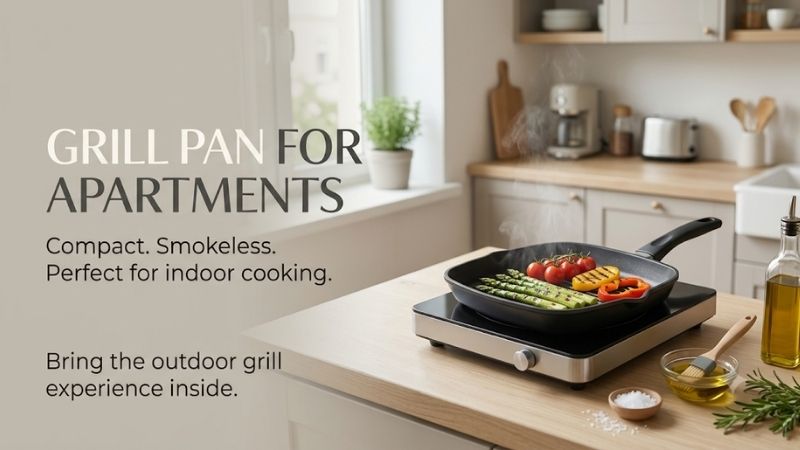
Cast iron grill pans
Cast iron grill pans use thick iron construction to retain heat during cooking, making them particularly suitable for burgers, steaks, and vegetables that benefit from sustained contact with a hot surface. Their main disadvantages are weight, slower temperature adjustments, and the maintenance associated with traditional seasoned finishes.
A conventional cast iron grill pan may take longer to preheat than thinner aluminum cookware. Once heated, however, its thermal mass can help maintain cooking temperature when food is added.
This characteristic is useful when preparing substantial portions of meat, although preheating an empty pan excessively can generate smoke once oil or food contacts the surface.
Traditional cast iron also requires attention after washing. The pan should be dried thoroughly, and a light coating of oil can help protect the seasoned surface during storage.
Advantages:
-
Durable construction with no disposable nonstick coating.
-
Useful heat retention for searing.
-
Many models work on gas, electric, and induction cooktops.
-
Suitable for a broad range of cooking tasks when properly maintained.
Limitations:
-
Heavy compared with many aluminum pans.
-
Cleaning between raised ridges can be inconvenient.
-
Requires appropriate drying and seasoning care.
-
Not particularly comfortable to move when hot.
Best for: Apartment cooks who frequently prepare meat and vegetables and do not mind hand washing their cookware.
Enameled cast iron grill pans
Enameled cast iron combines an iron body with a protective enamel finish that generally eliminates the routine seasoning required by uncoated cast iron. It offers similar heat-retention characteristics while providing a different cleaning and maintenance experience. However, enamel can chip if mishandled, and these pans remain relatively heavy.
Products such as the Le Creuset Signature Square Skillet Grill and Staub Square Grill Pan use enameled cast iron construction.
Their cooking interiors are designed for browning and searing, while the enamel reduces the need for traditional bare-iron seasoning routines.
These products appeal to apartment residents who want heavy-duty cookware but prefer not to maintain a conventional seasoned surface.
The trade-off is cost. Premium enameled cast iron generally requires a larger initial investment than basic seasoned cast iron cookware.
Cleaning also requires some care. Abrasive implements and sudden temperature changes can damage certain finishes, so follow the instructions for the exact pan.
Best for: Home cooks who prioritize long-term usability and reduced seasoning maintenance.
Nonstick aluminum grill pans
Nonstick aluminum grill pans are worth considering when low weight, quick handling, and easier everyday cleanup matter more than maximum heat retention. Aluminum conducts heat efficiently, but actual temperature distribution depends on the pan’s thickness and construction. Nonstick coatings also have specific operating and care restrictions.
A lightweight pan is particularly useful for people who frequently cook single portions, have limited grip strength, or store their cookware in high cabinets.
Nonstick surfaces can make cleanup less frustrating because grease and food residue may release more readily from the channels between ridges.
However, these pans are not necessarily the best choice for very high-temperature searing. Coating temperature limits vary, and overheating can damage the surface.
Buyers should also confirm induction compatibility rather than assuming every aluminum pan will work on an induction cooktop.
Best for: Apartment residents who value convenience, lighter cookware, and easy cleaning.
How to choose the right size and shape
A large grill pan might seem more versatile, but apartment kitchens rarely benefit from cooking surface area that exceeds their available burners or storage space. The ideal dimensions depend on the number of people being served, stove configuration, cabinet depth, and whether the pan will be used regularly or occasionally.
Small round grill pans for one person
Small round grill pans can be convenient when cooking individual servings in studios, dorm-style kitchens, or compact apartments. A smaller footprint makes the pan easier to store and may improve compatibility with small burners, although its limited cooking surface often requires preparing food in separate batches.
The Lodge 6.5 Inch Seasoned Cast Iron Grill Pan illustrates this category.
Its compact size is suited to relatively small portions, such as a single burger patty or a modest serving of vegetables.
The limitation is that food should not be crowded onto the ridges. Overloading the cooking area reduces effective contact and increases moisture accumulation.
A small pan may therefore be convenient for one person but inefficient for cooking several portions.
Medium square grill pans for everyday meals
Square grill pans provide useful cooking space without requiring an excessively large diameter. Their corners can accommodate longer vegetable pieces and rectangular sandwiches, while the raised ridges help create concentrated browning. For many apartment households, a medium square design offers a practical compromise between capacity and storage.
The Lodge 10.5 Inch Square Cast Iron Grill Pan is an example of this format.
Its square outline can make it easier to arrange food compared with a similarly sized round cooking area, although actual capacity depends on interior dimensions and ridge layout.
A medium pan is often easier to manage than a double-burner grill plate.
However, the flat base must still align reasonably well with the burner to distribute heat effectively.
Dual-handle grill pans for compact storage
Dual-handle designs replace a long projecting handle with shorter side handles, which can make a grill pan easier to fit inside cabinets or ovens. This configuration is particularly useful in apartments with shallow drawers, limited wall storage, or crowded stovetops, but both handles may become hot during cooking.
The Lodge Chef Collection Square Grill Pan demonstrates this approach.
Its two side handles reduce the amount of space occupied by a long handle, although the overall width still needs to be measured before purchase.
The design may also make lifting easier when both hands are used with appropriate heat protection.
The main disadvantage is convenience during active stovetop cooking. A long handle generally offers more distance from the burner when repositioning a hot pan.
Managing smoke and ventilation in an apartment
Smoke management is one of the most important considerations when using a grill pan in an apartment. Cooking at unnecessarily high temperatures, overheating oil, and allowing grease to accumulate can produce smoke even when the pan itself is well designed. Choosing the right cooking technique is therefore more important than expecting a particular grill pan to eliminate smoke.
Why grill pans produce smoke indoors
Grill pans produce smoke when fats, cooking residues, or food particles become hot enough to decompose or burn. The recessed channels between ridges may collect rendered fat and juices, and these materials can smoke if the pan is overheated. Ventilation and cooking temperature both influence how noticeable the smoke becomes.
Cast iron’s heat retention can be useful for browning, but it also means the pan does not cool immediately when the burner setting is reduced.
For most apartment cooking, begin with moderate heat and increase it only when necessary.
Avoid preheating an empty pan on maximum heat for extended periods. This can create excessive surface temperatures, especially on powerful electric or induction burners.
Use an appropriate amount of oil rather than pouring unnecessary fat into the ridged surface.
Never leave a hot pan unattended.
Cooking techniques that help reduce smoke
Controlling moisture, fat, and heat can make indoor grilling significantly more manageable. Patting suitable foods dry before cooking supports browning, while moderate oil application reduces the amount of excess fat that can collect between the ridges. These practices can improve results without relying on extreme stovetop temperatures.
For chicken and vegetables, use steady heat and give the food enough time to develop browning before attempting to move it.
For fatty meats, expect more rendered fat and monitor the channels between the ridges.
Avoid repeatedly adding oil to a very hot pan, particularly when the existing oil is already smoking.
If the pan begins smoking excessively, reduce the heat or remove it from the burner when safe to do so.
Use the range hood if available and appropriate. A recirculating hood may help with some airborne grease and odors but does not provide the same ventilation as a properly vented exhaust system.
Never disconnect or disable apartment smoke detectors to accommodate cooking.
Comparing grill pan features before buying
Product features should be evaluated according to their actual contribution to daily cooking rather than their appearance in advertising. Handle design, ridge spacing, base construction, pouring spouts, and cleaning instructions all influence convenience. Some features improve versatility, while others introduce maintenance requirements that may not suit a small household.
| Feature | Practical benefit | Potential drawback |
|---|---|---|
| Raised ridges | Creates concentrated browning and grill marks | Channels require more cleaning |
| Cast iron body | Retains heat effectively | Relatively heavy |
| Enameled finish | Usually needs no traditional seasoning | Can chip if mishandled |
| Nonstick coating | Can simplify food release | Temperature and utensil restrictions |
| Dual handles | Compact storage profile | Both handles may become hot |
| Pouring spouts | Help remove cooking liquids | Do not eliminate splashing risks |
| Square cooking surface | Useful for sandwiches and vegetables | Must fit the available burner |
| Oven compatibility | Supports additional cooking methods | Varies by exact model |
Cooktop compatibility and burner contact
A grill pan should be compatible with the specific cooking surface in your apartment, whether that is gas, electric coil, radiant glass, or induction. Cooktop compatibility depends on the pan’s material, base construction, and manufacturer instructions, while burner size influences how evenly the cooking surface receives heat.
For induction stoves, the pan must have a suitable magnetic base.
Most conventional cast iron pans are naturally compatible with induction, but users should still follow their cooktop’s instructions regarding weight, movement, and surface protection.
Lightweight aluminum cookware requires an induction-compatible base to work on induction burners.
On glass cooktops, avoid dragging heavy cast iron across the surface.
Also consider whether the pan’s bottom is sufficiently flat for stable contact.
Cleaning requirements and long-term maintenance
Cleaning a grill pan involves removing residue from both the raised ridges and the recessed channels, making the process more demanding than cleaning a flat skillet. Coating type, surface texture, and manufacturer instructions determine which brushes, detergents, and cleaning methods are appropriate.
For traditional seasoned cast iron, let the pan cool sufficiently before washing.
Remove food residue using suitable cleaning tools, wash according to the manufacturer’s guidance, dry completely, and maintain the seasoning as directed.
Enameled cast iron generally does not need traditional seasoning, but avoid aggressive scraping that could damage the finish.
For nonstick cookware, use gentle cleaning tools to protect the coating.
Even when a manufacturer labels a pan dishwasher-safe, hand washing may help preserve its appearance and cooking surface.
Common mistakes apartment cooks should avoid
Many disappointing grill pan experiences result from mismatched expectations or improper handling rather than a fundamentally defective product. An oversized pan, inappropriate cooking temperature, incompatible burner, or unsuitable cleaning tool can make an otherwise useful purchase frustrating. Understanding these mistakes helps apartment residents avoid unnecessary expense.
Buying a grill pan that is too large
A large cooking surface is not automatically better in a small apartment because the usable area depends on burner coverage, available workspace, and storage. Oversized pans can heat unevenly on small burners and become awkward to wash in compact sinks, particularly when their handles extend beyond the basin.
Measure your largest burner before selecting a pan.
Then check the product’s total dimensions, including its handles.
A compact pan that fits your stove and cabinets can be more practical than a larger pan used only occasionally.
Expecting outdoor barbecue results
A stovetop grill pan can create distinctive sear marks and browned surfaces, but it does not provide the full environment of an outdoor charcoal or gas grill. Smoke exposure, direct flames, radiant heat, and airflow differ substantially, so the resulting flavor and cooking characteristics will not be identical.
If your main goal is a uniformly browned steak crust, a flat heavy skillet may be more effective because more of the food contacts the cooking surface.
A grill pan is better suited when its ridged cooking pattern and grease channels provide a meaningful benefit.
Avoid buying one solely because you expect authentic charcoal-grilled flavor.
Ignoring safe cooking temperatures
Grill marks are not a reliable indication that food has reached a safe internal temperature. Thick chicken breasts, burgers, and other proteins can appear browned on the outside while remaining undercooked inside, particularly when cooked over excessive heat.
Use an appropriate food thermometer.
For example, poultry should reach a safe internal temperature of 165°F, while ground meats have different requirements depending on the type.
Insert the thermometer into the thickest relevant section of the food, away from the pan’s surface.
Follow current food-safety guidance for the particular ingredient.
Frequently Asked Questions
Apartment residents often have practical questions about smoke, induction compatibility, pan size, and maintenance before purchasing a grill pan. These concerns are especially important when working with limited ventilation or shared living spaces, where cooking inconvenience can affect more than the person preparing the meal.
Is a cast iron grill pan good for a small apartment?
A cast iron grill pan can work well in a small apartment when the owner has sufficient storage space, a compatible stovetop, and the ability to manage its weight and cleaning requirements. Its heat retention supports browning, but its ridged surface and relatively heavy construction make it less convenient than some alternatives.
Choose a medium or small model based on the number of portions you usually prepare.
If you rarely grill food indoors, a flat cast iron skillet may provide greater overall versatility.
Can I use a grill pan on an induction stove?
Many cast iron grill pans work on induction cooktops because cast iron is magnetic, but compatibility should still be confirmed for the exact product. Aluminum pans generally require a suitable magnetic base, while an uneven bottom or excessively large pan may reduce practical cooking performance.
Check the manufacturer’s compatibility statement.
Also ensure the base sits stably on your cooktop and falls within its supported cookware dimensions.
How do I clean burnt food from grill pan ridges?
Burnt residue can accumulate inside the grooves of a grill pan, especially when cooking marinades containing sugar or preparing fatty meats. Cleaning methods should depend on the pan’s finish because a tool suitable for seasoned cast iron may damage a nonstick coating or enamel surface.
Allow the pan to cool before cleaning.
Use warm water and manufacturer-approved cleaning tools.
Avoid sudden temperature changes, particularly with enameled cookware.
Dry seasoned cast iron thoroughly after washing.
Are grill pans better than flat skillets?
Grill pans and flat skillets serve different cooking purposes. A grill pan concentrates contact on raised ridges and can allow some fat to collect below the food, while a flat skillet generally provides broader contact for even browning, sauces, eggs, and many delicate ingredients.
Choose a grill pan for foods that benefit from the ridged format.
Choose a flat skillet when you need a versatile everyday cooking surface.
In a very small kitchen, the flat skillet is usually the more flexible first purchase.
Conclusion
The right grill pan for apartments depends on your available space, cooktop, cooking habits, and willingness to maintain the pan. A medium seasoned cast iron grill pan is a practical option for frequent searing, while enameled cast iron offers reduced seasoning maintenance and nonstick aluminum may be easier to handle and clean. Prioritize burner compatibility, manageable dimensions, ventilation, and safe cooking techniques over appearance or exaggerated performance claims.



Write Your Review
No reviews yet. Be the first to share your experience!