
A quality stainless steel cookware set provides durable pots and pans for boiling, sautéing, searing, and preparing everyday meals. However, fully clad and encapsulated-base designs differ in construction, heat distribution, weight, and cost. This guide compares six identifiable cookware collections and explains how to select the right assortment for your household.
- Quick verdict: Which stainless steel cookware set is best?
- Quick comparison table
- How we selected these stainless steel cookware sets
- Detailed stainless steel cookware set recommendations
- Buying guide: How to choose stainless steel cookware
- How to cook successfully with stainless steel
- Cleaning and maintaining stainless steel cookware
- Common mistakes when buying stainless steel cookware
- Frequently Asked Questions
- Conclusion
Quick verdict: Which stainless steel cookware set is best?
The most useful stainless steel cookware set should offer essential cooking vessels without unnecessary duplication. Fully clad cookware is attractive for versatile frying and sautéing, while impact-bonded collections may provide a more affordable way to equip a kitchen. Premium construction is valuable only when it supports the recipes and techniques you regularly use.
| Category | Recommended set | Main reason |
|---|---|---|
| Best overall | All-Clad D3 Stainless 10-Piece Set | Fully bonded tri-ply construction |
| Best value-oriented fully clad set | Tramontina Tri-Ply Clad 10-Piece Set | Versatile induction-compatible cookware |
| Best larger collection | Cuisinart MultiClad Pro 12-Piece Set | Broad selection of cooking vessels |
| Best budget-oriented stainless steel | Cuisinart Chef’s Classic 11-Piece Set | Encapsulated-base construction |
| Best premium five-ply | All-Clad D5 Brushed Stainless 10-Piece Set | Five-ply bonded construction |
| Best family-size assortment | All-Clad D3 Everyday Family-Sized 10-Piece Set | Larger skillets and stockpot |
For a household replacing its cookware, the All-Clad D3 and Cuisinart MultiClad Pro collections are particularly versatile. Tramontina is worth considering when practical construction and value are priorities.
Quick comparison table
Cookware sets should be evaluated by the number and size of actual cooking vessels, their material construction, and the intended stovetop. Lids count toward advertised piece totals, so a twelve-piece set does not necessarily contain twelve pots and pans. The following comparison focuses on functional differences rather than marketing terminology.
| Set | Pieces | Construction | Induction | Best for |
|---|---|---|---|---|
| All-Clad D3 Stainless | 10 | Fully clad tri-ply | Yes | Everyday versatile cooking |
| Tramontina Tri-Ply Clad | 10 | Fully clad tri-ply | Yes | Value-conscious buyers |
| Cuisinart MultiClad Pro | 12 | Fully clad triple-ply | Yes | Larger assortments |
| Cuisinart Chef’s Classic | 11 | Stainless steel with encapsulated base | Yes | Entry-level stainless |
| All-Clad D5 Brushed | 10 | Fully bonded five-ply | Yes | Premium construction |
| All-Clad D3 Everyday Family-Sized | 10 | Fully clad tri-ply | Yes | Larger family meals |
How we selected these stainless steel cookware sets
The recommendations focus on identifiable manufacturer product lines and documented specifications. Important criteria include cooking-surface construction, aluminum or other conductive layers, induction compatibility, included vessel sizes, handle design, oven limits, and cleaning requirements. The comparisons are editorial assessments, not results from personally conducted cooking tests.
A cookware collection should support the tasks performed most often.
For many households, this means frying vegetables and proteins, preparing sauces, boiling pasta, and cooking soups or stews.
An expensive collection with several redundant pans may provide less practical value than a smaller assortment containing the right sizes.
We also considered how cookware construction influences cooking techniques.
Fully clad pans can provide more consistent sidewall heating during suitable cooking tasks, while impact-bonded base cookware can work well for boiling and ordinary saucepan use.
Neither design should be treated as automatically superior for every recipe.
Detailed stainless steel cookware set recommendations
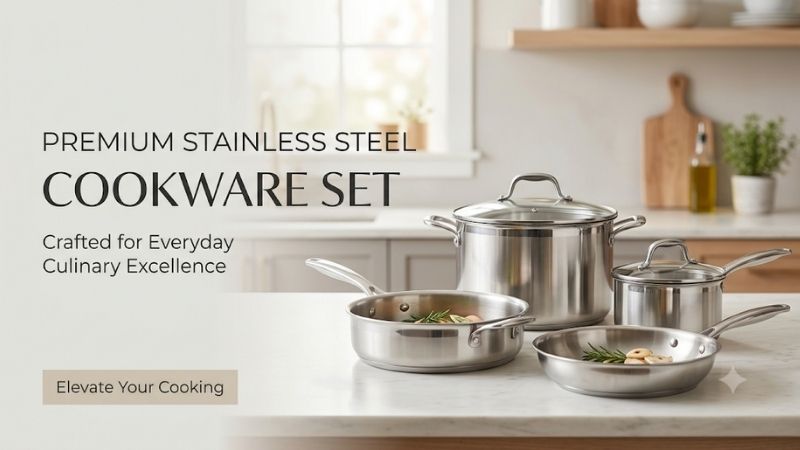
These six sets address different buying priorities, including affordability, premium construction, limited kitchen space, and family cooking. All provide stainless steel cooking surfaces, but the structure of the cookware body and included pieces differ. The following reviews explain which features may justify choosing one collection over another.
All-Clad D3 Stainless 10-Piece Set — Best overall
The All-Clad D3 Stainless 10-Piece Cookware Set uses a fully bonded tri-ply structure with stainless steel surrounding an aluminum core. This construction extends through the vessel rather than relying exclusively on a conductive disk at the bottom, making it useful for a broad range of cooking techniques.
Best for: Regular home cooks who want long-term stainless steel cookware.
Why we picked it: Its fully bonded construction and well-rounded assortment provide a practical foundation for varied cooking.
Key specifications:
-
Ten-piece set.
-
Fully bonded tri-ply construction.
-
Stainless steel cooking interior.
-
Aluminum core.
-
Induction compatible.
-
Oven and broiler safe up to 600°F.
-
Hand washing required by the manufacturer.
-
Limited lifetime warranty.
Features and benefits
The aluminum core helps distribute heat through the cooking vessel.
The stainless steel cooking surface can withstand appropriate browning and deglazing techniques.
Riveted handles provide stable attachment.
The collection includes useful frying and covered cooking vessels.
Performance and practical use
For everyday cooking, the set can prepare soups, pasta, sauces, vegetables, and proteins.
Stainless steel supports fond development when searing meat, allowing pan sauces to be prepared afterward.
However, the cooking surface requires proper preheating and sufficient cooking fat for delicate foods.
What makes it different: Fully bonded construction and a broad general-purpose assortment.
Pros: Durable cooking surfaces, useful versatility, and induction compatibility.
Cons: Premium investment and more demanding egg cooking than nonstick.
Buy if: You cook frequently and appreciate stainless steel technique.
Skip if: You mainly want low-maintenance nonstick cookware.
Tramontina Tri-Ply Clad 10-Piece Set — Best value-oriented fully clad option
The Tramontina Tri-Ply Clad Stainless Steel 10-Piece Cookware Set uses 18/10 stainless steel, an aluminum core, and a magnetic stainless steel exterior. Its fully clad construction supports induction and conventional cooktops, while the assortment covers essential cooking tasks without requiring a premium-priced collection.
Best for: Households seeking practical stainless steel cookware.
Why we picked it: It provides useful tri-ply construction and everyday vessel sizes.
Key specifications:
-
Ten-piece collection.
-
Fully clad tri-ply construction.
-
18/10 stainless steel interior.
-
Aluminum core.
-
Magnetic stainless steel exterior.
-
Tempered glass lids.
-
Induction compatible.
-
Dishwasher safe.
-
Oven safe up to 350°F in the referenced configuration.
Features and benefits
The aluminum core assists heat distribution.
The magnetic exterior supports induction cooking.
Glass lids allow some visual monitoring of simmering foods.
Its riveted handles provide secure attachment.
Performance and practical use
The set supports ordinary boiling, sautéing, simmering, and frying.
Its principal attraction is practical fully clad construction in a more accessible product category.
However, the glass-lid configuration has lower stated oven-temperature limits than some premium stainless steel collections.
What makes it different: Fully clad construction with a value-oriented assortment.
Pros: Induction compatibility, dishwasher-safe components, and practical cooking sizes.
Cons: Glass-lid temperature restrictions and potential condensation during cooking.
Buy if: You want fully clad stainless steel without prioritizing a premium brand.
Skip if: You need a collection with higher oven-safe limits.
Cuisinart MultiClad Pro 12-Piece Set — Best larger assortment
The Cuisinart MultiClad Pro Triple Ply Stainless 12-Piece Cookware Set, model MCPS-12N, combines stainless steel and an aluminum core in a fully clad construction. Its broad assortment is designed to support tasks ranging from reheating small portions to preparing family-size main courses and side dishes.
Best for: Households replacing most existing cookware.
Why we picked it: It offers an extensive collection with practical construction and compatibility.
Key specifications:
-
Model: MCPS-12N.
-
Twelve-piece assortment.
-
Triple-ply construction.
-
Aluminum core.
-
Stainless steel interior and exterior.
-
Induction compatible.
-
Oven safe up to 500°F.
-
Dishwasher safe.
-
Stainless steel lids.
Features and benefits
The bonded construction helps distribute heat through the cooking vessel.
The included cookware supports numerous cooking methods.
Stainless steel lids are durable and useful for simmering and covered cooking.
The manufacturer also lists sealed rims intended to improve durability and pouring.
Performance and practical use
For larger households, the assortment can accommodate simultaneous cooking tasks.
A skillet can brown proteins while a saucepan prepares sauce and a stockpot handles pasta.
However, the number of pieces increases storage requirements.
Buyers should evaluate the included sizes before purchasing.
What makes it different: Broad fully clad stainless steel assortment.
Pros: Versatile pieces, induction compatibility, and stainless steel lids.
Cons: Larger storage footprint and possible overlap with existing cookware.
Buy if: You want a nearly complete stainless steel kitchen collection.
Skip if: You only need a few replacement pans.
Cuisinart Chef’s Classic 11-Piece Set — Best budget-oriented option
The Cuisinart Chef’s Classic Stainless 11-Piece Cookware Set uses stainless steel construction with an aluminum-encapsulated base rather than fully bonded cladding throughout the entire vessel. This arrangement provides a practical approach to stainless steel cooking, particularly for boiling, simmering, and general household tasks.
Best for: Buyers entering stainless steel cookware.
Why we picked it: Its construction offers a more accessible alternative to fully clad premium collections.
Key characteristics:
-
Eleven-piece assortment.
-
Stainless steel cooking surfaces.
-
Aluminum-encapsulated base.
-
Matching lids.
-
Multipurpose pots and pans.
-
Manufacturer-supported conventional and induction stovetop use for the referenced collection.
Features and benefits
The encapsulated aluminum base helps distribute heat beneath the cooking surface.
The stainless steel interior supports ordinary boiling and sauce preparation.
The collection includes useful everyday vessels without requiring fully clad construction.
Performance and practical use
For soups, pasta, and simmering, an encapsulated base can be effective.
However, during recipes involving substantial sidewall heating, fully clad designs may provide different temperature distribution.
Buyers should not assume every stainless steel pot responds identically to direct heat.
What makes it different: Encapsulated-base construction in a value-focused collection.
Pros: Practical assortment, familiar stainless steel surface, and accessible construction.
Cons: Less extensive sidewall cladding than fully bonded sets.
Buy if: You want a foundational stainless steel set.
Skip if: Fully clad sidewall construction is a priority.
All-Clad D5 Brushed Stainless 10-Piece Set — Best premium five-ply option
The All-Clad D5 Brushed Stainless 10-Piece Cookware Set uses five bonded layers in its cookware construction. Its stainless steel cooking surface, brushed exterior, and induction compatibility make it relevant for experienced cooks who want premium multilayer cookware and a coordinated set of essential vessels.
Best for: Experienced home cooks who prefer premium stainless steel.
Why we picked it: It offers a construction approach distinct from tri-ply collections.
Key characteristics:
-
Ten-piece collection.
-
Five-ply bonded construction.
-
Stainless steel cooking surface.
-
Brushed stainless steel exterior.
-
Induction compatible.
-
Oven-compatible construction.
-
Riveted stainless steel handles.
Features and benefits
The multilayer construction affects how the vessel absorbs, distributes, and responds to heat.
The stainless steel cooking surface supports searing, deglazing, and sauce preparation.
The brushed exterior offers a different finish from mirror-polished cookware.
Performance and practical use
The collection can handle a broad range of stovetop recipes.
However, five-ply construction does not automatically guarantee better results than a well-designed tri-ply pan.
Weight, thickness, and specific metal layering matter.
The added cost should be justified by personal preferences and intended use.
What makes it different: Five-ply construction and premium finish.
Pros: Durable stainless steel, induction compatibility, and broad versatility.
Cons: Higher cost and potentially heavier cookware.
Buy if: You value premium multilayer construction.
Skip if: A practical tri-ply set already meets your cooking needs.
All-Clad D3 Everyday Family-Sized 10-Piece Set — Best for family meals
The All-Clad D3 Everyday Family-Sized 10-Piece Set uses fully bonded tri-ply construction with larger vessels suited to cooking substantial household portions. Its 10.5- and 12.5-inch skillets and 8-quart stockpot are particularly useful when preparing multiple servings.
Best for: Families and frequent batch cooking.
Why we picked it: Its larger cooking vessels directly support family-size meals.
Key specifications:
-
Ten-piece set.
-
Fully bonded tri-ply stainless steel.
-
Induction compatible.
-
Large 10.5-inch and 12.5-inch skillets.
-
Large sauté pan.
-
8-quart stockpot.
-
Oven and broiler compatible up to 600°F.
-
Hand washing required.
Features and benefits
The larger skillets provide room for cooking substantial portions.
The stockpot supports pasta, soups, and batch meals.
The cookware’s bonded construction enables versatile cooking techniques.
Performance and practical use
A family-size assortment can reduce the need to cook multiple batches when the stove provides adequate heating area.
However, large vessels are heavy and require additional storage space.
Their bases must also suit the available induction or conventional burners.
What makes it different: Family-oriented vessel sizes within the D3 construction family.
Pros: Large cooking capacity, versatile cookware, and induction compatibility.
Cons: Bulky and potentially excessive for smaller households.
Buy if: You regularly prepare meals for a family.
Skip if: You cook mostly single portions.
Buying guide: How to choose stainless steel cookware
The best stainless steel cookware set should provide the right vessels for your meals, construction appropriate for your cooking methods, and manageable cleaning requirements. Buyers should evaluate the cooking surface, conductive core, base compatibility, and piece selection rather than focusing exclusively on the advertised piece count.
Understanding stainless steel grades
Stainless steel cookware commonly uses grades designed for corrosion resistance and food contact. The term 18/10 generally refers to a stainless steel composition containing approximately 18% chromium and 10% nickel, although cookware may use different grades in different layers.
A cooking vessel can combine an 18/10 interior with magnetic stainless steel on the outside.
This arrangement supports corrosion resistance and induction compatibility.
However, an 18/10 label does not establish every performance characteristic.
Construction quality, thickness, and base design remain important.
Fully clad versus encapsulated-base cookware
Fully clad cookware uses bonded metal layers across the cooking vessel.
Encapsulated-base designs concentrate conductive layers in the bottom.
Both can prepare everyday meals successfully.
Fully clad construction can be useful when heating across the sidewalls matters.
Encapsulated-base cookware may provide a more affordable option for boiling and simmering.
Choose according to recipes and budget rather than assuming one design is universally necessary.
Choosing between three-ply and five-ply
Three-ply cookware commonly uses three bonded metal layers.
Five-ply construction incorporates additional layers.
However, layer count does not independently determine heat distribution or cooking performance.
The actual metals, thicknesses, and overall design matter.
For many households, a quality tri-ply set already provides excellent versatility.
Selecting useful pan sizes
A practical cookware collection should include a skillet suitable for ordinary portions, a saucepan for smaller liquid preparations, and a stockpot for larger cooking tasks.
An 8-inch skillet is convenient for small portions.
A 10-inch skillet provides more flexibility.
A larger skillet may be helpful for families.
A 2- or 3-quart saucepan supports sauces and grains.
A 6- or 8-quart stockpot provides room for soups and pasta.
Avoid unnecessary duplication.
Cooktop compatibility
Not all stainless steel cookware is induction-compatible.
Induction requires a suitable magnetic base.
Check the manufacturer’s specifications for the exact model.
Also compare the pan’s base diameter with the cooking zone.
For glass cooktops, use stable, flat-bottom cookware and avoid dragging heavy pans across the surface.
Handles and lid materials
Handle design affects grip comfort and safe movement.
Riveted metal handles are common in stainless steel cookware.
However, they can become hot during prolonged heating or oven use.
Glass lids provide some visibility but may have lower oven-temperature limits.
Stainless steel lids are durable, although their temperature limits must still be verified.
Dishwasher compatibility
Some stainless steel cookware collections are dishwasher-safe, while others are listed as hand wash only.
For example, Cuisinart MultiClad Pro and the referenced Tramontina Tri-Ply Clad configuration permit dishwasher cleaning.
All-Clad D3 specifies hand washing.
Always follow manufacturer instructions.
Dishwasher compatibility does not guarantee that every cleaning cycle will preserve the cookware’s appearance.
How to cook successfully with stainless steel
Stainless steel cookware offers versatile cooking surfaces but requires appropriate heat management. Foods can adhere when cooking temperature, surface preparation, or timing is unsuitable. Understanding these characteristics improves browning, food release, and cleanup without requiring special products.
Preheat the pan correctly
Begin with a suitable heat setting rather than maximum burner power.
Allow the pan to warm gradually.
Use cooking fat appropriate for the recipe.
Avoid prolonged empty heating.
Induction cooktops may heat suitable cookware rapidly, making careful adjustment especially important.
Develop browning without burning food
Stainless steel can support the development of browned residues that contribute flavor to sauces.
When cooking meat, allow sufficient contact time.
Avoid moving the food continuously before browning develops.
If residue begins burning, reduce the heat.
Do not assume that a dark surface always indicates desirable browning.
Deglaze for pan sauces
After cooking suitable proteins, browned residues may remain on the pan.
These can be loosened with an appropriate liquid.
Use a recipe suitable for the pan and ingredients.
Scrape gently with a compatible utensil.
Reduce the sauce according to the intended consistency.
Simmer without scorching
Saucepans and stockpots are useful for soups, grains, and sauces.
Use appropriate heat settings.
Stir foods that are prone to sticking.
Monitor liquid levels.
Do not leave a pot unattended when scorching or boiling dry is possible.
Cleaning and maintaining stainless steel cookware
Stainless steel is durable, but it can develop discoloration, mineral deposits, and browned cooking residue. These changes are often cosmetic, although severe overheating and improper cleaning can damage cookware. Regular maintenance helps preserve appearance and usability.
Remove ordinary food residue
Allow cookware to cool safely.
Wash using suitable detergent and warm water.
Use nonabrasive cleaning tools when recommended.
For stubborn residue, follow the manufacturer’s cleaning instructions.
Avoid sudden temperature shocks.
Understand rainbow discoloration
Stainless steel can develop rainbow-like discoloration after exposure to heat.
This does not automatically mean the cookware is defective.
However, cleaning methods should remain appropriate for the specific finish.
Use manufacturer-approved stainless steel cleaners when necessary.
Prevent mineral deposits
Hard water can leave visible marks after boiling.
Dry cookware after washing to reduce water spotting.
Avoid allowing concentrated mineral deposits to accumulate for extended periods.
Follow care instructions for removing persistent deposits.
Store cookware without damaging surfaces
Stack pots and pans carefully.
Avoid placing sharp objects directly inside polished cookware.
Protect lids from impact.
Ensure the storage arrangement is stable.
Heavy pieces should be positioned where they can be lifted safely.
Common mistakes when buying stainless steel cookware
A cookware set can appear comprehensive while lacking the particular pans a household needs. Buyers may also confuse stainless steel grade with overall construction quality or assume that higher prices always translate into better cooking performance.
Buying based on piece count alone
Piece totals frequently include lids.
A twelve-piece set may contain fewer than twelve cooking vessels.
Examine the complete assortment.
Compare actual pot and pan sizes.
Avoid buying pieces you will rarely use.
Assuming stainless steel is nonstick
Stainless steel generally requires cooking fat and suitable technique for delicate foods.
It does not behave like a manufactured nonstick coating.
For eggs and similar recipes, a separate coated skillet may be convenient.
Ignoring cookware weight
Fully clad and larger stainless steel cookware can be heavy.
Consider lifting comfort, cabinet access, and sink dimensions.
A large collection is not useful when the cookware is too awkward for everyday handling.
Assuming every product works on induction
Induction compatibility depends on magnetic base construction.
Check the exact product.
Do not rely solely on a stainless steel label.
Frequently Asked Questions
Stainless steel cookware buyers commonly ask whether the material is safe, how much cookware they need, and whether a premium collection is worth the investment. The most useful answers focus on construction, intended recipes, and proper operating practices rather than treating every stainless steel set as identical.
Is stainless steel cookware good for everyday cooking?
Yes. Stainless steel supports boiling, simmering, sautéing, searing, and numerous other techniques.
However, delicate foods may require careful heat and fat management.
Is tri-ply stainless steel worth buying?
Tri-ply cookware can offer useful heat distribution and durability.
Its value depends on construction quality, included pieces, and how frequently the cookware is used.
Can stainless steel cookware go in the oven?
Many stainless steel cookware products are oven-compatible, but the temperature limit depends on the exact pan and any attached lid or components.
Check manufacturer instructions.
Does stainless steel cookware contain nickel?
Some food-contact stainless steel grades contain nickel, while others have different compositions.
Buyers with particular material sensitivities should verify the manufacturer’s specifications for the exact product.
How many cookware pieces do I really need?
Many households can cook effectively with one or two skillets, one or two saucepans, a larger pot, and suitable lids.
Additional cookware is useful when it serves distinct cooking functions.
Is expensive stainless steel cookware always better?
No. Higher cost may reflect construction, manufacturing, or brand positioning, but actual usefulness depends on cooking requirements, compatibility, and durability.
A well-selected midrange set may be sufficient for many kitchens.
Conclusion
The best stainless steel cookware set should provide useful cookware sizes, durable construction, and compatibility with your stovetop. The All-Clad D3 Stainless 10-Piece Set offers a versatile fully bonded collection, while Tramontina Tri-Ply Clad provides a practical alternative. Cuisinart MultiClad Pro suits buyers who want a broader assortment, and Cuisinart Chef’s Classic offers an encapsulated-base approach. Families may benefit from larger D3 Everyday cookware, while experienced cooks may prefer D5 construction. Choose based on the pieces you actually need, realistic maintenance requirements, and cooking techniques rather than assuming that more layers or a higher price automatically produce better results.


Write Your Review
No reviews yet. Be the first to share your experience!