
Choosing a glass cooking pot for beginners on a budget requires more than finding an attractive transparent saucepan. Glass cookware varies in heat resistance, stovetop compatibility, capacity, and durability. This guide explains how to identify suitable materials, avoid unsafe purchases, and select affordable cookware for everyday meals.
- Quick answer: What glass cooking pot should beginners buy?
- Why choose a glass cooking pot as a beginner?
- Understanding glass cookware materials before buying
- How to choose an affordable glass cooking pot
- Practical glass cookware options for budget-conscious beginners
- Cooking techniques every beginner should learn
- Common mistakes that waste money
- Frequently Asked Questions
- Conclusion
Quick answer: What glass cooking pot should beginners buy?
Beginners should choose a glass cooking pot based on their heating equipment, usual portion sizes, and ability to follow the manufacturer’s care instructions. A modestly sized pot with clearly documented stovetop compatibility is generally a more practical purchase than a large decorative glass vessel with uncertain specifications or exaggerated heat-resistance claims.
For individuals and couples, a pot holding approximately 1.5 to 2.5 liters is a useful starting point for soups, oatmeal, sauces, and vegetables. A smaller vessel works for single portions, while larger households may benefit from additional capacity.
Consider two main material categories:
-
Glass-ceramic cookware: Certain purpose-built products, such as the Visions range, are designed for compatible stovetop cooking.
-
Borosilicate glass cookware: Some specially designed products can be heated on suitable stovetops, although requirements vary by model.
Ordinary oven-safe glass bakeware is not necessarily stovetop-safe. This distinction is particularly important for beginners shopping through online marketplaces where product descriptions may be incomplete.
If the budget is extremely limited, a conventional stainless steel saucepan may provide greater practical versatility than an inexpensive glass pot of uncertain quality.
The objective is to purchase cookware that suits your kitchen rather than buying glass simply because its appearance is appealing.
Why choose a glass cooking pot as a beginner?
Glass cookware provides a different cooking experience from conventional metal pots because the transparent walls allow ingredients and liquid levels to remain visible. This characteristic is helpful for people learning to manage simmering, evaporation, and food consistency. Nevertheless, glass requires appropriate handling and should not be treated as indestructible or universally compatible with kitchen appliances.
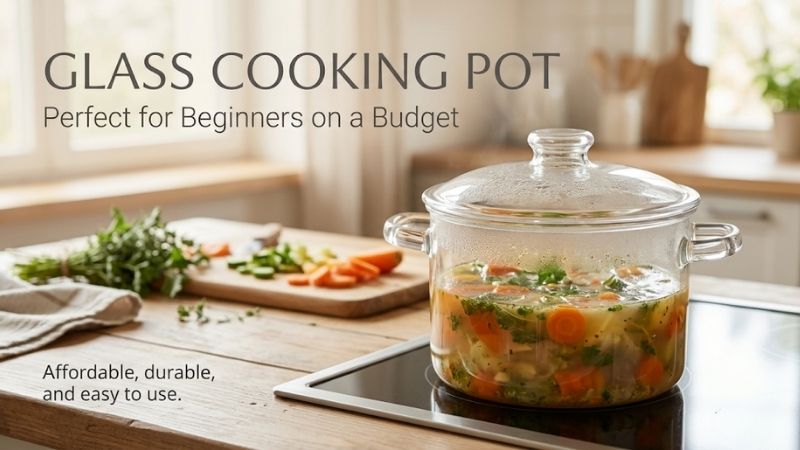
Transparent walls help you monitor the cooking process
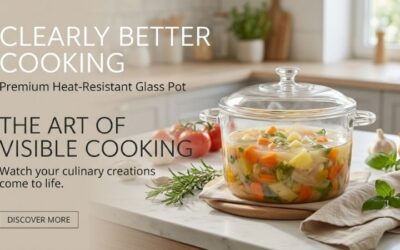
One of the most useful features of a transparent glass pot is the ability to observe ingredients while they heat. Beginners can see when water begins bubbling, how a sauce changes consistency, and whether ingredients are accumulating against the bottom or sides of the cooking vessel.
For example, oatmeal thickens as starch absorbs liquid. A transparent pot allows you to observe this process from the side, making it easier to recognize changes before the mixture becomes excessively thick.
When preparing soup, you can also monitor the amount of liquid remaining without constantly lifting the lid.
This does not eliminate the need for stirring. Foods such as milk-based sauces, rice, and porridge may still stick or scorch, even when the vessel is transparent.
Visibility also does not provide a reliable measurement of food temperature. When preparing meat, poultry, or other temperature-sensitive foods, use an appropriate food thermometer.
For beginners, transparent cookware is most beneficial when combined with moderate heat, regular observation, and suitable cooking techniques.
Nonporous surfaces simplify everyday maintenance
Glass and glass-ceramic cookware have nonporous surfaces that can be convenient for preparing soups, sauces, and vegetables. Unlike traditional seasoned cast iron, these materials do not require an intentionally maintained oil-based seasoning layer to protect the cooking surface.
This can simplify maintenance for beginners who want to wash their cookware after meals without performing additional seasoning procedures.
Glass cookware is also useful when preparing foods containing tomatoes, lemon juice, or vinegar, provided the product is designed for the intended cooking application.
The material itself does not depend on a conventional nonstick coating, although this does not mean food can never adhere to its surface.
Thick sauces and ingredients containing starch can still burn when heated excessively or left without stirring.
Cleaning requires care because abrasive tools may scratch certain glass surfaces, while impact damage can compromise the vessel’s integrity.
Use the cleaning methods recommended for the exact product and inspect the pot regularly for chips or cracks.
A versatile pot can reduce unnecessary purchases
Beginners often buy too many kitchen products before understanding their actual cooking habits. A suitable glass cooking pot may handle several everyday tasks, including preparing vegetables, simmering soup, reheating sauces, and making oatmeal.
Choosing one appropriately sized vessel can be more economical than purchasing multiple specialized pots for occasional recipes.
For example, a 2-liter pot may be adequate for a person who cooks breakfast porridge, prepares small batches of soup, and reheats leftovers.
However, glass cookware is not automatically suitable for high-temperature frying, aggressive searing, or induction cooking.
A glass pot cannot replace every skillet, saucepan, or Dutch oven.
Before purchasing, identify the dishes you prepare regularly and determine whether the pot is approved for those methods.
If most meals involve frying eggs, browning meat, and stir-frying vegetables, a stainless steel or nonstick skillet may deserve higher priority.
Versatility should be judged by cooking compatibility, not merely the number of uses advertised.
Understanding glass cookware materials before buying
The term glass cookware describes several materials with different thermal characteristics and manufacturing processes. Two vessels may appear nearly identical but have very different permitted uses. Beginners should understand the distinction between glass-ceramic, borosilicate glass, and ordinary oven-safe glass before comparing products or judging whether an inexpensive option offers good value.
Glass-ceramic cooking pots
Glass-ceramic is produced using a manufacturing process that creates a controlled crystalline structure within a glass-based material. Certain glass-ceramic cookware products are specifically engineered for cooking over compatible stovetop burners.
Visions cookware is a recognizable example of this category.
Its transparent glass-ceramic construction distinguishes it from ordinary glass casserole dishes intended only for oven cooking.
For beginners, glass-ceramic cookware can be appealing because it combines transparent walls with the convenience of direct stovetop heating when used according to manufacturer instructions.
This makes it suitable for many liquid-based dishes, including soups, sauces, and vegetables.
However, glass-ceramic should not be regarded as an unlimited substitute for metal cookware.
Cooking performance differs from aluminum and stainless steel, while impact damage remains a concern.
The purchase price can also be higher than that of basic metal saucepans.
Buyers should check whether the exact model supports gas, conventional electric, ceramic, or induction cooktops. Compatibility with one heating method does not automatically guarantee compatibility with another.
Borosilicate glass cooking pots
Borosilicate glass is valued for its relatively low thermal expansion compared with ordinary soda-lime glass. This property makes it useful in certain heat-resistant cookware and kitchen vessels.
However, borosilicate composition alone does not establish permission for direct stovetop heating.
Some products, including certain SIMAX cooking pots, are designed for cooking on specified heating surfaces. Other borosilicate products are intended exclusively for ovens, microwaves, or food preparation.
Beginners should never assume that a borosilicate baking dish can be placed directly over a gas flame.
When evaluating a product, look for explicit manufacturer statements about supported heat sources.
Some models may require a flame diffuser when used on a gas stovetop.
The diffuser helps distribute heat according to the product’s intended operating conditions, but it should not be used as an improvised method for heating ordinary glass dishes.
Borosilicate pots can be attractive for gentle, liquid-based cooking, but their suitability depends on the exact design.
Ordinary glass baking dishes are not stovetop cookware
An affordable glass casserole dish may look like a cooking pot, particularly when it has high sides and a matching lid. However, many ordinary glass baking products are manufactured for use in preheated ovens rather than over direct stovetop heat.
This distinction is essential when shopping for inexpensive cookware.
For example, conventional Pyrex glass bakeware is not intended for direct burner use or broiling.
Placing unsuitable glass over a flame or electric burner can expose it to damaging thermal stresses.
Sudden temperature differences may cause cracking or breakage.
The fact that a product survives high oven temperatures does not prove that it can tolerate the localized heat delivered by a burner.
Likewise, a microwave-safe designation does not establish stovetop compatibility.
Beginners should examine the product’s instructions before buying.
If the manufacturer does not clearly identify the supported heat sources, avoid using the vessel for direct stovetop cooking.
How to choose an affordable glass cooking pot
A budget purchase should balance initial cost against the ability to cook safely and regularly. An inexpensive product becomes poor value if it cannot work on your stove, is too small for your meals, or requires accessories that were not included in the advertised price. Evaluate practical specifications before paying for appearance or a large cookware set.
Choose capacity according to your usual meals
Capacity is one of the most important considerations when selecting a first cooking pot. Small vessels save space and may require less liquid for modest portions, while larger pots provide room for ingredients that expand or foam during cooking.
For one person, a 1- to 1.5-liter vessel may be sufficient for sauces, oatmeal, or reheating soup.
A 2-liter pot offers greater flexibility for individuals and couples who prepare modest batches of food.
Households preparing several portions of soup or stew may need a pot with approximately 3 to 5 liters of capacity.
Do not confuse total vessel volume with the amount of food that can be cooked comfortably.
Boiling water, expanding grains, and foaming ingredients require headroom to minimize spillovers.
A pot filled to its maximum stated capacity may be impractical for many cooking tasks.
Beginners should choose a size that comfortably handles regular recipes rather than the largest model available within the budget.
Storage dimensions and lifting comfort also matter.
Check compatibility with your kitchen appliances
Your stovetop determines which glass cooking pots are practical. Gas burners, conventional electric coils, smooth-top electric cooktops, and induction systems transfer heat in different ways.
Some purpose-built glass-ceramic cookware supports conventional gas and electric cooking.
Certain borosilicate pots require specific precautions, such as a flame diffuser for gas use.
Most ordinary glass pots are not directly compatible with induction cooking because they lack the magnetic interface required by induction technology.
A product’s oven-safe label does not establish compatibility with a conventional burner.
Check the manufacturer’s instructions for the exact cookware model.
If using a countertop cooking appliance, confirm compatibility separately because the manufacturer’s heat-source guidance may exclude that appliance.
Beginners should also consider the size and shape of the pot base.
A vessel that does not sit securely on the cooking surface can be difficult to manage, particularly when filled with hot liquid.
Avoid paying extra for unnecessary accessories
Some cookware packages include multiple lids, storage containers, utensils, or decorative accessories. These additions can increase the purchase price without improving the pot’s suitability for everyday cooking.
For beginners, a basic cooking vessel with an appropriate lid is often sufficient.
A lid helps retain moisture during simmering and makes it easier to manage certain recipes.
However, the lid must also be approved for the intended cooking conditions.
Plastic storage lids should not be treated as oven-safe cooking covers.
If a borosilicate pot requires a flame diffuser for your stovetop, include that accessory in the total purchase cost.
A seemingly inexpensive pot may offer less value once required equipment and shipping are included.
Avoid assuming bundled utensils are necessary, particularly when you already own suitable kitchen tools.
Spend money on dependable construction, verified compatibility, and practical capacity before considering decorative extras.
Compare total ownership cost rather than price alone
The cheapest advertised cookware is not necessarily the most economical choice over several years. A product with unclear specifications, weak replacement-part support, or poor compatibility may require earlier replacement.
For budget shoppers, total ownership cost includes purchase price, shipping, necessary accessories, maintenance supplies, and possible replacement of damaged components.
Consider whether the manufacturer provides clear care instructions and whether replacement lids are reasonably obtainable.
A specialty glass pot may be difficult to replace locally if it is discontinued or imported.
Used cookware can sometimes reduce upfront cost, but glass vessels require careful inspection for cracks, chips, and impact damage.
Do not accept visible structural damage merely because the product is discounted.
Likewise, avoid paying a premium for exaggerated claims about exceptional durability or universal heat resistance.
A modestly priced, identifiable cookware model with appropriate instructions can offer better long-term value than an unfamiliar product with impressive marketing language.
Practical glass cookware options for budget-conscious beginners
Beginners do not necessarily need a complete glass cookware collection. A single correctly chosen vessel can cover several daily tasks, provided its heat-source compatibility and capacity match the household. Instead of ranking products by unverified prices, consider established cookware families and compare the types of cooking they support.
Visions glass-ceramic cookware for everyday stovetop cooking
Visions offers transparent glass-ceramic cookware in different capacities, including small saucepans and larger covered cooking pots. Its major practical advantage is that identified cookware models are designed for compatible conventional stovetop heating, unlike ordinary glass baking dishes.
For beginners who want to make soup, simmer vegetables, or prepare sauces on a gas or conventional electric stove, this material offers a useful combination of visibility and cooking functionality.
A compact Visions saucepan may be adequate for individual meals, while a larger covered cookpot is more appropriate for several portions.
The main purchasing challenge is availability.
Certain models may be easier to obtain through specialty retailers or sellers of older cookware.
When purchasing used pieces, inspect the body and lid carefully for damage.
Do not assume that every transparent product bearing a familiar brand name has identical heat-source permissions.
Best for: Buyers who prioritize direct stovetop cooking and can verify the exact cookware model.
Main limitation: Specialty availability and potentially higher acquisition costs.
SIMAX borosilicate cooking pots for controlled heating
SIMAX produces several types of heat-resistant glassware, including purpose-built cooking vessels. Selected models in the NYKO range are designed for specified cooking surfaces and provide an alternative to glass-ceramic pots.
For beginners, the appeal is the transparent borosilicate construction and the ability to prepare liquid-based foods using the manufacturer’s recommended heating methods.
The 2-liter NYKO model is a useful size to evaluate for small households.
However, buyers using gas burners must account for the manufacturer’s flame-diffuser requirement.
This accessory adds expense and introduces another item to store.
Appropriate heating technique is essential. Avoid heating the pot empty or subjecting hot glass to sudden changes in temperature.
SIMAX cookware may also be less convenient to purchase through ordinary US retailers than conventional stainless steel cookware.
Best for: Home cooks who prefer borosilicate glass and are comfortable following specific heating requirements.
Main limitation: Burner restrictions and additional care considerations.
Oven-safe glass casseroles for baking-focused households
For buyers who primarily prepare baked vegetables, casseroles, and oven-based side dishes, a conventional glass casserole may be more economical than purchasing specialty stovetop-rated glass cookware.
These products are often easier to find at general household retailers.
They can be suitable for oven cooking when used according to their manufacturer instructions.
However, beginners must understand that an oven-safe casserole is not a replacement for a saucepan.
It cannot be used to cook directly over a conventional stovetop burner unless the exact model explicitly permits that application.
If most of your cooking involves boiling pasta, simmering sauces, or preparing oatmeal on the stove, purchasing an oven-only dish will not solve your primary need.
An oven casserole may still be a practical addition to a kitchen that already contains suitable metal pots.
Best for: Buyers who mainly cook in a conventional oven.
Main limitation: Direct stovetop heating is generally prohibited.
Cooking techniques every beginner should learn
Glass cookware is most practical when the user understands how heat interacts with food and the vessel. Proper technique helps prevent sticking, boiling over, and accidental damage. Beginners should focus on controlled simmering, careful lifting, appropriate stirring, and avoiding temperature shocks rather than assuming that a heat-resistant label makes every cooking method suitable.
Start with suitable heating conditions
Begin by following the heat-setting recommendations supplied with your cookware. Some glass-ceramic products are designed for stovetop cooking, while other glass vessels require specific precautions or cannot be used directly over burners.
For soups and other liquid-based dishes, monitor the contents as heating begins.
Adjust heat once the liquid reaches the desired simmer.
A vigorous rolling boil is unnecessary for many soups, sauces, and vegetable preparations.
High heat may also increase spillover risk and cause ingredients to stick when liquid levels become low.
Do not heat an empty glass vessel unless the manufacturer explicitly permits it.
Avoid extending a gas flame around the sides of cookware.
When a diffuser is required, use one designed for the intended cooking application.
Beginners should follow recipe instructions while remaining attentive to the actual appearance and behavior of the food.
Avoid sudden temperature changes
Thermal shock occurs when temperature differences create stresses within a material. Glass cookware varies in resistance to these stresses, but even products designed for heat-resistant cooking must be handled according to their instructions.
Do not assume that every glass pot can move directly from a freezer to a hot burner or from a hot oven into cold water.
Allow cookware to cool as directed before washing.
Avoid placing hot glass on wet, cold, or unstable surfaces.
Use a suitable dry, heat-resistant trivet when setting down hot cookware.
Adding cold liquid to a very hot vessel can also create a damaging temperature difference.
Follow the manufacturer’s instructions for adding liquids during cooking.
If cookware develops visible cracking, chipping, or other structural damage, discontinue use.
The potential cost of replacing a vessel is considerably less important than avoiding an injury from breakage and hot food.
Use appropriate utensils and cleaning methods
Glass cookware generally benefits from careful handling and nonabrasive utensils. Wooden, silicone, or suitable nylon tools can help reduce unnecessary scratching during ordinary stirring.
Avoid striking the rim with hard utensils.
Do not use sharp implements to scrape stubborn food residue from the surface.
For stuck-on food, allow the pot to cool according to the manufacturer’s instructions and use an approved soaking or cleaning method.
A soft sponge with ordinary dish detergent is often appropriate, although individual product instructions take precedence.
Dishwasher compatibility varies by cookware model and components.
Even when a pot body is dishwasher-safe, its lid or accessories may require different treatment.
Store the vessel where it cannot easily fall or collide with heavy cookware.
A small amount of care during washing and storage can help preserve its useful condition.
Common mistakes that waste money
Budget cookware purchases often become disappointing because shoppers focus on price while overlooking the actual cooking requirements. A glass vessel that cannot operate on the household’s stove, holds too little food, or arrives without clear care instructions may be unsuitable despite an attractive initial price. Avoiding these mistakes is more useful than buying the largest discounted set.
Buying decorative glassware as cooking equipment
Transparent bowls, serving dishes, and food-storage containers can resemble cookware, but visual similarity does not establish heat resistance.
Products intended for serving or refrigerated storage may not tolerate ordinary cooking conditions.
Before purchasing, look for an identifiable manufacturer, product designation, and permitted heating methods.
Do not rely on vague phrases such as high-temperature glass or universal cooking vessel.
If the product description does not distinguish between oven, microwave, and stovetop use, seek clarification.
Beginners should also avoid assuming that a lid makes a vessel suitable for cooking.
A food-storage lid may deform in an oven even when the glass body is approved for baking.
Matching the product to its intended application helps prevent unnecessary replacement costs.
Choosing an oversized pot for a small household
A large glass pot may appear to offer better value because it holds more food. However, additional capacity also increases storage requirements and the potential weight of the filled vessel.
For someone preparing one or two servings, a large pot can be awkward when making small amounts of sauce or oatmeal.
Its wide interior may also make it harder to keep modest quantities of food together during cooking.
Choose capacity according to the recipes you make most often.
Larger vessels are useful when cooking for families, preparing several meals in advance, or simmering substantial batches of soup.
They are less useful when kitchen storage is restricted and most meals are small.
A medium-size pot may deliver more frequent practical value than a much larger vessel purchased at a discount.
Ignoring replacement parts and long-term usability
Specialty glass cookware may have limited replacement-part availability, particularly when older models or imported products are involved.
A missing or broken lid can make certain recipes less convenient.
Before purchasing, check whether the product has an identifiable model number and whether compatible replacement components are offered.
Avoid improvising with poorly fitting lids that can shift during cooking.
When evaluating secondhand cookware, examine the vessel carefully for structural damage.
Do not assume that an apparently minor crack or chip is acceptable because the product still holds water.
Glass vessels that have been damaged may fail during later use.
For beginners, product condition and clear usage instructions are more important than obtaining an unusual design at the lowest possible price.
Frequently Asked Questions
Beginners often encounter conflicting information about glass cookware because different materials and product lines have different operating limits. The following questions address practical concerns that influence purchase decisions, particularly direct stovetop heating, material durability, cleaning, and whether glass cookware represents good value for a limited kitchen budget.
Is a cheap glass cooking pot safe to use?
Price alone cannot establish whether a glass cooking pot is suitable for food preparation or a particular heating method. An inexpensive product may be appropriate when it is manufactured for the intended application and accompanied by reliable instructions.
Look for clear manufacturer identification and model-specific compatibility information.
Avoid using unknown glassware directly over burners.
Inspect any new or secondhand vessel for cracks, chips, and other visible damage before use.
Can beginners use glass pots on gas stoves?
Yes, but only when the exact product is approved for gas cooking. Certain glass-ceramic cookware is designed for compatible conventional gas burners.
Some borosilicate glass pots also permit gas use when a suitable flame diffuser is installed.
Ordinary glass ovenware is generally not appropriate for direct gas heating.
Check the cookware manufacturer’s requirements before using a gas burner.
Is glass better than stainless steel for beginners?
Neither material is universally superior. Glass cookware can be useful for observing liquid-based dishes, while stainless steel often provides greater versatility across common cooking methods.
Stainless steel saucepans are generally easier to find in a broad range of prices, capacities, and induction-compatible designs.
A beginner who values transparency and mostly prepares soups may appreciate a suitable glass pot.
Someone who wants one saucepan for many cooking techniques may find stainless steel more practical.
Can I cook rice in a glass pot?
Certain stovetop-rated glass pots can be used for rice when the manufacturer permits the cooking method. However, rice absorbs water and can stick or scorch if heat and liquid are not controlled.
Follow an appropriate recipe and the cookware’s operating instructions.
A transparent vessel allows you to observe liquid levels, but it does not eliminate the need for suitable heat adjustment.
Avoid letting the pot boil dry.
How long does a glass cooking pot last?
There is no universal lifespan for glass cookware. Durability depends on construction, intended use, handling, storage, and exposure to impact or unsuitable heating conditions.
A properly maintained vessel may remain useful for many years.
However, even high-quality heat-resistant glass can be damaged by drops, sharp impacts, or inappropriate temperature changes.
Inspect cookware before use and discontinue using visibly damaged pieces.
Conclusion
The best glass cooking pot for beginners on a budget is one that safely matches your stove, holds enough food for your everyday recipes, and comes with clear manufacturer instructions. A modestly sized, stovetop-rated glass-ceramic or purpose-built borosilicate pot can be useful for soups and sauces, while ordinary glass casseroles are better reserved for approved oven applications. Prioritize compatibility, manageable capacity, and long-term usability over attractive packaging or unusually low prices.

Write Your Review
No reviews yet. Be the first to share your experience!