
Finding the right stackable pots and pans can free up valuable cabinet space without sacrificing everyday cooking versatility. The best sets combine thoughtful nesting designs, dependable materials, practical pan sizes, and manageable cleaning requirements. This guide compares six options and explains their trade-offs.
Quick verdict: Which stackable cookware should you choose?
A stackable cookware set should solve a genuine storage problem rather than simply look organized in product photographs. The most useful designs reduce the height or width of stored cookware while protecting cooking surfaces, keeping lids accessible, and allowing frequently used pans to be removed without dismantling the entire stack.
For a balanced everyday kitchen, Calphalon Premier Space-Saving Hard-Anodized Nonstick is a strong starting point because its coordinated pan and lid design supports compact storage without requiring removable handles.
Anolon SmartStack is especially interesting for cooks who want a broad selection of conventional pans with a dedicated stacking arrangement. Its interlocking handles help keep cookware separated during storage.
CAROTE’s detachable-handle sets are better suited to households where horizontal space is limited or where cookware needs to fit into unusually narrow cabinets. However, buyers should verify the exact package configuration and handle compatibility.
Tramontina’s Nesting Ceramic Nonstick collection offers a simpler option for households that primarily need saucepans rather than an extensive collection of frying pans.
The best choice ultimately depends on whether your priority is cabinet organization, frequent frying, long-term durability, compact handling, or flexible storage.
Quick comparison table
Not every space-saving set achieves its compact footprint in the same way. Some cookware uses interlocking handles, others depend on specially shaped lids, and detachable-handle systems remove one of the largest obstacles to nesting. Understanding these differences is more useful than comparing advertised space-saving percentages alone.
| Product | Best for | Key features | Main advantage | Trade-off |
|---|---|---|---|---|
| Calphalon Premier Space-Saving Nonstick | Everyday family cooking | Hard-anodized aluminum, coordinated stacking, glass lids | Full-size cookware with organized storage | Fixed handles and PTFE coating |
| Anolon SmartStack 10-Piece | Larger cookware collections | Interlocking handles, multiple pan sizes | Separates cookware while stacked | Requires dedicated cabinet height |
| CAROTE Detachable-Handle Cookware | Apartments and RVs | Removable handles, nesting pans | Very compact storage flexibility | Handle locking mechanism needs care |
| Gotham Steel Stackmaster | Budget-conscious households | Stackable nonstick cookware | Simple space-saving configuration | Coating longevity depends on usage |
| Tramontina Nesting Ceramic Nonstick 6-Piece | Saucepan-focused kitchens | Three covered saucepans, nesting design | Compact, straightforward setup | No frying pan included |
| T-fal Ingenio Removable-Handle Collection | Modular cooking and storage | Detachable-handle system, nesting bodies | Flexible stovetop and storage arrangements | Model availability and specifications vary |
How we selected these cookware sets
These selections emphasize the relationship between storage design and real cooking usefulness. A set earns consideration when its nesting arrangement addresses a clear household problem, its product identity can be established, and its construction provides a reasonable basis for evaluating cooking applications, maintenance, and practical limitations.
The assessment considers cabinet footprint, handle design, material, coating type, cookware assortment, lid storage, cleaning effort, and suitability for everyday American home cooking.
Manufacturer specifications inform product descriptions where available. This is an editorial comparison rather than a report of independently conducted cooking or durability tests.
No fixed price rankings are assigned because retail prices, promotions, and exact package contents can change.
Best stackable pots and pans for different kitchens
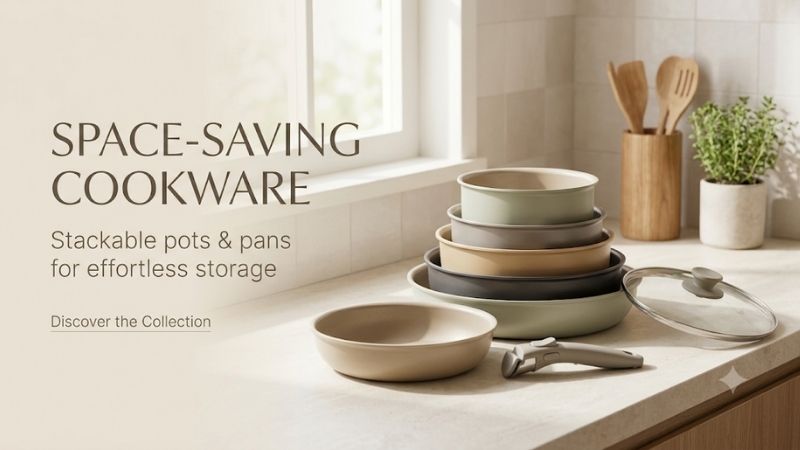
The six collections below represent different approaches to compact cookware storage. Some prioritize conventional full-size pots and pans, while others eliminate permanent handles or focus on smaller assortments. Each recommendation explains the intended buyer, the relevant construction details, practical benefits, and reasons to consider a different design.
Calphalon Premier Space-Saving Hard-Anodized Nonstick — Best overall
Calphalon Premier Space-Saving Hard-Anodized Nonstick is designed for home cooks who want conventional cookware without conventional storage clutter. Its coordinated diameters, flat glass covers, and stacking construction create an organized system while preserving fixed handles and familiar stovetop handling.
Best for: Families and frequent cooks who want a comprehensive nonstick set.
Why we picked it: The 10-piece configuration combines meaningful cooking versatility with a purpose-built space-saving design.
Key specifications:
-
Hard-anodized aluminum construction
-
MineralShield three-layer PTFE nonstick interior
-
Two frying pans measuring 8 and 10 inches
-
2.5-quart and 3.5-quart saucepans
-
3-quart sauté pan
-
6-quart stockpot
-
Tempered glass lids
-
Manufacturer-stated oven compatibility up to 450°F
-
Dishwasher-safe according to the manufacturer
The primary benefit is that this is recognizable, full-size home cookware. You do not need to learn a removable-handle system or organize several independent accessories before cooking dinner.
The 8-inch skillet is useful for smaller breakfasts, while the 10-inch skillet provides additional cooking area for vegetables, proteins, and one-pan meals. The saucepans cover common tasks such as reheating soup, preparing rice, or reducing sauces.
The stockpot is particularly valuable because many compact cookware sets omit a generously sized vessel. A 6-quart pot can handle family pasta meals, soups, and batch preparations.
Calphalon’s stacking arrangement allows cookware of compatible diameters to nest securely. The manufacturer advertises space savings compared with its conventional non-stacking cookware, although real results depend on cabinet dimensions.
One limitation is the nonstick interior. Even with a reinforced coating, nonstick cookware should not be treated as permanent equipment. Overheating, abrasive cleaning, and unnecessary utensil contact can shorten useful coating life.
Another consideration is weight and cabinet access. A tall stack may fit neatly but require lifting several pieces to reach the bottom pan.
Pros:
-
Broad assortment of practical cooking vessels
-
Purpose-built stacking lids and pan geometry
-
Conventional fixed-handle cooking experience
Cons:
-
PTFE coating requires appropriate heat and utensil care
-
Full-size handles still consume some horizontal space
Buy if: You want a coordinated everyday cookware collection and have enough cabinet height for organized stacks.
Skip if: You primarily need the smallest possible packing volume or prefer uncoated stainless steel.
Anolon SmartStack 10-Piece — Best for organized cabinet storage
Anolon SmartStack approaches cookware organization through a specially engineered handle arrangement that helps separate pots and pans during storage. The collection is intended for households that need a complete cooking assortment but dislike placing cooking surfaces directly against the bottoms of other pans.
Best for: Home cooks who frequently use multiple pan sizes and want protected stacking.
Why we picked it: The interlocking handles address one of the major drawbacks of ordinary cookware nesting: direct contact between cooking surfaces.
Key specifications and features:
-
10-piece coordinated cookware collection
-
Nonstick cooking surfaces
-
Interlocking handle design
-
Stackable tempered-glass lids
-
Multiple frying pans and covered saucepans
-
Large stockpot for family meals
Anolon’s published configuration includes 8.5-inch, 10-inch, and 12-inch frying pans, 2-quart and 4-quart covered saucepans, and an 8-quart stockpot with a steamer insert.
This assortment makes the collection suitable for households preparing several dishes at once. A smaller skillet can handle eggs, while the larger pan offers more space for sautéing vegetables or cooking several portions.
The stockpot expands the collection beyond basic frying and reheating. It is useful for boiling pasta, preparing stock, and cooking large-volume soups.
The defining characteristic is the storage design. Interlocking handles position cookware in organized stacks and help prevent direct contact between certain surfaces.
That separation matters because careless stacking can leave marks, especially when users place heavy cookware inside coated pans without protection.
However, specialized stacking systems have their own limitations.
Anolon SmartStack is designed to work as a coordinated collection. Replacing one pan with unrelated cookware may disrupt the intended storage arrangement.
Its larger pieces also need enough vertical clearance. A compact footprint is not necessarily the same as easy access, particularly in low drawers or deep cabinets.
Users should measure the available storage space and verify the dimensions of the specific set before purchase.
Pros:
-
Distinctive interlocking storage design
-
Broad range of cooking sizes
-
Reduced need to improvise pan protection
Cons:
-
Storage system works best with matching components
-
Large stockpot and skillet sizes may be excessive for single-person households
Buy if: You regularly cook family meals and want a coordinated cookware collection with a deliberate storage system.
Skip if: Your kitchen cabinets are extremely shallow or you only need two or three pans.
CAROTE Detachable-Handle Cookware — Best for small apartments
CAROTE detachable-handle cookware sets focus on removing one of the main obstacles to compact storage: permanently attached handles. Without protruding handles, compatible pot and pan bodies can nest more closely, making the design particularly attractive for apartments, RVs, and kitchens with narrow drawers.
Best for: Apartment dwellers, RV owners, and households with limited cabinet width.
Why we picked it: The detachable-handle system provides storage flexibility that traditional stacking designs cannot easily match.
Key features:
-
Nesting cookware bodies
-
Removable handle system
-
Nonstick cooking surfaces
-
Available in several package configurations
-
Some bundles include lids and additional storage accessories
CAROTE sells different detachable-handle configurations, so the exact cookware assortment, materials, and included accessories depend on the specific package.
The core advantage is simple: cookware without permanent handles uses less horizontal storage space.
A frying pan that normally requires a wide shelf may fit into a narrower cabinet once its handle is removed. Multiple pans can then be nested with suitable protection between their interiors.
This design also creates a different cooking workflow. A compatible pan body can be used on the stovetop with its removable handle attached, and the handle can be detached when the cookware is no longer being actively lifted or repositioned.
Some configurations support additional uses, but oven compatibility, lid compatibility, and storage functions must be confirmed for the exact model.
The most important consideration is handle security.
Before lifting a filled pot, the handle must be properly locked according to the manufacturer’s instructions. Users should not assume that every detachable handle supports the same weight or fits every pan in the collection.
For households with children, the attachment process deserves particular attention because a loose handle and a pot of hot liquid present an obvious burn hazard.
The removable mechanism should also be cleaned and inspected regularly. Food residue or damage could interfere with correct engagement.
Coating care is another consideration. Nested nonstick pans should have appropriate protective separators to reduce unnecessary surface contact.
Pros:
-
Excellent horizontal storage flexibility
-
Suitable for unusually compact cabinets
-
Can reduce the number of permanent handles in a kitchen
Cons:
-
Requires careful handle attachment and removal
-
Package contents and compatibility vary substantially
Buy if: Cabinet width is your biggest limitation and you are comfortable using a detachable-handle system.
Skip if: You want cookware that can always be lifted immediately without attaching an accessory.
Gotham Steel Stackmaster — Best for straightforward budget shopping
Gotham Steel Stackmaster is designed around the appeal of a coordinated, space-saving cookware collection at a more accessible position in the market. Instead of emphasizing professional stainless steel construction, the collection focuses on practical nonstick cooking and a stacking arrangement for everyday household organization.
Best for: Budget-conscious home cooks who want a coordinated nonstick set.
Why we picked it: It offers an identifiable stackable cookware collection without requiring buyers to invest in a premium stainless steel system.
Key features:
-
Stackable cookware design
-
Nonstick cooking surfaces
-
Coordinated pots and pans
-
Available as a 10-piece cookware bundle
The Stackmaster collection is particularly relevant to kitchens where cookware has accumulated gradually and no two pieces fit together properly.
Replacing a mismatched assortment with a coordinated set can improve organization, although buyers should first check whether they genuinely need every included piece.
The cooking appeal is familiar nonstick convenience. A nonstick skillet can simplify eggs, pancakes, and delicate foods, especially for beginners who struggle with temperature control in stainless steel.
The trade-off is that coating performance changes over time. Heat management, utensil selection, washing methods, and storage habits all affect the condition of the cooking surface.
There is also a difference between stacking compatibility and overall space efficiency. A cookware bundle may nest neatly but still require a substantial shelf area if its largest pot is wide.
Buyers should confirm the exact dimensions, lid arrangement, and compatible cooktops for the specific Stackmaster package.
Some products sold under broad cookware collection names may have revised configurations, making the model listing more important than the general branding.
Cleaning should follow the applicable instructions rather than assuming that a nonstick surface tolerates abrasive pads or unrestricted dishwasher use.
When comparing this set against a higher-priced collection, consider whether the initial savings outweigh any differences in materials, available replacement parts, or expected coating maintenance.
Pros:
-
Straightforward stackable collection
-
Nonstick convenience for basic cooking
-
Accessible alternative to premium organized cookware
Cons:
-
Long-term usefulness depends partly on coating care
-
Specifications need to be checked for the exact bundle
Buy if: You want a coordinated nonstick starter collection and prioritize simple organization.
Skip if: You frequently use high-heat cooking techniques or want uncoated cookware.
Tramontina Nesting Ceramic Nonstick 6-Piece — Best compact saucepan collection
Tramontina’s Nesting Ceramic Nonstick 6-Piece set takes a narrower approach to compact cookware. Rather than providing an oversized collection, it includes three covered saucepans that nest together, making it especially useful for households that prepare grains, vegetables, soup, and sauces more frequently than large skillet meals.
Best for: Small households that need versatile saucepans without a bulky cookware collection.
Why we picked it: The set provides a clearly defined assortment with purpose-built nesting construction.
Key specifications:
-
Heavy-gauge aluminum cookware bodies
-
Ceramic nonstick interiors
-
Porcelain enamel exteriors
-
1.25-quart covered saucepan
-
2-quart covered saucepan
-
3-quart covered saucepan
-
Glass lids with silicone rims
-
Soft-grip handles
-
Manufacturer-stated oven compatibility up to 350°F
The three sizes cover many everyday stovetop tasks.
The smallest saucepan is useful for warming milk, preparing a modest quantity of sauce, or reheating a single serving. The middle saucepan is more practical for rice, oatmeal, vegetables, and small portions of pasta.
The 3-quart saucepan provides flexibility for soups, larger side dishes, and preparing food for several people.
The main strength is restraint. Because the collection does not attempt to replace every pan in the kitchen, it can be easier to integrate into existing storage.
Its nesting design also creates a cleaner organization system than stacking unrelated saucepans that have incompatible handles and lids.
Tramontina describes the ceramic interior as a nonstick cooking surface. That should not be interpreted as proof that the coating is impervious to wear.
Ceramic nonstick coatings can gradually lose their easy-release characteristics, especially with repeated high-temperature exposure or abrasive handling.
Another limitation is the assortment itself. The set does not include frying pans, so it cannot serve as a complete kitchen cookware replacement.
Buyers should also confirm cooktop compatibility rather than assuming that an aluminum saucepan automatically works on induction.
Pros:
-
Useful selection of three saucepan capacities
-
Coordinated nesting storage
-
Manageable collection for compact kitchens
Cons:
-
No frying pans or large stockpot
-
Ceramic nonstick coating requires appropriate care
Buy if: You already own a suitable skillet and primarily need better-organized saucepans.
Skip if: You want one purchase to cover frying, sautéing, and large-batch cooking.
T-fal Ingenio Removable-Handle Collection — Best modular design
T-fal Ingenio cookware uses a detachable-handle approach intended to make cooking vessels easier to nest and organize. The collection includes different materials and configurations across markets, so shoppers should identify the exact Ingenio version rather than assume that all packages share the same construction or temperature limits.
Best for: Buyers who value modular storage and flexible cookware arrangements.
Why we picked it: The established Ingenio design directly addresses the storage problems created by fixed cookware handles.
Key features:
-
Detachable-handle architecture
-
Nesting pot and pan bodies
-
Multiple available cookware configurations
-
Collection-dependent materials and coatings
-
Model-specific cooktop and oven compatibility
The most practical benefit is the ability to separate the cookware body from its handle.
This arrangement allows several compatible vessels to occupy a smaller cabinet footprint. It can also make cookware easier to arrange in deep drawers where traditional handles interfere with dividers.
For buyers who prepare different dishes using a limited number of burners, modular cookware may make the working area less crowded.
However, storage convenience should not be confused with universal compatibility.
An Ingenio handle intended for one product series should only be used with compatible cookware as specified by T-fal. The handle must be correctly secured before lifting or moving hot cookware.
Oven use is especially model-specific. Some pan bodies may support oven cooking with their handles removed, but the allowable temperature and restrictions must be checked independently for the selected version.
The same applies to induction. Some Ingenio collections use magnetic bases, while others may not be suitable for induction cooking.
Because T-fal sells a number of Ingenio variations, buyers should inspect the exact package contents and material specifications before making comparisons.
This is also a system that benefits from disciplined storage. The detachable handle needs a dedicated location where it will remain accessible.
Pros:
-
Compact nesting possibilities
-
Flexible modular cookware organization
-
Reduced storage interference from fixed handles
Cons:
-
Exact features vary by Ingenio product line
-
Handle compatibility and locking require attention
Buy if: You want an established detachable-handle cookware system and can confirm the correct model.
Skip if: You prefer permanently attached handles or do not want to manage a separate component.
How to choose stackable pots and pans
The best storage arrangement is one that remains convenient after several months of cooking, cleaning, and reorganizing. Before buying, compare the actual cookware pieces you use most often with the available cabinet dimensions. A well-designed set should reduce clutter without making daily preparation unnecessarily complicated.
Choose the stacking system before choosing the brand
Different stacking mechanisms solve different organizational problems. A nested saucepan collection minimizes occupied volume, while a removable-handle set reduces the space extending beyond the cookware body. Interlocking handles help protect surfaces but may require more vertical clearance.
For a deep lower drawer, removable handles may be particularly useful because the cookware bodies can sit together without long handles crossing neighboring compartments.
A tall cabinet may be better suited to an integrated stack of conventional cookware.
If you frequently use the same skillet, consider whether it can be removed without lifting an entire stack of heavy pots.
A practical exercise is to arrange your existing cookware in the intended cabinet and identify what actually prevents an efficient fit.
Sometimes the problem is not the size of the pans but the handles, lids, or inefficient shelf organization.
Compare stainless steel, PTFE, and ceramic nonstick interiors
Cookware material affects cooking behavior, cleanup, longevity, and maintenance. Stainless steel generally offers a durable uncoated cooking surface that supports browning and deglazing, while nonstick cookware reduces sticking during delicate cooking. Ceramic and PTFE nonstick surfaces differ in composition and care requirements.
Uncoated stainless steel is a sensible choice for buyers who frequently sear meat, prepare acidic sauces, or want cookware without a coating that may eventually need replacement.
Traditional PTFE nonstick cookware can be convenient for eggs and lower-temperature cooking. It should be used within the manufacturer’s stated temperature limits and should not be heated empty over excessive heat.
Ceramic nonstick cookware may appeal to buyers who prefer its particular coating formulation. However, an advertised ceramic surface is not equivalent to solid ceramic cookware, and its easy-release performance can diminish with use.
Material selection should begin with your cooking habits rather than marketing language.
A household that frequently prepares delicate breakfasts may benefit from one nonstick skillet, even if the rest of its cookware is stainless steel.
Check whether the included pieces match your recipes
A 10-piece cookware set does not necessarily contain 10 cooking vessels. Manufacturers commonly count lids, inserts, and accessories as individual pieces, so the printed piece count can exaggerate the number of pans available for simultaneous cooking.
For most small households, an 8- or 10-inch skillet, a medium saucepan, and a larger pot cover a broad range of meals.
Families may benefit from a 12-inch skillet or a 6- to 8-quart stockpot.
A collection dominated by small saucepans may be less suitable for a household that frequently prepares skillet meals.
Conversely, a large set containing several nearly identical frying pans may waste cabinet space.
Write down the meals you prepare in an ordinary week and identify which cooking vessels they require.
Then compare that list with the set’s actual contents. This approach is more reliable than assuming a larger package automatically provides better value.
Measure cabinet space and stacked height
A cookware set that appears compact on a countertop may still be too tall for a particular cabinet. Lid handles, fixed side handles, and the widest pan diameter all affect storage fit, even when the cookware bodies nest efficiently.
Measure cabinet width, depth, and unobstructed height.
For drawers, include the clearance needed for the drawer to close without contacting lids or handles.
For shelves, consider whether you can lift the top pot comfortably while another piece remains underneath.
It is useful to reserve a little extra space for protective pads, removable handles, and routine access.
Do not organize extremely heavy cookware in a way that requires awkward lifting above shoulder height.
Storage efficiency should improve kitchen safety and convenience rather than create new handling problems.
Protect cookware surfaces during storage
Even cookware marketed as stackable can benefit from appropriate surface protection. Metal bases, lid rims, and trapped food particles may mark coated interiors when stacked under pressure, particularly if pans shift whenever a lower piece is removed.
Use manufacturer-supplied separators where provided.
Otherwise, suitable pan protectors can help separate cooking surfaces without adding substantial bulk.
Ensure cookware is completely dry before putting it away. Trapped moisture can contribute to staining or corrosion around vulnerable components.
Avoid placing rough accessories directly inside coated cookware.
For detachable-handle systems, store the handle separately instead of forcing it between cookware bodies.
Inspect the bottom of each pan periodically, particularly if cookware is also used on a glass-top stove.
A clean exterior prevents accumulated residue from transferring onto the next pan during storage.
Consider durability and replacement parts
A stackable cookware collection is often more specialized than conventional cookware. Unique handles, lids, or interlocking features may be difficult to replace if they become damaged or are misplaced, making component availability an important long-term purchasing factor.
Before buying, check whether the brand offers replacement handles, compatible lids, and individual pans.
A detachable-handle collection may become inconvenient if its only usable handle is lost.
Similarly, a specialized stacking arrangement may no longer function as intended if one component is replaced with an unrelated model.
Consider whether the manufacturer provides meaningful care instructions and warranty documentation.
Do not assume that a lifetime warranty covers normal nonstick coating wear, accidental damage, or cosmetic scratches.
The most economical set over several years may be a smaller, repairable collection rather than a large package with components that cannot be replaced individually.
Frequently asked questions
Stackable cookware raises questions that ordinary pots and pans do not, particularly about surface protection, lid placement, detachable-handle safety, and whether nesting designs remain convenient over time. These answers address practical concerns that can affect both the purchase decision and everyday use.
Are stackable pots and pans safe for nonstick coatings?
Stacking is compatible with many nonstick collections when the system is designed for that purpose and the cookware is stored according to its instructions. However, repeated contact with rough metal surfaces can damage coatings, so matching stacking features and protective separators matter.
Clean and dry the cookware before storage.
Avoid stacking pans containing utensils or food residue.
If the manufacturer’s design keeps cooking surfaces separated, follow that arrangement rather than inventing a different one.
Do not assume that every nonstick pan is suitable for nesting simply because it fits inside another pot.
Are removable handles safe when cooking?
Removable handles can be appropriate for everyday cooking when designed for the cookware and used according to the manufacturer’s instructions. The critical requirement is that the handle locks securely before any hot or filled vessel is lifted.
Check the connection before moving cookware.
Never exceed the published load restrictions.
Avoid attaching a handle while placing your hand near steam or hot surfaces.
Remove handles for oven use only when the manufacturer’s instructions specifically require or permit that arrangement.
A damaged locking mechanism should not be used.
Can stackable cookware work on induction cooktops?
Some stackable cookware is induction-compatible, but the storage design itself does not determine induction suitability. Induction cooking requires an appropriate magnetic cookware base, and compatibility must be established for the exact product.
A simple refrigerator magnet can provide a preliminary indication of whether a base is magnetic.
However, manufacturer labeling remains important because base geometry and construction also influence cookware operation.
Buyers planning to change from radiant electric cooking to induction should consider future compatibility before investing in a large collection.
Is a large stackable cookware set better than buying individual pans?
A large coordinated collection can improve organization and simplify matching lids, but it is not automatically the better purchase. The real value depends on how many included vessels you use regularly and whether the storage arrangement works in your kitchen.
For someone who primarily prepares breakfast and simple dinners, a skillet and two saucepans may be sufficient.
A larger family cooking multiple dishes simultaneously may benefit from a complete set.
Avoid paying for redundant pieces simply to obtain a coordinated appearance.
How long should nonstick stackable cookware last?
There is no dependable universal lifespan because coating durability depends on construction, cooking temperatures, cleaning methods, utensils, and storage habits. Some cookware remains useful for years with careful handling, while frequently overheated or heavily abraded coatings may deteriorate much sooner.
Follow the manufacturer’s care instructions.
Avoid excessive empty-pan heating.
Use suitable utensils and protective pads.
Replace cookware if the coating becomes extensively damaged or the pan develops defects that make cooking or handling unsafe.
Conclusion
The best stackable pots and pans combine practical cooking performance with storage arrangements that genuinely fit your kitchen. Calphalon Premier is a balanced option for conventional everyday cooking, Anolon SmartStack emphasizes organized stacking, and CAROTE or T-fal Ingenio offer the flexibility of detachable handles. For smaller saucepan needs, Tramontina provides a compact alternative. Choose according to cabinet dimensions, cooking habits, coating preferences, and long-term usability rather than advertised piece count alone.


Write Your Review
No reviews yet. Be the first to share your experience!