
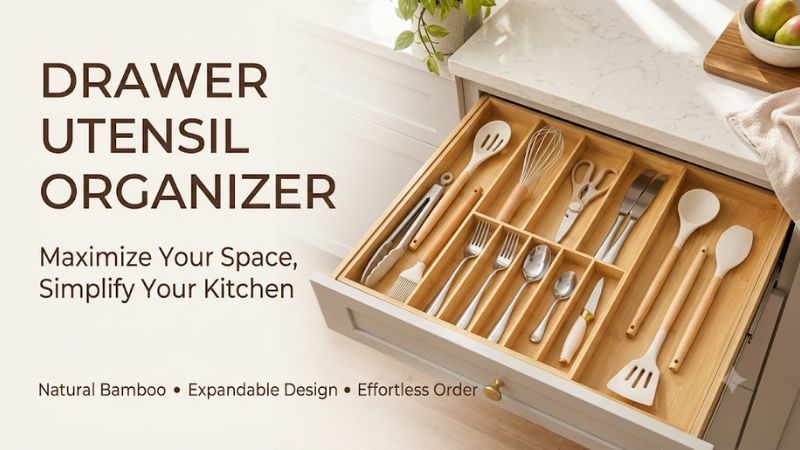
A well-designed drawer utensil organizer keeps forks, spoons, spatulas, measuring tools, and everyday kitchen gadgets easy to find without creating an overcrowded drawer. The best options separate different utensils while making effective use of available width, depth, and height. This guide compares six practical organizers for ordinary kitchens, small drawers, and mixed tool collections.
- Quick Verdict: The Best Drawer Utensil Organizer Options
- Quick Comparison Table
- How We Selected These Products
- Detailed Reviews of Six Drawer Utensil Organizers
- Buying Guide: How to Choose the Right Drawer Organizer
- Practical Drawer Layouts for Different Kitchens
- Common Drawer Organization Mistakes
- Frequently Asked Questions
- Conclusion
Quick Verdict: The Best Drawer Utensil Organizer Options
Kitchen drawers become frustrating when flatware, cooking utensils, and small gadgets are stored together without a consistent system. A conventional silverware tray can organize forks and spoons, but long spatulas and bulky can openers require different compartment shapes. Adjustable organizers provide flexibility, while compact tiered or removable trays can make better use of limited space.
Our recommended products:
- Best overall for mixed utensils: OXO Good Grips Expandable Utensil Drawer Organizer.
- Best for cutlery and gadgets together: Joseph Joseph DrawerStore Expanding Cutlery, Utensil & Gadget Organizer.
- Best soft-grip adjustable tray: madesmart Classic Expandable Utensil Tray.
- Best for deep drawers: YouCopia DrawerFit Sliding Drawer Bin with SlideLock Technology.
- Best straightforward silverware tray: Rubbermaid No Slip Cutlery Tray, Large.
- Best for tight shallow drawers: OXO Good Grips Compact Utensil Drawer Organizer.
The OXO Expandable Utensil Drawer Organizer is a versatile starting point because it includes an undivided area for irregular kitchen tools and a removable cup for small accessories.
Joseph Joseph combines dedicated cutlery compartments with expandable storage for larger utensils, making it a useful option when the drawer serves several purposes.
madesmart emphasizes soft-grip lining and an expandable arrangement, while YouCopia’s DrawerFit sliding bin is more suitable for deep drawers with unused vertical space.
Rubbermaid provides a conventional cutlery layout with an expandable section, and the OXO Compact is designed specifically for tighter drawers.
The right organizer should support the items you actually use rather than simply contain the largest number of compartments.
Quick Comparison Table
Utensil organizers can look similar in product photographs, but their internal arrangements vary substantially. Some products dedicate most of their space to silverware, while others include wider sections for bulky tools. Drawer height also matters, particularly for stacked cutlery or products with sliding compartments. The following comparison highlights the practical strengths and limitations of six identifiable designs.
| Product | Best For | Main Features | Key Advantage | Main Limitation |
|---|---|---|---|---|
| OXO Expandable Utensil Drawer Organizer | Mixed utensils | Expandable storage, removable cup | Handles irregular tools | Requires suitable drawer width |
| Joseph Joseph DrawerStore Expanding Organizer | Cutlery plus gadgets | Five deep compartments, expanding sides | Multiple tool categories | Check drawer height |
| madesmart Classic Expandable Utensil Tray | Everyday kitchen tools | Five compartments, soft-grip lining | Stable organized layout | Fixed compartment shapes |
| YouCopia DrawerFit Sliding Drawer Bin | Deep drawers | SlideLock sliding compartment | Uses available drawer depth or vertical space | More complex than a basic tray |
| Rubbermaid No Slip Cutlery Tray | Standard silverware | Five main slots, expandable sections | Familiar compartment organization | Long utensils may not fit |
| OXO Compact Utensil Drawer Organizer | Small shallow drawers | Stacked layout, removable tray | Saves width | Limited bulky-tool storage |
The comparison should be treated as a way to narrow the format, not proof that any product will fit an arbitrary drawer. Always measure internal drawer dimensions and consider the height of the utensils after loading.
A tray can fit perfectly while empty yet prevent the drawer from closing once the silverware is stacked inside.
How We Selected These Products
The shortlist focuses on identifiable manufacturer products and the different storage problems they solve. We considered compartment geometry, adjustability, nonslip features, cleaning, drawer compatibility, and daily access. The descriptions reflect published product features and practical editorial analysis rather than invented durability testing or personal product experience.
Selection criteria
- Internal layout: Separate areas for flatware and larger utensils.
- Adjustability: Expansion or removable components.
- Drawer fit: Width, depth, and height requirements.
- Stability: Nonslip feet or appropriate tray construction.
- Cleaning: Accessible corners and removable sections.
- Access: Ability to retrieve tools without moving other items.
- Materials: Manufacturer-described plastic or other construction.
- Versatility: Adaptation to changing kitchen tools.
- Maintenance: Ease of returning utensils to designated places.
We also considered how well an organizer distinguishes between tableware and cooking tools.
A dedicated flatware tray may work beautifully for forks and spoons but provide little space for a silicone spatula or a long whisk.
A mixed organizer should accommodate both types without sacrificing accessibility.
Detailed Reviews of Six Drawer Utensil Organizers
Each of the following products addresses a different drawer organization need. Some are designed for conventional flatware, while others combine utensils, gadgets, or deeper storage compartments. The reviews explain how the layout works, why it may be useful, and which limitations matter before purchase.
OXO Good Grips Expandable Utensil Drawer Organizer — Best Overall
The OXO Good Grips Expandable Utensil Drawer Organizer is designed for kitchen drawers that contain a combination of flatware, cooking utensils, and small gadgets. Its expandable structure includes storage areas that help stack utensils efficiently, a larger undivided compartment, and a removable cup for small hard-to-organize accessories. Nonslip feet help keep the tray in place during everyday drawer movement.
Best For
- Mixed kitchen utensils.
- Cooking tools and flatware.
- Can openers and small gadgets.
- Households wanting adjustable storage.
- Medium and large kitchen drawers.
Key Specifications
- Brand: OXO Good Grips.
- Product: Expandable Utensil Drawer Organizer.
- Design: Expandable tray.
- Main storage: Utensil compartments and an undivided section.
- Additional component: Removable accessory cup.
- Stability: Nonslip feet.
- Intended application: Kitchen drawer organization.
Why We Picked It
The main advantage is accommodating different tool shapes.
A traditional silverware tray cannot easily contain large measuring spoons, a can opener, or an unusual kitchen gadget.
The OXO organizer includes a larger open section that addresses these needs.
Features and Practical Performance
A useful arrangement places everyday flatware in the smaller compartments and irregular tools in the open area.
The removable cup can hold small accessories such as corn holders or wine stoppers that would otherwise become lost among larger products.
The expandable design allows some adjustment to the drawer’s available space.
However, users should not assume that expansion creates unlimited capacity.
A drawer filled with bulky tools may still become difficult to close or retrieve items from.
Before buying, measure the drawer and compare the product’s current dimensions with the intended layout.
Pros
- Flexible storage.
- Removable accessory cup.
- Space for irregular tools.
- Nonslip feet.
- Useful for everyday kitchen organization.
Cons
- Requires an appropriately sized drawer.
- Expansion does not solve every tool-size problem.
- Small accessories still need consistent sorting.
Buy If
You want one drawer to hold both everyday utensils and several irregular kitchen gadgets.
Skip If
You only need a narrow tray for forks, knives, and spoons.
Joseph Joseph DrawerStore Expanding Cutlery, Utensil & Gadget Organizer
The Joseph Joseph DrawerStore Expanding Cutlery, Utensil & Gadget Organizer is designed to separate everyday flatware from larger kitchen tools inside one adjustable tray. It combines five deep cutlery compartments, a longer section for narrow utensils, and expandable side storage for bigger items. The format is particularly useful when the household wants a defined location for both dining utensils and small cooking gadgets.
Best For
- Flatware and small kitchen tools.
- Family kitchens.
- Mixed cooking accessories.
- Drawers with suitable height.
- Households wanting deep compartments.
Key Specifications
- Brand: Joseph Joseph.
- Collection: DrawerStore.
- Product: Expanding Cutlery, Utensil & Gadget Organizer.
- Main cutlery storage: Five deep compartments.
- Additional storage: Long section and expanding sides.
- Material: Contains post-consumer recycled plastic.
- Manufacturer-stated minimum drawer height: 3 inches.
- Cleaning: Handwash and dry.
Why We Picked It
A common drawer problem is that forks and spoons occupy small sections while larger utensils accumulate in one uncontrolled pile.
This Joseph Joseph organizer provides a more intentional division of space.
The expandable sides make it possible to reserve more room for larger tools when the drawer width permits.
Features and Practical Performance
Place dinner forks, teaspoons, tablespoons, and similar utensils into their designated sections.
Use the longer compartment for appropriately sized tools that do not fit into short sections.
The expanding sides can accommodate larger utensils or gadgets, depending on their dimensions.
The three-inch drawer-height requirement is important.
A shallow drawer may not close correctly with the tray and utensils loaded.
Do not assume the organizer’s compact appearance means it fits every cabinet.
The tray also requires handwashing, so users should follow its care instructions rather than placing it in a dishwasher.
Pros
- Five deep cutlery compartments.
- Expandable sides.
- Separate long-tool section.
- Organized mixed storage.
- Identifiable material information.
Cons
- Minimum drawer height requirement.
- Handwash care.
- Bulky utensils may still need another drawer.
Buy If
You want structured storage for silverware and selected kitchen gadgets inside one drawer.
Skip If
Your drawer is very shallow or your utensil collection consists mostly of long spatulas and ladles.
madesmart Classic Expandable Utensil Tray
The madesmart Classic Expandable Utensil Tray is a five-compartment organizer designed for everyday kitchen tools. Its expandable construction allows adjustment within compatible drawers, while soft-grip lining and nonslip rubber feet are intended to reduce movement. The tray uses BPA-free plastic and focuses on accessible, familiar organization rather than complicated sliding mechanisms.
Best For
- Everyday utensils.
- Standard kitchen drawers.
- Households wanting nonslip storage.
- Simple adjustable organization.
- Mixed medium-size cooking tools.
Key Specifications
- Brand: madesmart.
- Product: Classic Expandable Utensil Tray.
- Referenced SKU: 26305.
- Compartments: Five.
- Expansion: Adjustable tray arrangement.
- Interior: Soft-grip lining.
- Base: Nonslip rubber feet.
- Material: BPA-free plastic.
Why We Picked It
The madesmart tray offers straightforward compartment organization with features aimed at keeping utensils in place.
A drawer organizer that moves every time the drawer opens can quickly become irritating.
Soft-grip lining and nonslip feet address that issue without requiring permanent installation.
Features and Practical Performance
A practical setup dedicates sections to serving utensils, measuring tools, and commonly used kitchen accessories.
The expandable portion can provide additional space where the drawer width allows.
However, fixed compartment shapes may not match every unusual tool.
A very long whisk or oversized spatula may require a separate storage location.
The soft-grip surface can also collect food residue, so periodic cleaning remains necessary.
Always follow the manufacturer’s instructions for the exact version.
Pros
- Expandable layout.
- Five compartments.
- Soft-grip lining.
- Nonslip feet.
- Familiar storage format.
Cons
- Fixed shapes limit some large tools.
- Soft-grip surfaces require cleaning.
- Expansion depends on drawer size.
Buy If
You prefer a conventional adjustable tray with nonslip features and clear sections for everyday utensils.
Skip If
You need specialized storage for numerous extra-long cooking tools.
YouCopia DrawerFit Sliding Drawer Bin with SlideLock Technology
The YouCopia DrawerFit Sliding Drawer Bin is designed to introduce another level of organization inside deep drawers. Its sliding construction helps separate small utensils and gadgets from larger items occupying the main drawer area. The SlideLock system is intended to secure the organizer’s adjustable arrangement, making it relevant to households where a conventional one-level tray leaves vertical drawer space unused.
Best For
- Deep kitchen drawers.
- Small cooking gadgets.
- Measuring tools.
- Mixed utensil storage.
- Users wanting layered organization.
Key Specifications
- Brand: YouCopia.
- Product family: DrawerFit.
- Product: Sliding Drawer Bin.
- Mechanism: SlideLock technology.
- Design: Sliding drawer organizer.
- Material: Plastic.
- Intended placement: Compatible deep drawers.
- Cleaning: Follow the exact product instructions.
Why We Picked It
A deep drawer can become cluttered when small tools sit at the bottom beneath larger cooking utensils.
A sliding organizer creates a separate accessible section rather than requiring every tool to occupy the same horizontal layer.
This can be useful for measuring spoons, small gadgets, and other accessories.
Features and Practical Performance
Before purchasing, measure the usable drawer height carefully.
The sliding bin must have enough room to move without colliding with the contents below or the cabinet frame above.
A practical arrangement could reserve the upper section for small frequently used gadgets while leaving long utensils in the main drawer.
However, layered storage introduces another movement step.
If the drawer is shallow or the household needs immediate access to large utensils, a simple open tray may be more convenient.
Pros
- Makes use of deep drawers.
- Separate sliding storage area.
- Useful for small gadgets.
- Adjustable organization.
- Can reduce loose tools.
Cons
- Requires specific drawer dimensions.
- More moving components.
- Less useful in shallow drawers.
- Compatibility should be checked carefully.
Buy If
You have a deep drawer with unused vertical space and want separate storage for smaller tools.
Skip If
You prefer a simple one-level tray or have limited vertical clearance.
Rubbermaid No Slip Cutlery Tray, Large — Best Traditional Layout
The Rubbermaid No Slip Cutlery Tray, Large is a familiar silverware organizer with five main compartments and two expandable side sections. It is designed to separate everyday flatware and additional serving utensils inside a drawer. Rubbermaid also identifies a nonslip base and dishwasher-safe care, making it a straightforward option for households prioritizing conventional organization.
Best For
- Forks and spoons.
- Dinner knives.
- Serving utensils.
- Everyday family flatware.
- Buyers wanting easy maintenance.
Key Specifications
- Brand: Rubbermaid.
- Product: No Slip Cutlery Tray, Large.
- Model: 1994536.
- Dimensions: 15 × 11.75 × 1.75 inches.
- Main sections: Five.
- Expansion: Two side sections.
- Material: BPA-free plastic.
- Cleaning: Dishwasher-safe according to Rubbermaid.
- Stability: Nonslip base and feet.
Why We Picked It
Not every utensil drawer requires a complex system.
For households whose main concern is finding the right fork or spoon, a conventional divided tray can be the most efficient option.
The expandable sections provide extra storage without abandoning the familiar layout.
Features and Practical Performance
Store dining utensils in separate main compartments and reserve the expandable areas for selected serving tools.
The tray should remain stable during normal drawer movement when placed on an appropriate surface.
Its dishwasher-safe construction can also simplify cleaning when food residue accumulates.
However, the format is still designed primarily around flatware.
Oversized spatulas, ladles, and unusually long kitchen tools may not fit comfortably.
Pros
- Familiar layout.
- Five main sections.
- Two expandable areas.
- Nonslip base.
- Dishwasher-safe construction.
- Published dimensions.
Cons
- Primarily intended for flatware.
- Limited space for long cooking tools.
- Fixed overall depth.
Buy If
You want a reliable conventional tray for a family silverware drawer.
Skip If
Your main problem is organizing bulky cooking utensils rather than forks and spoons.
OXO Good Grips Compact Utensil Drawer Organizer — Best for Shallow Drawers
The OXO Good Grips Compact Utensil Drawer Organizer is designed for kitchens where drawer width and height are limited. It uses divided sections to keep utensils neatly arranged and includes a removable tray for easier cleaning. Nonslip feet help keep the organizer in position, while squared corners reduce unnecessary gaps around the unit when placed inside a compatible drawer.
Best For
- Small kitchens.
- Narrow drawers.
- Shallow drawers.
- Everyday flatware.
- Compact utensil collections.
Key Specifications
- Brand: OXO Good Grips.
- Product: Compact Utensil Drawer Organizer.
- Format: Compact divided tray.
- Cleaning access: Removable tray.
- Stability: Nonslip feet.
- Shape: Square corners.
- Intended use: Tight and shallow kitchen drawers.
Why We Picked It
A large expandable organizer can be the wrong purchase for a small drawer.
The OXO Compact focuses on preserving accessible utensil storage without requiring the width of a larger conventional tray.
This makes it useful in apartment kitchens and older cabinetry.
Features and Practical Performance
Arrange everyday forks, spoons, and similar utensils in the divided sections.
The removable tray can be taken out for cleaning or when setting the table, depending on how the household prefers to use it.
However, compact storage requires more attention to loading height.
Stacked utensils may rise above the organizer, so the drawer must still close comfortably.
The product is also less suitable for large cooking tools.
A separate long-utensil compartment may be necessary when the household owns several spatulas or whisks.
Pros
- Compact design.
- Intended for shallow drawers.
- Nonslip feet.
- Removable tray.
- Simple cleaning access.
Cons
- Limited storage for bulky tools.
- Must account for utensil stack height.
- Not intended for every large cutlery collection.
Buy If
You need organized flatware storage in a small kitchen drawer.
Skip If
You have a wide drawer and want one organizer for many large cooking tools.
Buying Guide: How to Choose the Right Drawer Organizer
A drawer organizer should fit the dimensions of the cabinet and the types of utensils stored inside it. Even a product described as expandable has minimum and maximum dimensions, and some tiered designs require more height than ordinary cutlery trays. Before purchasing, measure the drawer and identify whether the main challenge is silverware, long tools, or assorted kitchen gadgets.
Measure Interior Width, Depth, and Height
The usable space inside a drawer is often smaller than its visible face. Drawer sides, runners, rear stops, and internal hardware can reduce the available area. Height is particularly important because utensils stacked inside a tray may prevent the drawer from closing even when the organizer itself fits.
Measurements to record
- Inside drawer width.
- Inside drawer depth.
- Clear height beneath the cabinet frame.
- Depth available for expansion.
- Space needed to remove the organizer.
- Length of the longest utensil.
- Height of stacked flatware.
Measure the tallest loaded section, not just the empty organizer.
For example, a tiered cutlery tray may fit the drawer dimensions but become too tall when dinner knives are inserted.
Separate Flatware From Cooking Utensils
Flatware and cooking utensils have very different storage shapes. Forks, spoons, and table knives are relatively narrow and can be grouped together, while spatulas, ladles, and tongs require longer or wider compartments. Trying to use one conventional cutlery tray for every item often creates clutter.
Flatware categories
- Dinner forks.
- Salad forks.
- Tablespoons.
- Teaspoons.
- Dinner knives.
- Serving spoons.
Cooking tool categories
- Spatulas.
- Ladles.
- Whisks.
- Tongs.
- Measuring tools.
- Peelers.
- Can openers.
If space allows, use a dedicated flatware drawer and a separate cooking-tool drawer.
If not, choose an organizer with both narrow and broad compartments.
Compare Expandable and Fixed Trays
An expandable tray can adapt to different drawer widths, while a fixed tray may provide simpler construction and fewer moving parts. The best choice depends on the drawer and whether the household expects its utensil collection to change. Expansion is useful only when it produces accessible storage rather than a narrow gap filled with miscellaneous objects.
Expandable trays
- Fit a range of compatible widths.
- Offer extra storage sections.
- Help use available drawer space.
- May include moving components.
- Require careful measurement.
Fixed trays
- Simpler configuration.
- Easier to understand.
- Often less expensive.
- May leave unused side gaps.
- Less flexible when moving to a different drawer.
The right choice is the one that uses space effectively without making the layout confusing.
Look for Nonslip Features and Easy Cleaning
Utensil drawers are opened frequently, so a tray that slides backward can become frustrating. Nonslip feet or lining may help maintain placement. Cleaning also matters because food particles, crumbs, and moisture can collect beneath utensils over time.
Useful features
- Nonslip feet.
- Smooth rounded corners.
- Removable sections.
- Accessible compartments.
- Appropriate washing instructions.
- Stable expansion mechanism.
- Durable material.
- Clear separation of utensils.
Some plastic trays are dishwasher-safe, while others require handwashing.
Always follow model-specific instructions.
Practical Drawer Layouts for Different Kitchens
An effective utensil drawer should reflect the way the household cooks and sets the table. A small apartment may need one compact tray, while a family kitchen may benefit from separating everyday flatware and cooking gadgets. The following arrangements help illustrate how organizer type affects access and long-term maintenance.
Small Apartment Kitchen
A small kitchen often has only one or two usable drawers. Choose a compact tray for everyday flatware and reserve a separate narrow section for essential cooking tools. Remove duplicates or rarely used gadgets rather than forcing every item into the same space.
Suggested setup
- Main section: Forks, spoons, and knives.
- Additional space: Measuring spoons.
- Separate long section: Frequently used cooking tools.
- Occasional gadgets: Another storage location.
The goal is convenient daily access.
Family Kitchen With Multiple Drawers
A larger kitchen can separate dining utensils from cooking equipment. One drawer can use a conventional cutlery tray, while another holds spatulas, ladles, whisks, and specialty tools. This reduces overcrowding and makes it easier for household members to return items to the correct place.
Suggested setup
- Drawer one: Daily silverware.
- Drawer two: Cooking utensils.
- Drawer three: Measuring tools and gadgets.
- Separate storage: Sharp knives where appropriate.
Avoid placing exposed sharp blades loosely inside a crowded drawer.
Mixed Kitchen Gadget Drawer
Some kitchens accumulate small accessories such as bottle openers, peelers, measuring spoons, and kitchen scissors. A flexible tray with broad compartments or removable organizers can help prevent these items from becoming mixed together.
Suggested setup
- Small section: Measuring tools.
- Medium section: Peelers and bottle openers.
- Long section: Tongs or spatulas.
- Removable cup: Tiny accessories.
Keep only the gadgets used regularly in the most accessible positions.
Common Drawer Organization Mistakes
Utensil organizers can fail when buyers focus on appearance or advertised capacity without measuring the drawer. Other problems occur when a tray is packed too tightly, when long utensils are forced into short compartments, or when the organizer prevents the drawer from closing normally. Avoiding these mistakes can make an inexpensive storage upgrade much more useful.
Mistakes to avoid
- Buying before measuring the drawer.
- Ignoring loaded utensil height.
- Purchasing too many compartments.
- Mixing sharp knives loosely with flatware.
- Storing long utensils diagonally across the entire tray.
- Failing to clean beneath the organizer.
- Buying expansion features that do not fit the drawer.
- Choosing an organizer that moves during use.
- Overcrowding with rarely used gadgets.
- Assuming every plastic tray is dishwasher-safe.
- Ignoring removable divider stability.
- Using one small tray for an oversized utensil collection.
A well-organized drawer should open smoothly and allow items to be retrieved independently.
Frequently Asked Questions
Shoppers often struggle to decide between conventional cutlery trays and more versatile organizers for cooking utensils. Drawer depth, utensil length, and the number of compartments all affect everyday usability. These answers address common decisions and clarify where adjustable or compact designs provide meaningful benefits.
What Is the Best Drawer Utensil Organizer?
The best organizer depends on what the drawer contains. A conventional cutlery tray works well for forks, spoons, and knives, while an expandable mixed organizer is often more practical for cooking tools and gadgets.
Measure the drawer first.
Choose compartments around the actual utensil collection rather than buying the largest tray available.
Are Expandable Utensil Organizers Worth It?
They can be useful when the drawer has extra width or contains utensils of different sizes. An expandable tray may create additional sections and reduce wasted space.
However, expansion is unnecessary when a fixed tray already fits well.
The best value comes from useful storage, not the number of adjustable parts.
How Do I Organize Long Kitchen Utensils in a Drawer?
Place long spatulas, whisks, tongs, and ladles in a dedicated long compartment or a separate organizer designed for those tools. Avoid stacking them over ordinary silverware if that makes the drawer difficult to close.
Measure the longest utensil.
Choose a drawer with sufficient depth and clearance.
Can Drawer Utensil Organizers Go in the Dishwasher?
Some models are dishwasher-safe, while others require handwashing. Rubbermaid identifies dishwasher-safe care for its No Slip Cutlery Tray, but the same instruction should not be assumed for all competing products.
Check the exact manufacturer’s guidance.
Dry the organizer before returning clean utensils.
How Can I Stop an Organizer From Sliding?
Choose a tray with nonslip feet or lining and make sure the drawer surface is clean and dry. Some models include rubber supports designed to resist movement during normal drawer use.
Do not use improvised adhesives that could damage the cabinet.
A properly sized tray is also less likely to shift excessively.
Conclusion
The best drawer utensil organizer should match the drawer dimensions and the utensils used most often. OXO’s expandable design is a flexible choice for mixed tools, while Joseph Joseph combines structured cutlery storage with larger compartments. madesmart offers soft-grip organization, YouCopia provides layered options for deep drawers, Rubbermaid suits conventional silverware, and OXO’s compact tray addresses small kitchen drawers. Measure loaded height, separate long utensils from flatware when possible, and choose an organizer that can be cleaned easily. A simple practical layout is more valuable than a crowded drawer filled with unnecessary compartments.






Write Your Review
No reviews yet. Be the first to share your experience!