
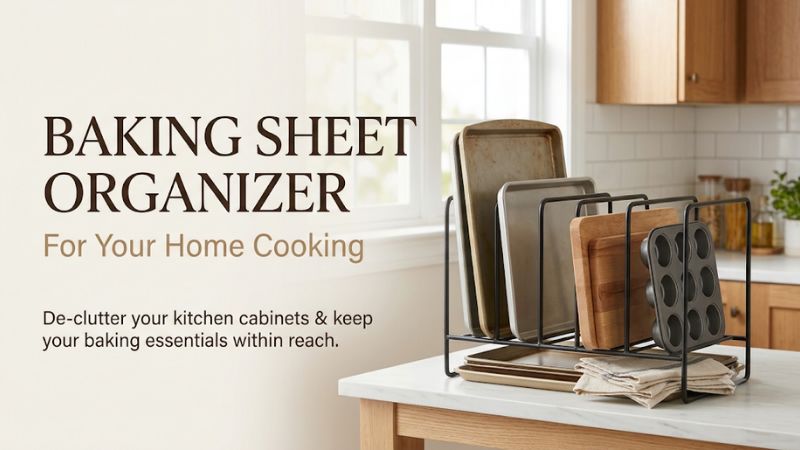
A baking sheet organizer for home cooking should make frequently used pans accessible without forcing you to lift several heavy trays. Vertical racks, adjustable dividers, and dedicated cabinet compartments can all improve kitchen organization. This guide explains how to choose a stable system, measure the space, separate different bakeware, and maintain convenient storage.
- Quick Answer: Start With a Vertical Adjustable Rack
- Why Baking Sheet Organization Matters in Home Kitchens
- Compare the Main Organizer Types
- How to Measure Your Kitchen Storage Space
- Materials and Stability: What to Look For
- Organize Baking Equipment Around Daily Cooking
- Common Buying Mistakes and How to Avoid Them
- Frequently Asked Questions
- Conclusion
Quick Answer: Start With a Vertical Adjustable Rack
For everyday home cooking, an adjustable vertical organizer is often the most practical solution because baking sheets vary in size, rim thickness, and shape. The rack should support each pan securely while allowing enough space to remove it without disturbing neighboring equipment. A simple freestanding design is useful for most households, provided it fits the cabinet.
Recommended storage options:
- For mixed baking sheets: Adjustable divider rack.
- For two or three pans: Compact fixed-slot stand.
- For heavy cookware collections: Sturdy wide-base organizer.
- For narrow cabinets: Slim vertical tray divider.
- For permanent kitchen upgrades: Cabinet-mounted tray organizer.
- For deep drawers: A compatible adjustable divider system.
The best organizer is not necessarily the one with the most compartments.
A smaller rack that holds your actual pans securely can be more convenient than an oversized system with limited clearance.
Why Baking Sheet Organization Matters in Home Kitchens
Baking sheets are among the most frequently used pieces of cookware in many households. They support cookies, roasted vegetables, sheet-pan dinners, and numerous other meals. Despite their versatility, their broad flat shape makes them awkward to store. Stacking them can save apparent space, but it often makes the bottom pan difficult to retrieve.
Common Problems With Stacking Baking Sheets
Traditional horizontal stacking places one baking sheet on top of another, sometimes with cooling racks and muffin tins mixed into the pile. The arrangement may look compact initially, but removing the bottom pan requires lifting everything above it. This becomes inconvenient during meal preparation and can encourage careless handling of heavy or delicate equipment.
Common stacking problems:
- Difficult access to lower pans.
- Scraping between metal surfaces.
- Unstable piles of mixed cookware.
- Hidden specialty trays.
- Poor visibility of available equipment.
- Increased effort during cooking.
A vertical organizer addresses these issues by separating equipment into accessible positions.
However, a poorly sized rack can create different problems, including leaning pans, insufficient cabinet height, or unstable dividers.
The goal is easy access, not simply changing the direction of the stack.
Why Vertical Storage Can Improve Cooking Efficiency
A vertical rack allows users to see different baking sheets and remove one without lifting an entire pile. This can be especially helpful when several pans are used during a single cooking session. Home cooks preparing roasted vegetables, baked proteins, and side dishes may need different tray sizes in quick succession.
Practical advantages:
- Individual pans are visible.
- Faster retrieval.
- Better separation of equipment.
- Reduced unnecessary handling.
- Easier return after washing.
- More predictable storage positions.
The benefit is greatest when each compartment offers enough clearance for the pan.
If several baking sheets are squeezed tightly into one slot, the organizer may recreate the original stacking problem.
Choose a layout that reflects how you cook rather than trying to maximize the number of pans.
Identifying Which Pans Need Dedicated Storage
Not every piece of bakeware needs to occupy the same cabinet. A household may use half-sheet pans daily while opening a specialty muffin pan only occasionally. Separating frequently used equipment from specialty items can make the main organizer more accessible.
Common categories:
- Half-sheet pans.
- Quarter-sheet pans.
- Cookie sheets.
- Cooling racks.
- Muffin tins.
- Roasting trays.
- Baking dishes.
Flat pans and cooling racks are often suitable for narrow vertical slots.
Thicker muffin pans and roasting trays may need wider compartments.
Heavy glass or ceramic baking dishes require more substantial support and should not automatically be treated like lightweight sheet pans.
Compare the Main Organizer Types
There are several practical ways to organize baking sheets, and each suits a different kitchen layout. Freestanding adjustable racks provide flexibility, while fixed dividers offer simplicity and built-in systems create permanent storage. Before purchasing, compare the size and weight of your equipment with the organizer’s construction and the cabinet’s available clearance.
Adjustable Divider Racks
Adjustable racks use removable or movable dividers to create compartments of different widths. They are especially useful for storing a combination of flat baking sheets, cooling racks, muffin tins, and cutting boards. Products such as the YouCopia StoreMore Bakeware Rack illustrate how repositionable dividers can adapt to varied bakeware thicknesses.
Best For: Home cooks with mixed pan sizes.
Key Features:
- Movable dividers.
- Multiple vertical compartments.
- Stable supporting base.
- Freestanding placement.
- Configurable spacing.
Pros:
- Flexible organization.
- Suitable for different pan thicknesses.
- Easy to reconfigure.
- Can accommodate changing cookware collections.
Cons:
- Requires initial arrangement.
- Narrow bases may not support every oversized pan.
- Thick bakeware reduces the number of usable spaces.
Buy If: Your kitchen contains several types of flat cookware.
Skip If: You prefer a fixed stand and own only a few similarly sized pans.
When setting up the dividers, begin with the widest equipment.
Create stable positions for thick pans first, then allocate narrower spaces to flat sheets and cooling racks.
Fixed-Slot Baking Sheet Stands
Fixed-slot stands use permanent dividers to hold pans upright. They are simple to set up and may be particularly convenient when the stored items have consistent dimensions. Compact metal stands, including tray-storage products from Yamazaki, illustrate this approach and can fit suitable shelves or countertops.
Best For: Small collections of flat baking trays.
Key Features:
- Fixed compartments.
- Open vertical construction.
- Freestanding base.
- Minimal assembly.
- Consistent spacing.
Pros:
- Straightforward setup.
- Predictable compartment positions.
- Often compact.
- Simple daily operation.
Cons:
- Limited adjustment.
- Thick pans may not fit.
- Large equipment can exceed the support area.
Buy If: You store a few relatively thin trays and want uncomplicated organization.
Skip If: You frequently add new bakeware or own many irregular pans.
A fixed-slot stand should provide enough room to grip each pan.
Do not assume that the advertised compartment count translates directly into the number of baking sheets your household can store.
Cabinet-Mounted Baking Sheet Organizers
Cabinet-mounted dividers attach to the interior surfaces of a suitable cabinet, creating dedicated spaces for baking sheets and serving trays. This format can be useful during a kitchen renovation or when a homeowner wants a permanent organization system. However, the installation must be compatible with cabinet construction and available space.
Best For: Dedicated bakeware cabinets and long-term kitchen upgrades.
Key Features:
- Fixed divider framework.
- Permanent mounting.
- Vertical storage compartments.
- Cabinet-specific installation.
- Potentially integrated appearance.
Pros:
- Dedicated storage position.
- No loose rack moving across the shelf.
- Useful in properly sized cabinets.
- Can create a consistent layout.
Cons:
- Installation may require drilling.
- Less flexible after mounting.
- Not ideal for renters.
- Fixed spacing can restrict future equipment changes.
Buy If: You have suitable cabinet structure and want permanent organization.
Skip If: You need a portable or easily adjustable storage solution.
Before drilling, check the cabinet floor and surrounding panels.
A mounted divider should not interfere with hinges, shelves, plumbing, or the normal movement of cabinet doors.
Drawer-Based Baking Sheet Organizers
Deep kitchen drawers can hold baking sheets vertically when sufficient height is available. This approach hides cookware from view while making individual pans accessible when the drawer is extended. Adjustable internal dividers may be suitable, although the drawer slides and bottom panel must support the combined equipment weight.
Best For: Kitchens with sturdy deep drawers.
Key Features:
- Vertical internal compartments.
- Hidden storage.
- Potentially adjustable positions.
- Easy access from above when fully opened.
- No countertop footprint.
Pros:
- Keeps cookware out of sight.
- Can be convenient near cooking areas.
- May accommodate mixed tray sizes.
- Supports a tidy kitchen appearance.
Cons:
- Requires sufficient drawer height.
- Heavy pans increase drawer load.
- Some drawer designs have limited clearance.
- Large sheets may protrude above the drawer frame.
Buy If: The drawer dimensions and load rating accommodate the intended contents.
Skip If: The drawer is shallow or needed for more essential equipment.
Check the full opening and closing path before installing dividers.
A baking sheet that fits while the drawer is open may still strike the cabinet frame as the drawer closes.
How to Measure Your Kitchen Storage Space
Accurate measurement prevents one of the most common organizer purchasing mistakes. A rack may fit on the cabinet shelf but fail to accommodate the tallest baking sheet, or the cabinet opening may be too narrow to retrieve a large pan comfortably. Measure both the equipment and the storage area before choosing a fixed or adjustable design.
Measure Your Largest Baking Sheet
Start with the baking sheet that occupies the most space. Measure its complete outside dimensions, including rolled edges, handles, and rims. The usable cooking surface is often smaller than the pan’s exterior footprint, so advertised baking dimensions may not match the space needed for storage.
Record:
- Overall length.
- Overall width.
- Rim height.
- Pan thickness.
- Weight if relevant.
- Handle protrusions.
- Required grip clearance.
A common half-sheet pan is approximately 18 by 13 inches, but actual products vary.
Do not assume that every pan labeled “half-sheet” has identical outside dimensions.
Measure your own cookware rather than relying on category names alone.
Check Cabinet Height and Depth
Vertical storage generally requires enough height for the pan’s larger dimension when placed upright. The supporting rack also occupies some height, and the cabinet opening may be smaller than the full interior.
Cabinet measurements:
- Usable interior height.
- Interior shelf depth.
- Clear opening width.
- Cabinet opening height.
- Shelf-to-shelf clearance.
- Distance from hinges.
- Space for lifting pans.
For example, a tall baking sheet may stand comfortably inside an open cabinet but become difficult to remove because an upper frame blocks the retrieval angle.
A cardboard template can help test the movement before purchasing.
Allow Room for Hands and Safe Retrieval
An organizer should make it easier to remove one pan, not force users to pinch narrow edges between closely packed dividers. Leave enough room to grip the pan without scraping fingers against neighboring equipment or cabinet hardware.
A little unused space is beneficial.
Practical clearance considerations:
- Space between pans.
- Room to lift a sheet vertically.
- Width of the cabinet opening.
- Access to heavier cookware.
- Position of nearby appliances.
- Ability to return pans without force.
If the organizer creates cramped access, reduce the number of stored items or change the spacing.
The right arrangement should support normal cooking movements.
Materials and Stability: What to Look For
Baking sheet organizers use coated steel, stainless steel, polymer bases, and other materials. The construction affects cleaning, corrosion resistance, divider strength, and how securely pans remain upright. However, material alone does not establish performance. The design of the base and the placement of dividers can matter just as much as the metal used.
Metal Dividers and Protective Coatings
Metal dividers provide a relatively narrow support structure and are common in adjustable bakeware racks. Some manufacturers use coated steel to reduce direct contact between hard metal and cookware surfaces. This can be useful when storing pans with delicate finishes, although a coating should not be assumed to prevent all scratching.
Features to evaluate:
- Smooth divider surfaces.
- Secure connections to the base.
- Appropriate structural rigidity.
- Finish suitable for the environment.
- No sharp exposed edges.
- Cleaning instructions.
Avoid forcing a large baking sheet between dividers that are too close.
Even a well-finished rack can mark cookware if pans are dragged repeatedly against hard surfaces.
Base Stability and Load Distribution
A tall baking sheet can become unstable when supported by a narrow base or when too many pans lean in the same direction. Stable vertical storage requires appropriate support and balanced loading. Some products use non-slip feet, while others rely on permanent mounting.
Stability checklist:
- Base rests flat.
- Dividers remain securely positioned.
- Heavy pans do not cause leaning.
- Stored items remain within the supported area.
- Organizer does not slide during normal retrieval.
- Total weight remains within intended use.
Do not assume that an organizer designed for thin baking trays can safely support heavy ceramic dishes.
Choose storage according to both dimensions and weight.
Cleaning and Moisture Considerations
Baking sheets should be cleaned and dried before being stored. Residual water trapped between metal surfaces can make cabinet maintenance more difficult, while grease and crumbs can accumulate around organizer bases. Choose a rack that permits routine cleaning and does not create inaccessible areas.
Useful maintenance features:
- Removable dividers.
- Open base construction.
- Smooth surfaces.
- Accessible corners.
- Appropriate moisture resistance.
- Easy removal from the cabinet.
Follow product-specific cleaning instructions.
Avoid soaking wooden or mixed-material organizers unless the manufacturer permits it.
Organize Baking Equipment Around Daily Cooking
A storage system works best when its arrangement matches the meals you regularly prepare. Households that bake cookies frequently may prioritize flat baking sheets, while families that prepare sheet-pan dinners may need larger rimmed pans within easy reach. Organize by frequency and purpose rather than treating every piece of equipment as equally important.
Keep Everyday Sheet Pans in the Easiest Positions
Most home cooks use a small number of pans repeatedly. These should occupy convenient positions in the organizer, allowing them to be removed without moving specialty bakeware.
Example layout:
- Everyday half-sheet pan.
- Second frequently used baking sheet.
- Quarter-sheet pan.
- Cooling rack.
- Muffin tin.
- Specialty baking equipment.
Place wider items in compartments that allow comfortable retrieval.
Avoid placing the largest pan where its edge contacts the cabinet door.
If a rack has adjustable dividers, modify the spacing when your cooking habits change.
Separate Flat Trays From Bulky Bakeware
Flat cookie sheets and cooling racks can often fit narrow slots, while muffin tins, roasting pans, and deeper baking dishes need more room. Mixing everything into one tightly packed organizer can create instability and make it difficult to find the right equipment.
Group similar items and avoid stacking bulky pans against delicate trays.
Useful categories:
- Flat baking sheets.
- Rimmed sheet pans.
- Cooling racks.
- Muffin tins.
- Specialty molds.
- Cutting boards when appropriate.
The organizer should support each category without forcing incompatible shapes together.
Create a Simple Return-and-Clean Routine
After cooking, allow hot bakeware to cool safely before washing and storing it. Clean according to the pan manufacturer’s instructions and dry thoroughly. Return each item to its designated compartment rather than adding it to the nearest available slot.
Routine checklist:
- Allow cookware to cool.
- Clean appropriately.
- Dry completely.
- Inspect for damage.
- Return to the correct compartment.
- Wipe organizer surfaces when needed.
This routine prevents clutter from building up and makes the system easier for other household members to use.
Common Buying Mistakes and How to Avoid Them
A baking sheet organizer can disappoint when shoppers focus on price, appearance, or divider count without checking real equipment dimensions. The most common problems involve choosing a rack that is too short or narrow, overlooking cabinet height, or overloading a lightweight structure with heavy pans. These mistakes can usually be prevented before purchase.
Choosing the Wrong Rack Size
A compact organizer may fit perfectly on the shelf but provide insufficient support for a large sheet pan.
Check both base dimensions and the intended cookware size.
A pan that extends substantially beyond the support area may lean or become awkward to retrieve.
Do not assume that a rack marketed for baking sheets accepts every standard baking format.
Measure the largest pan and compare it with the product’s intended use.
Overcrowding Adjustable Compartments
Adjustable dividers can create many narrow slots, but filling every position may reduce accessibility.
Leave room for fingers and pan edges.
If thick trays require wider spaces, use fewer compartments rather than forcing them into unsuitable gaps.
A rack that stores five pans comfortably is more useful than one that holds seven but requires pulling several out together.
Ignoring Cabinet Accessibility
A tall pan may fit inside the cabinet but still be difficult to remove through a smaller opening.
Check hinges, face frames, and nearby shelves.
Test the retrieval path rather than the stationary storage dimensions alone.
If the kitchen layout prevents upright removal, a deep drawer or horizontal storage position may be more practical.
Frequently Asked Questions
Home cooks often ask whether vertical storage is safe for baking sheets, how many pans a rack can hold, and whether a single organizer can accommodate different baking tools. The correct answer depends on the rack’s construction, cabinet dimensions, and the weight and shape of the equipment. These practical considerations help prevent buying an organizer that looks suitable but performs poorly in a real kitchen.
Is Vertical Storage Better for Baking Sheets?
Vertical storage can improve access by separating pans that would otherwise be stacked. It is particularly useful for frequently used baking sheets and cooling racks. However, the rack must provide stable support, and the cabinet must have enough height. Heavy or unusually large bakeware may be more suitable for horizontal storage if an upright rack cannot support it securely.
Can One Organizer Hold Baking Sheets and Muffin Tins?
Yes, many adjustable racks can accommodate both categories when the compartment widths are suitable. Muffin tins typically require more space than flat sheet pans, so movable dividers are useful. Check the actual dimensions and load suitability rather than assuming that every rack supports every bakeware type. Avoid tightly packing bulky pans against delicate surfaces.
Should I Buy an Adjustable Organizer?
An adjustable organizer is usually helpful when the collection contains pans of different thicknesses or is likely to change. Fixed-slot stands can work well for smaller, consistent collections. The added flexibility is valuable only when the rack remains stable and the dividers are easy to reposition. Choose according to the actual equipment rather than assuming adjustability is always necessary.
Will a Baking Sheet Organizer Damage Nonstick Pans?
An appropriately designed rack can reduce scraping associated with stacking, but contact damage remains possible. Choose smooth or coated contact points where appropriate and avoid dragging delicate surfaces across sharp metal edges. Follow the bakeware manufacturer’s storage instructions. No organizer should be described as universally scratchproof without reliable supporting evidence.
Can Baking Sheet Organizers Fit Small Kitchens?
Yes, compact vertical racks can make use of narrow cabinet areas, but upright baking sheets still require sufficient height. Measure the clear cabinet opening and the largest pan before purchasing. A compact rack is useful only if it supports the equipment securely. For very shallow or low cabinets, alternative horizontal or drawer storage may work better.
Conclusion
A baking sheet organizer for home cooking should make frequently used pans easier to retrieve while preventing unstable stacks and unnecessary cabinet clutter. Adjustable vertical racks are versatile for mixed bakeware, while compact fixed stands can suit smaller collections. Measure your largest pan and available cabinet space, choose stable dividers, and organize equipment by everyday use. A simple system that supports safe retrieval and easy cleaning will usually provide more value than one designed only to maximize capacity.




Write Your Review
No reviews yet. Be the first to share your experience!