
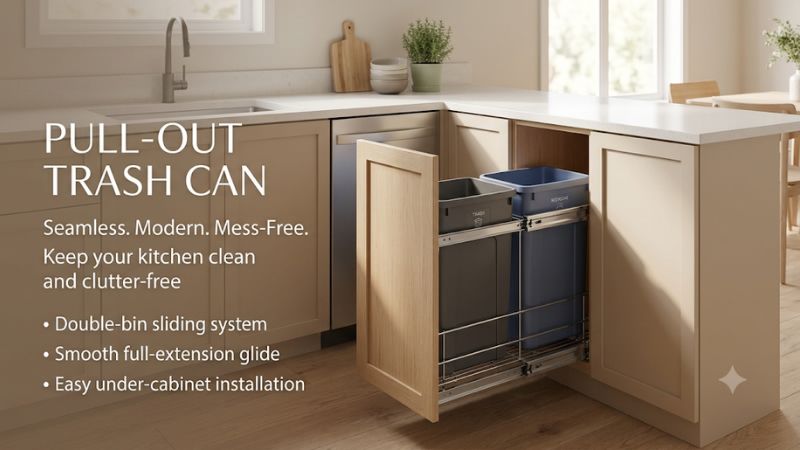
A pull out trash can hides garbage inside a kitchen cabinet while making disposal and bag changes more convenient. The best models differ in bin capacity, slide mechanism, mounting requirements, and waste-sorting options. This guide compares six identifiable systems and explains how to evaluate cabinet clearance, everyday access, installation, and maintenance before choosing one.
- Quick Verdict: Which Pull Out Trash Can Should You Buy?
- Quick Comparison Table
- How We Selected These Pull-Out Trash Systems
- Six Pull Out Trash Cans Compared in Detail
- Buying Guide: How to Choose a Pull Out Trash Can
- Maintaining a Pull-Out Trash Can
- Common Mistakes When Buying Pull-Out Trash Cans
- Frequently Asked Questions
- Conclusion
Quick Verdict: Which Pull Out Trash Can Should You Buy?
The best pull-out trash system is one that fits the cabinet properly and accommodates the waste your household actually produces. A single-bin design maximizes one waste compartment, while dual-bin systems allow sorting in the same cabinet. Soft-close hardware and full-extension slides may improve daily operation, but their value depends on how often the container is used and whether the mounting surface is suitable.
Our six recommendations:
- Best single-bin everyday choice: simplehuman 30L Under Counter Pull-Out Can.
- Best compact dual sorting: simplehuman 35L Dual Compartment Under Counter Pull-Out Can.
- Best for smaller cabinet openings: Knape & Vogt RS-PSW 20-Quart Bottom-Mount Waste Unit.
- Best soft-close compact option: Knape & Vogt SCB9-1-20PT Waste and Recycling Unit.
- Best modular waste-sorting option: IKEA HÅLLBAR Pull-Out Recycling Solution.
- Best built-in wooden-frame approach: Rev-A-Shelf 4WCTM-18DM2 Waste Container System.
The strongest purchase decision starts with measuring the clear cabinet opening and the space needed for the moving assembly.
A product advertised for an eighteen-inch cabinet does not necessarily fit every cabinet with that nominal outside width.
Quick Comparison Table
The following table compares six distinct pull-out waste systems, ranging from straightforward single-bin configurations to coordinated dual-container designs. Product capacity and construction are based on identifiable manufacturer information where available. Exact dimensions, bin combinations, and installation requirements should be confirmed for the selected version before purchase, particularly for hardware families with multiple variants.
| Product | Best For | Key Specifications | Main Advantage | Main Trade-Off |
|---|---|---|---|---|
| simplehuman 30L Pull-Out | Everyday garbage | 30L single bin, full-extension ball-bearing slides | Accessible single-container storage | No built-in dual sorting |
| simplehuman 35L Dual Pull-Out | Waste and recycling | 15L and 20L bins, steel frame | Two streams in a compact assembly | Smaller individual bin capacities |
| Knape & Vogt RS-PSW | Smaller cabinet openings | 20-qt single bin, bottom-mounted wire frame | Straightforward preassembled hardware | No documented soft-close feature |
| Knape & Vogt SCB9-1-20PT | Compact soft-close storage | 20-qt bin, full-extension soft-close slides | Controlled closing and compact size | Requires permanent mounting |
| IKEA HÅLLBAR Pull-Out | Modular waste sorting | Pull-out frame, two lidded bins in selected set | Flexible sorting and removable containers | Product bundle and fit need verification |
| Rev-A-Shelf 4WCTM-18DM2 | Built-in cabinet waste system | Double-bin wooden-frame pull-out configuration | Integrated cabinet organization | More demanding installation |
The IKEA HÅLLBAR configuration marketed as a five-gallon recycling solution is a package containing two individual three-gallon bins in the referenced U.S. listing. Buyers should examine the actual included components rather than interpreting the product title as the capacity of each bin.
For all six systems, practical capacity depends not only on volume but also on how bags fit, how waste is compressed naturally, and how much space remains for lifting containers out of the cabinet.
How We Selected These Pull-Out Trash Systems
These recommendations were chosen to represent meaningful differences in bin count, slide design, mounting style, material, and intended buyer. We considered documented manufacturer features, cabinet compatibility, waste sorting, bag removal, and cleaning. The products were not physically installed or subjected to original tests for long-term reliability, odor containment, or maximum load performance.
Selection criteria:
- Product identity: Recognizable models and manufacturer configurations.
- Sliding design: Partial or full extension, soft-close, and frame movement.
- Capacity: Single- and dual-bin arrangements.
- Cabinet fit: Opening width, depth, height, and mounting requirements.
- Accessibility: Comfortable disposal and bucket removal.
- Materials: Steel, polymer, and wood construction where documented.
- Waste sorting: Separate compartments and compatible liners.
- Maintenance: Removable bins and accessible hardware.
A high-quality pull-out should make daily waste disposal easier without creating a cabinet that is difficult to clean or service.
The recommendations below focus on that practical objective rather than an unsupported universal ranking.
Six Pull Out Trash Cans Compared in Detail
The following reviews explain how each organizer addresses different kitchen needs. Some products prioritize straightforward single-bin garbage collection, while others separate recycling or provide a more integrated cabinet appearance. The correct choice depends on the specific cabinet and whether the user values capacity, controlled slide movement, modular organization, or a permanent built-in installation.
simplehuman 30L Under Counter Pull-Out Can
The simplehuman 30L Under Counter Pull-Out Can is a single-container cabinet waste system designed around a steel sliding frame. The manufacturer identifies commercial-grade ball-bearing tracks that allow the unit to glide fully out of the cabinet and a prominent handle for retrieving the bin. Its thirty-liter capacity makes it relevant for households that want concealed everyday garbage storage without dividing the available space into two smaller containers.
Best For: A single main kitchen-waste stream in a compatible cabinet.
Why We Picked It: The documented full-extension mechanism and straightforward single-bin design provide practical daily access.
Key Specifications:
- Capacity: 30 liters.
- Configuration: Single waste container.
- Frame: Steel.
- Slides: Full-extension ball-bearing tracks.
- Handle: Chromed steel.
- Product warranty: Manufacturer lists five years.
- Identifying SKU: CW1124.
Features & Benefits:
- Conceals waste inside cabinetry.
- Full-extension access brings the bin forward.
- Large handle gives users a clear pull point.
- Steel frame provides a dedicated mounting structure.
- Removable bucket supports disposal and cleaning.
Performance & Practical Use
The full-extension design is valuable in deep cabinets because the bin can move farther forward for access.
This can simplify changing a liner and reduce the need to reach under the countertop.
The single-container arrangement is straightforward for everyday garbage, but the kitchen still needs a separate recycling strategy if local collection rules require sorting.
What Makes It Different
Unlike dual-bin systems, this product dedicates its storage capacity to one waste stream.
That can be useful in households that already collect recyclables elsewhere.
The main limitation is that the frame requires an appropriate cabinet floor and clear travel path.
Pros:
- Full-extension sliding access.
- Single medium-capacity bucket.
- Dedicated steel frame.
- Simple waste organization.
Cons:
- Requires cabinet installation.
- Does not separate recycling.
- Plumbing can limit compatibility.
- Full bags may become heavy.
Buy If: You want a concealed single-bin garbage system with accessible sliding movement.
Skip If: You need built-in waste separation or cannot accommodate the mounting frame.
The strongest reason to choose this model is convenience rather than a claim of exceptional odor control. A concealed container still requires regular emptying and cleaning. Buyers should also check compatible bag sizes and whether replacement liners are easy to obtain. A strong sliding assembly does not compensate for a bin that is too tall to remove comfortably from the cabinet.
simplehuman 35L Dual Compartment Under Counter Pull-Out Can
The simplehuman 35L Dual Compartment Under Counter Pull-Out Can combines a fifteen-liter container and a twenty-liter container in one sliding assembly. The manufacturer describes a heavy-duty steel frame, full-extension ball-bearing tracks, and a front handle. This design serves households that want to separate everyday trash and recyclables without placing two freestanding cans in the kitchen.
Best For: Compact waste and recycling separation.
Why We Picked It: Its two documented bin capacities and full-extension frame make it a practical alternative to a large single-bin pull-out.
Key Specifications:
- Total listed capacity: 35 liters.
- Individual bins: 15L and 20L.
- Configuration: Dual compartment.
- Frame: Steel.
- Slides: Full-extension ball-bearing tracks.
- Warranty: Manufacturer lists five years.
- Identifying SKU: CW1016.
Features & Benefits:
- Separates two waste categories.
- Keeps both containers concealed.
- Full-extension movement improves access.
- Individual buckets can be removed.
- Sliding handle simplifies operation.
Performance & Practical Use
The different compartment sizes can be useful when one waste category accumulates more quickly than another.
For example, a household may assign the larger compartment to everyday garbage and the smaller one to accepted recyclables.
However, the correct assignment depends on actual waste volume and local disposal requirements.
What Makes It Different
Compared with the simplehuman 30L single-bin version, the dual model trades uninterrupted capacity for sorting flexibility.
This can reduce the need for a separate recycling can on the floor, but it also means each waste stream has a smaller individual container.
Pros:
- Two separate waste streams.
- Full-extension access.
- Steel sliding frame.
- Removable containers.
Cons:
- Less individual capacity than a single large bin.
- Requires separate liners.
- Cabinet dimensions are important.
- More surfaces need cleaning.
Buy If: You want trash and recycling within the same cabinet.
Skip If: You prefer one larger waste container and already have a recycling station.
Before purchasing, confirm that the household will use both compartments. A dual system offers less benefit if one bin is constantly overflowing while the other remains almost empty. The total thirty-five-liter capacity should not be interpreted as thirty-five liters for each container, and bag compatibility should be evaluated separately for the two bucket sizes.
Knape & Vogt RS-PSW 20-Quart Bottom-Mount Waste Unit
The Knape & Vogt RS-PSW is a compact bottom-mounted waste organizer from the Real Solutions for Real Life range. The manufacturer describes a twenty-quart single-bin configuration with medium-duty ball-bearing precision slides, specialized wire framing, and a clip-on handle. The unit comes preassembled and uses a bottom-mount installation approach, which can simplify setup compared with more elaborate custom cabinet systems.
Best For: Compact cabinets needing a straightforward single-bin pull-out.
Why We Picked It: Its documented preassembled design and single twenty-quart container offer a practical starting point for smaller spaces.
Key Specifications:
- Brand: Knape & Vogt.
- Series: RS-PSW.
- Capacity: 20 quarts.
- Configuration: Single-bin waste unit.
- Slides: Ball-bearing precision slides.
- Mounting: Bottom-mount.
- Frame: Specialized wire support.
- Optional accessory: Door-mounting bracket kit.
Features & Benefits:
- Preassembled frame can reduce installation steps.
- Wire support holds the container in position.
- Clip-on handle provides a pull point.
- Sliding access reduces deep reaching.
- Optional door-mounting arrangement offers another configuration where compatible.
Performance & Practical Use
A twenty-quart container can suit smaller households or kitchens where a full-size thirty-liter or larger system would consume too much cabinet space.
The preassembled frame can simplify the hardware arrangement, but installation still requires accurate measurements and a suitable mounting surface.
What Makes It Different
This model focuses on straightforward bottom-mounted sliding access without relying on the more elaborate soft-close arrangement documented for the Knape & Vogt SCB series.
It can be relevant when the buyer values a simple compact waste system.
Pros:
- Compact single-bin design.
- Preassembled construction.
- Ball-bearing sliding mechanism.
- Optional door mounting.
Cons:
- Smaller waste capacity.
- Requires cabinet mounting.
- Soft-close is not part of the verified identifying configuration.
- Not suited to every cabinet opening.
Buy If: You want an uncomplicated compact pull-out for everyday waste.
Skip If: You require two bins or specifically want soft-close hardware.
The main purchase consideration is the relationship between the cabinet opening and the sliding assembly. Even a relatively narrow waste system must pass the cabinet face frame and hinges without binding. Check the manufacturer’s exact installation requirements and test the mechanism before loading it with heavy or wet waste.
Knape & Vogt SCB9-1-20PT Soft-Close Waste Unit
The Knape & Vogt SCB9-1-20PT belongs to the manufacturer’s SCB Soft-Close Bottom-Mount Waste and Recycling series. Its listed configuration uses one twenty-quart bin, a platinum-finish assembly, and medium-duty full-extension ball-bearing slides with soft-close technology. Manufacturer documentation also identifies a clip-on pull handle and preassembled bottom-mount structure intended for cabinet installation.
Best For: Buyers seeking a compact pull-out with controlled closing movement.
Why We Picked It: Its documented soft-close and full-extension features distinguish it from more basic compact waste organizers.
Key Specifications:
- Model: SCB9-1-20PT.
- Capacity: One 20-quart bin.
- Finish: Platinum.
- Assembly width: Approximately 8⅜ inches.
- Assembly depth: Approximately 20⅛ inches.
- Assembly height: Approximately 17⁵⁄₁₆ inches.
- Slides: Full-extension ball-bearing with soft-close.
- Additional travel: Manufacturer describes one inch of overtravel for the series.
Features & Benefits:
- Soft-close helps control final closing movement.
- Full-extension mechanism improves bucket access.
- Compact width can suit certain narrower cabinet openings.
- Wire frame supports the bin.
- Preassembled hardware reduces some setup work.
Performance & Practical Use
The soft-close feature is especially relevant where the waste container is opened repeatedly during cooking.
Instead of relying solely on a manual push to stop the basket, the slide mechanism controls part of the closing travel.
This can improve the feel of normal operation, though it should not be treated as proof of superior durability without comparative testing.
What Makes It Different
Compared with the RS-PSW, this product adds a documented full-extension soft-close configuration.
The difference matters for buyers who value smooth controlled movement, but not every household needs that feature.
Pros:
- Soft-close sliding hardware.
- Full-extension access.
- Compact assembly width.
- Preassembled installation format.
Cons:
- Requires sufficient cabinet depth.
- Higher hardware complexity.
- One relatively small bucket.
- Permanent mounting required.
Buy If: You have a cabinet matching the listed measurements and prefer soft-close movement.
Skip If: You need a larger container or have insufficient cabinet depth.
The approximate twenty-inch assembly depth is important: a narrow width does not make the product suitable for a shallow cabinet. Buyers must also account for the clear opening and the space needed to lift the container after extension. A compact pull-out is practical only if its complete movement and removal path remain unobstructed.
IKEA HÅLLBAR Pull-Out Recycling Solution
The IKEA HÅLLBAR Pull-Out Recycling Solution combines compatible waste-sorting bins with a cabinet-mounted sliding frame. The referenced five-gallon U.S. set includes two individually lidded three-gallon bins and one pull-out frame. IKEA describes removable lids, bag-holding rings, carry handles, and a frame intended to keep the containers organized inside cabinetry.
Best For: Flexible household waste sorting in a suitable cabinet.
Why We Picked It: The modular design and removable containers make it a distinctive alternative to fixed single-bin systems.
Key Specifications:
- Series: IKEA HÅLLBAR.
- Referenced product: Five-gallon pull-out recycling solution.
- Included bins: Two individually listed three-gallon containers.
- Frame: HÅLLBAR pull-out frame.
- Bin material: Polypropylene-based construction.
- Features: Lids, bag-holding rings, carrying handles.
- Mounting: Cabinet-bottom installation.
Features & Benefits:
- Separate bins support waste sorting.
- Removable lids make cleaning easier.
- Carry handles help transport contents.
- Bag-holding rings organize liners.
- Modular components offer configuration flexibility.
Performance & Practical Use
The HÅLLBAR system can suit a household that wants relatively small waste streams managed in one cabinet.
The removable containers make it possible to take collected recyclables to a separate disposal point.
However, buyers should assess the actual size of each bin rather than relying solely on the marketed total capacity.
What Makes It Different
HÅLLBAR emphasizes modular components and coordinated containers rather than a single large steel-frame garbage bin.
That makes it useful for households where sorting organization is more important than maximum individual bucket volume.
Pros:
- Two separate lidded containers.
- Removable bins with handles.
- Modular system.
- Defined bag-holding components.
Cons:
- Small individual containers.
- Frame requires installation.
- Component compatibility must be verified.
- Lids and bag rings add handling steps.
Buy If: You want a compact sorting system and are comfortable with smaller individual bins.
Skip If: You need a large single trash container or cannot mount the frame.
The key practical limitation is capacity. Although the set is marketed as a five-gallon solution, its included containers are separately identified as three-gallon bins. Compare the actual package contents and installed dimensions rather than assuming the marketed naming describes one continuous compartment.
Rev-A-Shelf 4WCTM-18DM2 Waste Container System
The Rev-A-Shelf 4WCTM-18DM2 is an identifiable member of the manufacturer’s wooden waste-container pull-out range. This configuration is designed as a double-bin cabinet organization system with a wooden support structure and sliding hardware. It is relevant for homeowners who want trash storage integrated into a dedicated kitchen cabinet instead of placing a freestanding can on the floor.
Best For: Homeowners planning a more integrated double-bin cabinet installation.
Why We Picked It: The wooden-frame pull-out design provides a different construction approach from wire-frame and polymer-based systems.
Key Specifications:
- Brand: Rev-A-Shelf.
- Model: 4WCTM-18DM2.
- Product family: Wooden pull-out waste-container systems.
- Configuration: Double-bin cabinet waste storage.
- Mounting: Cabinet-installed.
- Access: Sliding waste-container assembly.
- Exact dimensions and component specifications: Confirm for the selected version.
Features & Benefits:
- Concealed trash storage.
- Separate waste-container positions.
- Wooden support platform.
- Dedicated cabinet installation.
- Can support a consistent kitchen organization layout.
Performance & Practical Use
An integrated double-bin system is useful when trash and recycling are regular parts of the kitchen workflow.
The fixed support structure keeps containers in designated positions, while the sliding assembly brings them toward the opening.
However, a wooden support platform and cabinet-mounted slides create a more permanent installation than a removable freestanding organizer.
What Makes It Different
The main distinction is construction and installation style.
Unlike simple steel wire frames, the system uses a wooden carrier structure within the cabinet.
This can be attractive during a kitchen renovation or a planned cabinet upgrade, although appearance should not outweigh fit and maintenance considerations.
Pros:
- Integrated cabinet appearance.
- Dedicated double-bin arrangement.
- Designed for concealed storage.
- Suitable for planned kitchen upgrades.
Cons:
- Requires careful installation.
- More difficult to relocate.
- Exact hardware and bin specifications vary across the product family.
- Cabinet structure must be suitable.
Buy If: You have a dedicated cabinet and want a permanent double-bin installation.
Skip If: You rent, have uncertain cabinet dimensions, or need a quick no-drill solution.
The purchasing priority is exact model compatibility. Confirm the selected package’s container capacities, frame dimensions, slide type, required opening, and mounting arrangement before ordering. Avoid assuming that a photograph of a related 4WCTM model represents the same specification as this particular configuration.
Buying Guide: How to Choose a Pull Out Trash Can
A pull-out garbage system is both a storage accessory and a moving cabinet mechanism. It must accommodate the container, liner, frame, hardware, and the path required for full extension and removal. The most successful purchase matches the cabinet structure and household waste volume while preserving practical cleaning and maintenance access.
Measure the Clear Cabinet Opening
Start by measuring the narrowest unobstructed opening with the cabinet door fully open. A nominal fifteen-inch cabinet may have a smaller usable opening because of the face frame or hinges.
Measurements to record:
- Clear opening width.
- Interior cabinet width.
- Usable depth.
- Available height.
- Hinge protrusions.
- Cabinet-floor thickness.
- Door movement.
- Full-extension clearance.
Do not choose a product based solely on an advertised cabinet category.
A sliding frame must travel through the actual opening without contacting hardware.
Account for Container Removal
A pull-out system must allow the waste bucket to be removed from its frame. This is important for emptying bags, washing the container, and inspecting the cabinet.
Check the following:
- Height above the fully extended bucket.
- Distance to the countertop.
- Space around the cabinet frame.
- Whether a lid blocks removal.
- Whether dual bins can be lifted separately.
- Whether the full bag catches on hardware.
A bin that slides smoothly but cannot be emptied comfortably is not a practical purchase.
Test the removal path using the product dimensions before installation.
Compare Full-Extension and Partial-Extension Slides
Full-extension slides generally expose more of the cabinet interior than partial-extension systems. This can make liner changes and bucket cleaning easier, particularly in deep cabinets.
Soft-close mechanisms may control the final closing movement.
Full-extension advantages:
- More complete access to the bucket.
- Easier reach toward rear containers.
- Better visibility of the storage area.
Potential trade-offs:
- More hardware complexity.
- Installation requirements.
- Need for suitable clearance and load capacity.
Partial-extension designs can still be useful when they expose enough of the container for normal handling.
Choose according to the required reach, not terminology alone.
Choose Single or Dual Containers
A single bin offers one continuous waste space, while a double-bin system creates separate categories. The best configuration depends on household waste habits and the size of the cabinet.
Single-bin advantages:
- Larger uninterrupted capacity.
- Fewer components.
- Simple bag replacement.
- Convenient for mixed everyday garbage.
Dual-bin advantages:
- Dedicated sorting.
- Separate liners.
- Easier organization of accepted recyclables.
- Can reduce the need for another visible bin.
Neither option automatically reduces waste or improves recycling quality.
Correct sorting depends on household behavior and local collection rules.
Evaluate Installation and Cabinet Strength
Most pull-out garbage systems require permanent mounting. The hardware places loads on cabinet floors, slides, and mounting brackets whenever the bin extends.
Installation priorities:
- Inspect cabinet structure.
- Confirm the exact model’s mounting instructions.
- Locate plumbing and hidden obstacles.
- Check mounting-surface thickness.
- Use approved hardware.
- Align the frame correctly.
- Test empty movement.
- Load gradually.
Avoid installing heavy systems into damaged or water-weakened cabinetry.
If the mounting instructions exceed your experience, professional installation may be appropriate.
Maintaining a Pull-Out Trash Can
A concealed trash system still needs regular care. Food residue, moisture, and loose packaging can accumulate around the buckets, rails, and cabinet floor. The best design makes cleaning accessible and allows the mechanism to operate without forcing or scraping against nearby objects.
Keep Buckets and Liners Clean
Use appropriately sized liners and remove waste before it becomes excessively heavy or begins to leak.
Maintenance checklist:
- Replace liners regularly.
- Clean spills promptly.
- Wash removable buckets according to instructions.
- Dry containers before installing fresh bags.
- Keep liner edges clear of the slides.
- Inspect the cabinet floor for residue.
Do not rely on a closed cabinet door to contain odors indefinitely.
The most effective odor-control practice is timely waste removal and suitable cleaning.
Inspect Rails and Mounting Hardware
Sliding components should remain free from loose packaging, spilled food, and other debris.
If the frame develops resistance or unusual movement, unload the container and inspect it.
Avoid forcing the slide.
Follow manufacturer instructions regarding cleaning and lubrication.
Some mechanisms are designed to operate without added household lubricants, and applying inappropriate products may attract debris.
Keep Plumbing and Cleaning Products Accessible
Pull-out trash cans are often installed beneath sinks, where plumbing and cleaning supplies may also occupy the cabinet.
Keep water shutoff valves accessible.
Avoid placing cleaning bottles where the sliding frame can strike them.
For households with children, store chemicals according to safety instructions and consider appropriate cabinet controls.
A convenient waste system should not compromise household maintenance or chemical storage safety.
Common Mistakes When Buying Pull-Out Trash Cans
Most purchasing problems can be traced to insufficient measurement, unrealistic capacity expectations, or overlooking installation. Buyers may focus on the number of gallons while ignoring the frame dimensions, or choose a full-extension model that cannot clear the cabinet door. Avoiding these mistakes is more valuable than paying for unnecessary features.
Measuring the Exterior Cabinet Width
A cabinet advertised as fifteen inches wide may have significantly less usable width inside the opening.
Measure the clear entrance and compare it with the actual sliding assembly.
Do not assume the product will fit because its advertised cabinet category matches the kitchen.
Ignoring Plumbing and Cabinet Hardware
Drain traps, supply lines, hinges, and internal dividers can obstruct pull-out systems.
Check the complete movement path before installation.
Do not reposition plumbing solely to accommodate a trash organizer without qualified assessment.
Where a standard pull-out cannot fit, consider a compact door-mounted or specialized sink-base design.
Choosing Capacity Without Considering Emptying
A larger bin requires more space and can become heavier when full.
Check whether the bucket can be lifted comfortably and whether liners can be replaced without difficulty.
If the household generates wet food waste, a smaller frequently emptied container may be preferable.
Capacity should match both disposal volume and cleaning habits.
Frequently Asked Questions
Pull-out trash cans are popular for concealed kitchen storage, but buyers often need clarification about cabinet sizes, slide types, installation, and waste separation. The most important principle is that the complete system must fit and operate safely within the actual cabinetry. Capacity and appearance become secondary if the bucket cannot extend, empty, or return smoothly.
Are Pull-Out Trash Cans Worth It?
They can be worthwhile when concealed waste storage improves the kitchen’s layout and keeps floor space available. Full-extension systems may make waste collection easier than reaching into a deep cabinet. However, they require appropriate mounting space and can reduce cabinet storage for other items. The value depends on the household’s daily workflow and installation cost.
Can I Install a Pull-Out Trash Can Under Any Sink?
No. Plumbing, sink depth, cabinet doors, and frame construction can prevent installation. Measure the clear opening, interior dimensions, and movement path. Specialized under-sink models may fit some difficult cabinets, but none should be assumed universally compatible. Check manufacturer requirements before drilling or modifying cabinetry.
Is Soft-Close Worth Paying Extra For?
Soft-close can provide more controlled closing movement and may improve everyday convenience when the bin is used frequently. However, it does not automatically establish greater durability or capacity. Prioritize cabinet fit, stable mounting, and smooth full access before paying extra for closing features. A simpler system that operates reliably may be sufficient.
Should I Buy a Single or Double Pull-Out Trash Can?
Choose a single container when one larger waste compartment is more useful. Choose a double system when the household routinely separates trash and recycling and the cabinet has enough room for both buckets. Consider the actual volume of each waste category, bag replacement, and local sorting rules. Two smaller bins are not automatically better than one well-sized container.
How Do I Clean a Pull-Out Trash Can?
Remove the bucket and clean it according to the manufacturer’s instructions. Wipe spills from the frame and cabinet floor, keeping moisture away from mechanisms that should not be soaked. Dry components before reassembly and inspect mounting hardware periodically. Avoid forcing sticky slides or using unapproved lubricants. Regular cleaning is particularly important for systems storing food waste.
Conclusion
The best pull out trash can combines suitable cabinet dimensions, practical waste capacity, and accessible sliding movement. The simplehuman 30L provides straightforward single-bin storage, while its 35L dual model supports sorting. Knape & Vogt offers compact standard and soft-close alternatives, IKEA HÅLLBAR provides modular containers, and Rev-A-Shelf’s wooden system suits more permanent cabinet installations. Measure the complete assembly and removal path before purchasing, then prioritize stable mounting and easy cleaning over unnecessary features.





Write Your Review
No reviews yet. Be the first to share your experience!