
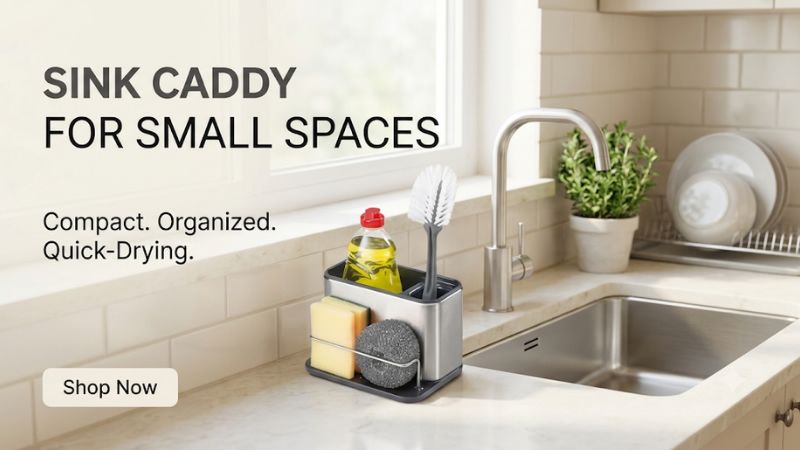
A sink caddy for small spaces keeps sponges, dish brushes, and dish soap organized without taking over valuable countertop space. The right design should provide drainage, resist everyday moisture, and fit comfortably beside or inside the sink. This buying guide explains compact organizer types, materials, measurements, mounting options, and practical ways to maintain a cleaner kitchen workstation.
- Quick Answer: What Sink Caddy Works Best in a Small Kitchen?
- Why Sink Caddy Design Matters in Compact Kitchens
- Types of Sink Caddies for Small Spaces
- How to Measure Your Sink Area Correctly
- Materials, Drainage, and Cleaning Features
- Organize Your Sink Supplies Without Overcrowding
- Common Buying Mistakes to Avoid
- Frequently Asked Questions
- Conclusion
Quick Answer: What Sink Caddy Works Best in a Small Kitchen?
For most compact kitchens, a narrow countertop sink caddy with an open drainage design is a reliable starting point. An in-sink suction organizer can save more counter space, but it must attach securely to a compatible surface. Faucet-mounted and over-sink designs are useful when they do not interfere with washing dishes or operating the faucet. The best choice is the one that accommodates your essential cleaning tools without trapping water.
Recommended choices by kitchen layout:
- Best overall: Compact stainless steel or durable polymer countertop caddy with drainage.
- Best for tiny counters: In-sink suction-mounted sponge holder.
- Best for shallow sinks: Narrow freestanding organizer positioned beside the faucet.
- Best for renters: Removable countertop or suction-mounted design.
- Best for multiple cleaning tools: Divided organizer with sponge, brush, and detergent compartments.
- Best for easy maintenance: Open-bottom caddy with removable components.
A sink caddy does not need to hold every cleaning product in the kitchen. Most households benefit from keeping only a sponge or dish brush, a small dish soap bottle, and perhaps a scraper within immediate reach. Additional cleaning products can remain in an appropriate cabinet, away from food and out of children’s reach.
Why Sink Caddy Design Matters in Compact Kitchens
Small kitchens require careful decisions about where everyday supplies belong. A sponge left beside the faucet, a dish brush resting inside the sink, and several detergent bottles scattered around the counter can make the washing area feel crowded. A well-chosen caddy groups these items into one predictable location, but only when its footprint and drainage system match the kitchen.
Reducing Clutter Around the Sink
The sink area is one of the busiest parts of a kitchen. It accommodates dishwashing, rinsing produce, filling containers, and sometimes preparing ingredients. When cleaning supplies occupy too much of the surrounding counter, they can interfere with these tasks and create unnecessary movement. A compact organizer reduces clutter by defining a small storage zone rather than allowing bottles and tools to spread across multiple surfaces.
Practical benefits:
- Keeps dishwashing tools in one location.
- Reduces loose items around the faucet.
- Makes sponges and brushes easier to find.
- Supports more consistent cleaning routines.
- Can free room for a cutting board or food preparation.
- Helps separate cleaning accessories from kitchen utensils.
However, adding a large organizer to an already crowded counter may make the problem worse. A caddy should consolidate existing items rather than create an excuse to store additional bottles beside the sink.
Start by removing supplies you rarely use. Once the essential items are identified, select an organizer that supports them comfortably.
Managing Moisture and Sponge Drying
Sponges and dish brushes are exposed to water, detergent, food residue, and frequent handling. Storage that holds a wet sponge against a solid surface can slow drying and leave moisture collecting underneath. An appropriate sink caddy should permit drainage and airflow while remaining easy to clean.
Important drying features:
- Open slots or perforated surfaces.
- Raised sponge support.
- Space between stored items.
- Drainage openings.
- Removable trays where appropriate.
- Smooth surfaces that can be cleaned regularly.
A caddy cannot sanitize a dirty sponge simply by improving airflow. Cleaning tools still require appropriate maintenance and replacement when damaged, contaminated, or persistently unpleasant.
After washing dishes, rinse or clean reusable tools as appropriate, remove excess water, and place them where they can dry. Avoid leaving a sponge submerged in standing water.
Improving Everyday Dishwashing Efficiency
A compact caddy should help create a predictable workflow. Dish soap should be easy to reach without moving the sponge, and a brush should be removable without knocking over a bottle. These small details become important when the sink is used repeatedly throughout the day.
Consider where your dominant hand naturally reaches during dishwashing and whether the organizer blocks access to the faucet controls.
Useful layout principles:
- Keep the most-used tool closest to the normal washing position.
- Separate wet sponges from detergent bottle openings.
- Give brushes enough height to stand securely.
- Avoid placing cleaning tools where they obstruct the drain.
- Leave room to rinse large cookware.
- Keep the organizer stable during normal use.
The best setup reduces the number of movements required to wash dishes while keeping cleaning products away from food preparation surfaces.
Types of Sink Caddies for Small Spaces
Sink organizers come in several configurations, including freestanding countertop trays, suction-mounted holders, faucet attachments, and designs that span part of the sink. Each has advantages and limitations. The most suitable format depends on sink material, available counter space, faucet geometry, and whether permanent or semi-permanent mounting is appropriate.
Compact Countertop Sink Caddies
Countertop caddies stand beside the sink and hold cleaning supplies in a small designated area. They are commonly constructed from stainless steel, coated metal, polymer, or mixed materials. Some designs include separate compartments for sponges and brushes, while others provide a simple open tray with drainage.
Best For: Kitchens with a narrow but usable space beside the sink.
Key Features:
- Freestanding construction.
- Sponge compartment.
- Brush holder.
- Soap bottle area on selected models.
- Drainage openings or removable tray.
- Non-slip base or feet.
Pros:
- No installation required.
- Compatible with many sink materials.
- Easy to relocate.
- Can accommodate several cleaning tools.
- Convenient for renters.
Cons:
- Uses countertop space.
- Drainage trays require attention.
- Oversized models may obstruct the faucet.
- Some designs retain moisture beneath the base.
Buy If: You want a straightforward organizer that can move with you.
Skip If: There is almost no usable counter space around the sink.
A narrow freestanding caddy often provides the best balance between convenience and adaptability. However, check the drainage arrangement before purchasing. A tray that holds water beneath the sponge may require frequent emptying, while an open design may let water reach the countertop.
In-Sink Suction-Mounted Sponge Holders
Suction-mounted holders attach to suitable smooth sink walls and keep sponges or small brushes inside the basin. This arrangement can preserve nearly all surrounding counter space. The principal limitation is attachment reliability, which depends on surface material, cleanliness, texture, and the suction system itself.
Best For: Smooth compatible sinks with limited countertop space.
Key Features:
- Suction cups or removable mounting points.
- Open drainage design.
- Compact sponge compartment.
- Minimal counter footprint.
- Removable installation.
Pros:
- Keeps the countertop clear.
- Allows water to drain into the sink.
- Usually simple to reposition.
- Convenient for basic sponge storage.
Cons:
- Suction may fail on textured surfaces.
- Can interfere with large pots.
- Reduces usable sink space.
- Requires periodic attachment checks.
Buy If: You have a compatible smooth sink surface and need to save counter space.
Skip If: Your sink is textured, unusually shallow, or frequently used for large cookware.
Before relying on suction mounting, clean and prepare the surface according to the product instructions. Test the attachment with the intended contents and check it regularly.
An organizer that repeatedly detaches is not a practical solution, even if its footprint is small.
Faucet-Mounted Sink Caddies
Faucet-mounted organizers use hooks, straps, or specially designed supports to hang cleaning tools near the faucet. They can be useful where the counter is narrow, but faucet geometry varies considerably. An attachment designed for a slender conventional faucet may not fit a large pull-down kitchen faucet or a model with unusual controls.
Best For: Compatible faucet designs with sufficient clearance.
Key Features:
- Hanging or adjustable attachment.
- Sponge support.
- Optional brush compartment.
- Open drying area.
- Removable installation.
Pros:
- Preserves counter space.
- Keeps cleaning tools nearby.
- Often requires no drilling.
- Can provide direct drainage into the sink.
Cons:
- May interfere with faucet operation.
- Compatibility is model-specific.
- Some attachments can rotate or slip.
- Weight capacity is usually limited.
Buy If: The product explicitly supports your faucet shape and leaves the controls unobstructed.
Skip If: You have a pull-down sprayer or faucet design that conflicts with the attachment.
Do not install a caddy that places unnecessary stress on moving faucet parts or water supply connections. The organizer should remain stationary during normal operation and should never require forcing a spray head into position.
Over-Sink and Hanging Rail Organizers
Over-sink organizers rest across part of the sink or hang from a compatible support rail. Some designs can accommodate a sponge, dish brush, and small detergent bottle while directing water back into the basin. They can be efficient in compact kitchens, but they occupy space needed for rinsing and handling cookware.
Best For: Suitable sinks with enough width and a predictable washing routine.
Key Features:
- Sink-spanning or rail-mounted design.
- Open drainage.
- Multiple accessory positions.
- Removable construction.
- Adjustable width on selected models.
Pros:
- Uses space above the sink.
- Keeps surrounding counters clearer.
- Can accommodate several tools.
- May eliminate the need for a water-collection tray.
Cons:
- Can obstruct sink access.
- Requires careful dimensional matching.
- May be inconvenient for large cookware.
- Stability depends on correct support.
Buy If: Your sink geometry supports the organizer securely.
Skip If: You need uninterrupted access to the full basin.
Check the rack’s support points and intended capacity before adding detergent bottles or heavy brushes.
A narrow organizer that shifts under normal use can become more frustrating than a simple countertop holder.
How to Measure Your Sink Area Correctly
Accurate measurement prevents many disappointing sink caddy purchases. A product can appear compact in photographs while extending into the space needed for a faucet handle, dish rack, or cutting board. Measure the actual usable footprint and account for how cleaning tools are removed and replaced during ordinary dishwashing.
Measure Available Countertop Width and Depth
Begin by clearing the area around the sink and identifying the space that can realistically remain dedicated to cleaning supplies. Measure the width parallel to the sink and the depth from the backsplash or wall to the sink edge. Avoid including space needed for other equipment.
Measurement checklist:
- Available counter width.
- Usable counter depth.
- Faucet-control clearance.
- Distance to the sink edge.
- Space beneath windowsills or shelves.
- Room for removing brushes.
- Access to nearby electrical outlets.
A narrow caddy may fit beside the faucet but still interfere with a soap dispenser or the movement of a pull-down sprayer.
A cardboard template matching the proposed dimensions can reveal these problems before purchase.
Check Sink Material and Mounting Compatibility
Suction-mounted and magnetic accessories require compatible surfaces. Stainless steel, porcelain, composite, and textured sinks behave differently, and a product marketed for smooth surfaces may not attach securely to every finish.
Questions to ask:
- Is the surface smooth or textured?
- Is the wall flat or curved?
- Does the product require suction cups?
- Is the surface actually magnetic?
- Will the attachment contact a removable accessory?
- Can the caddy be removed without damaging the finish?
Do not infer magnetic compatibility from a stainless steel appearance alone.
For suction systems, follow the manufacturer’s surface preparation instructions and test attachment reliability.
If compatibility is uncertain, choose a freestanding organizer instead of improvising mounting hardware.
Allow Clearance for Everyday Washing
The organizer should not interfere with filling pots, washing baking sheets, or handling large cutting boards. A compact kitchen often uses the sink for many tasks, so every accessory needs to justify the space it occupies.
Test the intended placement using your largest routinely washed pan.
Move the faucet through its normal range and confirm that the organizer does not contact it.
Leave enough space to remove sponges and brushes without knocking over other supplies.
Clearance priorities:
- Faucet operation.
- Sprayer movement.
- Large cookware washing.
- Sink drain access.
- Comfortable hand movement.
- Easy cleaning underneath the organizer.
A design that saves a few inches but disrupts basic washing tasks is not necessarily space-efficient.
Materials, Drainage, and Cleaning Features
Sink caddies remain in a humid, frequently wet environment. Material quality, drainage, and ease of cleaning therefore matter more than decorative appearance alone. Stainless steel, coated metal, polymer, and silicone components offer different strengths, but actual performance depends on the complete product design and manufacturer’s care instructions.
Stainless Steel and Coated Metal Organizers
Metal caddies can provide a slim, structured frame with open drainage. Stainless steel is commonly used for wet-area accessories, while coated carbon steel can provide a different appearance and construction. Neither material should be assumed permanently rustproof under every condition.
Features worth checking:
- Material grade where disclosed.
- Surface finish.
- Smooth welded joints.
- Drainage openings.
- Corrosion protection.
- Removable components.
- Cleaning instructions.
Advantages:
- Open wire construction can improve drainage.
- Slim structural supports.
- Often easy to rinse.
- Suitable for compact compartment designs.
Limitations:
- Some finishes may stain or corrode.
- Wire joints can collect residue.
- Hard contact points may scratch delicate surfaces.
- Mineral deposits may remain visible.
If a metal caddy develops damaged coating or corrosion, assess whether it remains suitable for continued use.
Polymer and Silicone Sink Caddies
Polymer organizers can provide molded compartments, removable trays, and shapes that suit narrow counters. Silicone components may offer flexible contact surfaces or drainage structures. Material alone does not determine durability or hygiene, so inspect construction and cleaning requirements.
Advantages:
- Lightweight.
- Available in compact shapes.
- Often simple to wipe.
- Can include removable compartments.
- Less likely to have exposed metal corrosion points.
Limitations:
- Some materials may discolor.
- Narrow drainage channels can trap residue.
- Plastic components may crack or wear.
- Not every product is dishwasher-safe.
A removable tray is useful only if users can clean and dry it easily.
Avoid choosing a complicated molded organizer with inaccessible channels simply because it has an attractive appearance.
Drainage Systems That Reduce Standing Water
Drainage is one of the most important sink caddy features. Some organizers allow water to flow directly into the sink, while others collect it in a small removable tray. Both designs can work when maintained properly.
Direct-drain designs:
- Direct water toward the basin.
- Reduce tray emptying.
- Require suitable placement.
- Need unobstructed drainage paths.
Collection-tray designs:
- Work independently of sink-edge positioning.
- Can protect some surrounding surfaces from drips.
- Require regular emptying.
- Need thorough cleaning and drying.
Open-bottom designs:
- Promote ventilation.
- May allow water to reach the counter.
- Can be easy to rinse.
- Require a suitable drainage area.
A drip tray should not become permanent water storage.
Check it regularly and remove standing water before residue accumulates.
Organize Your Sink Supplies Without Overcrowding
A small sink caddy works best when it contains only the tools needed during ordinary dishwashing. Overfilling compartments with specialty brushes, extra detergent bottles, and unrelated household accessories can make cleaning more difficult. The ideal layout gives frequently used items predictable positions and keeps wet accessories separate where practical.
Keep Only Daily-Use Tools Beside the Sink
Start by placing every current sink accessory on the counter. Identify which items are used during most washing sessions and which are needed only occasionally. Keep the frequent-use tools in the caddy and store backups or specialty cleaners in a suitable cabinet.
A practical everyday setup may include:
- One sponge or dish brush.
- One small dish soap container.
- One narrow cleaning scraper.
- One bottle brush when used frequently.
- One small compartment for compatible accessories.
Avoid storing excessive replacement sponges in a wet caddy.
Keep unused cleaning supplies clean, dry, and protected in appropriate storage.
Separate Wet Tools From Detergent Containers
A damp sponge should have a place to drain without resting against unrelated items. Dish brushes need enough height for bristles to remain clear of dirty surfaces, while soap bottles should stand securely.
Organizing tips:
- Keep sponge drainage unobstructed.
- Position brushes where air can circulate.
- Prevent bottles from tipping.
- Remove residue from soap dispensers.
- Avoid stacking damp tools.
- Keep cleaning products away from food.
This arrangement helps maintain a tidier workstation and makes regular cleaning easier.
Establish a Simple Maintenance Routine
Sink caddies are not maintenance-free. Soap residue, food particles, and moisture can accumulate on their surfaces, particularly in narrow compartments and drainage trays.
Daily habits:
- Remove visible food debris.
- Rinse cleaning tools appropriately.
- Remove excess sponge water.
- Empty standing water.
- Keep drainage openings clear.
Periodic care:
- Remove all contents.
- Clean the caddy according to its instructions.
- Inspect suction cups or mounting hardware.
- Dry components before reassembly.
- Replace damaged cleaning tools.
If a suction-mounted caddy repeatedly slips or a freestanding rack becomes unstable, address the cause rather than continuing to rely on an unreliable setup.
Common Buying Mistakes to Avoid
Small-space organizers are often purchased based on appearance rather than practical fit. A sleek caddy may be too wide for the sink edge, an adhesive attachment may be incompatible with the wall, or a design with several compartments may trap moisture. These problems can be avoided by measuring accurately and selecting features that match actual washing habits.
Choosing Too Many Compartments
Extra compartments are useful only when the household regularly needs them. A large caddy can encourage clutter by creating a place for unnecessary tools.
Choose enough capacity for essential supplies.
Do not buy a six-compartment organizer when the household uses only one sponge and a dish soap bottle.
Unused sections still occupy space and require cleaning.
A smaller, simpler design may provide better everyday convenience.
Ignoring the Drainage Method
A caddy that traps water beneath a sponge can become unpleasant to maintain.
Check whether water drains into the sink, collects in a removable tray, or reaches the countertop.
Choose a design compatible with the intended location.
Do not rely on a drainage spout when the caddy cannot be positioned correctly.
Assuming Every Mounting Method Will Work
Suction cups, magnets, adhesive strips, and hanging attachments have specific compatibility requirements.
A product that fits one kitchen may not work in another.
Check surface material, attachment instructions, and supported weight.
For renters, avoid mounting systems that could damage the sink or surrounding finishes.
When uncertain, a freestanding caddy is generally the lower-commitment choice.
Frequently Asked Questions
Compact sink caddies raise questions about drainage, mounting reliability, materials, and hygiene. The most useful answers depend on the sink’s construction and the cleaning tools stored. A successful organizer supports everyday washing while remaining easy to remove, inspect, and clean, rather than permanently trapping water or adding clutter.
What Is the Best Sink Caddy for a Very Small Kitchen?
A compact freestanding caddy or compatible in-sink suction holder is often a practical choice. The best option depends on the available counter area and sink surface. Freestanding designs are flexible, while in-sink holders can preserve counter space. Choose an organizer that provides adequate drainage without obstructing faucet operation or large cookware washing.
Are Suction-Cup Sink Caddies Reliable?
They can work well on compatible smooth, clean surfaces, but attachment reliability varies with surface texture, moisture, product construction, and installation. Follow manufacturer instructions and test the holder with its intended contents. If the accessory repeatedly detaches, choose another mounting location or a freestanding design rather than relying on an unstable attachment.
Is Stainless Steel Better Than Plastic for Sink Caddies?
Neither material is universally superior. Stainless steel can provide slim structural supports and open drainage, while polymer designs may offer lightweight construction and convenient removable trays. Actual corrosion resistance, cleaning ease, and stability depend on product details. Compare the complete design and care instructions rather than selecting solely on material.
Should a Sink Caddy Have a Drainage Tray?
A tray is useful when the organizer sits on a counter that should remain dry. However, collection trays require regular emptying and cleaning. Direct-drain organizers may reduce this work when positioned correctly over the sink. The best approach depends on the location and whether water can drain safely without creating puddles.
Can a Sink Caddy Help Keep Sponges Cleaner?
A caddy can support better drying by keeping sponges away from standing water and allowing airflow. However, it does not replace appropriate sponge cleaning, maintenance, and replacement. Remove food residue, follow suitable cleaning practices, and replace tools that are damaged or persistently contaminated. Good storage is one part of maintaining a hygienic dishwashing area.
Conclusion
A sink caddy for small spaces should organize essential cleaning tools without interfering with normal kitchen tasks. Compact freestanding designs provide flexibility, while compatible in-sink and over-sink holders can preserve more counter space. Prioritize accurate measurements, reliable drainage, easy-to-clean materials, and stable placement. Keep only regularly used supplies beside the sink and maintain the organizer consistently. A simple caddy that stays dry and accessible is usually more useful than an oversized model with unnecessary compartments.









Write Your Review
No reviews yet. Be the first to share your experience!