
An expandable silverware organizer for beginners can turn a crowded kitchen drawer into a practical place for forks, spoons, knives, and everyday utensils. However, expandable trays vary in width, depth, compartment layout, and cleaning requirements. This guide explains how to measure correctly, choose suitable materials, arrange silverware, and avoid common mistakes before purchasing your first organizer.
- Quick Answer: What Should Beginners Buy?
- Why an Expandable Silverware Organizer Is Useful
- Types of Expandable Silverware Organizers
- How to Measure a Drawer Before Buying
- Choose Compartments Based on Your Actual Silverware
- Stability, Materials, and Everyday Durability
- How to Set Up Your First Expandable Organizer
- Common Mistakes First-Time Buyers Should Avoid
- Frequently Asked Questions
- Conclusion
Quick Answer: What Should Beginners Buy?
For most first-time buyers, a simple expandable flatware tray with four or five core compartments and one or two adjustable side sections is a sensible choice. It offers enough separation for everyday silverware without introducing an unnecessarily complicated layout. The best design should fit the drawer at its smallest setting, expand only as much as needed, and remain stable during regular opening and closing.
Recommended features:
- Best overall design: Expandable tray with clearly divided spaces for everyday utensils.
- Best for small drawers: Compact organizer with a narrow collapsed width.
- Best for mixed utensils: Tray with an additional long compartment.
- Best for easy cleaning: Removable polymer organizer with smooth corners.
- Best for a natural appearance: Bamboo expandable organizer with suitable surface protection.
- Best for changing households: Adjustable side compartments that accommodate future silverware additions.
The biggest mistake is choosing an organizer based on how wide it expands without confirming how narrow it becomes. If the collapsed tray is already too wide, the expansion feature offers no benefit. Begin with the dimensions of your drawer and the utensils you actually own rather than shopping according to appearance alone.
Why an Expandable Silverware Organizer Is Useful
Kitchen drawers tend to collect more than forks and spoons. Serving utensils, reusable straws, chopsticks, measuring tools, and small gadgets often end up mixed together because the original tray lacks suitable compartments. An expandable organizer creates designated spaces while making use of available drawer width. However, that flexibility works best when the basic tray layout matches your daily routine.
The Difference Between Fixed and Expandable Trays
A fixed flatware organizer has a predetermined footprint and compartment arrangement. It can be an excellent choice when a drawer closely matches its dimensions and the household owns a consistent set of silverware. An expandable tray adds one or more sliding sections that widen the organizer, allowing users to cover more of the drawer interior without leaving a large loose gap.
Fixed organizer advantages:
- Simple construction.
- Consistent compartment positions.
- Often easy to remove for cleaning.
- No moving expansion panels.
Expandable organizer advantages:
- Adjustable overall width.
- Better use of different drawer sizes.
- Additional compartments on selected designs.
- Flexibility when moving between kitchens.
Expandable organizer limitations:
- The minimum width may still be too large.
- Sliding sections can collect crumbs.
- Some designs become less stable when fully extended.
- Compartment widths may not adjust individually.
For beginners, expandability is useful primarily when it addresses a real width mismatch. It cannot compensate for insufficient drawer depth or height.
Why Compartment Layout Matters More Than Appearance
A beautiful silverware organizer can become frustrating when its compartments do not fit the utensils used most often. Dinner forks, salad forks, teaspoons, tablespoons, table knives, and serving spoons vary in length and width. Some modern flatware sets have unusually broad handles, while others use compact proportions that fit almost any standard tray.
The most practical layout gives each frequently used category its own position without forcing utensils to overlap awkwardly. Begin by separating your existing silverware into groups and estimating how much space each group needs.
Common categories:
- Dinner forks.
- Smaller forks.
- Tablespoons.
- Teaspoons.
- Table knives.
- Serving utensils.
- Chopsticks or reusable straws.
- Frequently used small gadgets.
Avoid buying an organizer with many narrow sections simply because it promises maximum compartment count. A few sufficiently wide compartments usually make silverware easier to remove and return.
Types of Expandable Silverware Organizers
Expandable organizers differ not only in material but also in how they use the available space. Some retain a conventional flat compartment layout, while others stack utensils diagonally or overlap categories to reduce their footprint. Understanding these distinctions helps beginners select a design they can maintain without frequently rearranging the drawer.
Traditional Expandable Flatware Trays
Traditional expandable trays use parallel compartments for utensils, with adjustable sections extending from the sides. They are familiar and easy to understand because each utensil category occupies a separate channel. This format suits most households that want a straightforward organization system without changing how silverware is stored or retrieved.
Best For: Everyday forks, spoons, knives, and a few additional utensils.
Key Features:
- Four or more central compartments.
- Sliding side extensions.
- Open-top construction.
- Rectangular drawer footprint.
- Polymer, bamboo, or mixed-material construction.
Pros:
- Familiar storage arrangement.
- Clear category separation.
- Easy to organize.
- Can accommodate more items as the drawer width permits.
Cons:
- Wider trays consume substantial drawer space.
- Long utensils may need a separate compartment.
- Expansion joints require cleaning.
Buy If: You want the simplest transition from a crowded drawer to organized flatware.
Skip If: The drawer is extremely narrow or has insufficient depth for the tray.
A traditional tray is often the strongest first purchase because it requires little explanation to other household members. Everyone can recognize where forks and spoons belong, making the system easier to maintain over time.
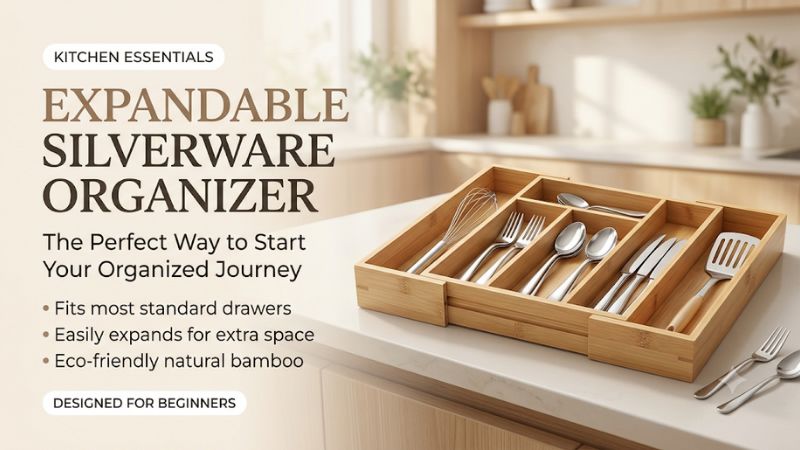
Bamboo Expandable Silverware Organizers
Bamboo trays offer a natural appearance and are commonly marketed with sliding side compartments. The material can coordinate with wooden cabinetry and may feel more substantial than lightweight polymer designs. However, bamboo still requires appropriate moisture care, and the smoothness of divider joints and the stability of extended sections depend on product construction.
Best For: Buyers who prefer a natural-looking drawer interior and dry storage conditions.
Key Features:
- Bamboo compartment walls.
- Expandable side sections.
- Multiple flatware channels.
- Fixed central structure.
- Removable installation.
Pros:
- Natural appearance.
- Clearly separated utensils.
- Suitable for standard dry silverware storage.
- Can coordinate with other bamboo kitchen accessories.
Cons:
- Not all models are dishwasher-safe.
- Excessive moisture can affect finishes or joints.
- Sliding surfaces may require occasional cleaning.
- Thick compartment walls reduce usable internal width.
Buy If: You value appearance and are comfortable wiping and drying the organizer by hand.
Skip If: You want a tray that can routinely be washed in a dishwasher.
Bamboo is best treated according to the exact manufacturer’s care instructions. Do not assume that an attractive natural finish makes the organizer waterproof. Silverware should be thoroughly dried before returning it to an enclosed wooden drawer.
Polymer Expandable Cutlery Trays
Polymer trays are available in conventional and compact designs. Their molded walls can create smooth compartments, and certain models include non-slip features or removable sections. Some manufacturers also use recycled polymer content. Material disclosures are useful, but they do not guarantee compatibility with every cleaning method or resistance to all types of wear.
Best For: Households prioritizing easy routine cleaning and straightforward organization.
Key Features:
- Molded compartments.
- Adjustable width.
- Lightweight construction.
- Rounded interior corners on selected designs.
- Optional non-slip feet or bases.
Pros:
- Often easy to wipe.
- Lightweight and portable.
- Available in compact designs.
- Suitable for many everyday silverware collections.
Cons:
- Thin trays may flex under excessive loading.
- Certain finishes can show scratches.
- Expansion channels may trap crumbs.
- Dishwasher suitability varies.
Buy If: You prefer a practical low-maintenance organizer and want a lightweight removable tray.
Skip If: You strongly prefer natural materials or need an unusual custom drawer layout.
For beginners, polymer is a useful option because cleaning usually involves fewer special considerations. Still, follow the manufacturer’s instructions rather than assuming every molded organizer tolerates high-temperature washing.
Tiered and Space-Saving Cutlery Organizers
Tiered organizers arrange utensils in partially overlapping compartments rather than placing every category side by side. This can reduce horizontal space requirements, making the format relevant for narrow drawers. Some expandable designs combine tiered central storage with additional side compartments for larger kitchen tools.
Best For: Drawers where conventional side-by-side compartments consume too much width.
Key Features:
- Overlapping utensil channels.
- Angled or layered storage.
- Compact central footprint.
- Optional expandable side areas.
- Separate positions for smaller cutlery.
Pros:
- Makes use of drawer depth.
- Can reduce overall width.
- Suitable for narrow kitchen layouts.
- Keeps flatware categories separated.
Cons:
- Less intuitive for some users.
- Utensils can overlap when overloaded.
- Tall handles may interfere with drawer closure.
- Some models are difficult to clean beneath stacked sections.
Buy If: Your drawer is narrow but sufficiently deep and tall.
Skip If: You prefer seeing the entire utensil at once or have many unusually thick handles.
A tiered organizer is useful only when the drawer provides enough vertical clearance. The tray may fit when empty but prevent closure once it contains bulky flatware. Measure with the actual utensils in mind.
How to Measure a Drawer Before Buying
Accurate measurements prevent the most common silverware organizer returns. A product advertised as expanding to twenty inches may still be unsuitable for a drawer that is only eleven inches wide at its narrowest point. Buyers should measure the usable interior dimensions, account for hardware, and compare both the collapsed and expanded tray sizes.
Measure the Inside Width, Not the Cabinet Front
Open the drawer fully and measure from one interior wall to the other. Do not use the exterior drawer-front width because it includes cabinet framing and may be substantially larger than the storage compartment. Measure at more than one point if the drawer has tapered sides or internal hardware.
Record these dimensions:
- Interior width at the front.
- Interior width near the back.
- Narrowest usable width.
- Space occupied by internal dividers.
- Required clearance for removing the organizer.
The tray’s minimum width must fit within the narrowest usable measurement. Its maximum expansion should also leave enough clearance for normal drawer operation.
Avoid forcing an organizer tightly against the drawer walls. A little space makes removal and cleaning easier.
Measure Depth and Drawer Height
Depth determines whether the organizer fits from front to back. Height determines whether utensils can rest inside without contacting the cabinet frame when the drawer closes. Some silverware organizers are unexpectedly long, especially models designed for deep modern kitchen drawers.
Check the following:
- Usable drawer depth.
- Interior wall height.
- Clearance beneath the countertop or cabinet frame.
- Height of the organizer.
- Thickness of stacked utensil handles.
- Space required for expansion hardware.
For example, a tray measuring approximately sixteen inches deep cannot fit inside a fourteen-inch usable drawer regardless of how narrow its adjustable width becomes.
Test the complete configuration before ordering.
Make a Simple Cardboard Fit Template
A cardboard template can help beginners understand whether a proposed organizer will leave room for other tools. Cut a rectangle matching the tray’s minimum dimensions and place it inside the empty drawer. Extend the outline with additional cardboard strips to simulate its expanded width.
Place several utensils on the template.
Check whether the longest table knife fits without protruding over the edge.
Try closing the drawer carefully without forcing anything.
This inexpensive exercise can reveal that a small non-expandable tray plus a separate utensil bin is more appropriate than one large expandable organizer.
Choose Compartments Based on Your Actual Silverware
A successful organizer should reflect the utensils currently used in the household rather than a decorative product photograph. Families may own enough flatware for twelve place settings, while single-person households may use only a handful of utensils daily. Compartment quantity, depth, and width should correspond to that inventory.
Separate Standard Flatware Before Shopping
Remove everything from the current drawer and create distinct piles for forks, spoons, knives, and special utensils. Count the items in each group and check whether they fit comfortably in a single compartment without creating excessively tall stacks.
Inventory checklist:
- Dinner forks.
- Salad or dessert forks.
- Tablespoons.
- Teaspoons.
- Table knives.
- Serving spoons.
- Chopsticks.
- Specialty utensils.
Measure the longest pieces and the widest handles. Some flatware has decorative ends that occupy substantially more width than narrow modern sets.
If the household owns many serving utensils, reserve an expandable side section for them rather than overcrowding standard compartments.
Decide What Does Not Belong in the Silverware Tray
Kitchen drawers frequently become cluttered because unrelated tools are placed wherever there is an empty space. Bottle openers, peelers, scissors, measuring spoons, and small gadgets can occupy compartments needed for forks or knives.
A beginner-friendly system should establish clear boundaries.
Keep in the main tray:
- Everyday eating utensils.
- Common serving utensils if appropriately sized.
- Reusable chopsticks when used frequently.
Store separately when practical:
- Large cooking knives.
- Sharp specialty tools.
- Oversized serving equipment.
- Loose replacement parts.
- Rarely used gadgets.
Sharp kitchen knives need dedicated protective storage and should not be mixed loosely with silverware.
A silverware tray is intended primarily for ordinary flatware, not as a substitute for a knife drawer organizer.
Leave Space for Future Changes
An expandable organizer provides flexibility, but it should not be purchased solely for hypothetical future utensils. Start with a layout that fits the existing collection and offers a modest amount of room for realistic additions.
A household may eventually buy new teaspoons or replace a serving set.
Having one small adjustable compartment can be useful in that situation.
However, leaving half the drawer occupied by unused organizer space does not improve functionality.
Choose a configuration that works now and can adapt modestly later.
Stability, Materials, and Everyday Durability
A silverware organizer moves every time its drawer opens or closes, so stability matters. An expandable tray that shifts across the drawer can make utensils slide into neighboring compartments, while poorly fitted extension sections can move unexpectedly. Construction details should therefore be considered alongside material and appearance.
Look for Non-Slip Features
Some expandable trays include non-slip feet or bottom surfaces designed to reduce movement. These features are useful, but their effectiveness depends on the drawer material and how the organizer is loaded.
Stability considerations:
- Flat supporting base.
- Secure expansion sections.
- Non-slip contact points.
- Adequate side clearance.
- Appropriate total load.
- Smooth drawer motion.
Do not use loose makeshift wedges that could jam the drawer.
If a tray moves excessively, check whether the organizer is correctly expanded and whether the base is clean and level.
Check Divider Height and Strength
Thin compartment walls can save space, but they should remain sufficiently rigid for the intended number of utensils. A divider that bends under normal loading may allow forks or spoons to migrate into another section.
Inspect the product’s construction and intended use.
Avoid stacking heavy utensils above the divider height.
For wooden organizers, check that joints are smooth and secure.
For polymer models, look for cracked edges or warped expansion components.
The best tray provides enough structural separation without becoming unnecessarily bulky.
Match Cleaning Requirements to Your Routine
Kitchen drawers accumulate crumbs, dust, and moisture even when only clean utensils are stored. An organizer should be easy to remove and clean without complex disassembly.
Cleaning priorities:
- Smooth interior corners.
- Accessible expansion channels.
- Removable construction.
- Manufacturer-approved washing method.
- Thorough drying before replacement.
- No hard-to-reach cavities.
If the household prefers dishwasher cleaning, verify that the exact organizer is dishwasher-safe.
Bamboo trays usually need more careful moisture management than many polymer alternatives.
How to Set Up Your First Expandable Organizer
Installation normally does not require drilling or permanent cabinet modifications. However, a few minutes of preparation can make the organizer substantially more effective. Begin with an empty, clean drawer, place the tray at its minimum width, and extend it gradually until it occupies the intended space without binding.
Follow a Simple Setup Process
A beginner does not need a complicated organization system. The most useful process is to measure, position, categorize, test, and adjust. Keep the initial layout straightforward so household members can learn where utensils belong without labels or instructions.
Setup steps:
- Empty the drawer.
- Clean and dry the interior.
- Place the organizer at its minimum width.
- Expand it to the desired size.
- Check drawer clearance.
- Group silverware by category.
- Load the compartments.
- Open and close the drawer several times.
- Adjust spacing if items shift.
Do not expand the tray past its designed limit.
If the organizer leaves an awkward gap, consider using that space for a separate small bin rather than stretching the tray beyond a stable position.
Arrange Utensils for Fast Retrieval
Put the most frequently used categories where the hand naturally reaches when opening the drawer. This may mean keeping forks and spoons in the center and larger serving utensils in an expandable side section.
There is no universally correct order.
The main goal is consistency.
Practical arrangement:
- Everyday forks in one compartment.
- Tablespoons in another.
- Teaspoons separated from larger spoons.
- Table knives in a defined channel.
- Serving utensils in a longer section.
- Specialty flatware in a secondary position.
Avoid forcing different categories into one compartment simply because the tray has fewer divisions than expected.
Reconfigure the extension or choose a different organizer if the daily layout remains inconvenient.
Maintain the System Over Time
A silverware organizer is effective only when utensils return to the correct locations. Encourage household members to keep categories consistent rather than allowing the drawer to revert to a mixed collection.
Simple maintenance routine:
- Return clean, dry utensils.
- Remove unrelated gadgets.
- Wipe spills promptly.
- Clean the organizer periodically.
- Check sliding sections for debris.
- Reassess the layout when flatware changes.
If the organizer becomes overcrowded, remove unused or duplicate utensils before buying another tray.
Common Mistakes First-Time Buyers Should Avoid
Expandable trays are often marketed as flexible solutions, but flexibility has limits. A product may expand in width while remaining too deep for the drawer, or it may provide additional compartments that are too narrow for the household’s utensils. Understanding these limitations helps beginners avoid wasting money on a tray that looks useful but performs poorly in everyday cooking.
Buying Based Only on Maximum Width
An organizer’s expanded width is not enough to establish compatibility.
Check the minimum width, fixed depth, height, and expansion range.
A tray cannot be made narrower than its designed collapsed size.
If the drawer is smaller than that measurement, choose a more compact organizer rather than attempting to modify the product.
Ignoring Long Serving Utensils
Serving spoons, chopsticks, and specialty flatware may be too long for standard compartments.
Measure the longest utensils before purchasing.
Look for a dedicated long section or an arrangement that keeps them separate.
A tray that fits dinner forks perfectly can still become frustrating if several long utensils must sit diagonally across neighboring categories.
Choosing Appearance Over Cleaning
Natural bamboo and polished polymer can both look attractive, but the finish is not the only consideration.
Check whether the expansion channels can be cleaned and whether the product’s care requirements suit the household.
If you regularly wash organizational accessories in a dishwasher, choose a model explicitly approved for that method.
Easy maintenance is a more durable advantage than appearance alone.
Filling Every Compartment Immediately
Extra compartments are not an invitation to collect more utensils.
An organizer works best when everything has a purpose.
Leave unused space available for normal changes.
If the tray is already crowded on the first day, reconsider the layout or reduce unnecessary items.
Frequently Asked Questions
First-time buyers often ask whether expandable trays fit every drawer, whether bamboo is better than polymer, and how much space is needed for a standard silverware set. The most useful answers depend on actual drawer dimensions and utensil shape. A simple measurement and inventory check usually prevents more problems than choosing the most feature-rich organizer.
Are Expandable Silverware Organizers Worth Buying?
They can be worthwhile when a drawer is wider than a standard fixed tray or when the household needs several different compartment widths. The adjustable sections make it easier to use available space without permanent modifications. However, a fixed organizer may be simpler when it already matches the drawer and silverware collection. Expandability is valuable only when it solves a real fit or capacity problem.
Do Expandable Organizers Fit All Kitchen Drawers?
No. Each product has minimum and maximum width requirements, plus fixed depth and height dimensions. Some drawers are too narrow or shallow for a particular model. Measure the usable interior, account for drawer hardware, and compare every dimension with the selected organizer. Do not rely solely on the cabinet’s exterior width or a product title describing universal fit.
Is Bamboo Better Than Plastic for Silverware Storage?
Neither is universally better. Bamboo offers a natural appearance but usually requires careful moisture management. Polymer trays can be lightweight and may offer simpler cleaning, depending on the model. Construction, compartment layout, stability, and care instructions matter more than the material alone. Choose a design that fits your drawer and the household’s maintenance routine.
How Many Compartments Should a Beginner Choose?
Most households benefit from distinct spaces for forks, tablespoons, teaspoons, and table knives, with additional compartments for smaller flatware or serving utensils. The correct number depends on the actual collection. Too many narrow sections can be less useful than a few generously sized compartments. Sort and count your utensils before deciding.
Can I Store Sharp Kitchen Knives in a Silverware Organizer?
Loose sharp knives should not be stored alongside ordinary flatware. Use a dedicated knife organizer, individual blade guards, or another suitable protective storage method. The goal is to prevent accidental contact with exposed edges and reduce blade damage. Table knives are different from sharp chef’s knives and may fit appropriately in standard flatware compartments.
How Often Should a Silverware Organizer Be Cleaned?
Clean it when crumbs, dust, spills, or residue accumulate and inspect it periodically during routine drawer cleaning. The frequency depends on household use. Remove the tray, follow the manufacturer’s washing instructions, and dry both the organizer and drawer before replacing clean utensils. Expansion channels deserve particular attention because debris can collect beneath moving sections.
Conclusion
An expandable silverware organizer for beginners should fit the drawer at its minimum width, expand securely, and provide useful compartments for the utensils actually used every day. Traditional trays are easy to understand, tiered designs can save horizontal space, and bamboo or polymer options offer different maintenance requirements. Measure all three drawer dimensions, sort your silverware before shopping, and choose a stable organizer that remains easy to clean. A straightforward layout is usually the best first step toward a more functional kitchen.









Write Your Review
No reviews yet. Be the first to share your experience!