
A versatile Santoku knife can make everyday vegetable chopping, herb preparation, and boneless meat slicing more comfortable, especially when you prefer a shorter blade than a conventional chef’s knife. Santoku designs vary in steel, handle, edge shape, and weight, so the right choice depends on your cutting habits. This guide compares seven established options for home kitchens.
- Quick Verdict: Which Santoku Knife Is Best?
- Quick Comparison Table
- How We Selected These Santoku Knives
- Detailed Reviews of Seven Santoku Knives
- Buying Guide: How to Choose the Right Santoku Knife
- Santoku Knife vs. Chef’s Knife vs. Nakiri
- Everyday Cooking Scenarios
- How to Maintain a Santoku Knife
- Common Santoku Buying Mistakes
- Frequently Asked Questions
- Conclusion
Quick Verdict: Which Santoku Knife Is Best?
Santoku knives are commonly associated with three broad kitchen tasks: cutting vegetables, fish, and meat. In modern home cooking, they are particularly useful for chopping, slicing, and dicing ingredients that do not require a long heavy blade. Many Santoku knives have blades around 6.5 to 7 inches long, with a relatively broad profile and a tip that differs from the pointed shape of a traditional Western chef’s knife.
Our seven recommended options:
- Best overall Japanese-style Santoku: Tojiro Classic Santoku 170mm, F-503.
- Best accessible everyday option: Victorinox Swiss Classic Santoku, 7-Inch.
- Best German-style forged Santoku: WÜSTHOF Classic 7-Inch Hollow Edge Santoku.
- Best ergonomic German alternative: ZWILLING Pro 7-Inch Hollow Edge Santoku.
- Best all-metal Japanese design: GLOBAL G-46 7-Inch Santoku.
- Best refined Japanese Santoku: Shun Classic 7-Inch Santoku.
- Best compact alternative: MAC Superior SK-65 6.5-Inch Santoku.
The Tojiro Classic offers a Japanese-made blade with a VG10 core and a conventional handle, making it a useful starting point for someone interested in a traditional double-bevel Santoku.
Victorinox offers a practical Swiss-made alternative with a relatively accessible design.
WÜSTHOF and ZWILLING provide German-manufactured Santoku options, each with distinctive handle and bolster construction.
GLOBAL’s G-46 offers an all-stainless design, Shun emphasizes refined Japanese blade construction, and MAC provides a compact 6.5-inch format.
The best Santoku is one that fits your grip and cutting style, not simply the most expensive or decorative model.
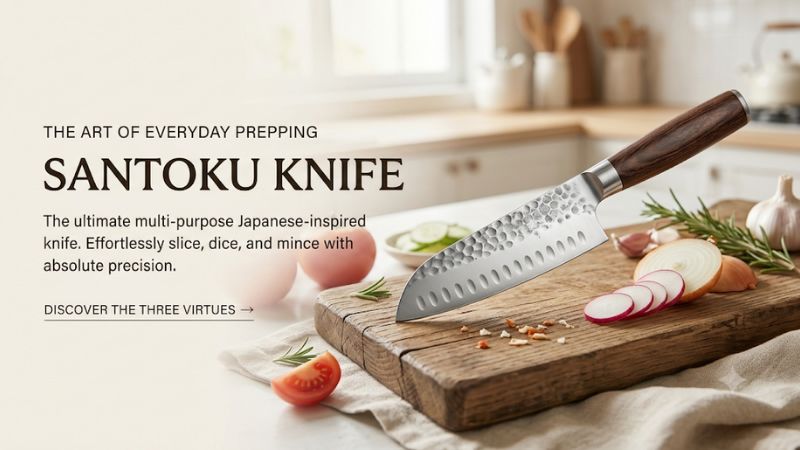
Quick Comparison Table
A Santoku is not one fixed design. Some models emphasize controlled chopping with a relatively straight cutting profile, while others provide additional curve to accommodate familiar rocking movements. Hollow-edge indentations are common, but their effectiveness at reducing food adhesion varies according to the ingredient and cutting motion. The table highlights important differences rather than treating all seven knives as interchangeable.
| Knife | Blade Length | Construction Highlight | Best For | Main Limitation |
|---|---|---|---|---|
| Tojiro Classic F-503 | 170 mm | VG10 core, stainless cladding | Everyday Japanese-style prep | Fine edge requires care |
| Victorinox Swiss Classic | 7 in | Swiss-made stainless blade | Practical kitchen use | Less decorative finish |
| WÜSTHOF Classic Hollow Edge | 7 in | Forged German steel | General chopping and slicing | More substantial design |
| ZWILLING Pro Hollow Edge | 7 in | Curved bolster | Pinch-grip comfort | Grip feel is personal |
| GLOBAL G-46 | 7 in | Stainless blade and handle | Streamlined handling | Metal grip preference |
| Shun Classic Santoku | 7 in | VG-MAX core, layered blade | Refined precision prep | Requires careful care |
| MAC Superior SK-65 | 6.5 in | Compact Japanese-made blade | Smaller cutting boards | Limited reach for large ingredients |
The correct blade should make normal kitchen tasks comfortable without encouraging unsafe cutting methods.
A Santoku can be versatile, but it is not a heavy-duty meat cleaver or a serrated bread knife.
How We Selected These Santoku Knives
The shortlist includes identifiable models from established manufacturers. We considered blade length, handle design, construction, intended use, edge-maintenance requirements, and meaningful differences between Japanese and Western interpretations of the Santoku. These recommendations are editorial assessments of suitability rather than claims of independent cutting tests or personally measured edge retention.
Selection criteria
- Versatility: Suitability for vegetables, herbs, and boneless proteins.
- Blade shape: Practicality for controlled slicing and chopping.
- Length: Compatibility with home cutting boards.
- Handle: Comfort and secure grip.
- Steel: Manufacturer-described construction and maintenance needs.
- Hollow edge: Presence and practical limitations of blade indentations.
- Cleaning: Appropriate handwashing and corrosion care.
- Value: Relevance of the product’s features to everyday cooking.
- Safety: Proper use rather than claims of automatic protection.
We did not assign invented sharpness scores or assume that a harder steel always provides a better knife.
Actual cutting performance depends on geometry, sharpening, maintenance, ingredient texture, and technique.
Detailed Reviews of Seven Santoku Knives
The following reviews examine each model’s distinctive design, everyday applications, and limitations. Rather than promising that every Santoku performs identically, the comparisons focus on how different blade lengths, handle materials, and edge constructions may suit different home cooks. Each recommendation also identifies the kinds of cutting tasks that should be handled by another kitchen tool.
Tojiro Classic Santoku 170mm F-503 — Best Overall Japanese Style
The Tojiro Classic Santoku 170mm, model F-503, is a Japanese-made all-purpose kitchen knife featuring a VG10 cutting core clad with stainless steel. Its 170mm length is typical of many Santoku knives and provides a useful balance between compact handling and everyday slicing capacity. The Western-style handle gives it a familiar shape for cooks transitioning from conventional kitchen cutlery.
Key Specifications
- Brand: Tojiro.
- Series: Classic.
- Model: F-503.
- Blade length: 170 mm, approximately 6.7 inches.
- Core: VG10 stainless steel.
- Cladding: 13-chrome stainless steel.
- Handle: Western-style construction.
- Intended use: General Santoku preparation.
Why We Picked It
The Tojiro Classic is a clear example of the Santoku format from a Japanese manufacturer.
Its steel composition and blade length are documented, and the design provides a useful point of comparison with longer gyuto knives.
The conventional handle can also feel familiar to users accustomed to Western-style cutlery.
Features and Practical Performance
Use the knife for slicing vegetables, mincing herbs, and cutting boneless proteins.
Its relatively short blade can feel manageable on smaller boards.
The broad profile also supports transferring appropriately chopped ingredients using the blade’s side, although the cutting edge should not be scraped sideways against the board.
Instead, use the spine or a bench scraper when appropriate.
The VG10 edge should not be twisted or used to strike bones.
Careful handwashing and drying remain essential.
Pros
- Japanese-made Santoku.
- Documented VG10 core.
- Versatile 170mm length.
- Conventional handle.
- Suitable for everyday food preparation.
Cons
- Fine edge needs careful handling.
- Less reach than longer chef’s knives.
- Not designed for bone cutting.
Buy If
You want a Japanese-made Santoku with an established steel configuration and practical all-purpose blade length.
Skip If
You regularly cut very large ingredients requiring a longer knife.
Victorinox Swiss Classic Santoku 7-Inch — Best Everyday Value
The Victorinox Swiss Classic Santoku is a Swiss-made kitchen knife with an approximately seven-inch stainless steel blade and a practical synthetic handle. Victorinox offers several color and blade-finish variants within the family, so shoppers should check the exact selected model. The knife is relevant to cooks who want a straightforward tool for chopping vegetables and preparing daily meals without decorative blade construction.
Key Specifications
- Brand: Victorinox.
- Series: Swiss Classic.
- Blade length: Approximately 7 inches or 17 cm, depending on variant.
- Blade: Stainless steel.
- Handle: Synthetic material.
- Country of origin: Switzerland.
- Example product family: Swiss Classic Santoku.
- Variant note: Straight-edge and fluted-edge options may differ.
Why We Picked It
The Swiss Classic Santoku offers an alternative to more elaborate forged or layered Japanese-style knives.
Its practical handle and familiar construction are suitable for people who want a reliable everyday kitchen tool.
The availability of different handle colors may also be useful in kitchens that distinguish tools by preparation category.
Features and Practical Performance
The blade can be used for everyday vegetables, herbs, and boneless ingredients.
Its shorter length may be easier to control than a large chef’s knife on a compact board.
However, the exact variant matters.
Some Swiss Classic Santoku listings describe fluted edges, while others have different blade finishes.
Buyers should compare the selected item number rather than assume every model is identical.
The knife still requires safe handling, sharpening, and suitable storage.
Pros
- Practical everyday design.
- Swiss manufacture.
- Manageable blade length.
- Synthetic handle.
- Useful alternative to premium decorative knives.
Cons
- Less decorative construction.
- Variant differences require checking.
- Not intended for hard bones or frozen ingredients.
Buy If
You want a straightforward Santoku for routine meal preparation.
Skip If
You specifically want a premium Japanese-made blade with natural handle materials.
WÜSTHOF Classic 7-Inch Hollow Edge Santoku
The WÜSTHOF Classic 7-Inch Hollow Edge Santoku combines a Japanese-inspired blade shape with forged German steel construction. Its blade includes oval indentations intended to help reduce contact between food and the knife, while the traditional triple-riveted handle provides a familiar Western grip. This makes it a practical alternative for cooks who like German knife construction but prefer the shorter Santoku format.
Key Specifications
- Brand: WÜSTHOF.
- Series: Classic.
- Product: 7-Inch Hollow Edge Santoku.
- Example article number: 1040131317.
- Blade length: 7 inches.
- Construction: Forged German steel.
- Blade feature: Hollow-edge indentations.
- Handle: Triple-riveted synthetic material.
Why We Picked It
Some cooks want the compact versatility of a Santoku without adopting a traditional Japanese handle or unusually fine cutting geometry.
The WÜSTHOF Classic provides a recognizable Western-style approach to the shape.
It can be particularly relevant to users already familiar with WÜSTHOF kitchen knives.
Features and Practical Performance
The blade is suitable for chopping onions, slicing vegetables, and preparing boneless meats.
The hollow-edge indentations may reduce sticking for certain foods, but they do not guarantee release under every condition.
Wet potatoes and other starchy ingredients may still cling to the blade.
The knife’s balance and feel are different from lighter Japanese models.
For some users, the more substantial design may feel reassuring. Others may prefer a slimmer blade.
Care includes handwashing, drying, and manufacturer-approved sharpening.
Pros
- Forged German construction.
- Familiar triple-riveted handle.
- Seven-inch Santoku format.
- Hollow-edge blade.
- Versatile everyday use.
Cons
- More substantial feel than some lighter models.
- Food may still stick despite indentations.
- Requires regular edge maintenance.
Buy If
You like Western-style knife construction but want a Santoku shape for everyday chopping.
Skip If
You specifically prefer a very light Japanese gyuto-style blade.
ZWILLING Pro 7-Inch Hollow Edge Santoku
The ZWILLING Pro 7-Inch Hollow Edge Santoku is a German-made forged knife featuring a curved bolster designed to support a secure pinch grip. Its seven-inch blade includes hollow-edge indentations, while the broad Santoku profile is intended for common slicing and chopping tasks. This product is particularly relevant to cooks who value handle ergonomics and a familiar Western-style cutting approach.
Key Specifications
- Brand: ZWILLING.
- Series: Pro.
- Model: 38408-183.
- Blade length: 7 inches.
- Construction: Forged.
- Manufacturing: Made in Germany.
- Bolster: Curved design.
- Blade: Hollow-edge Santoku profile.
- Handle: Traditional Western-style construction.
Why We Picked It
The ZWILLING Pro stands apart through its curved bolster.
That design is intended to accommodate the thumb and index finger near the blade during controlled cutting.
For cooks who use a pinch grip, the handle transition may be an important consideration.
Features and Practical Performance
The knife is well suited to vegetable chopping, herb preparation, and boneless protein slicing.
Its relatively short blade can be practical when cutting boards are limited in size.
The hollow-edge indentations may improve food release for certain ingredients, although they cannot eliminate sticking.
Buyers should distinguish this model from ZWILLING’s separate Rocking Santoku products.
Those knives have different blade profiles intended to emphasize particular cutting motions.
Choose the exact configuration that matches your preferred technique.
Pros
- Curved bolster.
- Forged German construction.
- Hollow-edge blade.
- Practical seven-inch length.
- Pinch-grip-oriented design.
Cons
- Different feel from Japanese-handle knives.
- Hollow-edge indentations are not universally effective.
- Must be distinguished from other ZWILLING Santoku variants.
Buy If
You want a Santoku with familiar German construction and a bolster designed around pinch-grip handling.
Skip If
You prefer a traditional Japanese handle or a much thinner blade profile.
GLOBAL G-46 7-Inch Santoku — Best All-Metal Design
The GLOBAL G-46 is a seven-inch Japanese Santoku knife featuring stainless steel blade construction and the brand’s recognizable all-metal handle design. The dimpled handle creates a distinctive gripping surface, while the blade’s broad Santoku shape is intended for vegetables, herbs, and boneless ingredients. It is particularly relevant to cooks who prefer a streamlined kitchen tool without traditional riveted handle scales.
Key Specifications
- Brand: GLOBAL.
- Model: G-46.
- Blade length: 7 inches.
- Blade: Stainless steel.
- Handle: Stainless steel with dimpled grip.
- Country of manufacture: Japan.
- Intended use: Multipurpose Santoku preparation.
Why We Picked It
The G-46 provides a different handling option from Japanese knives with wooden or composite handles.
Its metal construction gives it a recognizable appearance and may appeal to users who already enjoy GLOBAL’s chef’s knives.
However, handle comfort remains highly personal.
Features and Practical Performance
The knife is useful for slicing peppers, chopping onions, cutting boneless proteins, and preparing herbs.
Its shorter blade can feel manageable for cooks who find an eight-inch chef’s knife unnecessarily long.
The dimpled handle is intended to provide grip, but users should still keep their hands clean and dry when cutting.
Some people prefer the texture of synthetic handles, while others like the feel of metal.
Neither preference can be determined from a product photograph.
The G-46 also requires careful edge maintenance and safe storage.
Pros
- Japanese manufacture.
- Streamlined all-metal design.
- Seven-inch Santoku blade.
- Dimpled handle.
- Suitable for everyday preparation.
Cons
- Metal grip may not suit everyone.
- Fine edge requires care.
- Not appropriate for frozen foods or bones.
Buy If
You prefer GLOBAL’s distinctive stainless steel handle and want a compact general-purpose Santoku.
Skip If
You favor natural wood or strongly textured synthetic grips.
Shun Classic 7-Inch Santoku — Best Refined Japanese Option
The Shun Classic 7-Inch Santoku is a Japanese-made kitchen knife built around the brand’s VG-MAX cutting-core technology and layered Damascus-style stainless cladding. Its distinctive blade and Pakkawood handle make it relevant to shoppers seeking a more refined Japanese knife for vegetable preparation and boneless proteins. The seven-inch length remains practical for ordinary household cutting boards.
Key Specifications
- Brand: Shun.
- Series: Classic.
- Referenced product family: Classic Santoku.
- Blade length: 7 inches.
- Core steel: VG-MAX.
- Cladding: Layered Damascus-style stainless steel.
- Handle: Pakkawood.
- Country of manufacture: Japan.
- Edge: Manufacturer-specific sharpening geometry.
Why We Picked It
The Shun Classic combines a recognizable Japanese-style blade with decorative cladding and a carefully finished handle.
Its appeal lies in the complete construction rather than any one specification.
The knife is suitable for cooks who want a refined Santoku and are prepared to maintain it appropriately.
Features and Practical Performance
The broad blade can support precise chopping and slicing of vegetables, herbs, and boneless proteins.
However, its fine edge should not be twisted through dense ingredients or used on hard surfaces.
The decorative Damascus-style finish is not proof that the knife cuts better than a simpler model.
The Pakkawood handle should be cleaned and dried according to Shun’s instructions.
Avoid dishwasher use and prolonged soaking.
A protective sheath, block, or appropriate in-drawer organizer can help preserve the edge.
Pros
- VG-MAX cutting core.
- Japanese manufacture.
- Layered blade construction.
- Pakkawood handle.
- Useful seven-inch format.
Cons
- Fine edge needs careful handling.
- Premium features may be unnecessary for occasional cooking.
- Decorative appearance does not guarantee better results.
Buy If
You want a refined Japanese Santoku and are willing to maintain the blade carefully.
Skip If
You prefer a basic utility knife for rough kitchen use.
MAC Superior SK-65 6.5-Inch Santoku — Best Compact Alternative
The MAC Superior SK-65 is a Japanese-made 6.5-inch Santoku designed for everyday slicing, chopping, and food preparation. Its shorter length makes it especially relevant to kitchens with compact cutting boards or cooks who prefer more maneuverable tools. The design offers an alternative to conventional seven-inch Santoku knives without moving into the very small utility-knife category.
Key Specifications
- Brand: MAC Knife.
- Series: Superior.
- Model: SK-65.
- Blade length: 6.5 inches.
- Blade style: Santoku.
- Country of manufacture: Japan.
- Intended application: Multipurpose kitchen preparation.
- Handle: Manufacturer-described composite handle construction.
Why We Picked It
Not every cook needs a full seven- or eight-inch knife.
A slightly shorter Santoku can provide comfortable control when preparing smaller vegetables or working on a limited countertop.
The SK-65 is a useful option for buyers who prioritize compact handling.
Features and Practical Performance
The knife is suitable for everyday chopping, slicing, and dicing of compatible ingredients.
For example, it can be used to prepare onions, mushrooms, carrots, and boneless proteins for a small household dinner.
However, the shorter blade provides less reach for very large ingredients.
It may require additional strokes when cutting large melons or substantial vegetable portions.
The knife is also not a substitute for a heavy cleaver.
Like other quality kitchen knives, it requires handwashing, drying, proper sharpening, and edge protection.
Pros
- Compact 6.5-inch blade.
- Japanese manufacture.
- Practical Santoku profile.
- Suitable for small cutting boards.
- Useful for everyday ingredient preparation.
Cons
- Shorter reach for large ingredients.
- Still requires routine maintenance.
- Not intended for heavy bone cutting.
Buy If
You want a compact Japanese Santoku for everyday food preparation.
Skip If
You regularly cut very large ingredients and prefer a longer blade.
Buying Guide: How to Choose the Right Santoku Knife
A Santoku should be selected according to the ingredients you prepare, the size of your cutting board, and the cutting motion you prefer. While most models share a relatively broad blade and compact length, they differ in edge geometry, handle construction, steel, and balance. Understanding these differences helps prevent purchasing a knife that looks attractive but does not suit your routine.
Understand the Santoku Blade Shape
Santoku knives typically feature a broad blade with a relatively flat cutting section and a less sharply pointed tip than many Western chef’s knives. This can make them useful for controlled chopping and slicing, especially with vegetables and boneless ingredients. However, the exact curvature varies between manufacturers, and not every Santoku supports the same rocking motion.
Common Santoku tasks
- Chopping onions.
- Slicing cucumbers.
- Cutting carrots.
- Mincing herbs.
- Dicing vegetables.
- Preparing boneless poultry.
- Slicing boneless fish.
- Cutting everyday fruit.
A Santoku is not automatically the best tool for large roasts, bread, or heavy bones.
Choose the blade according to its intended cutting range.
Choose Between Six- and Seven-Inch Blades
A shorter Santoku can be convenient in a compact kitchen, while a seven-inch blade provides a little more reach. The best length depends on the user’s hands, cutting board, and typical ingredients. More blade length is not always beneficial when the available workspace is limited.
Practical length guide
- Around 5 inches: Small compact Santoku variants.
- 6–6.5 inches: Controlled preparation on smaller boards.
- 7 inches: Common general-purpose Santoku size.
- Longer alternatives: Consider a gyuto or traditional chef’s knife.
A shorter blade may be easier to control during detailed vegetable preparation.
A longer blade may be better for large ingredients.
Compare Straight and Hollow-Edge Designs
Many Santoku knives include oval indentations or hollow-edge patterns intended to reduce food adhesion. These features can be useful for certain ingredients, but actual food release depends on the moisture, starch content, slicing motion, and blade surface. No hollow-edge design should be expected to prevent every potato or cucumber slice from sticking.
Hollow-edge considerations
- May reduce contact with some foods.
- Does not guarantee nonstick performance.
- Does not replace a sharp edge.
- May require different cleaning attention.
- Should not be confused with serrated edges.
A plain blade can still perform very well when properly sharpened.
Choose hollow-edge construction as a potential convenience feature rather than the main reason for purchasing a knife.
Understand Steel Hardness and Edge Care
Santoku knives may use different stainless steels, powdered steels, and high-carbon formulations. A harder edge can support certain sharpening characteristics, but it may also require more careful handling. Steel names alone do not establish quality because blade geometry, heat treatment, and user technique influence performance.
Important considerations
- Manufacturer-described steel.
- Recommended sharpening method.
- Edge geometry.
- Corrosion resistance.
- Appropriate cutting surfaces.
- Care requirements.
- Suitability for the intended ingredients.
Avoid striking bones or frozen food with a fine Santoku edge.
Do not twist the blade while embedded in dense ingredients.
A correctly maintained edge is more useful than an impressive hardness number.
Evaluate the Handle and Balance
Santoku knives may have synthetic, wooden, composite, or stainless steel handles. The best option is the one that provides a secure, natural grip. A handle that feels comfortable in a product photograph may not suit every user, especially when cutting for extended periods.
Handle checklist
- Comfortable circumference.
- Secure texture.
- Suitable length.
- Pinch-grip clearance.
- Balance point.
- Moisture care.
- Left- or right-handed suitability.
- Ease of cleaning.
If possible, evaluate the knife’s balance safely before purchasing.
Do not assume a premium handle material is automatically more comfortable.
Santoku Knife vs. Chef’s Knife vs. Nakiri
These kitchen knives are sometimes marketed for overlapping tasks, but their shapes and typical applications differ. A Santoku is a versatile multipurpose knife with a broad blade, a Western chef’s knife commonly offers a longer curved profile, and a Nakiri is designed primarily around vegetable preparation. Understanding these distinctions helps shoppers avoid buying redundant tools.
| Knife Type | Typical Strength | Blade Character | Best Use |
|---|---|---|---|
| Santoku | General chopping and slicing | Broad, relatively compact | Vegetables and boneless proteins |
| Western chef’s knife | Multipurpose prep with rocking | Pointed, often curved | General household cooking |
| Gyuto | Versatile precise preparation | Longer pointed Japanese chef profile | Vegetables and boneless proteins |
| Nakiri | Vegetable chopping | Rectangular vegetable blade | Repetitive vegetable prep |
| Paring knife | Fine small tasks | Short narrow blade | Peeling and trimming |
| Bread knife | Crusty bread slicing | Serrated blade | Bread and certain baked goods |
A Santoku and gyuto may cover many of the same tasks.
If you already own a comfortable chef’s knife, adding a Santoku should address a real preference for its shorter blade or cutting style.
Everyday Cooking Scenarios
A Santoku can be useful in different kitchens, but its advantages become clearer when connected to specific food preparation habits. Some cooks mainly prepare vegetables, others need a compact all-purpose blade, and some want a shorter alternative to a full-size chef’s knife. The examples below show how to decide whether a Santoku genuinely improves the daily routine.
Vegetable-Heavy Home Cooking
A household that prepares salads, stir-fries, roasted vegetables, and soups may use a Santoku frequently. Its broad blade can handle many vegetable-cutting tasks without requiring a large cutting board. The main priority is choosing a comfortable grip and an edge suited to regular chopping.
Suggested tasks
- Slice onions.
- Dice carrots.
- Chop mushrooms.
- Prepare peppers.
- Mince herbs.
- Slice zucchini.
- Portion tomatoes.
- Prepare soup vegetables.
Avoid scraping the sharp edge sideways along the board.
Use the spine or a suitable scraper for transferring ingredients.
Cooking for One or Two People
A smaller household may find a six- or seven-inch Santoku sufficient for most everyday food preparation. The shorter blade can be manageable when preparing modest amounts of vegetables and boneless proteins. However, the knife still needs enough space to cut ingredients safely and must be kept sharp.
Suggested setup
- Compact cutting board.
- One comfortable Santoku.
- A paring knife for small tasks.
- A serrated bread knife.
- Suitable blade storage.
- Appropriate sharpening equipment.
A small, carefully selected knife collection can be more useful than an expensive block filled with redundant tools.
Family Meal Preparation
Family cooking often involves larger quantities of ingredients, making handle comfort and blade maintenance important. A seven-inch Santoku can be useful for repeated chopping, while a longer chef’s knife may still be preferable for large produce or extensive meat preparation. The appropriate choice depends on what the cook reaches for most often.
Suggested setup
- Use the Santoku for everyday vegetables.
- Reserve a longer knife for large ingredients if needed.
- Keep raw and ready-to-eat foods separated.
- Maintain sharp edges.
- Use stable cutting boards.
- Store knives safely between tasks.
A Santoku should complement the household’s cooking habits rather than forcing a completely new technique.
How to Maintain a Santoku Knife
Proper maintenance is important for every Santoku, regardless of price or country of manufacture. Handwashing, drying, sharpening, and safe storage protect both the cutting edge and handle. Different steels and edges require different sharpening approaches, so the manufacturer’s instructions should guide the maintenance routine.
Recommended care steps
- Use a suitable cutting board.
- Avoid glass and stone cutting surfaces.
- Keep hands and grip surfaces clean and dry.
- Use controlled cutting motions.
- Avoid bones, frozen food, and twisting.
- Wash the knife by hand.
- Dry immediately after cleaning.
- Store with edge protection.
- Sharpen according to manufacturer guidance.
- Inspect the handle and blade periodically.
Never leave a sharp knife hidden in a sink or loose in a utensil drawer.
Clean the blade and cutting surfaces appropriately after raw meat, poultry, seafood, or eggs to reduce cross-contamination risk.
Common Santoku Buying Mistakes
Santoku knives are often promoted using attractive blade finishes, hollow-edge patterns, and claims of extraordinary sharpness. These features can distract from practical considerations such as handle comfort, suitable blade length, and whether the user’s cutting technique matches the edge profile. Avoiding common mistakes can lead to a more useful purchase and reduce the risk of damage.
Mistakes to avoid
- Buying solely because the blade has a Damascus pattern.
- Assuming every Santoku is made in Japan.
- Confusing hollow-edge indentations with serrations.
- Expecting food never to stick.
- Selecting a blade too short for typical ingredients.
- Ignoring handle comfort.
- Using a Santoku as a heavy cleaver.
- Cutting bones or frozen foods.
- Sharpening at an inappropriate angle.
- Twisting the blade during cutting.
- Placing the knife in the dishwasher.
- Storing the edge unprotected.
- Assuming higher hardness always means a better knife.
A useful Santoku should feel natural during everyday cooking rather than requiring the user to compensate for an unsuitable design.
Frequently Asked Questions
Santoku knives have become popular in American home kitchens, but their Japanese-inspired shape can create confusion about intended use, sharpening, and how they compare with conventional chef’s knives. These answers explain the practical differences and help shoppers identify when a Santoku is worth adding to the kitchen.
What Is a Santoku Knife Best Used For?
A Santoku is well suited to everyday chopping, slicing, and dicing of vegetables, herbs, and boneless proteins. Its relatively short broad blade makes it practical for many home cooking tasks, particularly when the user prefers controlled cuts on a smaller cutting board.
It is not intended for splitting bones or cutting frozen foods.
Use specialized tools for those tasks.
Is a Santoku Better Than a Chef’s Knife?
Neither is universally better. A Santoku may appeal to users who prefer a shorter broad blade, while a conventional chef’s knife often provides more reach and a curved profile suitable for rocking cuts.
The best choice depends on cutting style, hand comfort, and ingredients.
Many kitchens can function well with either one.
What Does Hollow Edge Mean on a Santoku Knife?
Hollow-edge Santoku knives have indentations along the side of the blade, usually intended to reduce contact between some foods and the metal surface. Their effectiveness varies with ingredients and technique.
Hollow edge does not mean serrated.
It also does not guarantee that food will never stick.
Is a Seven-Inch Santoku a Good Size?
A seven-inch Santoku is a versatile length for many home cooks. It provides useful cutting reach without being as long as some traditional chef’s knives. However, a shorter 6.5-inch model may be preferable in a compact kitchen.
Consider the cutting board and hand comfort.
Choose a length you can control safely.
Can I Use a Santoku to Cut Raw Meat?
A Santoku can be used for appropriate boneless meat preparation when the knife is clean, sharp, and suitable for the task. It should not be used to split bones or force its edge through frozen products.
Use proper food-safety practices.
Wash the knife and cutting surface thoroughly after contact with raw animal ingredients.
How Should I Sharpen a Santoku Knife?
Follow the manufacturer’s sharpening guidance for the exact knife. Santoku models can have different edge angles, steels, and bevel configurations, so a universal sharpening setting may not be appropriate.
Use suitable sharpening tools or a reputable professional service.
Avoid removing excessive metal unnecessarily.
Conclusion
The best Santoku knife should provide controlled everyday chopping and slicing while fitting comfortably in your hand and kitchen. Tojiro Classic F-503 is a practical Japanese-style option, while Victorinox Swiss Classic offers straightforward everyday usability. WÜSTHOF and ZWILLING provide forged German interpretations, GLOBAL G-46 offers an all-metal design, Shun Classic appeals to cooks seeking refined Japanese construction, and MAC SK-65 is worth considering for compact boards. Compare blade length, handle, edge geometry, and maintenance needs rather than buying solely for decorative features. A properly chosen and maintained Santoku can be a versatile addition to many home kitchens.










Write Your Review
No reviews yet. Be the first to share your experience!